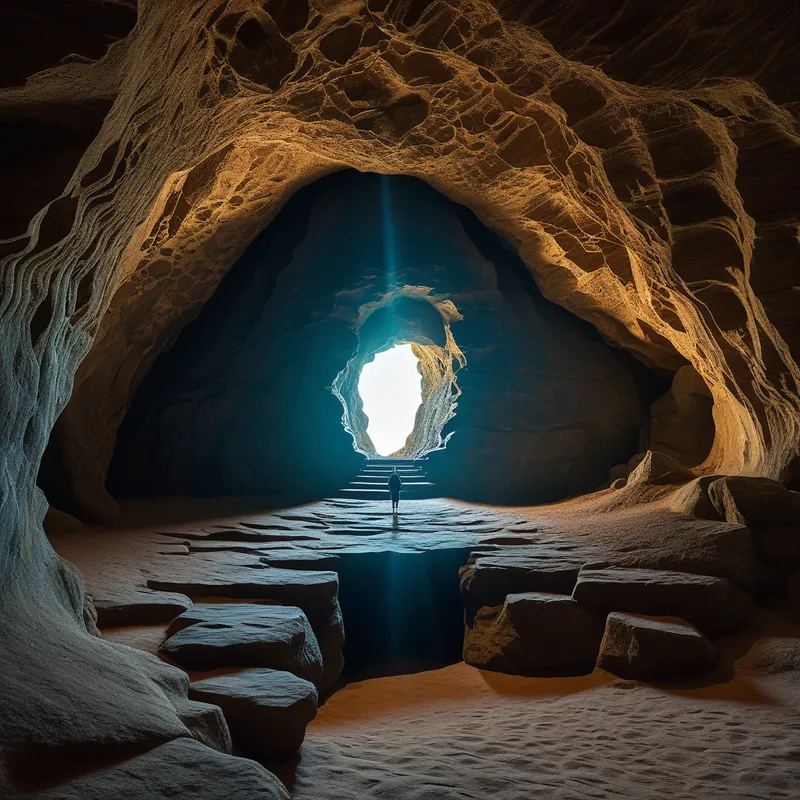
The Womb Cave Myth Meaning & Symbolism
A universal myth of descent into a primordial cave, facing the dark feminine source, and returning with the gift of life for the world.
The Tale of The Womb Cave
Listen. Before the world was as it is, when the sky was closer and the earth still whispered its first secrets, there was a hunger. Not a hunger of the belly, but of the spirit. The people walked under a sun that gave light but no warmth, on a land that yielded stone but no seed. Life was a fading echo. The springs were silent, the wombs of women and earth were still, and a great silence, thick as hide, stretched over all.
In this time of waiting, a figure was called. Sometimes a hunter, sometimes a shaman, sometimes a grieving mother or a curious child—the one whose ears could hear the land’s low hum of pain. They were drawn away from the circle of fires, away from the known paths, following a thread of sound only they could perceive: the deep, slow drumbeat of the earth’s own heart, a rhythm felt in the bones, not the ears.
The journey stripped them bare. Thorns tore at their skin, winds scoured their identity, until they were no longer a person of the village, but a naked question walking. And then, they found it: not a grand mountain or a shining tree, but a opening in the side of the world. The Womb Cave. It was not inviting. It breathed out air ancient and cool, smelling of damp clay and forgotten roots. Its mouth was a darkness so complete it seemed to swallow the very light that dared approach it.
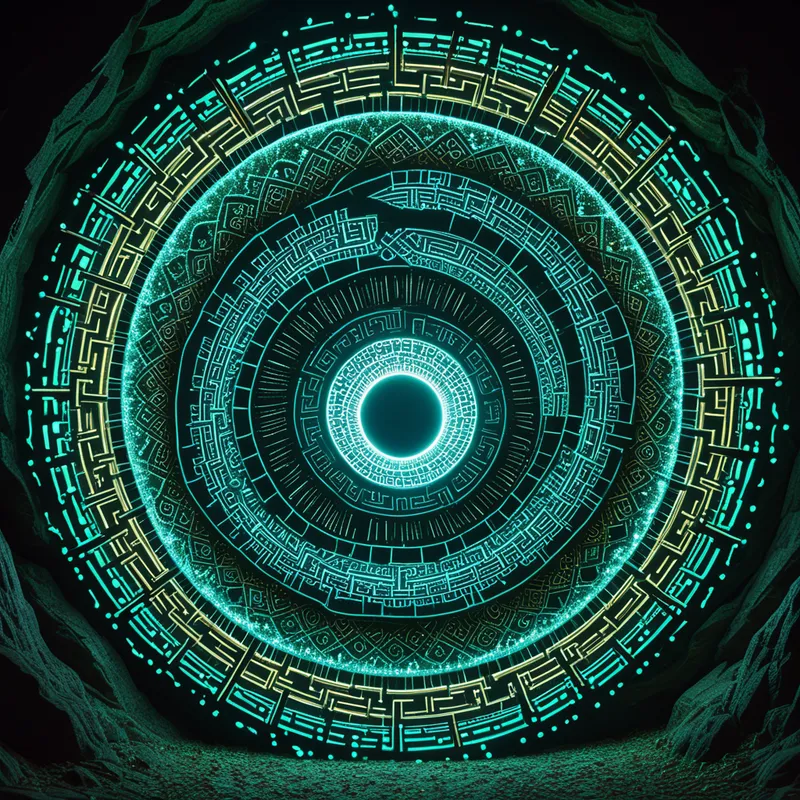
To enter was to die to the world above. The comfort of the sun vanished with the first step. The air grew heavy, warm, and moist. The only light was a faint, phosphorescent glow from strange fungi and veins in the rock, casting long, dancing shadows. The sound of their own breath and heartbeat became a roaring in their ears. Deeper they went, past formations that wept eternal tears, through tunnels that tightened like a birth canal, into the utter, silent black.
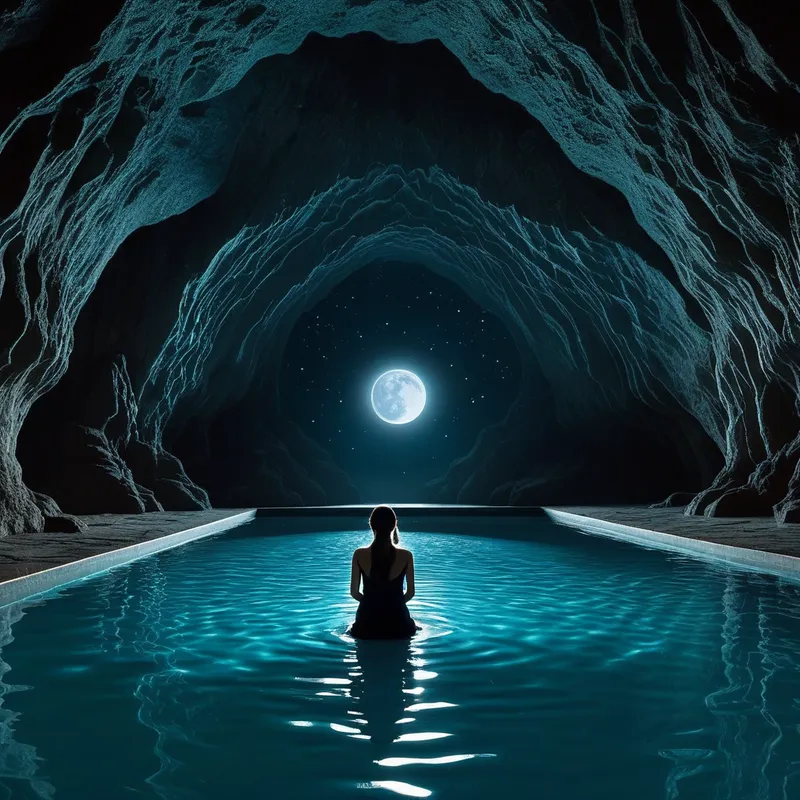
Here, in the core of the world, they encountered Her. Not a goddess with a face and form, but a Presence. The Dark Mother. She was the damp wall, the still pool, the echoing silence. She was the potential of all life and the certainty of all return. A voice, not of words but of direct knowing, vibrated in their marrow: “Why have you come to the place of unmaking? What do you seek from the source that takes all things back?”
Terror threatened to unravel them. This was not a place of answers, but of dissolution. Yet, in that terror, a memory of the people’s thirst, of the barren fields, flared. They had nothing to offer but their own fear and their need. They spoke it, their voice a fragile thing in the immense dark. They offered their small self, their identity, their story.
And in that offering of surrender, the darkness shifted. It was not less dark, but it became nurturing. The still pool began to swirl. From the clay, a warmth spread. The Presence bestowed not a object, but a knowing—a song, a pattern, a seed of dream. It was the secret of the water’s return, the rhythm that quickens life. Sometimes it was a literal vessel of water or a pouch of strange seeds. Always, it was a piece of the cave’s own essence, a fragment of the primordial potential.
The return was a second trial. The gift was heavy, not in weight, but in responsibility. The world above seemed harsh, bright, and shallow. But they climbed, carrying the darkness within them now, a living seed of the deep earth. They emerged, blinking, transformed. Where their feet touched the barren ground, the first green shoots trembled into life. The song they brought back, when sung at the dry spring, called the water whispering forth. The people drank, and the great silence over the world was broken by the cry of a newborn child.
Cultural Origins & Context
The myth of the Womb Cave is not the property of a single tribe or nation, but a foundational pattern woven through the dreaming culture.") of countless Indigenous traditions across the globe. From the kivas of the Pueblo peoples, which are literal ceremonial womb-caves for spiritual rebirth, to the Dreamtime stories of Australian Aboriginal nations describing ancestral beings emerging from hollows in the earth, the motif is pervasive. It appears in the lore of the Tlingit and Hopi, in the narratives of the San people, and in the shamanic traditions of Siberia.
This story was never merely entertainment. It was a core cosmogonic myth, told during rites of passage, healing ceremonies, and seasonal rituals. Elders and shamans would recount it to map the interior, psychic landscape onto the physical one, teaching that the source of life and healing often requires a journey away from the community, into the solitary, terrifying, and fertile darkness. The cave itself was often a real geographical feature, a sacred site where such rituals of descent and rebirth were performed. The myth served as both a map for the ritual and a container for the profound psychological experience of it, ensuring the individual’s terrifying journey was recognized as a sacred, culture-sustaining act.
Symbolic Architecture
At its heart, the Womb Cave myth is a master symbol of the Nekyia, or descent into the underworld of the psyche. The cave is the ultimate symbol of the unconscious itself—dark, mysterious, potentially terrifying, yet the source of all creativity and renewal. It represents the feminine principle in its most primordial form: not the nurturing mother of the hearth, but the Magna Mater, who gives life and demands its return.
The hero does not go to slay a monster, but to be dissolved by the source, so they may be remade as a vessel for the world’s thirst.
The barren land above symbolizes a state of psychic or spiritual sterility—a life lived on the surface, devoid of depth, meaning, or connection to the instinctual roots of being. The journey is one of necessary regression, a return to the pre-personal, embryonic state. The confrontation with the Dark Mother is the ego’s encounter with the sheer, impersonal power of the life force, which is indifferent to individual identity. The “gift” retrieved—water, seed, song—is the symbolic prize of this confrontation: a renewed connection to the libido, the psychic energy that animates and fertilizes conscious life.
The Dreamer's Resonance
When this myth stirs in the modern dreamer, it often manifests not as a literal cave, but as dreams of descending: into basements, subways, ancient ruins, or dense, root-filled forests. There is a feeling of going down into the foundations of the psyche. One might dream of discovering a hidden room in their own house, a secret passage, or a forgotten cellar filled with stagnant water or rich, dark soil.
Somatically, this dreaming process can coincide with feelings of depression, ennui, or a profound sense of being stuck—the “barren land” of the myth. The dream descent is the psyche’s autonomous attempt to find the nutrient-rich darkness below the sterile surface. To dream of finding a pool, a spring, or a glowing object in such a place signals the beginning of a healing process, the retrieval of a vital, forgotten part of the self. The terror in the dream is real; it is the ego’s resistance to its own necessary dissolution and re-formation. The dream is an invitation to surrender to a process larger than the conscious mind’s plans.

Alchemical Translation
For the individual navigating the path of individuation, the Womb Cave myth is a precise alchemical manual. The first stage, nigredo (the blackening), is the barren land and the descent into the cave—the confrontation with the shadow, depression, and the sense of meaninglessness. The encounter with the formless Dark Mother is the ultimate nigredo, the total dissolution of the ego’s pretensions.
The alchemical vessel is not the cave, but the psyche of the one who enters it. The heat and pressure of confinement transmute leaden despair into golden connection.
The surrender and offering of one’s old identity is the beginning of albedo (the whitening), the purification. The gift received—the water, the seed—is the lapis philosophorum, the philosopher’s stone. In psychological terms, it is a new, grounded attitude, a living symbol that bridges the deep unconscious with conscious life. It is the creative insight that heals, the genuine emotion that connects, the purpose that springs from depth rather than expectation.
The return and the regeneration of the world symbolize the final stage: the integration. The individual does not simply return to old life with a trophy; they return as a transformative agent. Their very being, now rooted in the deep earth of the unconscious, becomes a source of fertility for their outer world—their relationships, work, and creativity. They have learned that renewal is not found by striving upward toward the light alone, but by having the courage to descend, be unmade, and carry the essential darkness back into the day.
Associated Symbols
Explore related symbols from the CaleaDream lexicon: