The Witch of Endor Myth Meaning & Symbolism
A desperate king consults a forbidden medium to summon a dead prophet's ghost, receiving a final, devastating prophecy of his doom.
The Tale of The Witch of Endor
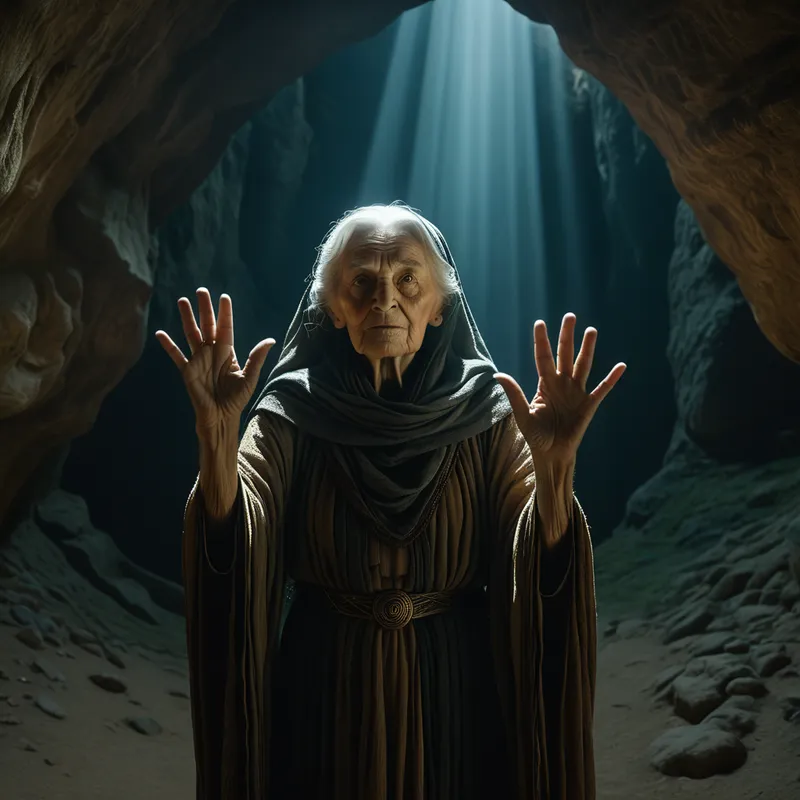
The silence was a living thing in the hills of Endor. It was the silence of held breath, of secrets kept behind closed doors, of a people who had turned their faces from the old ways. In one humble dwelling, a woman waited. She was known, in whispers, as a ba’alat ov—a mistress of the ghost. The law of the land, proclaimed by the king himself, had banished such as her. To summon the shades was an abomination. Yet, in the deep night, a knock came.
Before her stood two men, shadows against the greater dark. The taller one was cloaked in desperation that clung to him like a second garment. “Bring up for me the one I shall name,” he commanded, his voice a dry riverbed of fear. She, wise to the traps of power, saw through the poor disguise. “Surely you know what Saul has done,” she protested, “how he has cut off the mediums and the necromancers from the land. Why are you laying a snare for my life to bring about my death?”
But the king—for it was he, Saul—swore by YHWH that no punishment would fall upon her. His terror was absolute. The Philistine host was marshaled like a storm on the plain, and the spirit of YHWH had departed from him. The heavens were brass, offering no dream, no prophet, no Urim. He was a man utterly abandoned, groping in the void.
Reluctantly, the woman consented. “Whom shall I bring up for you?” He answered, a name torn from the depths of his memory and his regret: “Bring up Samuel.”
She began her rites. And then she cried out with a loud voice. The power that moved through her was not her own trickery; it was a vast and dreadful force that made her see truly. “Why have you deceived me? You are Saul!” The king, his pretense shattered, begged for calm. “What do you see?”
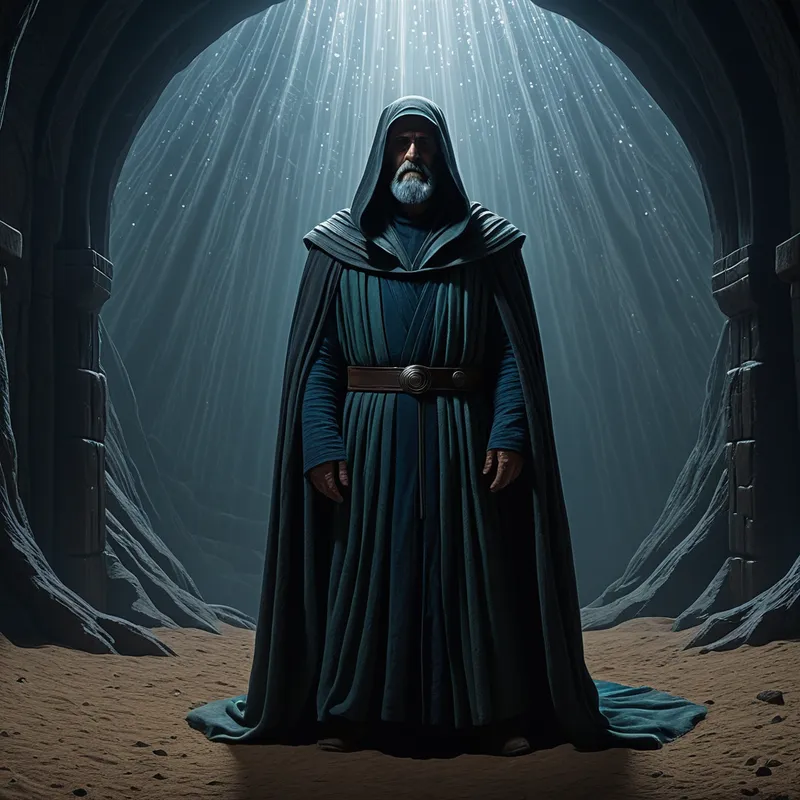
“I see a divine being coming up out of the earth,” she whispered. “An old man is coming up, and he is wrapped in a robe.”
Saul knew. He bowed his face to the ground and prostrated himself.
Then the voice came, not from the woman, but from the apparition itself—a voice from beyond the veil, thick with the dust of the grave. “Why have you disturbed me by bringing me up?”
Saul poured out his anguish: the Philistines, the silent God, the terror. The shade of Samuel offered no comfort. His words were the final nails in a coffin long being built. “Why then do you ask me, since YHWH has turned from you and become your adversary? He has torn the kingdom out of your hand and given it to your neighbor, David. Tomorrow, you and your sons shall be with me. YHWH will give the army of Israel also into the hand of the Philistines.”
The words fell like stones. Saul collapsed, his great frame undone, for he had eaten nothing all day and night in his dread. The woman, the witch, the medium—now became a caregiver. She saw the ruin before her, the shattered vessel of a king. With a courage born of pity, she urged him to eat. She slaughtered her fatted calf, took flour, kneaded it, and baked unleavened cakes. She served the king and his servants, and they ate. Then they rose and went out into the night, into the last darkness Saul would ever know.
Cultural Origins & Context
This haunting narrative is preserved in the First Book of Samuel, Chapter 28. It exists within a profound tension in ancient Hebrew thought. The official, priestly theology vehemently rejected necromancy and consultation with the dead, considering it a trespass against the sovereignty of YHWH, the sole source of truth and authority. Such practices were associated with the surrounding Canaanite cultures and were explicitly forbidden by the Mosaic law.
Yet, the very existence of the story, and the detailed, non-dismissive portrayal of the witch’s successful ritual, testifies to a persistent undercurrent of folk belief. It acknowledges a realm beyond—the Sheol—where the dead, or their rephaim (shades), retained a form of consciousness. The story functions as a powerful theological and political lesson: even in seeking forbidden knowledge from the dead, Saul only confirms the judgment already pronounced by the living prophets. It is a narrative about the futility of circumventing divine decree and the tragic end of a leader who has lost his sacred connection, forced to seek illumination in the very shadows he condemned.
Symbolic Architecture
The myth is a stark tableau of the encounter with the inescapable. Saul represents the crumbling ego, the ruler who has externalized his power for so long that its internal [source](/symbols/source “Symbol: The origin point of something, often representing beginnings, nourishment, or the fundamental cause behind phenomena.”/) has dried up. He is the man of [action](/symbols/action “Symbol: Action in dreams represents the drive for agency, motivation, and the ability to take control of situations in waking life.”/) rendered impotent, seeking answers anywhere but within.
The [Witch](/symbols/witch “Symbol: The image of a witch embodies the archetype of the outlawed or misunderstood, often associated with feminine power, magic, and the unknown.”/) of Endor is far more than a [plot](/symbols/plot “Symbol: A plot symbolizes the unfolding of a story, representing personal narratives and life direction.”/) [device](/symbols/device “Symbol: A device in dreams often symbolizes the tools or mechanisms that we use to navigate our inner or outer worlds.”/); she is the marginalized [shadow](/symbols/shadow “Symbol: The ‘shadow’ embodies the unconscious, repressed aspects of the self and often represents fears or hidden emotions.”/) of the official culture. She is the denied wisdom, the intuitive, chthonic [knowledge](/symbols/knowledge “Symbol: Knowledge symbolizes learning, understanding, and wisdom, embodying the acquisition of information and enlightenment.”/) that society outlaws but cannot eradicate. In her cave, she holds the keys to a [reality](/symbols/reality “Symbol: Reality signifies the state of existence and perception, often reflecting one’s understanding of truth and life experiences.”/) the [king](/symbols/king “Symbol: A symbol of ultimate authority, leadership, and societal order, often representing the dreamer’s inner power or external control figures.”/)’s laws cannot erase.
The most terrifying truth is not spoken by an enemy, but summoned from the depths of one’s own forgotten soul.
Samuel’s ghost is the voice of [Fate](/symbols/fate “Symbol: Fate represents the belief in predetermined outcomes, suggesting that some aspects of life are beyond human control.”/) itself, the objective, impersonal [truth](/symbols/truth “Symbol: Truth represents authenticity, honesty, and the quest for knowledge beyond mere appearances.”/) that the ego has spent a lifetime avoiding. He is not a comforting [ancestor](/symbols/ancestor “Symbol: Represents lineage, heritage, and the collective wisdom or unresolved issues passed down through generations.”/) but the embodiment of the consequences of a [life](/symbols/life “Symbol: The symbol of ‘Life’ represents a journey of growth, interconnectedness, and existential meaning, encompassing both the joys and challenges that define human experience.”/)’s choices, rising from the collective past to pronounce a [verdict](/symbols/verdict “Symbol: A formal judgment or decision, often legal or moral, representing closure, accountability, and societal evaluation.”/) on the present. The entire [séance](/symbols/sance “Symbol: A ritual to communicate with spirits or the dead, representing a journey into the unknown or subconscious realms.”/) is a [metaphor](/symbols/metaphor “Symbol: A figure of speech where one thing represents another, often revealing hidden connections and deeper truths through symbolic comparison.”/) for the psyche turning in desperation to its own [depths](/symbols/depths “Symbol: Represents the subconscious, hidden emotions, or foundational aspects of the self, often linked to primal fears or profound truths.”/), only to have its deepest fears and failures objectively mirrored back with terrifying [clarity](/symbols/clarity “Symbol: A state of mental transparency and sharp focus, often representing resolution of confusion or attainment of insight.”/).
The Dreamer’s Resonance
When this myth stirs in the modern dreamtime, it often manifests as a profound state of existential crisis. The dreamer may find themselves in a position of authority that feels hollow, facing an insurmountable external threat (a looming deadline, a relationship rupture, a financial cliff). All conventional resources—plans, advice, logic—fail. The dream landscape becomes a liminal space: a deserted road at night, an empty government building, a silent phone that will not connect.
The urge arises to seek a forbidden solution: to snoop through a partner’s phone, to consult a dubious psychic, to indulge in a compulsive behavior once sworn off. This is the “journey to Endor.” If the dream culminates in an encounter with a ghostly or authoritative figure who delivers bad news, it signifies the dreamer’s unconscious is forcing a confrontation with a truth they have been evading. The somatic experience is often one of crushing weight, paralysis, or a cold, sinking dread—the body registering the shock of the psyche’s self-revelation. It is the moment the shadow speaks, and the ego must listen.

Alchemical Translation
The alchemical process modeled here is the nigredo, the blackening, the descent into utter despair and the dissolution of the old king (the outmoded conscious attitude). Saul’s conscious identity, built on divine election and military might, is already dead; the séance is its funeral rite.
The true individuation work, however, is subtly embodied by the Witch. She performs the crucial act of integration. First, she names the shadow (“You are Saul!”), forcing the disguised truth into the light. Then, after the devastating revelation, she does not abandon the shattered king. She offers sustenance—earthly, simple, human care. She translates the horrific, abstract truth of fate into a concrete act of compassion. She binds the wound she was forced to open.
Transmutation begins not in avoiding the fall, but in the humble act of feeding the broken self that remains.
For the modern individual, the myth instructs that when our strategies fail and our gods are silent, we may be driven to consult our inner “witch”—the repressed, intuitive, perhaps guilt-inducing parts of ourselves we have outlawed. This consultation will likely summon our personal “Samuel”: the cold, hard truth of our situation, the consequences of our actions. The alchemical goal is not to avoid this shattering revelation, but to have the wisdom of the Witch within us—to hold the space for our own collapse, and then, with profound self-compassion, to nourish the ruins. The kingdom of the old self must die, but the soul need not perish of starvation in the process. The meal at Endor is the first, bitter sacrament of a new beginning, taken in the full, awful knowledge of the end.
Associated Symbols
Explore related symbols from the CaleaDream lexicon:
- Witch — The mediator of forbidden knowledge, representing the intuitive, shadowy wisdom that official consciousness represses but cannot destroy.
- Shadow — The entirety of the repressed and unseen, embodied by both the Witch in her cave and the truth about Saul’s fate that rises from the underworld.
- Death — The central presence in the tale, both as the ghost of Samuel and as the prophesied fate of Saul, representing inevitable endings and the truth that resides beyond life.
- Fate — The inexorable decree delivered by Samuel’s shade, symbolizing the unavoidable consequences of one’s choices and alignment (or misalignment) with a larger order.
- Cave — The dwelling of the Witch, a symbol of the unconscious, the womb of the earth, and the hidden place where secret knowledge and confrontation occur.
- Mirror — The entire séance acts as a dark mirror, reflecting back to Saul the truth of his own abandoned state and impending doom with absolute, unforgiving clarity.
- Ritual — The forbidden act of necromancy, representing a desperate, structured attempt to bridge the world of the living and the dead to access hidden knowledge.
- God — The absent, silent deity whose departure creates the vacuum of meaning and authority that drives Saul to seek answers in the underworld.
- Fear — The primary motivator for Saul, a terror so profound it overrides his own laws and drives him to the very practices he outlawed.
- Truth — The devastating, objective reality spoken by Samuel’s ghost, which remains true regardless of the forbidden means used to access it.
- Journey — Saul’s desperate night-time trek to Endor, symbolizing the psychic journey into the shadowlands of the self when all conventional paths are blocked.
- Mountain — The hills of Endor, representing a remote, marginal place outside the center of power, where taboo knowledge resides.