The Wheel of the Year Myth Meaning & Symbolism
The eternal story of the Oak King and Holly King, whose sacred duel turns the seasons within the great cosmic wheel of life, death, and rebirth.
The Tale of The Wheel of the Year
Listen. [The world](/myths/the-world “Myth from Tarot culture.”/) is not a line, but a circle. A great, turning wheel of ash and oak, its rim [the horizon](/myths/the-horizon “Myth from Various culture.”/) where [the sky](/myths/the-sky “Myth from Persian culture.”/) meets the land. And at its heart, two kings are bound in an eternal dance.
In the deep green womb of the world, when the sun hung fat and golden in the long days, the Oak King held sway. His crown was a living canopy of leaves, his cloak the warmth of the high sun. The forests breathed with his strength; the rivers ran full with his laughter. The land was a riot of life, a testament to his vibrant rule. He was the burgeoning force, the unstoppable push towards blossom and fruit.
But as his power reached its zenith, at the very moment the day was longest, a chill entered the edge of the light. From the northern shadows, where the ancient, evergreen forests stood silent, came his other half, his necessary shadow. The [Holly King](/myths/holly-king “Myth from Celtic culture.”/). His crown was sharp with dark, glossy leaves and blood-red berries. His cloak was the frost of the first morning, his breath [the mist](/myths/the-mist “Myth from Celtic culture.”/) that rose from still waters. He did not come as a thief, but as a successor, his purpose written in the very turning of the stars.
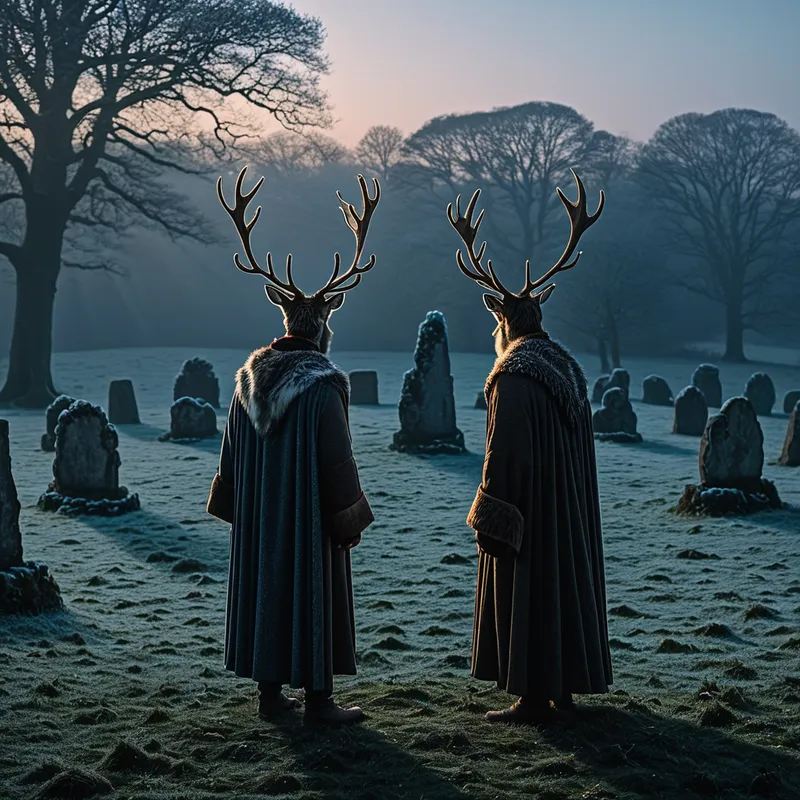
They met at the Litha stones, where the sun seemed to stand still. No hatred fueled their combat, but a deep, solemn duty. The clash was not of sword and shield, but of essence against essence—the expansive, fiery force of the Oak against the contracting, crystalline resolve of the Holly. [The Oak King](/myths/the-oak-king “Myth from Celtic culture.”/) fought with the strength of the thriving earth, but [the Holly King](/myths/the-holly-king “Myth from Celtic culture.”/) parried with the patience of the deep root and the enduring stone. As the sun began its slow descent from that highest point, [the Oak King](/myths/the-oak-king “Myth from Celtic culture.”/)’s strength waned. With a touch as gentle as the first falling leaf, the Holly King prevailed.
The vibrant green king did not die, but withdrew. He sank into the rich soil, a seed of promise, as the Holly King took up the governance of the world. The days grew shorter, the light thinner. The Holly King’s rule was one of quiet wisdom, of drawing inward, of preserving life’s essential spark beneath the blanket of frost. He was the guardian of the hidden flame.
Yet, at the depth of this reign, at the Yule tide when the night seemed eternal, the wheel turned again. From the darkness where the Oak King rested, a new spark ignited. Nourished by the quiet time, he rose, green and potent once more. They dueled again at the midwinter stones, and this time, the Holly King yielded with the same solemn grace, retreating to his evergreen halls as the Oak King emerged, reborn, to coax the world back into light.
And so it goes, turn after turn, at the four great solar hinges and the four cross-quarter fires in between. A king of light, a king of dark, locked in a sacred embrace that spins the very wheel of the seasons. Their battle is the world’s breath. Their sacrifice is its heartbeat.
Cultural Origins & Context
The story of the dueling kings is a modern synthesis, a beautiful and poignant narrative woven from threads of Celtic, Germanic, and later folkloric tradition to explain the Wheel of the Year. The ancient Celts did not leave us a single, codified myth of two kings. Instead, they lived by a cyclical time sense, deeply attuned to the rhythms of their pastoral and agricultural world. Their year was marked by four great fire festivals—Imbolc, Beltane, [Lughnasadh](/myths/lughnasadh “Myth from Celtic culture.”/), and [Samhain](/myths/samhain “Myth from Celtic culture.”/)—and the solstices and equinoxes observed by their megalithic ancestors.
The figures of the Oak and Holly Kings draw potency from this landscape. The oak was sacred, a tree of sovereignty, strength, and [the druids](/myths/the-druids “Myth from Celtic culture.”/). The holly, evergreen and protective, was a potent symbol of life in death, brought indoors at midwinter. The motif of a ritual battle for seasonal supremacy appears in fragments of Welsh lore and echoes in English folk plays where characters representing summer and winter vie for dominance. This myth, as we tell it today, is the work of the modern bard—taking the raw materials of seasonal change, archetypal conflict, and sacred trees, and crafting a story that gives profound, personified meaning to the cosmic cycle our ancestors honored.
Symbolic Architecture
At its core, this is not a myth of good versus evil, but of complementary opposites engaged in a necessary, rhythmic exchange. It is the archetypal [drama](/symbols/drama “Symbol: Drama signifies narratives, emotional expression, and the exploration of human experiences.”/) of enantiodromia—the tendency of any extreme to transform into its opposite.
The Oak King represents the psychic principle of extraversion: the outward surge of energy, growth, consciousness, and manifestation. He is the ego in its expansive phase, building identity, achieving goals, and engaging with the world.
The Holly King embodies the principle of introversion: the inward turn, reflection, consolidation, and the nurturing of the unconscious. He is the necessary retreat, the time of incubation, where what was built is integrated and wisdom is gathered from the dark.
Their battle at the solstices symbolizes the critical tipping points in any cycle. The victory of the Holly [King](/symbols/king “Symbol: A symbol of ultimate authority, leadership, and societal order, often representing the dreamer’s inner power or external control figures.”/) at midsummer reminds us that every peak contains the seed of its own decline, a call to begin the [inward](/symbols/inward “Symbol: A journey toward self-awareness, introspection, and the exploration of one’s inner world, thoughts, and unconscious mind.”/) [journey](/symbols/journey “Symbol: A journey in dreams typically signifies adventure, growth, or a significant life transition.”/). The Oak [King](/symbols/king “Symbol: A symbol of ultimate authority, leadership, and societal order, often representing the dreamer’s inner power or external control figures.”/)’s [rebirth](/symbols/rebirth “Symbol: A profound transformation where old aspects of self or life die, making way for new beginnings, growth, and renewal.”/) at midwinter is the ultimate [symbol](/symbols/symbol “Symbol: A symbol can represent an idea, concept, or belief, serving as a powerful tool for communication and understanding.”/) of hope—that from the deepest darkness, a new [consciousness](/symbols/consciousness “Symbol: Consciousness represents the state of awareness and perception, encompassing thoughts, feelings, and experiences.”/) is always prepared to emerge.
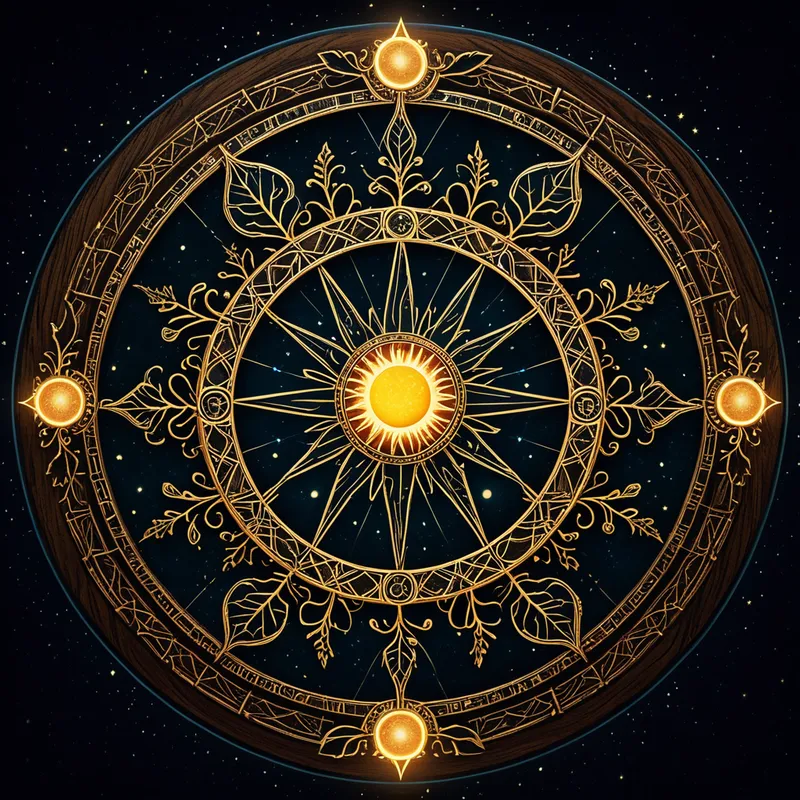
The Wheel itself is the [Mandala](/symbols/mandala “Symbol: A sacred geometric circle representing wholeness, the cosmos, and the journey toward spiritual integration.”/) of the [cosmos](/symbols/cosmos “Symbol: The entire universe as an ordered, harmonious system, often representing the totality of existence, spiritual connection, and the unknown.”/) and the [psyche](/myths/psyche “Myth from Greek culture.”/). The eight spokes (the festivals) map the complete process of any [life](/symbols/life “Symbol: The symbol of ‘Life’ represents a journey of growth, interconnectedness, and existential meaning, encompassing both the joys and challenges that define human experience.”/) cycle: [conception](/symbols/conception “Symbol: The beginning of new life, ideas, or projects; a moment of profound creation and potential.”/) (Yule), quickening (Imbolc), [birth](/symbols/birth “Symbol: Birth symbolizes new beginnings, transformation, and the potential for growth and development.”/) (Ostara), [maturation](/symbols/maturation “Symbol: The process of developing toward a more advanced, complete, or effective state, often involving growth, learning, and integration of experiences.”/) (Beltane), fruition (Litha), harvest (Lughnasadh), decay ([Mabon](/myths/mabon “Myth from Celtic culture.”/)), and [death](/symbols/death “Symbol: Symbolizes transformation, endings, and new beginnings; often associated with fear of the unknown.”/)/release (Samhain), only to begin again.
The Dreamer’s Resonance
When this myth stirs in the modern dreamer, it often manifests as powerful imagery of turning points, dualities, and seasonal shifts within [the self](/myths/the-self “Myth from Jungian culture.”/). You may dream of standing at a crossroads where one path is sun-drenched and overgrown, the other crisp and frost-laden, feeling a profound pull to choose. You might dream of a figure who is both young and old, vibrant and weary, in the same moment. Dreams of a great, turning wheel—sometimes smooth, sometimes stuck—speak directly to the feeling of being caught in or resisting a natural life cycle.
Somatically, this can feel like a deep, internal tug-of-war. A period of intense creative output (the Oak King’s reign) may be followed by dreams of being buried, frozen, or retreating into a deep forest (the Holly King’s domain). These are not nightmares of failure, but the psyche’s enactment of the necessary balance. The dream is the ritual duel happening inside you. The anxiety or conflict felt is the friction of the turn, the resistance to surrendering one mode of being for its opposite, which is essential for wholeness.
Alchemical Translation
For the individual on the path of individuation, the Wheel of the Year is a master map for psychic transmutation. It models the alchemical opus: [solve et coagula](/myths/solve-et-coagula “Myth from Alchemical culture.”/) (dissolve and coagulate).
The work of the Oak King phase is coagulation: building the conscious personality, developing skills, forging an identity in the world (the alchemical citrinitas, the yellowing). But to evolve, this structure must be willingly surrendered at its height. The Holly King’s victory represents the [solutio](/myths/solutio “Myth from Alchemical culture.”/)—the dissolution. This is [the dark night of the soul](/myths/the-dark-night-of-the-soul “Myth from Christian Mysticism culture.”/), where hardened attitudes, outgrown identities, and inflated achievements are broken down in the waters of the unconscious (the [nigredo](/myths/nigredo “Myth from Alchemical culture.”/)).
The true alchemy occurs in the Holly King’s reign. It is not emptiness, but a sacred hollowing. In this dark, quiet space, the scattered gold of experience is refined. Insights gestate. The soul’s essential pattern, undistracted by the blaze of sun, can be seen by the light of the moon and stars.
The Oak King’s rebirth is then not a simple return, but a new coagulation at a higher level of integration. He returns not just with vitality, but with the wisdom of the dark woven into his green crown. This is the albedo (whitening) and ultimately the [rubedo](/myths/rubedo “Myth from Alchemical culture.”/) (reddening)—the creation of the Philosopher’s Stone, which is the fully realized Self, capable of containing both king and king, light and dark, without internal war.
To live this myth consciously is to stop fighting the turn of your own inner wheel. It is to honor your periods of ambition and action, and to grant equal sacredness to your periods of retreat and introspection. It is to understand that you are both kings, and your wholeness depends on the graceful, sacrificial handover of power between them, season after soul-season, forever turning toward completion.
Associated Symbols
Explore related symbols from the CaleaDream lexicon: