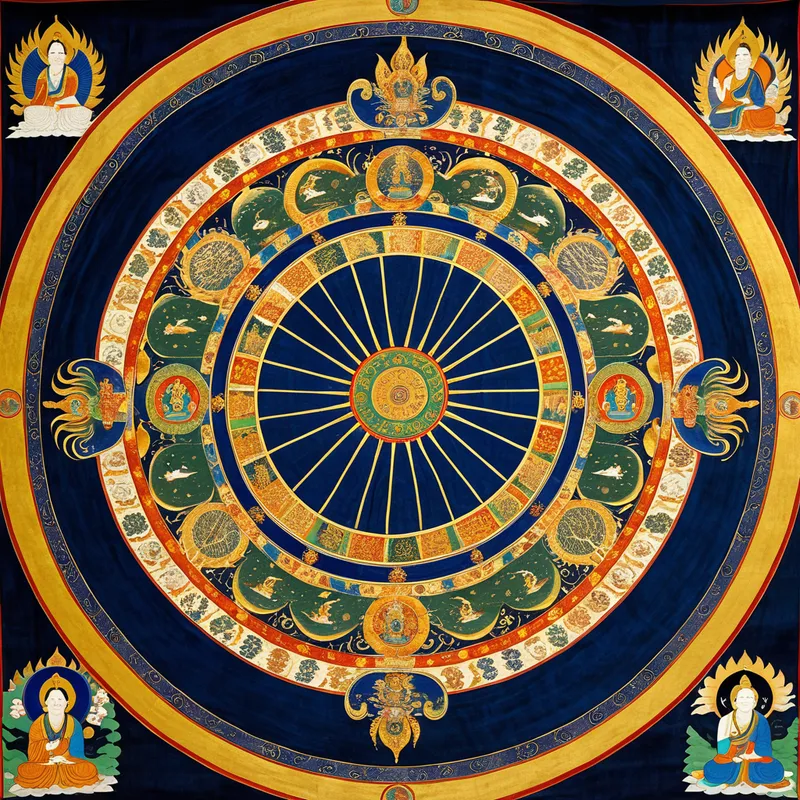
The Wheel of Life Myth Meaning & Symbolism
A cosmic diagram of existence, held by the Lord of Death, depicting the six realms of being and the path to liberation from suffering.
The Tale of The Wheel of Life
In the silent, wind-scoured heights where the world touches the void, there is a painting that is not a painting. It is a mirror, a map, and a warning, whispered from the lips of the Awakened One himself. The story begins not with a birth, but with a confrontation at the very edge of perception.
It is said that Shakyamuni Buddha, having attained the supreme peace of Nirvana, was challenged by a king. This king was no ordinary monarch, but Yama, the Lord of Death, the sovereign of all conditioned realms. Yama, whose form is a bull-headed demon of terrifying majesty, whose skin is the blue of a midnight storm and whose eyes burn with the fire of relentless time, stood before the Compassionate One. In his claws, he held a great wheel—a vast, intricate, and horrifyingly beautiful mandala of all existence.
“See!” roared Yama, his voice the grinding of continents. “This is my domain! This wheel, which I turn without beginning and without end. Behold the six worlds of hunger and hope, of agony and ecstasy, all spinning in the palm of my hand. None escape my grasp. Not even you, O Teacher.”
The Buddha did not flinch. The silence around him deepened, becoming a pool of absolute knowing. He looked not at the demon, but into the wheel itself. He saw, painted in the vibrant pigments of reality, the Six Realms—the soaring, prideful heavens; the jealous, warring realms of the demi-gods; the bittersweet human world of choice and consequence; the ignorant, driven animal kingdom; the parched, insatiable deserts of the hungry ghosts; and the frozen or burning pits of hell. He saw the twelve-linked chain of cause and effect—Pratityasamutpada—coiling around the rim like a serpent eating its own tail, from ignorance to aging and death, and back again.
And then, the Awakened One spoke. His voice was not a roar, but a clear bell that shattered the illusion of the wheel’s solidity. He pointed to the very center of the mandala, where a pig, a rooster, and a snake—blind ignorance, clinging desire, and aggressive aversion—chased each other in an endless circle. He traced the path outward, to the figure of the Buddha himself, standing outside the wheel, pointing to the moon of liberation. He described the truths that make the wheel turn, and the path that leads beyond its rim.
Yama listened. The fierce grip of his claws loosened. The wheel, once a symbol of his ultimate power, was revealed as a diagram of a prison—a prison whose walls were made of the mind’s own projections, whose locks were forged from craving and aversion. The Lord of Death, the great jailer, was shown to be none other than the embodied principle of impermanence, holding up the very truth that could set all beings free. In that moment of revelation, Yama was not defeated, but transformed. He became the holder of the teaching, the fierce guardian who presents the map of the maze so that the wise may find the way out. And so, the Wheel of Life was given to the world—not as a curse, but as the ultimate gift of clarity, held in the compassionate, terrifying grasp of reality itself.
Cultural Origins & Context
The Wheel of Life is not a folktale but a profound pedagogical tool, a “thangka of the mind” central to Tibetan Buddhist monastic education and popular devotion. Its origins are traced to the Buddha’s own teachings, particularly those on the nature of Samsara. It was systematized in the Abhidharma philosophical texts and transmitted through lineages from India to Tibet.
Traditionally, this “myth” is less narrated than depicted. It is the master visual aid, painted on the walls of monastery gateways or on portable scrolls (thangkas). Lamas would use it to teach illiterate laypeople and novice monks alike, providing a complete cosmology and psychology in a single, potent image. The societal function was multifaceted: it was a moral exhortation (illustrating the karmic consequences of actions), a philosophical diagram (mapping the causal processes of the mind), and a soteriological guide (charting the path to escape the cycle). The one who “tells” the myth is often the painting itself, with a teacher acting as its interpreter, unlocking its symbolic layers for the seeker.
Symbolic Architecture
The Wheel is a perfect [mandala](/symbols/mandala “Symbol: A sacred geometric circle representing wholeness, the cosmos, and the journey toward spiritual integration.”/) of the psyche. Its [architecture](/symbols/architecture “Symbol: Architecture in dreams often signifies structure, stability, and the framing of personal identity or life’s journey.”/) is a precise [diagnosis](/symbols/diagnosis “Symbol: A medical or psychological assessment revealing a condition, often symbolizing self-awareness, vulnerability, or a need for change.”/) of the [human](/symbols/human “Symbol: The symbol of a human represents individuality, complexity of emotions, and social relationships.”/) [condition](/symbols/condition “Symbol: Condition reflects the state of being, often focusing on physical, emotional, or situational aspects of life.”/).
The wheel is not out there, turning in some external cosmos. It is the very structure of our clinging consciousness, and Yama is the unflinching truth of our own mortality that holds it all together.
At the hub, the three poisons—the pig (ignorance), the rooster (desire), and the snake (aversion)—drive the entire [mechanism](/symbols/mechanism “Symbol: Represents the body’s internal systems, emotional regulation, or psychological processes working together like a machine.”/). They represent the core, unconscious drives that generate all experience. The six spokes dividing the realms are metaphors for the six primary psychological states: god-[realm](/symbols/realm “Symbol: The symbol of ‘Realm’ often signifies the boundaries of one’s consciousness, experiences, or emotional states, suggesting aspects of reality that are either explored or ignored.”/) pride, demi-god [jealousy](/symbols/jealousy “Symbol: A complex emotion signaling perceived threat to valued relationships or status, often revealing insecurities and unmet needs.”/), human desire, animal ignorance, hungry ghost insatiability, and hell-[realm](/symbols/realm “Symbol: The symbol of ‘Realm’ often signifies the boundaries of one’s consciousness, experiences, or emotional states, suggesting aspects of reality that are either explored or ignored.”/) hatred. To be born in a “realm” is to be dominated by that particular psychic state.
Yama, the holder, is the most profound [symbol](/symbols/symbol “Symbol: A symbol can represent an idea, concept, or belief, serving as a powerful tool for communication and understanding.”/). He is not evil, but the embodiment of impermanence and [the law](/symbols/the-law “Symbol: Represents external rules, societal order, moral boundaries, and the tension between personal freedom and collective structure.”/) of karma. He is the [reality](/symbols/reality “Symbol: Reality signifies the state of existence and perception, often reflecting one’s understanding of truth and life experiences.”/) of change and consequence. His terrifying [aspect](/symbols/aspect “Symbol: A distinct feature, quality, or perspective of something, often representing a partial view of a larger whole.”/) mirrors our own deep-seated fear of [death](/symbols/death “Symbol: Symbolizes transformation, endings, and new beginnings; often associated with fear of the unknown.”/) and [loss](/symbols/loss “Symbol: Loss often symbolizes change, grief, and transformation in dreams, representing the emotional or psychological detachment from something or someone significant.”/), yet his [role](/symbols/role “Symbol: The concept of ‘role’ in dreams often reflects one’s identity or how individuals perceive their place within various social structures.”/) is ultimately compassionate: he presents the [truth](/symbols/truth “Symbol: Truth represents authenticity, honesty, and the quest for knowledge beyond mere appearances.”/) without sugarcoating it. The small figure of the [Buddha](/symbols/buddha “Symbol: The image of Buddha embodies spiritual enlightenment, peace, and a quest for inner truth.”/) outside the wheel, pointing to a [moon](/symbols/moon “Symbol: The Moon symbolizes intuition, emotional depth, and the cyclical nature of life, often reflecting the inner self and subconscious desires.”/) or a [stupa](/symbols/stupa “Symbol: A Buddhist monument representing enlightenment, the Buddha’s mind, and the path to spiritual awakening through its architectural symbolism.”/), represents the awakened [awareness](/symbols/awareness “Symbol: Conscious perception of self, surroundings, or internal states. Often signifies awakening, insight, or heightened sensitivity.”/) that can witness the entire process without being identified with any part of it—the possibility of liberation inherent within the very [structure](/symbols/structure “Symbol: Structure in dreams often symbolizes stability, organization, and the framework of one’s life, reflecting how one perceives their environment and personal life.”/) of [confinement](/symbols/confinement “Symbol: A dream symbol representing restriction, limitation, or being held back physically, emotionally, or psychologically.”/).
The Dreamer’s Resonance
When this myth stirs in the modern dreamer, it rarely appears as a literal painted wheel. Instead, it manifests as the somatic experience of being trapped in a cycle. One may dream of running on a hamster wheel of endless tasks, being stuck in a revolving door of identical relationships, or watching one’s life replay like a film on a loop. The feeling is one of futility and compulsion.
Psychologically, this is the dream-ego confronting its own patterned existence—its complexes and karmic propensities. The “six realms” manifest as dream scenarios: soaring, grandiose success (god realm); bitter office politics and envy (demi-god realm); consuming romantic or material longing (human realm); feeling driven by base instincts or confusion (animal realm); experiencing insatiable hunger or emotional emptiness (hungry ghost realm); and nightmares of torture, persecution, or icy isolation (hell realm). To dream this myth is to have the unconscious present a diagnostic report: “This is the wheel you are currently powering. This is the realm in which your psyche is currently residing.” The process initiated is one of recognition, the first step toward breaking the chain of unconscious repetition.

Alchemical Translation
The alchemical work modeled by the Wheel is the ultimate psychic transmutation: turning the lead of compulsive, suffering-filled existence into the gold of liberated consciousness. The process is one of radical dis-identification and integration.
The first operation is to “meet Yama”—to consciously confront one’s own mortality, impermanence, and the shadow aspects of the psyche that one has been running from. This is the nigredo, the blackening, the descent into the truth of one’s conditioned nature. One must stare into the jaws of the holder and acknowledge, “This wheel is mine. I built it.”
Individuation is not about climbing to the top of the wheel, to the god realm of perfect success. It is about stepping off the wheel entirely, which requires dismantling the central axle of ignorance, desire, and aversion.
The second operation is the detailed analysis of the twelve links of dependent origination within one’s own life. This is the albedo, the whitening, the meticulous separation of components. The modern seeker asks: “Where does this reaction (aversion) come from? What craving (desire) preceded it? What fundamental ignorance (misperception of reality) is at its root?” By breaking the chain at any link—through mindfulness, ethical living, and wisdom—the entire karmic engine seizes up.
The final operation is symbolized by the Buddha figure outside the wheel. This is the rubedo, the reddening, the birth of the true, non-grasping Self. It is the establishment of a witnessing consciousness that can contain the entire spectacle of the six realms—the pride, the fear, the passion, the ignorance—without being possessed by any of them. The wheel does not disappear; life with all its joys and sorrows continues. But one is no longer glued to its spokes. The transmutation is complete when the fierce, compassionate awareness that was once projected onto Yama is reclaimed as one’s own innate nature, holding the totality of experience with clarity and freedom.
Associated Symbols
Explore related symbols from the CaleaDream lexicon:
- Wheel — The central, all-encompassing symbol of cyclic existence, the relentless turning of psychological states driven by karma and delusion.
- Death — Personified by Yama, it represents the impermanence that underpins all phenomena and the necessary confrontation with mortality to achieve liberation.
- Circle — The perfect, endless shape of samsara, with no beginning or end, representing the self-perpetuating nature of unexamined psychic processes.
- Moon — The cool, reflective symbol of liberation and enlightenment that the Buddha points to, representing the clarity of mind that lies beyond the wheel’s turmoil.
- Serpent — One of the three animals at the wheel’s hub, symbolizing aggression, aversion, and hatred, a core poison that fuels the cycle of suffering.
- Bird — Represented by the rooster at the hub, symbolizing clinging attachment and greedy desire, another fundamental driver of the wheel.
- Pig — At the wheel’s hub, symbolizing fundamental ignorance, delusion, and the blind unconsciousness that is the root of the entire cyclic process.
- Bridge — The Noble Eightfold Path, the means to cross over from the shore of samsara to the shore of nirvana, implied by the Buddha’s pointing gesture.
- Mirror — The Wheel itself acts as a mirror, perfectly reflecting the viewer’s own mind, its realms, and its karmic propensities without distortion.
- Key — The wisdom of understanding dependent origination and the nature of emptiness, which unlocks the prison of cyclic existence.
- Dream — The entire spectacle of the six realms is likened to a dream from which one must awaken, a projection of the mind mistaken for solid reality.
- Root — The root of samsara is the three poisons at the hub; spiritual work involves pulling out this root to stop the endless cycle of rebirth.