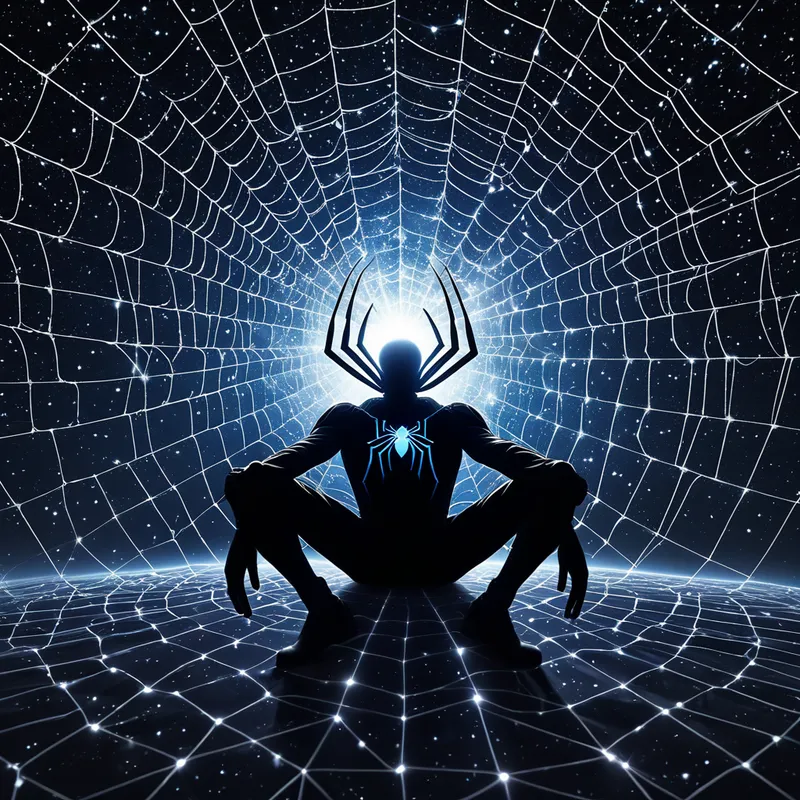
The Web of Life Myth Meaning & Symbolism
A cosmic tapestry woven by divine hands, connecting all beings in a shimmering web of destiny, responsibility, and sacred interdependence.
The Tale of The Web of Life
In the time before time, when the world was a dark and formless whisper, there existed only the Great Silence and the Great Weaver. She dwelt in the space between spaces, a being of infinite patience and fathomless thought. From the substance of her own being—from starlight and shadow, from breath and silence—she began to spin.
First, she spun the anchor lines. These were the great, unyielding threads of Cosmic Law, cast out into the void to form the loom of existence. They hummed with a deep, foundational tone, the Om of potential. Then, with movements as fluid as a river and as precise as a falling star, she began the true work. Her fingers, which were both hands and constellations, drew forth threads of vibrant, singing energy.
Each thread was a life. A shimmering strand for the first wolf, its howl woven into its fiber. A glistening filament for the ancient oak, its rings and roots encoded in its pulse. A delicate, brave thread for the first human, its capacity for love and terror spun together in a dazzling twist. She did not place them randomly. Each thread was tied, with a knot of profound significance, to countless others. The wolf’s thread connected to the deer, and the deer’s to the grass, and the grass’s to the sun, and the sun’s back to the Weaver herself. She wove the Web of Life, a living tapestry of breathtaking complexity and beauty, where every tremor of joy, every pang of hunger, every fall of a leaf resonated through the whole.
For eons, the Web shimmered in harmonious balance. The Weaver watched, her countless eyes reflecting the dance of connection. But into this web, she had woven a thread of a different nature—the thread of Conscious Choice. This thread belonged to humanity. And one day, a human, feeling the tug of so many connections as a burden, took a sharp stone and tried to cut himself free.
He sawed at the luminous strand connecting him to the forest. As it frayed, a strange silence fell around him; the birdsong seemed distant, the leaves dull. Emboldened by a false sense of independence, he cut the thread to the river, and the water’s voice became mute to his soul. With each severance, a part of his own light dimmed, and a corresponding shudder—a tear of darkness—rippled outwards through the Web. Animals grew wary, plants sickened downstream, and a cold wind blew where none had before.
The Great Weaver felt these tears as wounds in her own being. She did not rage. Instead, she descended, her form becoming that of an immense, gentle spider of light and shadow, and appeared before the now-lonely and frightened human. She did not speak with words, but placed upon his heart the weight of the entire Web. He felt the wolf’s hunger, the river’s longing to be clean, the oak’s deep, slow thoughts, and his own isolated thread, now brittle and grey. He felt the beautiful, terrible responsibility of his knot in the pattern.
Weeping, he understood. The Weaver then gave him a simple tool: not a needle to mend, for the Web mends itself, but a Tuning Stone. His task was not to control, but to listen. To pluck his own thread gently and learn the song of the whole, to feel the pulls and tensions, and by adjusting his own actions, help the great pattern find its harmony once more. The human, humbled, took the stone. His first act was to kneel and place his hands upon the earth, re-weaving his connection not by force, but by attention. And slowly, faintly, his thread began to glow again.
Cultural Origins & Context
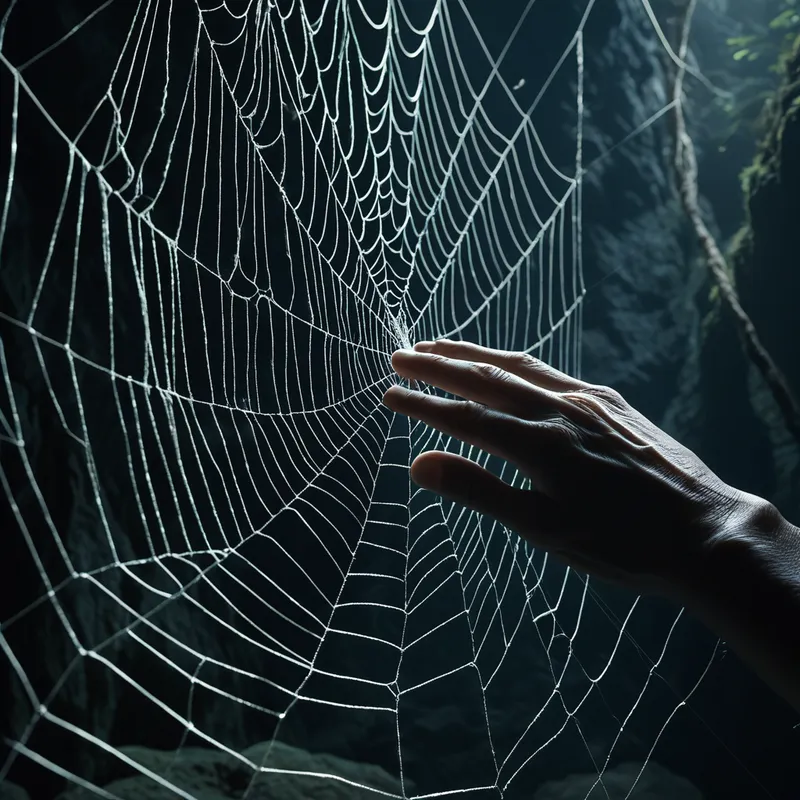
The motif of the Web of Life is not the property of a single culture, but a profound archetypal truth that has emerged independently across the globe. It is found in the teachings of numerous First Nations elders, who speak of all things being connected like the strands of a spider’s web. It is echoed in the Hindu concept of Dharma and the interdependent net of Indra, where each jewel at a node reflects all others. It is present in the Norse Norns at the foot of Yggdrasil, weaving the fates of gods and men.
This myth was never confined to a single holy text. It was passed down in fireside stories, in ceremonial teachings, in the practical ethics of hunters who thanked the spirit of the deer, and farmers who understood the kinship of soil and seed. Its societal function was foundational: it was an ontological map, a moral compass, and a cosmological science. It taught that an action against the land, the animal, or the stranger was ultimately an action against oneself and the whole community. It fostered a worldview based on reciprocal relationship rather than dominion.
Symbolic Architecture
The Web is the ultimate symbol of the Unus Mundus, the unitary world. It represents the psyche itself—a vast network where memories, complexes, instincts, and archetypes are all in dynamic relation. The Great Weaver is the archetypal Magna Mater and the objective psyche, the Self that spins the totality of our being.
The individual ego is not the weaver of the web, but a single, conscious knot within it. Its freedom lies not in cutting the threads, but in understanding its unique position and tension.
The act of cutting the thread is the birth of the modern ego’s illusion: the fantasy of separateness, of independence without consequence. This is the root of psychological and ecological alienation. The resulting loneliness and environmental decay are not punishments, but the natural, resonant feedback of a severed system. The Tuning Stone symbolizes conscious attention—the tool of introspection and empathy. It is not about fixing the outer world first, but about listening to the inner one and recognizing its extended connections.
The Dreamer's Resonance
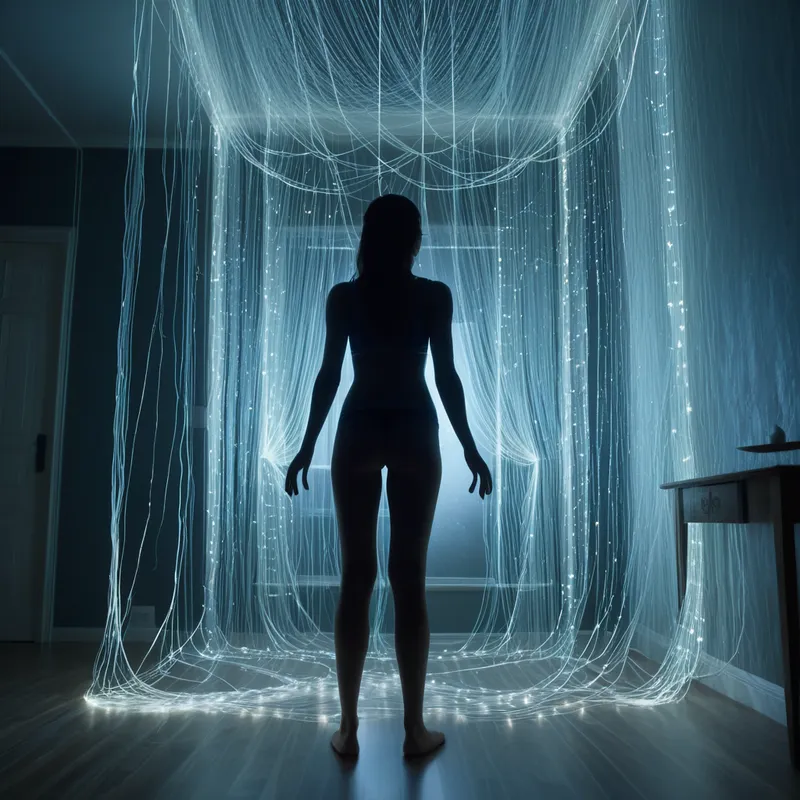
When this myth activates in the modern dreamer, it often manifests as dreams of intricate networks: neural pathways, city grids, mycelial fungi, or literal webs. The dreamer may find themselves at a central node, feeling overwhelmed by the sheer number of connections, or desperately trying to trace a single thread through a tangled labyrinth.
Somatically, this can feel like a hum of anxiety—the psychic weight of social media networks, global crises, and personal obligations all pulling simultaneously. It is the psyche’s way of processing the reality of our hyper-connected age and the deep, often ignored, truth of our biological and psychic interdependence. The dream may highlight a specific thread that is frayed (a neglected relationship) or overly taut (a stressful obligation), guiding the dreamer toward what needs conscious re-attunement. The process is one of moving from the panic of entanglement to the peace of conscious belonging.
Alchemical Translation
The alchemical journey modeled here is the transmutation of the ego in isolation into the conscious node in the Self. The initial state is nigredo—the blackening, represented by the human cutting his threads, a state of active alienation that feels like freedom but is actually a spiritual death. The Conscious Choice thread becomes a noose.
The appearance of the Weaver is the albedo, the whitening, the moment of divine illumination. It is the shocking, humbling realization that one is not, and never was, separate. This is the dissolution of the ego’s grand narrative. The gift of the Tuning Stone begins the citrinitas, the yellowing, the slow work of integration. This is the daily practice of mindfulness, therapy, and ethical living—learning to “pluck your thread” and listen for the resonance in your relationships, your work, your body, and the earth.
Individuation is not about becoming a separate, perfected gem. It is about polishing the unique facet you are on the jewel of the Net, so you may more perfectly reflect and be reflected by the whole.
The final stage, rubedo—the reddening—is not an end state, but a mode of being. It is living as a healed, glowing node within the Web. Your actions are taken with an awareness of their ripple effects; your identity is rooted in relationship. You carry the tension of your connections not as a burden, but as the sacred responsibility that gives your life meaning and context. You become, in a small, human way, a co-weaver, tending your corner of the pattern with conscious, caring hands.
Associated Symbols
Explore related symbols from the CaleaDream lexicon: