The Village Storyteller / Griot Myth Meaning & Symbolism
A mythic figure emerges from the village firelight, weaving past and future into a living story that holds the community's soul.
The Tale of The Village Storyteller / Griot
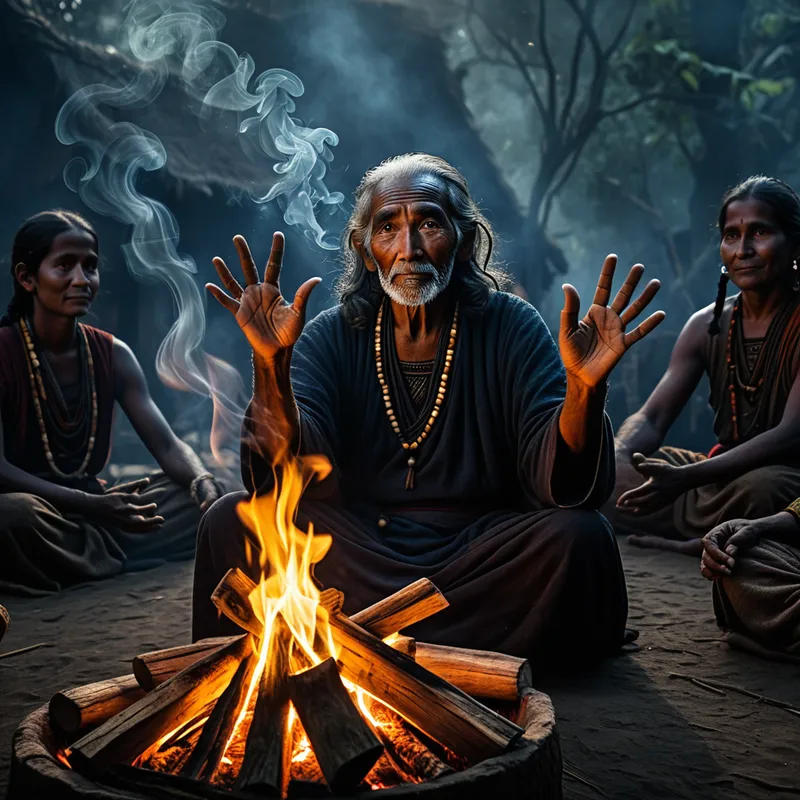
Listen. The night is not silent. Beneath the blanket of stars, a deeper darkness gathers at the edge of the village, a darkness that is not of shadow, but of forgetting. It is a quiet hunger. It swallows the names of the founders, erases the paths of the rivers, turns the deeds of heroes into dust on [the wind](/myths/the-wind “Myth from Various culture.”/). The people feel it in their bones—a chill, a lightness, as if they might float away, rootless, into [the void](/myths/the-void “Myth from Buddhist culture.”/).
In the center of the circle, the fire fights back. Its light is a small, defiant kingdom. And in that kingdom sits Mamadou Kouyaté, though that is only one of his ten thousand names. His body is a map of droughts and harvests, his eyes are pools that reflect not [the sky](/myths/the-sky “Myth from Persian culture.”/), but the long road of the ancestors. He is silent. The people are silent. The only sound is the crackle of the fire and the distant, gnawing silence of the forgetting.
He does not merely speak. He reaches into the embers. From the heat, he draws forth the First Hunter, He-Who-Saw-The-[Water](/myths/water “Myth from Chinese culture.”/). The air thickens with the scent of wet earth and fear. They see him, spear in hand, facing the great beast at [the river](/myths/the-river “Myth from Buddhist culture.”/)’s bend. The children gasp; the elders nod, their own memories stirring. The story is not a tale of then; it is a presence of now. [The hunter](/myths/the-hunter “Myth from African culture.”/)’s [triumph](/myths/triumph “Myth from Roman culture.”/) becomes their courage.
But the storyteller does not stop at triumph. He weaves the shame of The Brother-Who-Betrayed-The-Granary. The air grows heavy with the sour smell of spoiled millet and collective guilt. Faces turn down. This, too, must be remembered. For to forget [the fall](/myths/the-fall “Myth from Biblical culture.”/) is to be doomed to repeat it. The story is the mortar that binds the broken pieces of the community back together, shame and glory in equal measure.
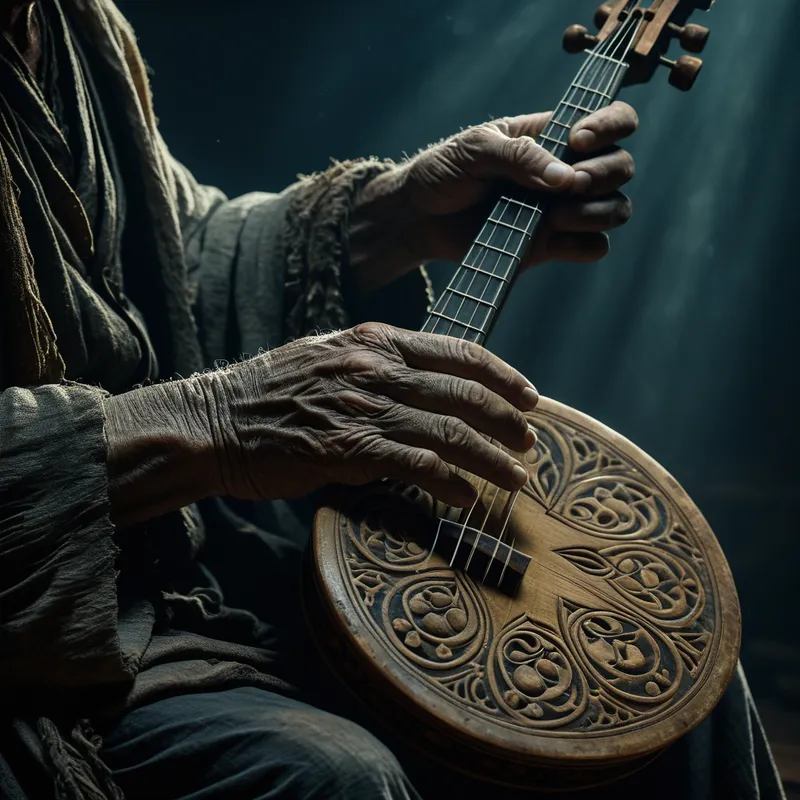
His voice dips into a melody, and the kora in his lap awakens. The strings become the footsteps of the migration, the long, weary exodus from the parched lands. The notes are blisters on feet, the wail of a child, the sudden cry of a bird signaling a new oasis. The people feel the journey in their muscles. They are the migration. Their identity is not a fact, but a path, sung into being note by note.
As the night deepens, he sings the names. Not just the great chiefs, but the forgotten ones: [the potter](/myths/the-potter “Myth from Abrahamic culture.”/) whose design caught the rain, [the child](/myths/the-child “Myth from Alchemy culture.”/) who laughed and ended a feud. He sings the name of every stream, every hill, every tree that marks a grave. Each name is a star, stitched into the canopy of night, pushing back the void. The hunger of the forgetting recedes, thwarted by this litany of belonging.
When his voice finally fades, not into silence, but into the hum of the remembered world, the people do not applaud. They breathe. They feel the weight of their history settle around their shoulders like a well-worn cloak. They are no longer individuals in the dark, but a people, anchored in time. The fire burns lower. The storyteller closes his eyes, [the vessel](/myths/the-vessel “Myth from Alchemical culture.”/) once more empty, the guardian once more at his post. The memory is safe. For now.
Cultural Origins & Context
This is not a myth from a single scroll or tablet, but a living pattern etched into the human [psyche](/myths/psyche “Myth from Greek culture.”/) across continents. From the Griots of the Mande peoples to the seanchaithe, from the Slavic skomorokhs to the Indigenous elders who keep the “long story,” the Village Storyteller is a universal archetype of oral tradition. This figure emerged not from priesthood or kingship, but from the fundamental human need to transcend biological memory.
The myth was passed down by performing the very function it describes. A Griot did not learn the stories from a book, but through years of apprenticeship, absorbing the cadence, the moral weight, and the musical accompaniment that made memory incarnate. Their societal function was multifaceted: they were historians, genealogists, entertainers, diplomats, and social conscience. In a world before widespread literacy, they were the living library, the adhesive of culture, and [the mirror](/myths/the-mirror “Myth from Various culture.”/) in which the community saw its collective soul—beautiful and flawed.
Symbolic Architecture
At its core, the myth is not about a person, but about the [Vessel](/symbols/vessel “Symbol: A container or structure that holds, transports, or protects something essential, representing the self, emotions, or life journey.”/) of [Memory](/symbols/memory “Symbol: Memory symbolizes the past, lessons learned, and the narratives we construct about our identities.”/). The Storyteller symbolizes the [human](/symbols/human “Symbol: The symbol of a human represents individuality, complexity of emotions, and social relationships.”/) [capacity](/symbols/capacity “Symbol: A measure of one’s potential, limits, or ability to contain, process, or achieve something, often reflecting self-assessment or external demands.”/) to transform ephemeral [event](/symbols/event “Symbol: An event within dreams often signifies significant life changes, transitions, or emotional milestones.”/) into enduring meaning, to alchemize the raw data of experience into the gold of [identity](/symbols/identity “Symbol: Identity represents the sense of self, encompassing personal beliefs, cultural background, and social roles.”/).
The Storyteller is the threshold where chaos becomes cosmos. They take the scattered fragments of time and, through narrative, impose a sacred order.
The [village](/symbols/village “Symbol: Symbolizes community, connection, and a reflection of one’s roots or origins.”/) circle represents the known world, the container of culture. The encroaching darkness of forgetting is the ever-present [threat](/symbols/threat “Symbol: A threat in dreams often reflects feelings of vulnerability, anxiety, or fear regarding one’s safety or well-being. It can indicate unresolved conflicts or the presence of external pressures.”/) of psychic and cultural [dissolution](/symbols/dissolution “Symbol: The process of breaking down, dispersing, or losing form, often representing transformation, release, or the end of a state of being.”/)—the return to a state where nothing matters and nothing coheres. The fire is the focused light of [consciousness](/symbols/consciousness “Symbol: Consciousness represents the state of awareness and perception, encompassing thoughts, feelings, and experiences.”/) itself, the necessary heat to forge narrative. The names are the fundamental units of [reality](/symbols/reality “Symbol: Reality signifies the state of existence and perception, often reflecting one’s understanding of truth and life experiences.”/); to know [the true name](/myths/the-true-name “Myth from Various culture.”/) of a [thing](/myths/thing “Myth from Norse culture.”/) is to have a [relationship](/symbols/relationship “Symbol: A representation of connections we have with others in our lives, often reflecting our emotional state.”/) with it, to hold its essence.
The storyteller’s power lies in their [inclusion](/symbols/inclusion “Symbol: The state of being accepted, welcomed, or integrated into a group, community, or society. It represents belonging and participation.”/) of [shadow](/symbols/shadow “Symbol: The ‘shadow’ embodies the unconscious, repressed aspects of the self and often represents fears or hidden emotions.”/). They do not only sing of victories; they sing of the [betrayal](/symbols/betrayal “Symbol: A profound violation of trust in artistic or musical contexts, often representing broken creative partnerships or artistic integrity compromised.”/) at the [granary](/symbols/granary “Symbol: The granary symbolizes abundance, storage of resources, and the cyclical nature of life, embodying both nourishment and the need for preservation.”/). This represents the psychological necessity of integrating the shameful, painful, and traumatic parts of the personal or collective past. Denied, these fragments fester and split the psyche. Remembered and woven into the larger narrative, they become sources of wisdom and [resilience](/symbols/resilience “Symbol: The capacity to recover quickly from difficulties, adapt to change, and maintain strength through adversity.”/).
The Dreamer’s Resonance
When this myth stirs in the modern dreamscape, it often manifests as a profound anxiety of rootlessness. One may dream of being in a featureless landscape, or a house whose rooms keep changing, symbolizing a loss of personal or familial narrative. The dreamer might be frantically searching for a lost book, a deleted file, or a name they cannot recall—all metaphors for a severed connection to one’s own story.
Conversely, the dream may present the Call to Witness. The dreamer finds themselves compelled to listen to an old figure telling a long, intricate tale, or feels an urgent pressure to write down or record something before it is lost forever. This is the psyche’s somatic signal that a critical piece of personal history—a trauma, a forgotten talent, a family secret—is demanding integration. The body may feel heavy, ears may ring, or a sense of deep, anxious responsibility may linger upon waking. The process is one of psychic recollection, gathering the exiled parts of [the self](/myths/the-self “Myth from Jungian culture.”/).

Alchemical Translation
For the individual navigating the modern world—often a landscape of fragmented identities and digital amnesia—the myth of the Storyteller models the path of individuation as the construction of a personal myth.
The first alchemical stage is Descending into the Archive. This is the internal equivalent of sitting by the fire. It requires turning away from the noise of the present and listening inward to the fragmented voices of our past: childhood memories, ancestral whispers, forgotten passions, and unhealed wounds. This is the raw, chaotic material.
The second stage is The Weaving. Here, we take on the role of our own Griot. We do not judge the fragments as “good” or “bad” memories. Instead, we seek the narrative thread that connects them. Why does this childhood shame echo in that adult relationship? How does a grandparent’s migration story live in my own fear of stagnation? This is the act of finding meaning, not as a simple moral, but as a coherent pattern.
The alchemical fire is the courageous attention we pay to our own totality. In its heat, the lead of random suffering is transmuted into the gold of a story that can be carried.
The final stage is The Performance, which is simply the act of living from this integrated story. It is not about recounting your tale to everyone, but about allowing this cohesive narrative to inform your choices, your values, and your sense of purpose. You become the vessel of your own memory, and thus, the author of your own becoming. You anchor yourself against the void of forgetting, not with a list of facts, but with a living, breathing story that says, This is who I am, because this is the path I have remembered. In doing so, you take your seat in the eternal circle, a keeper of your own flame.
Associated Symbols
Explore related symbols from the CaleaDream lexicon: