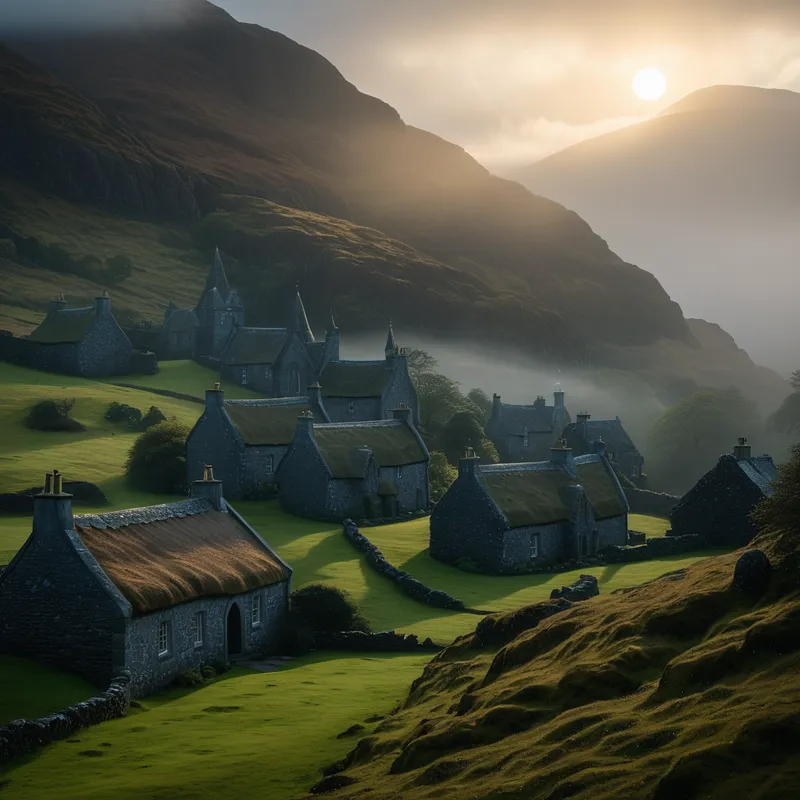
The village of Brigadoon from Myth Meaning & Symbolism
A Scottish village, hidden by an ancient enchantment, awakens for a single day every hundred years, a timeless sanctuary for those who truly seek it.
The Tale of The village of Brigadoon from
Listen, and I will tell you of a place that exists just beyond the edge of the map, in the fold between one breath and the next. It is a tale not carved on ancient stone, but whispered on the wind that sighs through the Highland glens.
In a time when the old magic still clung to the hills like mist, a village named Brigadoon faced a terrible darkness. A plague of witches, some say, or a scourge of mortal strife so vile it threatened to poison the very soul of the land. The village minister, a man of deep and desperate faith, did not pray for strength to fight, but for sanctuary. He went to the ancient standing stones that watched over the valley and made a pact with a power older than the kirk. He offered a profound sacrifice: the village’s place in the relentless river of time.
And the land listened.
A deep, slumbering enchantment settled over Brigadoon. The bustling village green fell silent mid-laugh. The blacksmith’s hammer hung frozen above the glowing iron. The children’s game was paused, a ball suspended in air. The entire village—its people, its sheep, its smoke curling from chimneys—was wrapped in a deep, protective sleep. It would not age, nor change, nor know sorrow. But the cost was its connection to the waking world. For every one hundred years that passed in the world outside, Brigadoon would awaken for but a single day. On that day, the mist would part, the sun would find the hidden glen, and life would resume as if only a moment had passed. But if any villager were to leave the glen on that day of waking, the enchantment would shatter forever, and the village would vanish into dust.
Centuries rolled by like thunder beyond the mountains. The world changed; empires rose and fell, machines were born, and time accelerated into a frantic blur. But in the hidden glen, there was only the peace of a perpetual, gentle yesterday.
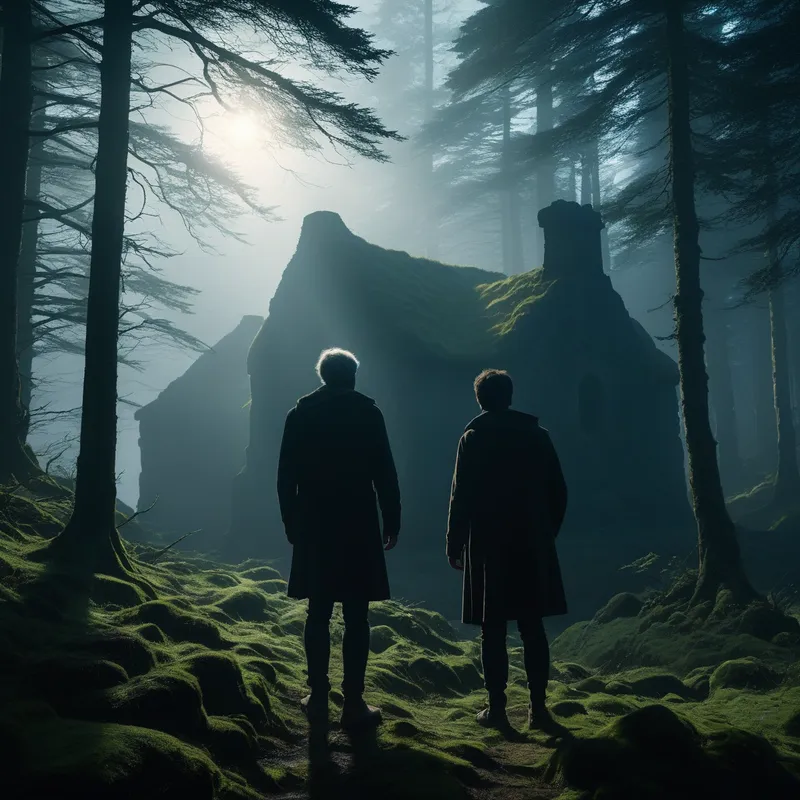
Then, one fateful waking day in the 20th century, two hunters from that frantic modern world—Tommy Albright and Jeff Douglas—stumbled through the Highland mist, lost and disoriented. They crossed a forgotten bridge and found a village that should not exist, dressed in clothes of another age, speaking of a battle that was centuries old. For Tommy, it was not a historical curiosity; it was a homecoming for a soul he never knew was homesick. He met Fiona MacLaren, and in her eyes, he saw the timeless peace his modern life so desperately lacked. He fell in love not just with her, but with the very essence of the place—its simplicity, its sincerity, its freedom from the tyranny of clocks.
But as the sun began to set, the terrible truth of the enchantment was revealed. To stay was to leave his entire world behind, forever. To ask Fiona to leave was to condemn her home and everyone in it to oblivion. As the last light faded, the mists began to creep back into the glen. With a heart breaking in two directions at once, Tommy was pulled back across the bridge by Jeff, back into the world of time. Brigadoon faded behind him, a dream dissolving at dawn.
Yet, for a soul that has truly touched the timeless, the world of minutes and hours becomes a prison. Tommy could not forget. He returned to Scotland, year after year, haunted by the memory. And in a final, desperate act of faith—a belief in love over logic, in enchantment over evidence—he walked back to the empty glen. He called out not to a place, but to the principle of sanctuary itself. And for him, and him alone, the mists parted one final time. The bridge appeared. He crossed over, and the village, sustained by the power of a love that defied time, welcomed him home.
Cultural Origins & Context
The myth of Brigadoon is a fascinating modern entry into the universal canon, born not from ancient oral tradition but from the mid-20th century American stage. Its creators, Alan Jay Lerner (book and lyrics) and Frederick Loewe (music), crafted a new “Scottish” folk tale for the 1947 Broadway musical. While it draws upon deep, pre-existing archetypes—the Tír na nÓg of Celtic lore, the Isle of Avalon, the El Dorado that sleeps—it is fundamentally a myth for the modern, post-war psyche.
Its societal function was profound for its time. In an era grappling with the trauma of global war and the anxious dawn of a nuclear, consumerist age, Brigadoon offered a powerful narrative of sanctuary. It spoke to a deep cultural longing for simplicity, authenticity, and a return to a perceived innocent past untouched by the complexities and horrors of modernity. It is a myth passed down not by bards, but through the communal ritual of theater and later film, becoming a shared daydream of escape. It functions as a collective reverie, a place we collectively imagine to cope with the accelerating, dislocating pace of contemporary life.
Symbolic Architecture
At its core, Brigadoon is not a geographical location, but a state of soul. It symbolizes the Self in its pristine, pre-conflict state—the inner sanctuary of peace and authenticity that feels forever lost to the demands of the external persona.
The village is the soul’s memory of itself before it was fractured by time and obligation.
The enchantment itself is the ultimate psychological defense mechanism: a complete withdrawal from the painful flow of chronological time (history, aging, loss) to preserve a state of perfect, if static, innocence. The villagers represent aspects of the psyche that have chosen safety over growth. Tommy Albright represents the modern ego, successful yet profoundly alienated, who stumbles upon this hidden part of himself. His journey is the ego’s shocking, often disbelieving, recognition of the soul’s deeper needs. Fiona is the anima, the bridge to this inner world—she is the feeling-toned connection that makes the sanctuary feel like home, not just a museum.
The central conflict—to stay or to leave—maps perfectly onto the human dilemma between the comfort of inner fantasy and the demands of outer reality. The potential dissolution of the village if anyone leaves underscores the fragility of this inner world; it can be destroyed by the harsh, uncomprehending light of a purely rational, disenchanted consciousness (represented by Jeff).

The Dreamer’s Resonance
When this myth pattern surfaces in modern dreams, it seldom appears as a literal Scottish village. Instead, one dreams of discovering a forgotten, perfect room in a familiar house; of encountering a group of joyful, timeless people at a party that exists outside of normal hours; or of revisiting a childhood home that remains exactly, impossibly, as it was.
These dreams signal a somatic and psychological process of nostalgia in its deepest sense—not a mere longing for the past, but a painful homesickness for a state of being. The dreamer is likely experiencing acute stress, burnout, or a feeling of being out of sync with their own life’s rhythm. The dream is the psyche’s attempt to self-regulate, to conjure an image of the prima materia of the self, untouched by corrosion. The emotional tone is key: a bittersweet joy upon discovery, followed by acute grief upon waking. This grief is not pathological; it is the soul pointing directly to what it is missing—a connection to its own timeless core.
Alchemical Translation
The myth of Brigadoon models a specific, and somewhat perilous, path of individuation. It is the alchemy of reclamation, not of transformation. The village does not evolve; it is preserved and then re-integrated through an act of supreme faith.
The process begins with the nigredo of Tommy’s modern life—a depression, a feeling of being lost in the “mist” of meaningless routine. The discovery of the village is the albedo, a whitening, an illumination of the pure, hidden self. The crisis at sunset is the citrinitas, the yellowing or testing, where the conscious ego must choose between the known world and the soul’s truth. His initial return to the world is a failed rubedo, a reddening or integration that is aborted.
The final, successful alchemy occurs not in the village, but in the years of longing in the outer world. The yearning itself becomes the crucible.
His faithful return and the village’s reappearance symbolize the ultimate psychic transmutation: the conscious ego, after a long period of fermentation and suffering, finally subordinates itself to the reality of the Self. It chooses the soul’s time over clock time. The enchantment, once a defense, becomes a covenant fulfilled by conscious love. For the modern individual, this translates not to literal escape, but to the courageous act of creating “Brigadoon moments”—sanctuaries of timeless presence, authentic connection, and soulful activity within the flow of daily life. It is the practice of letting the enchanted, inner village inform and sanctify our passage through the world of years, so we are not merely living in time, but occasionally, profoundly, touching the eternal.
Associated Symbols
Explore related symbols from the CaleaDream lexicon: