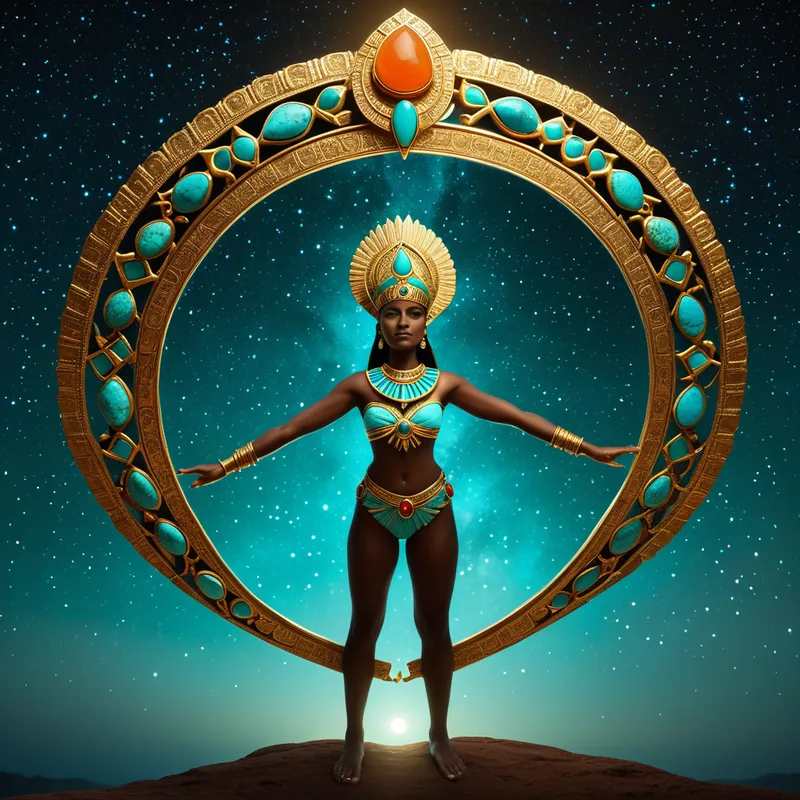
The Usekh Collar Myth Meaning & Symbolism
A myth of divine protection and cosmic order, where a sacred collar becomes the key to restoring harmony between the heavens and the human heart.
The Tale of The Usekh Collar
Hear now a tale not of a single hero, but of a sacred object, a vessel of cosmic intent. It begins not with a birth, but with a breath—the first, shuddering exhalation of Benben from the waters of Nun. As the sun first crested that holy mound, its light did not merely illuminate; it fashioned. And from the sun’s own tears of joy at the sight of the fledgling world, mingled with the sweat of the shaping gods, a substance was formed: not quite gold, not quite light, but a metal that hummed with the song of Maat.
The great sky mother, Nut, arched her star-dusted body over [the earth](/myths/the-earth “Myth from Hindu culture.”/). She saw her children—the people of the Black Land—frail and trembling in the vast space between the ordered fields and the lurking chaos beyond [the horizon](/myths/the-horizon “Myth from Various culture.”/). Their hearts, the Ib, were exposed, vulnerable to the whispers of doubt, the cold of fear, the searing heat of rage. A cry went up, a collective sigh that rustled the [papyrus](/myths/papyrus “Myth from Egyptian culture.”/) and stirred the dust of [the desert](/myths/the-desert “Myth from Biblical culture.”/).
Nut’s own heart, vast as the night, constricted with a mother’s sorrow. She called to her husband, the earth god Geb. “Our children are naked to [the wind](/myths/the-wind “Myth from Various culture.”/) of chaos. Their Ib flutters like a bird in a storm. We must give them a fortress that does not confine, a boundary that defines.”
Geb, feeling the tremor in the very soil, agreed. But it was the cunning [Thoth](/myths/thoth “Myth from Global/Universal culture.”/), the measurer and scribe, who conceived the form. He took the humming metal of the first light. To it, he added the deep blue-green of the life-giving Nile, captured in polished turquoise—a piece of [the river](/myths/the-river “Myth from Buddhist culture.”/)’s soul. He added the fiery red of carnelian, the blood of the desert sun, to hold the spark of life and courage. He strung these upon a thread spun from the rays of the dawn sun, [Khepri](/myths/khepri “Myth from Egyptian culture.”/).
What he crafted was not a necklace, but a collar. A wide, embracing crescent that would rest upon the shoulders and encircle the throat, the gateway of breath and word. It was a miniature cosmos: rows of beads like the ordered stars, colors mapping [the world](/myths/the-world “Myth from Tarot culture.”/) from the red land of chaos to the black land of life. It was named Usekh: “the Broad One.”
The first to receive it was not a god, but a mortal king. In the cool, incense-heavy darkness of the inner sanctum, the collar was placed upon his shoulders. The weight was immense, not of metal, but of covenant. As it settled, a visible sigh seemed to pass through the land. The Nile’s flood receded to its perfect bounds. Crops stood straighter. The people felt, in their chests, a subtle warmth, a firmness where before there was a hollow flutter. The collar did not stop pain or fear, but it held the space around the heart, a divine reminder that they were connected, protected, part of a vast and beautiful order. The myth was not of a battle won, but of a sanctuary built—stone by sacred stone, bead by cosmic bead—around the fragile, luminous human soul.
Cultural Origins & Context
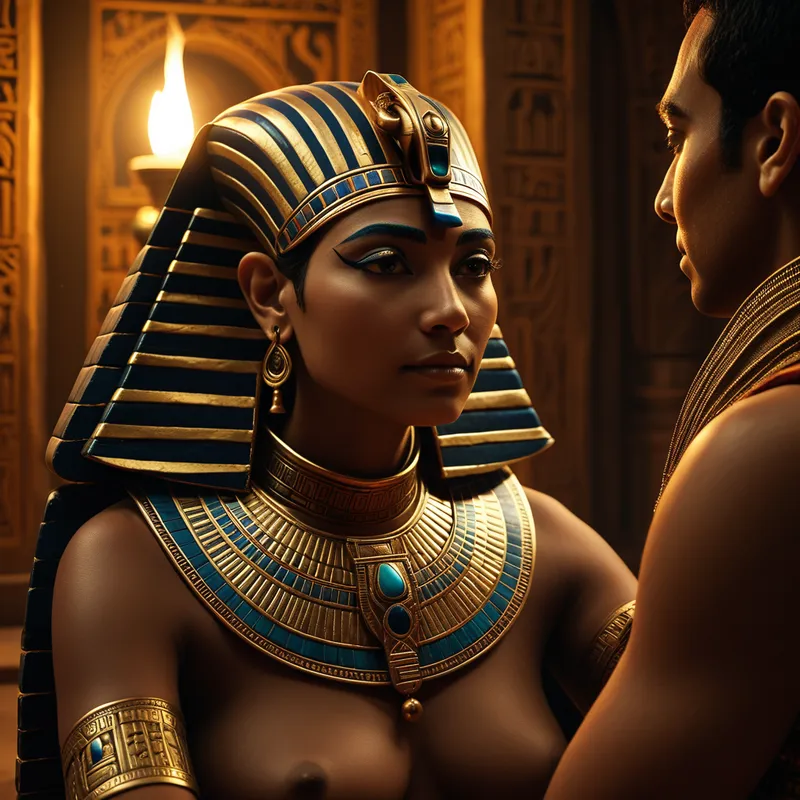
The myth of the [Usekh Collar](/myths/usekh-collar “Myth from Egyptian culture.”/) is woven not from a single papyrus scroll, but from the very fabric of Egyptian ritual life. It is a “performed myth,” its story told not by bards in halls, but by priests in temples and artists on tomb walls. Its primary narratives are found in the [Pyramid Texts](/myths/pyramid-texts “Myth from Egyptian culture.”/), Coffin Texts, and the Book of the Dead, where spells often involve the ceremonial donning of collars for protection.
The collar was a supreme symbol of status and divine favor, worn by pharaohs, deities in statuary, and the elite in death. The myth served a profound societal function: it sacralized kingship. [The pharaoh](/myths/the-pharaoh “Myth from Egyptian culture.”/), by wearing the Usekh, became the living conduit of Maat. His adorned body was a microcosm holding chaos at bay for the entire nation. In funerary rites, the placement of a collar on the mummy was a re-enactment of this primal myth, aiming to reconstitute the psychic integrity of the deceased for the perilous journey through the Duat. It was a collective story of psychic and social stabilization, teaching that order is not a given, but a sacred, daily achievement maintained through ritual, symbol, and righteous living.
Symbolic Architecture
At its core, the Usekh [Collar](/symbols/collar “Symbol: In dreams, a collar can symbolize control, restriction, or social status, often representing the constraints one feels in their life.”/) is an archetypal [symbol](/symbols/symbol “Symbol: A symbol can represent an idea, concept, or belief, serving as a powerful tool for communication and understanding.”/) of the containing [vessel](/symbols/vessel “Symbol: A container or structure that holds, transports, or protects something essential, representing the self, emotions, or life journey.”/). Its [symbolism](/symbols/symbolism “Symbol: The use of symbols to represent ideas or qualities, often conveying deeper meanings beyond literal interpretation. In dreams, it’s the language of the unconscious.”/) operates on multiple, interconnected levels.
The collar is the cosmos contracted to a wearable scale, a map of reality meant not for the eyes, but for the skin.
Physically encircling the [throat](/symbols/throat “Symbol: Represents communication, expression, and the transmission of thoughts.”/) and upper [chest](/symbols/chest “Symbol: The chest symbolizes the core of one’s being, encompassing emotions, identity, and the protective barriers we create around ourselves.”/), it symbolically fortifies the two most vulnerable psychic centers: the voice ([identity](/symbols/identity “Symbol: Identity represents the sense of self, encompassing personal beliefs, cultural background, and social roles.”/), [expression](/symbols/expression “Symbol: Expression represents the act of conveying thoughts, emotions, and individuality, emphasizing personal communication and creativity.”/), [truth](/symbols/truth “Symbol: Truth represents authenticity, honesty, and the quest for knowledge beyond mere appearances.”/)) and the [heart](/symbols/heart “Symbol: The heart symbolizes love, emotion, and the core of one’s existence, representing deep connections with others and self.”/) ([emotion](/symbols/emotion “Symbol: Emotion symbolizes our inner feelings and responses to experiences, often guiding our actions and choices.”/), conscience, [life](/symbols/life “Symbol: The symbol of ‘Life’ represents a journey of growth, interconnectedness, and existential meaning, encompassing both the joys and challenges that define human experience.”/) force). The beads represent multiplicity unified into a protective whole—the disparate experiences of a life strung together into a coherent [identity](/symbols/identity “Symbol: Identity represents the sense of self, encompassing personal beliefs, cultural background, and social roles.”/). The materials are alchemical: turquoise ([water](/symbols/water “Symbol: Water symbolizes the subconscious mind, emotions, and the flow of life, representing both cleansing and creation.”/), healing, the celestial), carnelian (fire, vitality, aggression transformed into courage), and gold (the incorruptible, solar divine). Together, they transmute base vulnerabilities into spiritual [armor](/symbols/armor “Symbol: Armor represents psychological protection, emotional defense, and the persona presented to the world. It symbolizes both safety and the barriers that separate us from vulnerability.”/).
Psychologically, the collar represents the necessary [structure](/symbols/structure “Symbol: Structure in dreams often symbolizes stability, organization, and the framework of one’s life, reflecting how one perceives their environment and personal life.”/) for the [psyche](/myths/psyche “Myth from Greek culture.”/). It is [the ego](/myths/the-ego “Myth from Jungian culture.”/)-function at its healthiest: not a [prison](/symbols/prison “Symbol: Prison in dreams typically represents feelings of restriction, confinement, or a lack of freedom in one’s life or mind.”/), but a defined vessel that allows the contents of the unconscious (the chaotic Nun) to be experienced without flooding and dissolving the conscious self. It is the “[skin](/symbols/skin “Symbol: Skin symbolizes the boundary between the self and the world, representing identity, protection, and vulnerability.”/)” of the [personality](/symbols/personality “Symbol: Personality in dreams often symbolizes the traits and characteristics of the dreamer, reflecting how they perceive themselves and how they believe they are perceived by others.”/), the [boundary](/symbols/boundary “Symbol: A conceptual or physical limit defining separation, protection, or identity between entities, spaces, or states of being.”/) that enables [relationship](/symbols/relationship “Symbol: A representation of connections we have with others in our lives, often reflecting our emotional state.”/) with the “other” without annihilation.
The Dreamer’s Resonance
When the symbol of the Usekh Collar appears in modern dreams, it seldom manifests as a literal piece of jewelry. More often, it is felt as a sensation: a sudden, comforting weight on the shoulders, a tightening or fortifying around the chest, or the visualization of a luminous pattern—a tattoo, a light-grid, a harness—encircling the upper body.
Such dreams often surface during periods of profound emotional exposure or psychic fragmentation. The dreamer may be experiencing a “crisis of heart”: grief that feels bottomless, love that feels dangerously unbounded, or anxiety that threatens to dissolve all sense of self. The dream collar is the psyche’s innate healing response, attempting to re-containerize. It signals an unconscious process of re-establishing boundaries that have been violated or dissolved. The somatic feeling of weight is crucial; it is the dream-ego accepting the burden of self-definition, the responsibility of holding oneself together. It is not a call to close off, but to gather one’s scattered pieces into a vessel strong enough to once again engage with the world.
Alchemical Translation
The alchemical journey modeled by the Usekh myth is not one of heroic conquest, but of sacred reception and integration. The modern individuation process often begins with a state of dis-integration: the “chaotic waters” of the unconscious have breached the ego’s defenses, leaving one feeling exposed, raw, and without a coherent center.
The work is not to defeat the chaos, but to build a vessel capable of holding it, thereby transforming it from a threat into a source of depth and vitality.
The first step ([Nigredo](/myths/nigredo “Myth from Alchemical culture.”/)) is the recognition of this vulnerability—the “cry” that reached the ears of Nut. The second step (Albedo) is the appeal to a higher, ordering principle—the conscious ego (Thoth) calling upon the transcendent function (the divine parents) for a new structure. The crafting of the collar is the Conjunctio, the marriage of opposites: fire and [water](/myths/water “Myth from Chinese culture.”/) (carnelian and turquoise), chaos and order, vulnerability and strength.
For the individual, this translates to the conscious, often painstaking work of building internal structure. This is the “alchemical translation”: establishing personal rituals, ethical codes, therapeutic practices, and creative disciplines that act as the “rows of beads.” These are not rigid rules, but lived expressions of personal Maat. To “wear the Usekh” is to have done the work of integrating one’s shadows and strengths into a resilient, defined self. The weight one feels is the dignity of self-ownership. The protected heart is not a closed heart, but a heart with a sanctuary—a center that can engage with the tumult of life and relationship without losing its essential form. The myth ultimately teaches that true freedom and connection are only possible from within a sacred, self-crafted container.
Associated Symbols
Explore related symbols from the CaleaDream lexicon: