The Trimurti Myth Meaning & Symbolism
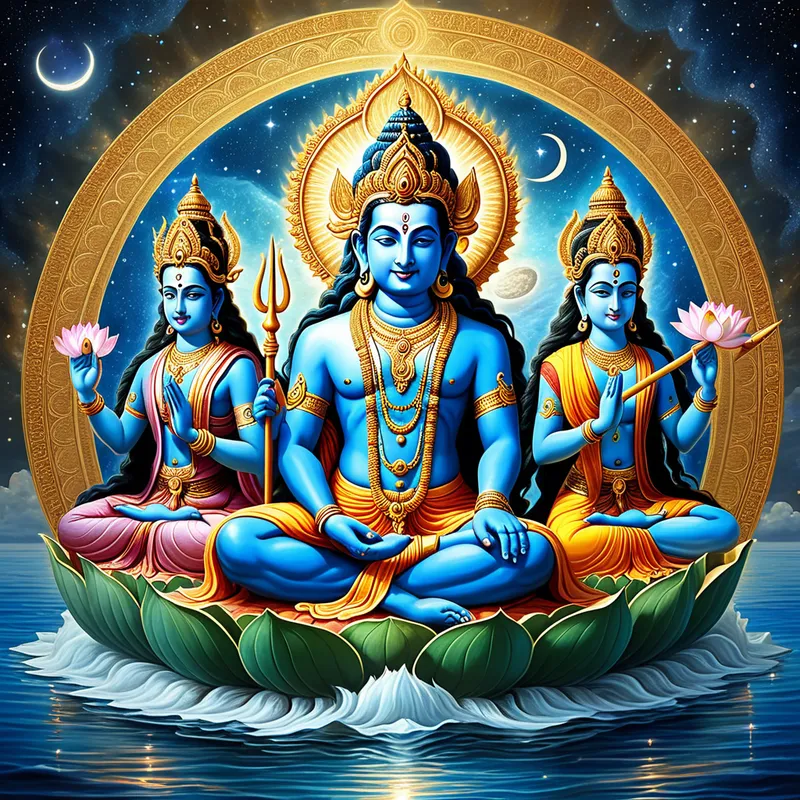
The eternal cosmic cycle personified as three deities: Brahma creates, Vishnu preserves, and Shiva destroys, in a sacred dance of becoming and unbecoming.
The Tale of The Trimurti
In the beginning, before time had a name, there was only the One. A boundless, silent ocean of potential, dark and deep and without a shore. It was not emptiness, but a fullness so complete it had no need for form. This was the Brahman, dreaming a dream of itself.
From the stillness of that infinite sea, a sound arose. Not a crash or a cry, but a vibration, a hum that was the first thought. It was the syllable Aum. And as Aum echoed in the void, a golden warmth began to glow upon the waters. From this warmth emerged a lotus blossom, its petals unfurling to cradle the first consciousness. Upon this throne sat Brahma. He opened his eyes—not two, but four, facing the four directions—and beheld the infinite possibility. With a breath, he began to weave. From his mind sprang the Vedas, the sacred laws. From his hands, the elements took shape: fire danced, wind sighed, earth solidified, waters flowed, and ether expanded. He populated the worlds with creatures and thoughts, colors and sounds, filling the silence with the magnificent, chaotic symphony of existence.
But a symphony needs a conductor, a story needs a teller. As the worlds spun from Brahma’s will, they threatened to fly apart into chaos. From the heart of the cosmic ocean, another presence manifested. Upon the coils of the great serpent Ananta Shesha, reclined Vishnu. His skin was the blue of the deep sky and the fathomless sea. In his hands he held the tools of preservation: the conch to sound the divine order, the discus to cut away disorder. With a gentle gaze, he stabilized the spinning worlds. He descended, time and again, as avataras—as a fish, a boar, a man-lion, a dwarf, a warrior prince—to uphold dharma whenever it wavered. He was the sustainer, the thread that held the pearls of creation together.
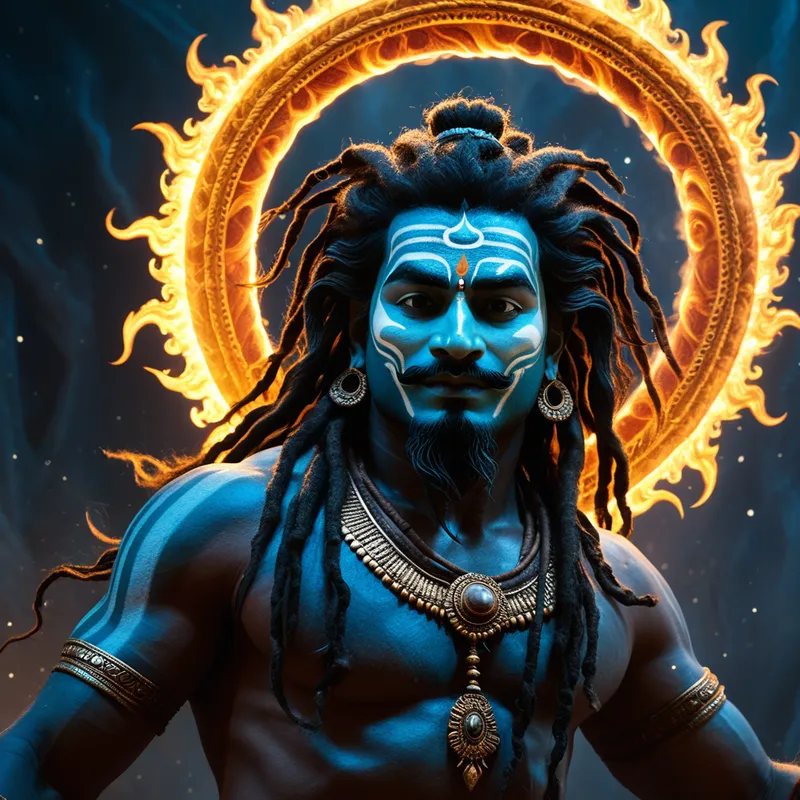
Yet, what is created and sustained must also, one day, end. From the highest peaks of the Himalayas, in the desolate, glorious cremation grounds, a third power stirred. He was Shiva, the ascetic, smeared with the ash of all that is burned away. His matted hair held the crescent moon and the raging river Ganga. In his hand was the trident, piercing the illusions of reality. When the universe grew weary, heavy with the weight of its own accumulated stories, Shiva opened his third eye. Or he began to dance—the Tandava—a dance of furious, ecstatic grace. With each stamp of his foot, stars dissolved into dust, ages collapsed, and forms returned to the formless. He was the fire that reduces the sacred offering to smoke, returning it to the heavens. He was not an end, but a return, a necessary night so that a new dawn could be dreamed once more.
And so the cycle turns. From the One, Brahma emerges to dream the Many. Vishnu tenderly holds the dream, giving it meaning and duration. And Shiva, with fierce compassion, dissolves the dream back into the dreamer. They are not three gods fighting for dominion, but one breath of the cosmos: the inhalation of creation, the pause of preservation, the exhalation of dissolution. The story has no final page, for the last word is also the first: Aum.
Cultural Origins & Context
The concept of the Trimurti crystallized in the early centuries of the Common Era, finding its most prominent expression in the Puranas. These were not dry theological tracts, but living, breathing compendiums of story, genealogy, and cosmology, recited by traveling bards and learned pandits at festivals and in temple courtyards. The Trimurti provided a powerful theological and philosophical framework to unify the vast, seemingly polytheistic pantheon of Sanatana Dharma into a coherent monistic or henotheistic system.
Its societal function was profound. It offered a model of the cosmos that was both intelligible and awe-inspiring, explaining the visible cycles of nature—birth, life, death, and rebirth—through divine personification. More importantly, it provided a psychological map. By attributing the forces of creation, order, and destruction to conscious divine aspects, it made the often terrifying processes of change, decay, and renewal sacred and integral to the whole. The myth was told to kings to illustrate their duty to preserve order (like Vishnu), to artists to inspire creation (like Brahma), and to ascetics to embody transformative dissolution (like Shiva). It taught that to revere one aspect while fearing another was to misunderstand the fundamental, rhythmic nature of reality itself.
Symbolic Architecture
The Trimurti is not merely a description of cosmic management; it is a profound symbolic architecture of the psyche’s own processes. It represents the tripartite structure of all manifested reality.
Brahma symbolizes the Emanating Mind. He is the faculty of conception, the spark of an idea, the burst of inspiration that arises from the unconscious (the primordial waters). His four faces represent the totality of thought, oriented in all directions. Yet, in myth, Brahma is rarely worshipped. This speaks a deep truth: pure, incessant creation without preservation or dissolution leads to a chaotic, unsustainable proliferation. It is the mind lost in potential, never committing to form.
Vishnu symbolizes the Sustaining Heart. He is the principle of relationship, maintenance, and empathetic connection. His blue color signifies infinitude and depth. His avatars represent the divine’s compassionate involvement in the world, the willingness to enter the fray to protect what is sacred. He is the ego’s function of creating stable identity, nurturing bonds, and upholding personal and collective values (dharma).
Shiva symbolizes the Liberating Void. He is the function of the unconscious that breaks down outworn structures, habits, and identities. His ash signifies what remains when all that is non-essential is burned away. His dance is the ecstatic release from attachment to form. He is not nihilistic destruction, but the transformative fire that makes space for the new by clearing away the old.
Together, they form a complete psychological circuit: an impulse arises (Brahma), it is given form and integrated into the psyche’s narrative (Vishnu), and eventually, when it has served its purpose, it is deconstructed and its energy returned to the source (Shiva) for future creation.
The Dreamer’s Resonance
When the pattern of the Trimurti stirs in modern dreams, it signals a profound engagement with the life-death-rebirth cycle at a psychic level. One does not simply dream of “a Hindu god”; one dreams into the archetypal energy they represent.
Dreaming of chaotic, unstoppable creation—endless rooms being built, countless faces speaking—may resonate with an unchecked Brahma energy. It suggests a psyche overwhelmed by possibilities, anxieties, or new projects, lacking the Vishnu-like focus to ground them or the Shiva-like courage to let some go.
Dreams of preservation—guarding a sacred object, repairing a beloved but crumbling home, or navigating a vast, orderly bureaucracy—touch the Vishnu archetype. This often surfaces during life phases dedicated to caregiving, career-building, or maintaining stability, but can also warn of an ego becoming too rigid, resistant to necessary change.
To dream of dissolution—watching a familiar landscape erode, a house burning down with a sense of release, or encountering a serene, ash-smeared figure in a liminal space—is to brush against the Shiva current. This is the psyche’s deep work of shadow integration, grieving, or the dismantling of a long-held self-concept. The somatic experience can be one of terrifying loss or profound, quiet peace, often a paradoxical mix of both, mirroring Shiva’s dual nature as destroyer and auspicious one.
Alchemical Translation
The alchemical journey of individuation—becoming the unique, integrated Self—is perfectly modeled by the Trimurti’s dance. It is a process of psychic transmutation that requires all three forces.
The work begins in the Nigredo, the blackening. This is Shiva’s realm. The individual must confront and consent to the dissolution of the outworn persona—the job title, the relationship identity, the story of who they “are.” This is an inner Tandava, a fierce dance of letting go. It feels like destruction, but it is the essential clearing of the psychic vessel.
From the ashes of the Nigredo arises the Albedo, the whitening. This is Brahma’s moment. From the cleared space, new potentials, insights, and visions bubble up from the unconscious. This is not yet creation, but the reception of the raw material for creation—the lotus rising from the murky waters.
Finally, the Rubedo, the reddening, is the work of Vishnu. This is the long, patient process of giving durable form to the new consciousness. It is the preservation and integration of the transformation into daily life. The individual becomes their own avatara, embodying their renewed dharma in the world, sustaining the hard-won gold of the Self.
The ultimate alchemical goal is to become the vessel that contains this entire process. Not to be only a creator, a preserver, or a destroyer, but to hold the tension of the triad within. To have the courage to let parts of oneself die (Shiva), the openness to receive new life (Brahma), and the commitment to nurture that life into authentic being (Vishnu). In doing so, one moves from identifying with the individual deities to resting in the awareness of the Brahman from which they all arise—the silent, boundless ocean that dreams the eternal dream of becoming.
Associated Symbols
Explore related symbols from the CaleaDream lexicon: