The Trickster Game Myth Meaning & Symbolism
A cosmic game of chance and cunning played by the Trickster, which shatters the old world to seed the unpredictable patterns of the new.
The Tale of The Trickster Game
Listen. Before the roads were straight and the laws were written, when [the world](/myths/the-world “Myth from Tarot culture.”/) was still soft clay beneath the feet of the first people, there was a silence. It was not a peaceful silence, but a heavy, waiting one. The sun rose and set on a land of perfect, unchanging order. The rivers flowed where they were told. The seasons turned with metronomic precision. And in this stillness, the people grew weary, for their hearts beat with a rhythm the world had forgotten.
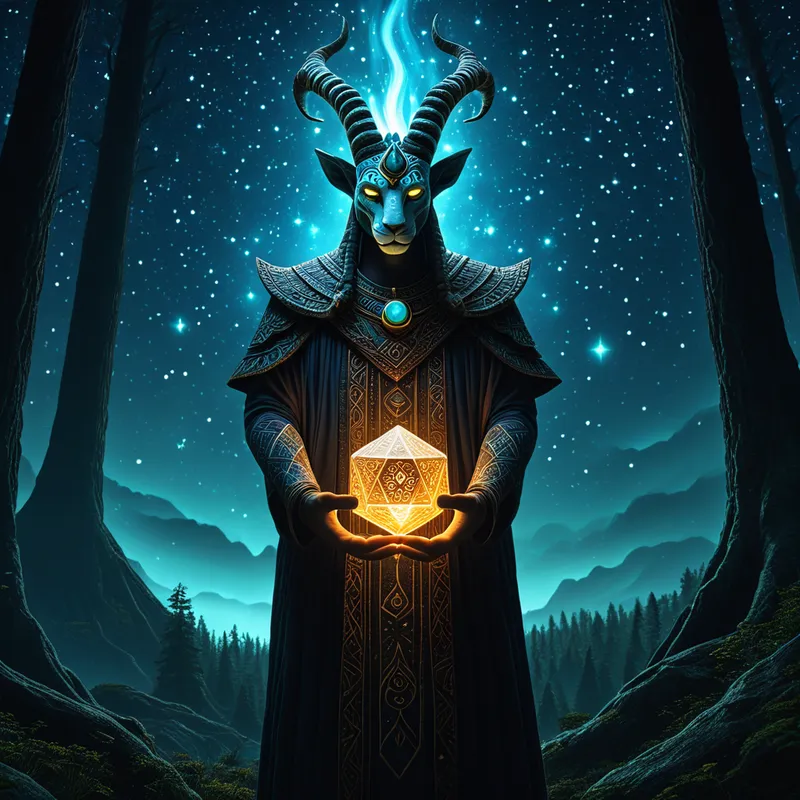
Then, from the place where the path ends and the wild begins, he came. He was not announced by thunder, but by a rustle in the dry grass. He was the Trickster, wearing a cloak of fox-fur and crow-feathers, his eyes holding the glint of a distant, mischievous star. In his hands, he carried no weapon, but a pouch of strange, clattering bones.
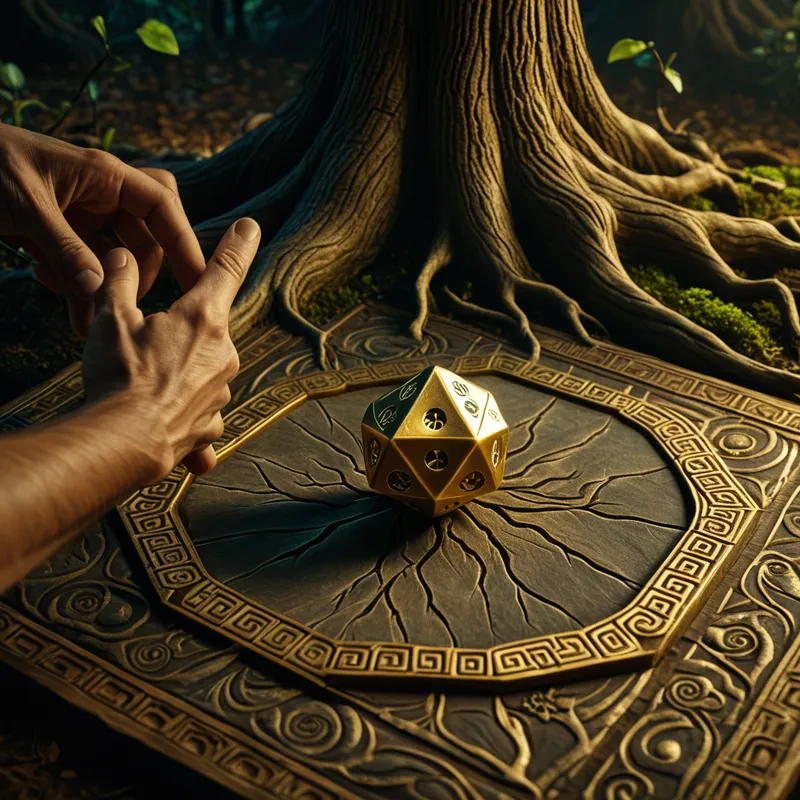
He walked into the village square, where the elders sat ruling on the same three disputes they had ruled on since the dawn of memory. Without a word, he emptied his pouch onto the flat stone at the center. Out tumbled the Dice of Maybe. They were not cubes, but shapes that hurt the eye to follow—ahedron, tetrahedron, forms that spoke of other geometries. They were carved from the tooth of the first beast and the heartwood of the [World Tree](/myths/world-tree “Myth from Global culture.”/).
“The world is bored,” [the Trickster](/myths/the-trickster “Myth from Various culture.”/) said, his voice like stones tumbling in a stream. “It dreams the same dream. Let us play a game. If I win, I reshape one law. If you win, you keep your perfect silence.”
The Chief Elder, whose face was a map of unchanging lines, scoffed. “We do not play games with chaos.”
The Trickster smiled. “Everything is a game. You are playing the game of ‘Forever-Same.’ I am offering a new one. It is called ‘What-If.’”
He picked up the dice, breathed upon them—a breath that smelled of ozone and turned earth—and cast them upon the stone. They did not roll; they danced. They chimed against the rock, a sound like breaking ice, and came to rest. Where the pips should have been, symbols glowed: a winding river, a closed door, a laughing mouth.
From that throw, [the river](/myths/the-river “Myth from Buddhist culture.”/) that fed the village shifted its course overnight, carving a new, playful channel. The people were furious, then curious. They followed it to a pond they had never seen, full of fat, silver fish.
The game had begun. The Trickster played against the spirit of the land itself, against the stubbornness of the elders, against the fear in every human heart. Each throw of the dice was a question. Each outcome was an answer that broke a small, sacred certainty. A tree that always bore sweet fruit now bore one that was tart and thrilling. [The law](/myths/the-law “Myth from Biblical culture.”/) that said “walk only by day” was undone by a throw that showed a moon and an owl, and the people discovered the beauty of the starlit hunt.
The world trembled, not in anger, but in awakening. The final cast was for the greatest stake: the pattern of the human soul itself. The Trickster threw the dice into the air, and they did not fall. They hung there, spinning, reflecting every possibility—courage and cowardice, love and spite, creation and destruction—all at once. And then they dissolved into a shower of sparks that fell into the chest of every man, woman, and child.
The old, silent order was gone. In its place was a world humming with risk, with surprise, with consequence. The Trickster, his game concluded, tipped his patchwork hat and faded back into the edge of the woods, leaving behind only the memory of his laugh and the indelible, unsettling, glorious gift of chance.
Cultural Origins & Context
The myth of the Trickster Game is not the provenance of a single tribe, but a story that emerged like a hardy weed along trade routes and at seasonal gatherings of disparate Folklore peoples. It was a tale for [the crossroads](/myths/the-crossroads “Myth from Celtic culture.”/), told not by the official lore-keepers of a settled village, but by travelers, traders, and edge-dwellers. It flourished in cultures where fate was not seen as a rigid tapestry woven by distant gods, but as a path walked step-by-step, where luck, wit, and adaptability were survival virtues.
It was often recounted during times of transition: before a long journey, at the onset of a new season, or when a community faced an unpredictable change. The storyteller would take on the Trickster’s fluid [persona](/myths/persona “Myth from Greek culture.”/), using gestures and voices to embody the chaotic energy. The function was not to prescribe morality, but to inoculate the [psyche](/myths/psyche “Myth from Greek culture.”/) against rigidity. It taught that the universe is not a locked room but a game with ever-changing rules, and that the skill lies not in knowing the rules, but in learning how to play the moment you are in.
Symbolic Architecture
At its [heart](/symbols/heart “Symbol: The heart symbolizes love, emotion, and the core of one’s existence, representing deep connections with others and self.”/), the myth is a dramatization of [the principle](/symbols/the-principle “Symbol: A fundamental truth, law, or doctrine that serves as a foundation for a system of belief, behavior, or reasoning, often representing moral or ethical standards.”/) of enstasy—the disruptive force necessary to break a [system](/symbols/system “Symbol: A system represents structure, organization, and interrelated components functioning together, often reflecting personal or social order.”/) out of stagnant [equilibrium](/symbols/equilibrium “Symbol: A state of balance, stability, or harmony between opposing forces, often representing inner peace or external order.”/). The Perfect Silence represents the psyche, or the society, in a state of neurotic order, where all spontaneity and [life](/symbols/life “Symbol: The symbol of ‘Life’ represents a journey of growth, interconnectedness, and existential meaning, encompassing both the joys and challenges that define human experience.”/) have been sacrificed to the idol of control. It is [death](/symbols/death “Symbol: Symbolizes transformation, endings, and new beginnings; often associated with fear of the unknown.”/) disguised as [peace](/symbols/peace “Symbol: Peace represents a state of tranquility and harmony, both internally and externally, often reflecting a desire for resolution and serenity in one’s life.”/).
The Trickster does not bring chaos to order; he reveals the chaos that was always sleeping within order, waiting to be born.
The [Dice](/symbols/dice “Symbol: Dice symbolize chance, risk, and the unpredictability of outcomes in life.”/) of Maybe are the ultimate [symbol](/symbols/symbol “Symbol: A symbol can represent an idea, concept, or belief, serving as a powerful tool for communication and understanding.”/) of potentiality. Their unnatural shapes defy the predictable six-sided die of the mundane world. They represent [quantum](/symbols/quantum “Symbol: Represents fundamental uncertainty, interconnectedness, and the collapse of possibilities into reality. It signifies the observer’s role in shaping existence.”/) possibility, the unmanifest potential that exists before observation collapses it into a single [reality](/symbols/reality “Symbol: Reality signifies the state of existence and perception, often reflecting one’s understanding of truth and life experiences.”/). The game board is the world itself, the field upon which potential becomes actual.
The [Trickster](/symbols/trickster “Symbol: A boundary-crossing archetype representing chaos, transformation, and the subversion of norms through cunning and humor.”/) himself is the archetypal agent of the unconscious. He is not evil, but amoral—a force of [nature](/symbols/nature “Symbol: Nature symbolizes growth, connectivity, and the primal forces of existence.”/) like [lightning](/symbols/lightning “Symbol: Lightning symbolizes sudden insights or revelations, often accompanied by powerful emotions or disruptive change.”/) or a genetic [mutation](/symbols/mutation “Symbol: Represents profound personal transformation, adaptation to stress, or fear of losing one’s identity. Often signals internal change processes.”/). His game is the process by which the unconscious contents (the wild, the unpredictable, the repressed) force their way into the conscious [realm](/symbols/realm “Symbol: The symbol of ‘Realm’ often signifies the boundaries of one’s consciousness, experiences, or emotional states, suggesting aspects of reality that are either explored or ignored.”/) (the [village](/symbols/village “Symbol: Symbolizes community, connection, and a reflection of one’s roots or origins.”/), [the law](/symbols/the-law “Symbol: Represents external rules, societal order, moral boundaries, and the tension between personal freedom and collective structure.”/), the known), not to destroy it, but to force it to grow, adapt, and become more complex.
The Dreamer’s Resonance
When this myth stirs in the modern dreamer, it often manifests as dreams of surreal games. You may dream of playing chess with shifting rules, betting in a casino where the currency is your memories, or finding yourself a piece on a giant, living board. The somatic feeling is one of anxious exhilaration—a knot in the stomach paired with a racing heart.
This is the psyche’s signal that a foundational structure in your life—a relationship, a career path, a core belief—has become the “Perfect Silence.” It is stable but lifeless. The dreaming self, in the guise of the internal Trickster, is initiating the Game. The anxiety is [the ego](/myths/the-ego “Myth from Jungian culture.”/)’s terror at the dissolution of its familiar world. The exhilaration is the soul’s recognition of a long-awaited chance for liberation.
The dream is not a prediction, but an invitation. It asks: Where in your life are you refusing to roll the dice? What small, sacred certainty is ready to be broken open? The process is one of loosening the ego’s tyrannical grip on the outcome, of making space for the fertile, frightening maybe.
Alchemical Translation
In the alchemical vessel of individuation, the Trickster Game models the [nigredo](/myths/nigredo “Myth from Alchemical culture.”/) stage—the blackening, the dissolution of the old, rigid personality (the [prima materia](/myths/prima-materia “Myth from Alchemical culture.”/) of the stagnant self). This is not a gentle process. It is the necessary crisis, the “creative illness,” where the structures we built for safety become our prisons.
The conscious ego is the Chief Elder, clinging to its known laws. [The Self](/myths/the-self “Myth from Jungian culture.”/), in its totality, employs the Trickster archetype to shatter this hubris. Each throw of the dice is a confrontation with a complex, a shadow aspect, or an unlived life that demands integration. The shifted river is a redirected flow of psychic energy. The new fruit is a taste of a previously forbidden feeling or talent.
To win the Trickster’s Game is to lose your certainty. The prize is not a trophy, but the entire, unpredictable field of play.
The final cast, where the dice dissolve into the hearts of the people, symbolizes the culmination of this psychic transmutation. The potentialities are no longer “out there,” governed by fate or external gods. They are internalized. The individual realizes they contain the dice. They are both player and played, the thrower and the thrown. The chaos is not an external force to be feared, but the raw, creative material of their own becoming. The goal is not to return to a new, better order, but to develop the agility to play—to live—authentically within the eternal, wondrous, and terrifying Game.
Associated Symbols
Explore related symbols from the CaleaDream lexicon: