The Tree of Hesperides Myth Meaning & Symbolism
A sacred tree of golden immortality apples, guarded by a dragon and nymphs, becomes the object of a hero's final, world-altering labor.
The Tale of The Tree of Hesperides
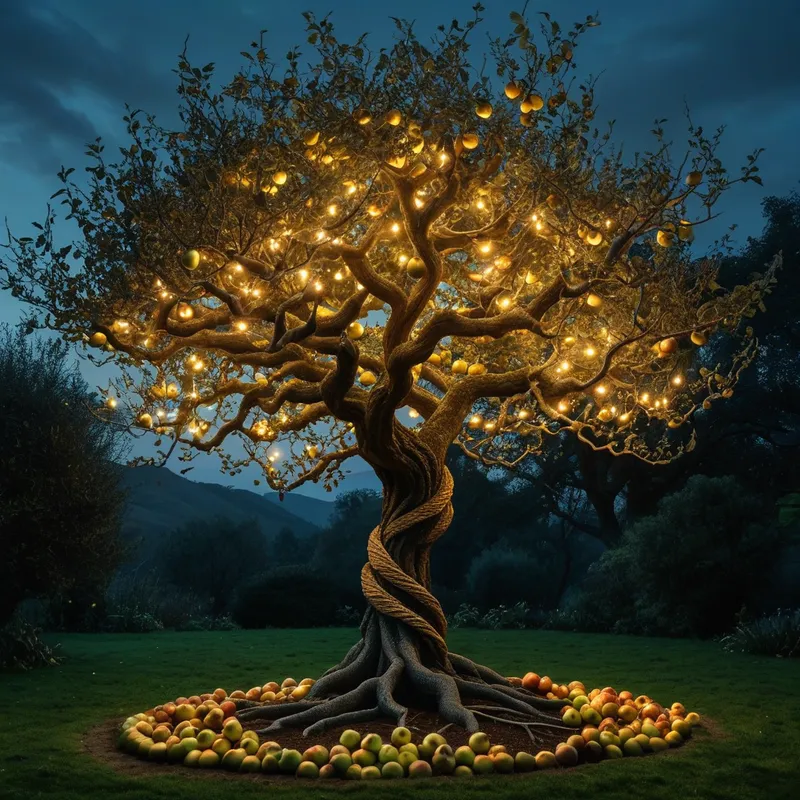
Listen, and let the scent of citrus and evening star fill your mind. Far to the west, where the sun sinks into the ocean’s memory and twilight is a permanent, fragrant kingdom, lies the garden of the gods. Here, at the very edge of [the world](/myths/the-world “Myth from Tarot culture.”/), where Hesperus first kindles his lamp, grows a tree unlike any other. Its roots drink from the deep, secret springs of [the earth](/myths/the-earth “Myth from Hindu culture.”/), and its branches, heavy and dark with leaves like polished jade, reach not for the sun, but for the silver gleam of the stars. And from these branches hang fruit of pure, hammered gold—apples that hold not sweetness, but the very essence of unending life.
This tree was the pride of Hera, a wedding gift from Gaia herself. To tend its immortal grove, she placed her daughters, the [Hesperides](/myths/hesperides “Myth from Greek culture.”/), whose songs were the sound of dusk settling on the waves. But a treasure such as this could not be trusted to song alone. So around the gnarled trunk, Hera coiled the great, unsleeping dragon [Ladon](/myths/ladon “Myth from Greek culture.”/), a creature of scales like ancient armor and a hundred heads, each whispering a different watchful thought. The garden was a perfect, closed circle: beauty, song, and terror, guarding the secret of immortality.
Into this sealed paradise came the laborer, the breaker of cycles: [Heracles](/myths/heracles “Myth from Greek culture.”/). His eleventh labor, imposed by a king who wished him dead, was to fetch these very apples. No map led to the garden, only rumors of the west. He journeyed through lands of giants and trickster gods, a man wrestling with his own divine, tragic blood. When he finally reached the world’s end, he stood before the wall of twilight and heard the soft, chilling harmony of nymphsong intertwined with the dry rustle of serpent scales.
He could not fight Ladon; to slay the guardian of a goddess’s treasure was an offense beyond even his strength. He could not charm the Hesperides, whose loyalties were as deep as the roots they tended. So, the hero used cunning. He sought out the Atlas, who groaned under the weight of the celestial sphere. Heracles offered a bargain: you, who stand at the axis of the world, know where the garden lies. Fetch the apples for me, and I will hold the heavens while you go.
Atlas, feeling the unthinkable relief of freedom, agreed. He returned with the three golden apples glowing in his vast hand. But standing free, he tasted the air of liberty and refused to take [the sky](/myths/the-sky “Myth from Persian culture.”/) back. “I will deliver them myself,” he said. Heracles, trapped by the unbearable weight upon his shoulders, agreed—but with a final trick. “As you wish,” he said, “but let me just adjust my cloak for a better grip.” The simple Titan took back the sky for a moment, and in that moment, Heracles seized the apples and fled, leaving Atlas once more eternally burdened.
The apples were brought to the king, but they could not remain in the mortal world. They were returned to the goddess, completing the labor but not possessing the prize. The garden, for a moment breached, sealed itself once more. The tree still grows in the eternal west, its gold forever guarded, its lesson forever echoing: some treasures are not for the taking, only for the seeking.

Cultural Origins & Context
The myth of the Tree of the Hesperides is a late, complex strand woven into the grand tapestry of Heracles’s labors. It appears most definitively in the accounts of Hesiod and later mythographers like Apollodorus. Its function was multifaceted. On one level, it served as an etiological myth for the far-western “Isles of the Blessed,” a paradisiacal land at the edge of the known world, reflecting Greek geographical curiosity and the allure of the setting sun.
More importantly, it was a narrative device to elevate Heracles from a brute strongman to a figure of intelligence and endurance. The earlier labors often involve direct confrontation, but the final tasks—fetching the apples, capturing Cerberus—are journeys into the supernatural and require guile, negotiation, and a bearing of cosmic burdens. The myth was told and retold in symposia and poetic recitations, serving as a reminder that true heroism lies not just in force, but in the resilience to journey to the world’s end and the wisdom to know what can and cannot be possessed.
Symbolic Architecture
The [Tree](/symbols/tree “Symbol: In dreams, the tree often symbolizes growth, stability, and the interconnectedness of life.”/) is the [Axis](/symbols/axis “Symbol: A central line or principle around which things revolve, representing stability, orientation, and the fundamental structure of reality or consciousness.”/) Mundi of a private, divine [cosmos](/symbols/cosmos “Symbol: The entire universe as an ordered, harmonious system, often representing the totality of existence, spiritual connection, and the unknown.”/). It is the still point of immortality, of perfected, unchanging [life](/symbols/life “Symbol: The symbol of ‘Life’ represents a journey of growth, interconnectedness, and existential meaning, encompassing both the joys and challenges that define human experience.”/). Its golden apples are not mere [fruit](/symbols/fruit “Symbol: Fruit symbolizes abundance, nourishment, and the fruits of one’s labor in dreams.”/) but solidified light, the fruit of divine [favor](/symbols/favor “Symbol: ‘Favor’ represents the themes of acceptance, goodwill, and the desire for approval from others.”/) and eternal vitality.
The guardian is the key to the treasure. The dragon is not an obstacle to the goal; it is the defining feature of the goal’s sacredness.
The Hesperides represent the allure of the [treasure](/symbols/treasure “Symbol: A hidden or valuable object representing spiritual wealth, inner potential, or divine reward.”/), the beautiful, singing face of the unconscious that invites us in. Ladon is its protective, paranoid [defense](/symbols/defense “Symbol: A protective mechanism or barrier against perceived threats, representing boundaries, security, and resistance to external or internal challenges.”/) [mechanism](/symbols/mechanism “Symbol: Represents the body’s internal systems, emotional regulation, or psychological processes working together like a machine.”/)—the [psyche](/myths/psyche “Myth from Greek culture.”/)’s instinct to keep its most profound, transformative contents safe from a conscious ego not yet ready to integrate them. Heracles’s [journey](/symbols/journey “Symbol: A journey in dreams typically signifies adventure, growth, or a significant life transition.”/) is [the ego](/myths/the-ego “Myth from Jungian culture.”/)’s arduous [quest](/symbols/quest “Symbol: A quest symbolizes a journey or search for purpose, fulfillment, or knowledge, often representing life’s challenges and adventures.”/) for this wholeness (the Self), symbolized by the golden apples. His bargain with Atlas is profoundly alchemical: to gain the [treasure](/symbols/treasure “Symbol: A hidden or valuable object representing spiritual wealth, inner potential, or divine reward.”/), he must first take on the [weight](/symbols/weight “Symbol: Weight symbolizes burdens, responsibilities, and emotional loads one carries in life.”/) of the world—the full burden of [consciousness](/symbols/consciousness “Symbol: Consciousness represents the state of awareness and perception, encompassing thoughts, feelings, and experiences.”/) and [responsibility](/symbols/responsibility “Symbol: Responsibility in dreams often signifies the weight of duties and the expectations placed upon the dreamer.”/). The trickery is not villainous, but necessary; it is [the ego](/myths/the-ego “Myth from Jungian culture.”/)’s final, clever maneuver to escape being permanently crushed by a burden meant for a [Titan](/symbols/titan “Symbol: Titans represent immense power, strength, and a connection to the primordial forces of nature and creation.”/) (the archetypal [realm](/symbols/realm “Symbol: The symbol of ‘Realm’ often signifies the boundaries of one’s consciousness, experiences, or emotional states, suggesting aspects of reality that are either explored or ignored.”/)) and return to the [human](/symbols/human “Symbol: The symbol of a human represents individuality, complexity of emotions, and social relationships.”/) world, transformed by the [journey](/symbols/journey “Symbol: A journey in dreams typically signifies adventure, growth, or a significant life transition.”/), if not by permanent possession of the prize.
The Dreamer’s Resonance
When this myth stirs in the modern dreamer, it signals a late-stage encounter with the core of the psyche. Dreaming of a radiant, forbidden tree in a walled garden speaks to a confrontation with one’s own latent potential or innate value that feels tantalizingly close yet protected. The guardian dragon or serpent in the dream is not a monster to be slain, but a somatic signal of deep anxiety and awe—the body’s recognition that one is approaching a psychic truth so potent it could destabilize the current personality.
The [nymphs](/myths/nymphs “Myth from Greek culture.”/) may appear as alluring figures or voices offering ambiguous help, representing the seductive pull of regression into unconscious bliss instead of conscious integration. The labor of reaching this place in the dream—the feeling of being at the world’s edge, utterly weary—mirrors the dreamer’s real psychological exhaustion from a long period of seeking, therapy, or introspection. This dream pattern asks: What golden apple of wholeness, talent, or self-knowledge are you seeking? And what immense, perhaps divine, burden must you consciously agree to carry in order to even approach it?
Alchemical Translation
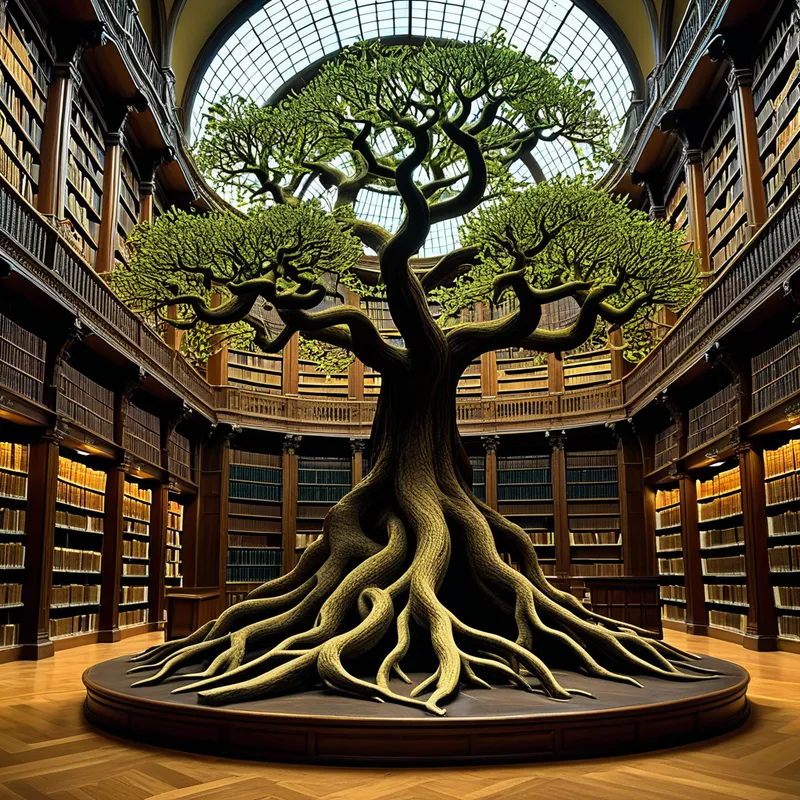
The myth models the final stages of individuation. The hero’s journey to the garden is the conscious mind’s directed effort toward integration. The garden itself is [the Self](/myths/the-self “Myth from Jungian culture.”/), the total, organized psyche. The apples are the [lapis philosophorum](/myths/lapis-philosophorum “Myth from Alchemical culture.”/), the philosopher’s stone—the achieved state of psychic wholeness and timeless value.
The treasure is never truly stolen; it is earned through a willing exchange of burdens. One must hold up the sky of one’s own world-view to gain the gold of the soul.
Heracles does not kill Ladon. This is critical. To violently seize the treasure by destroying the psyche’s natural defenses leads to inflation and psychic ruin. Instead, he end-runs the guardian by engaging a greater archetypal force (Atlas, the Great Bearer). In psychological terms, the ego cannot brute-force its way into the Self. It must first accept a monumental task—the conscious bearing of one’s entire fate, history, and suffering (holding the sky). This act of supreme responsibility temporarily relieves the deeper, autonomous psyche (Atlas) to retrieve the treasure for the ego. The final trick, the reclaiming of the apples and the burden, signifies that the integrated ego must ultimately reassume the burden of conscious life, but now enriched by the touch of the golden, eternal Self. The apples are returned to the goddess, meaning the wholeness of the Self can be experienced but never owned by the ego; it remains a sacred, central fact of the greater psyche, now in a conscious relationship with the individual who dared to journey to the twilight garden at the edge of the world.
Associated Symbols
Explore related symbols from the CaleaDream lexicon: