The Torah Myth Meaning & Symbolism
The myth of the divine word inscribed in fire, offered to a people at a mountain of smoke, becoming the living soul of a civilization.
The Tale of The Torah
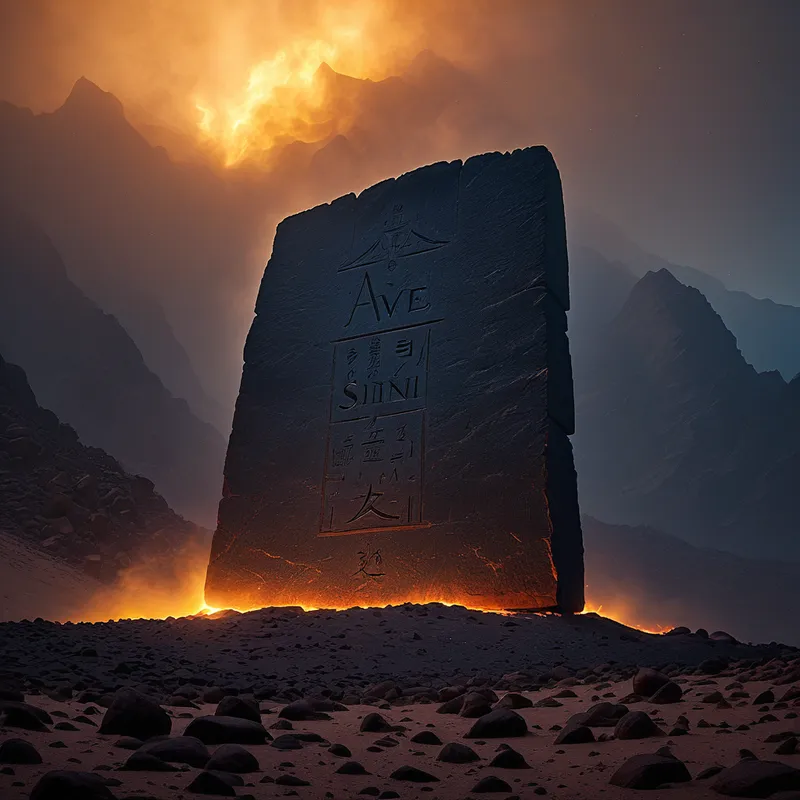
Listen, and let the story settle in your bones. It begins not in a palace, but in the crucible of the desert—a vast, whispering emptiness of sand and sky. A people, newly born from the iron womb of slavery, wander there, their spirits raw, their memory a tangled knot of brick-dust and miracle. They camp at the foot of a mountain, but this is no ordinary rock. Sinai is a mountain that dreams of fire. For three days, a thick, impenetrable cloud descends, swallowing its peak. The air grows heavy, charged with a silence so profound it becomes a sound—a deep, thrumming hum felt in the teeth and the hollow of the chest. Then, the mountain awakens.
Thunder without cloud. Lightning from the heart of the stone. The summit blazes, a crown of consuming fire, and the smoke of it rises like the breath of the world itself. The sound is the voice of the Infinite, shaped into a roar that shakes the foundations of the earth. The people tremble at the boundary, their world redefined by terror and awe. From within that impossible nexus of fire and cloud, a call is issued. Not to the masses, but to one man: Moshe, the stutterer, the reluctant shepherd. He alone ascends into the blinding mystery.
For forty days and nights, he dwells in the heart of the revelation. What transpires there is beyond tale. It is the transfer of a pattern, the inscription of a cosmic architecture onto the human soul. He receives two tablets, hewn not by human hand, but by the divine voice itself. Their surface is sapphire, the letters are light bored into the stone, a language of creation made contract. This is the Brit: not merely rules, but the very grammar for a holy people, a blueprint for a nation meant to be a priesthood, a light. He descends, his face shining with a borrowed radiance, carrying the weight of the world’s meaning in his arms.
But the camp below has forged a golden calf, a circle-dance around a god of certainty and tangible gold. The covenant is shattered before it is even proclaimed, the tablets broken against the idolatrous rock of human impatience. This is the great fracture. Yet, the story does not end in ruin. Moshe pleads in the tent of meeting, and the Voice speaks again, not from the mountain, but from the mercy between words. A second set is carved, this time by Moshe’s hand, guided by the divine dictation. The law is rewritten, now containing the story of its own breaking and restoration. This scroll, this teaching, this Torah, becomes the portable homeland. It is placed in an ark, carried through wilderness and into the promised land, not as a relic, but as a living, beating heart around which a civilization would constellate its every breath, its every argument, its every dream.

Cultural Origins & Context
The myth of the Torah’s revelation is the foundational narrative of Jewish civilization, emerging from the tribal confederacies of ancient Israel. Its transmission was not a single act but a process of weaving oral traditions, liturgical poetry, and legal codes into the majestic literary tapestry of the five books. It was told and retold at pilgrimage festivals, sung by Levites in the Temple, and debated in the courtyards of sages. Its primary societal function was constitutive: it transformed a loose collection of tribes into Am Yisrael, a people defined not by land or king alone, but by a shared story and a binding legal-ethical covenant. The Torah served as the national constitution, the historical archive, the cosmic map, and the divine love letter all at once. Its study became the highest form of worship, a way of re-ascending Sinai with every generation, making the ancient revelation perpetually contemporary.
Symbolic Architecture
The Torah myth is a profound drama of interface—where the Unbounded seeks form, and chaos yearns for order. Sinai represents the terrifying and necessary point of contact between the transcendent and the immanent. The fire and smoke symbolize the divine essence, which is ultimately unknowable and consuming, while the inscribed letters represent that essence translated into a code accessible to human reason and relationship.
The broken tablets are as sacred as the whole. They teach that the vessel of perfection must shatter to make room for the human hand in the work of repair.
The tablets themselves are a supreme symbol. They are not papyrus or parchment, but stone—eternal, durable, heavy. The writing is “the writing of God,” suggesting that the laws of morality and community are not social constructs, but are engraved into the fabric of reality itself. Moshe as the intermediary embodies the human capacity to receive the overwhelming and translate it into a livable path. The golden calf is the shadow archetype: the desperate human urge to worship the manageable symbol, the finished product, rather than endure the terrifying relationship with the unseen Source.
The Dreamer's Resonance
To dream of the Torah or its symbols is to dream of foundational law and personal covenant. Dreaming of the glowing letters may indicate a profound encounter with one’s own inner ethical architecture—a confrontation with core values, a “commandment” from the deep self that feels non-negotiable. Dreaming of the broken tablets often surfaces during a life crisis where one’s personal code, belief system, or sense of order has been shattered. The somatic feeling is one of collapse and weightlessness.
Conversely, dreaming of carefully writing a scroll points to a process of slow, deliberate self-reconstruction, the patient integration of a new understanding into the fabric of one’s identity. The mountain of fire in a dream can represent an awesome, frightening, but necessary psychological initiation—a confrontation with a truth so vast it threatens to consume the old self. The dreamer is undergoing the ordeal of Sinai, where the chaotic elements of the psyche are being called to order under a new, more conscious authority.
Alchemical Translation
The alchemical journey of the Torah myth is the individuation path of becoming a covenant. It begins in the nigredo of slavery—the unconscious, compulsive existence. The exodus is the first separation, the difficult journey into the wilderness of the unknown self. Sinai is the supreme albedo, the blinding illumination where the totality of the Self (the divine) reveals its pattern to the conscious ego (Moshe). This is not a gentle revelation, but a searing encounter with one’s own deepest potential and responsibility.
The revelation is not the receiving of answers, but the granting of the questions that will shape a soul.
The shattering of the tablets is the crucial mortificatio. The perfect, received image of the Self must break against the reality of the ego’s fragility and its shadow (the golden calf). This break is not failure, but the necessary descent that makes integration possible. The second tablets, carved by human hands under divine guidance, represent the rubedo—the achieved integration. The law is no longer an external, overwhelming decree, but an internalized structure co-created by the divine and the human. The individual is no longer merely subject to the law; they become the scribe of their own soul, carrying the living scroll within. The ark that holds the Torah is the integrated personality—a vessel strong enough to contain the holy, mobile enough to journey through life’s wildernesses, making every place a potential site of dwelling for the sacred.
Associated Symbols
Explore related symbols from the CaleaDream lexicon: