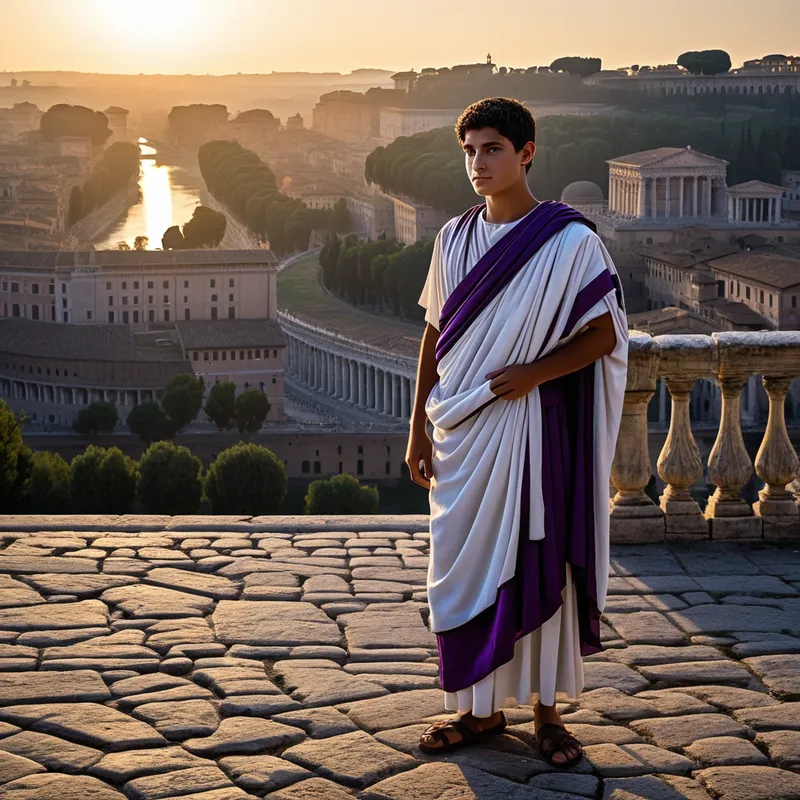
The Toga Praetexta Myth Meaning & Symbolism
The sacred purple-striped garment of Rome, marking the boundary between childhood and civic duty, woven with the threads of divine sanction and mortal obligation.
The Tale of The Toga Praetexta
Hear now the tale not of a god or a hero, but of a garment. A weight of wool, pure and undyed as winter snow, yet marked by a single, profound declaration: a stripe of Tyrian purple, the color of clotted blood and deep twilight, running along its curved edge.
In the cool, grey light of a Roman dawn, within the solemn silence of the atrium, a boy stands. He is no longer a puer, not yet a vir. The air is thick with the scent of burning incense and the faint, metallic whisper of the [Lares](/myths/lares “Myth from Roman culture.”/) watching from their niche. His father approaches, his own toga, the plain toga virilis, a testament to years of duty. In his hands, he carries the folded destiny of his son.
The fabric is heavy, a tangible gravity. As the father lifts it, the wool seems to drink the dim light. He arranges it over the boy’s tunic, the complex draping a ritual in itself—a geometry of identity. The boy feels the coarse texture against his neck, the immense, awkward bulk of it. But his eyes are fixed on that purple border, the praetexta itself. It is not a decoration. It is a boundary, a river of sacred dye separating the white field of his nascent self from [the world](/myths/the-world “Myth from Tarot culture.”/).
They leave the house, the boy walking stiffly beneath his new burden. The city awakens around them. They climb the Capitoline Hill, towards [the temple](/myths/the-temple “Myth from Jewish culture.”/) of Jupiter Optimus Maximus. Here, at the navel of the world, the boy offers a lock of his hair and a coin to the god. The purple stripe upon his shoulder is now seen by Jupiter, by the Senate, by the very stones of Rome. It is a covenant. It says: This one is under protection. This one carries potential. This one stands at [the threshold](/myths/the-threshold “Myth from Folklore culture.”/).
The day passes in a blur of introductions to the Forum, of his name entered into the civic lists. [The toga](/myths/the-toga “Myth from Roman culture.”/) is hot, cumbersome, a constant reminder. When he stumbles on the uneven street, the fabric threatens to unravel, to expose him. The purple border catches the dust of the city. By evening, returning home, the pristine white is smudged, the purple darkened with the grime of public life. The garment is no longer an idea; it is a lived experience. He has crossed over. The threshold is behind him. The long road of the cursus honorum lies ahead, and the praetexta is his first, sacred uniform.

Cultural Origins & Context
The myth of the Toga Praetexta is not a narrative with a plot, but a living, ritual myth enacted in the lives of Rome’s patrician and later, equestrian youth. Its “storytellers” were the fathers, the paterfamilias, and the state itself. The ceremony of assuming the toga virilis, which began with the donning of the toga praetexta in childhood, was a primary rite of passage, typically occurring between the ages of 14 and 17.
This garment was a potent social semaphore. It was worn not only by freeborn boys but also by certain priests, like the Pontifex Maximus, and most significantly, by serving magistrates—consuls, praetors, and curule aediles. This shared symbol created a profound symbolic link: the boy in his praetexta was, in essence, clothed in the same visible authority as a consul commanding legions or a priest interpreting the will of the gods. It signaled that he existed in a sacred, liminal state of fas, under divine and social protection, and was being prepared for the exercise of imperium.
The societal function was one of seamless integration. The myth-in-ritual served to bind the individual’s psychological transition to the civic body’s continuity. It transformed the terrifying leap from private family life to public responsibility into a formal, sanctified procedure. The purple border, derived from the immensely valuable murex shellfish dye, was a symbol of status, but more deeply, of a sacred boundary that both protected the wearer and marked him as belonging to something greater than himself—the res publica.
Symbolic Architecture
The [Toga](/symbols/toga “Symbol: The toga is a garment that symbolizes citizenship, authority, and status in ancient Rome, often associated with political power.”/) Praetexta is a master [symbol](/symbols/symbol “Symbol: A symbol can represent an idea, concept, or belief, serving as a powerful tool for communication and understanding.”/) of liminality. It is the garment of the threshold. The white [wool](/symbols/wool “Symbol: A natural fiber representing warmth, protection, and connection to tradition. Often symbolizes comfort, labor, or spiritual purity.”/) represents the [tabula rasa](/myths/tabula-rasa “Myth from Alchemical culture.”/) of potential, the unformed self. The purple stripe is the defining limit, the container that gives shape to that potential. It is the [river](/symbols/river “Symbol: A river often symbolizes the flow of emotions, the passage of time, and life’s journey, reflecting transitions and movement in one’s life.”/) one must cross from the land of the [family](/symbols/family “Symbol: The symbol of ‘family’ represents foundational relationships and emotional connections that shape an individual’s identity and personal development.”/) (domus) to the world of the [city](/symbols/city “Symbol: A city often symbolizes community, social connection, and the complexities of modern life, reflecting the dreamer’s relationships and societal integration.”/) (civitas).
The praetexta does not conceal the child, nor does it fully reveal the man. It proclaims the sacred space of becoming.
Psychologically, the purple border represents the internalization of [authority](/symbols/authority “Symbol: A symbol representing power structures, rules, and control, often reflecting one’s relationship with societal or personal governance.”/) and law. It is not yet the full, personal authority of the adult in his plain toga, but a borrowed, sanctioned authority. The [child](/symbols/child “Symbol: The child symbolizes innocence, vulnerability, and potential growth, often representing the dreamer’s inner child or unresolved issues from childhood.”/) wears the [mantle](/symbols/mantle “Symbol: A symbolic cloak representing authority, responsibility, or a role passed down through generations, often signifying leadership or spiritual inheritance.”/) of the [father](/symbols/father “Symbol: The father figure in dreams often symbolizes authority, protection, guidance, and the quest for approval or validation.”/) and the state before he has earned his own. This creates a necessary [tension](/symbols/tension “Symbol: A state of mental or emotional strain, often manifesting physically as tightness, pressure, or unease, signaling unresolved conflict or anticipation.”/)—a psychic scaffolding. The symbol protects (as it did literally, invoking sacrosanctity) the vulnerable, developing ego as it learns to navigate the complex codes of society and self-discipline. The garment is heavy because [responsibility](/symbols/responsibility “Symbol: Responsibility in dreams often signifies the weight of duties and the expectations placed upon the dreamer.”/) is heavy. It is awkward because the [integration](/symbols/integration “Symbol: The process of unifying disparate parts of the self or experience into a cohesive whole, often representing psychological wholeness or resolution of internal conflict.”/) of social [persona](/symbols/persona “Symbol: The social mask or outward identity one presents to the world, often concealing the true self.”/) with inner [identity](/symbols/identity “Symbol: Identity represents the sense of self, encompassing personal beliefs, cultural background, and social roles.”/) is always an awkward, conscious process at first.
The act of finally laying it aside for the toga virilis was a second, crucial threshold. The protective, defining border was removed, implying that [the law](/symbols/the-law “Symbol: Represents external rules, societal order, moral boundaries, and the tension between personal freedom and collective structure.”/) and authority had been successfully internalized. The citizen now stood in his own unadorned whiteness, expected to generate his own moral [boundary](/symbols/boundary “Symbol: A conceptual or physical limit defining separation, protection, or identity between entities, spaces, or states of being.”/) from within.

The Dreamer’s Resonance
When this mythic pattern stirs in the modern unconscious, it rarely appears as a literal Roman garment. Instead, one dreams of uniforms that don’t quite fit, of ceremonial robes one is forced to wear, of being on a stage or in a spotlight before feeling ready. It manifests in the somatic feeling of being weighed down, of carrying a visible mark or badge that sets one apart in a way that feels both honorable and isolating.
This dream complex signals a profound psychological process: [the ego](/myths/the-ego “Myth from Jungian culture.”/)‘s encounter with a new level of responsibility or social role. It is the dream of the newly promoted manager, the first-time parent, the artist about to go public with their work. The [psyche](/myths/psyche “Myth from Greek culture.”/) is processing the “assumption of the praetexta”—the putting on of a sanctioned identity that feels larger than the current self. The anxiety in the dream is the fear of tripping over the cumbersome folds, of failing to live up to the symbolic stripe.
The dream may also highlight [the shadow](/myths/the-shadow “Myth from Jungian culture.”/) side: the purple border can become a symbol of unearned privilege, of hiding behind a borrowed authority, or of being perpetually trapped in a preparatory, never-quite-adult state. The dream asks: What authority have I put on that is not yet truly my own? What sacred duty am I being called to grow into?

Alchemical Translation
The alchemical journey modeled by the Toga Praetexta is the transmutation of potential into responsible form. In [the vessel](/myths/the-vessel “Myth from Alchemical culture.”/) of the individual life, the massa confusa of childhood and latent talent is the undyed wool. The [nigredo](/myths/nigredo “Myth from Alchemical culture.”/) is the awkward, heavy, and often confusing stage of first taking on a new role—the feeling of being stained by the demands of the world.
The purple border is the coagula that follows the solve. It is the conscious application of limit, discipline, and tradition (the “dye” of culture and personal choice) to give shape to the dissolving self. One does not simply become an adult; one agrees to be bound by the purple thread of ethical consideration and social contract.
Individuation is not the rejection of the purple border, but the process of learning to weave its thread from the substance of one’s own soul, until the external symbol becomes an inner reality.
The final alchemical stage, the production of the lapis, is symbolized by the exchange of the toga praetexta for the toga virilis. This is not the abandonment of responsibility, but its full integration. The authority that was once an external, colored stripe has now become the very quality and weave of the entire garment. The individual no longer wears responsibility; they embody it. Their authority is self-generated, authentic, and no longer requires a separate, sacred mark to proclaim it. They have moved from being under protection to becoming a protector, from one who is shaped by law to one who, in their sphere, helps to uphold and embody it. The journey of the praetexta is the eternal human journey from innocent potential to earned, and therefore true, power.
Associated Symbols
Explore related symbols from the CaleaDream lexicon: