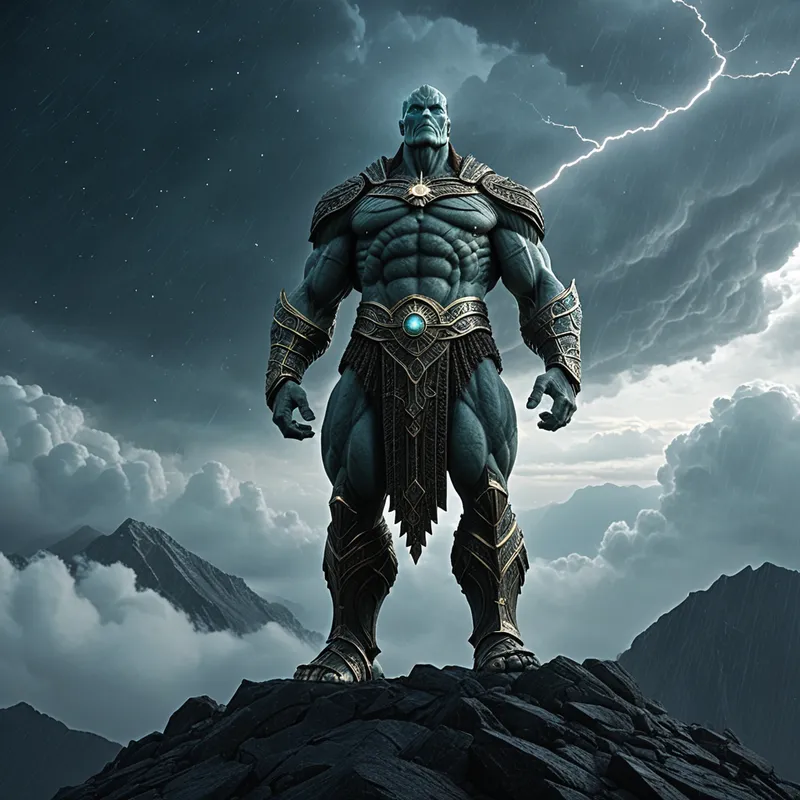
The Titans Myth Meaning & Symbolism
The primordial struggle where the Olympian gods overthrow their Titanic forebears, a myth of cosmic order emerging from primal chaos.
The Tale of The Titans
In the beginning, there was only Chaos, a yawning, formless dark. From its depths, the first beings stirred: Gaia, broad and solid, and Tartarus, deep and dreadful. Then came Eros, the shimmering force of attraction, and Erebos with his sister Nyx. From Gaia, alone and mighty, came Ouranos, the starry vault, to cover her completely.
Their union birthed the first gods, monstrous and vast. The three Hekatoncheires roared with the fury of earthquakes, and the three Cyclopes forged lightning in their single, blazing eyes. But Ouranos, gazing upon his fierce children, felt only terror. He hated their raw power and shoved them back into the dark womb of Gaia, imprisoning them deep within her stony flesh. Gaia groaned in agony, her body strained and wounded.
From her pain grew a cunning and ruthless resolve. From her next union with Ouranos came the twelve Titans, beings of elemental majesty. She forged a great sickle of adamant, grey and sharp, and presented it to her children. "Who among you will avenge me?" she whispered. Only Kronos, the youngest and most ambitious, dared to answer. That night, as Ouranos lay upon Gaia in endless embrace, Kronos emerged from hiding. With a single, brutal sweep, he severed his father from the source of his power and cast the bleeding sky into the void.
Thus began the rule of the Titans, the Golden Age of Kronos. But the blood of Ouranos, falling upon the earth, birthed the Erinyes and the Giants. And Kronos, haunted by a prophecy that he too would be overthrown by his child, devoured each babe his sister-wife Rhea bore to him. His hunger was a prison of fear.
Rhea, heartbroken and furious, tricked him when her sixth child was born. She wrapped a stone in swaddling clothes, which Kronos swallowed, and hid the infant Zeus in a cave on Crete. There, the Kouretes clashed their shields to mask his cries. Zeus grew strong on the milk of the goat Amaltheia and the wisdom of the earth.
When he came of age, Zeus confronted his father. With a potion of Mnemosyne, he forced Kronos to disgorge his swallowed siblings: Hestia, Demeter, Hera, Hades, and Poseidon, now fully grown and burning with rage. The great war, the Titanomachy, began. The cosmos shook. Mountains were hurled as weapons, and the seas boiled.
Zeus, heeding Gaia’s counsel, freed the Hekatoncheires and Cyclopes from their subterranean prison. In gratitude, the Cyclopes forged his thunderbolts, the defining weapons of a new order. With the hundred-handed ones hurling mountains and Zeus casting lightning that split the fabric of the sky, the Titans were finally overwhelmed. The defeated gods of the old age were cast down into Tartarus, bound in chains forged by the Cyclopes, and guarded by the Hekatoncheires. The primal roar of the world was silenced, and a new, structured cosmos, ruled from Mount Olympos, was born from the thunder.
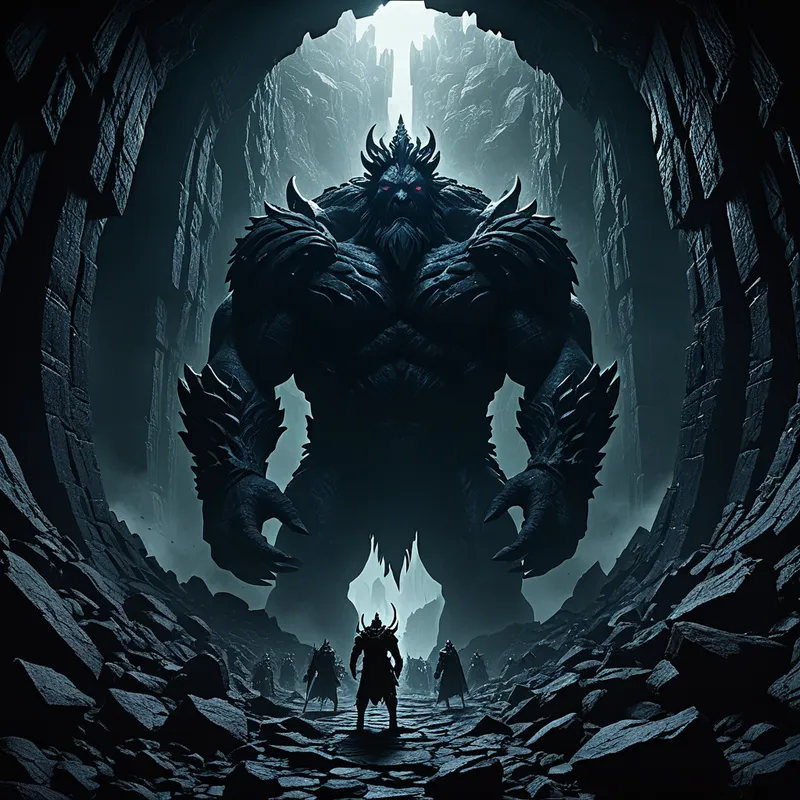
Cultural Origins & Context
This foundational myth was not a single, fixed story but a fluid tapestry woven by generations of oral poets, most famously crystallized in Hesiod’s Theogony around the 8th century BCE. It served as Greece’s divine genealogy, a narrative answer to the profound questions of origin, sovereignty, and cosmic order. Performed at religious festivals and aristocratic symposia, it was both sacred scripture and compelling epic.
Its societal function was multifaceted. It legitimized the Olympian pantheon worshipped in city-states, framing Zeus’s rule not as arbitrary usurpation but as a necessary evolution from brute force to a (theoretically) more just sovereignty. It explained the existence of the world’s raw, terrifying aspects—earthquakes, volcanic fury, and storms—as the imprisoned thrashings of the Titanic powers. The myth established a paradigm where order (cosmos) must be violently won from chaos, a narrative that resonated deeply with the Greek experience of building civilized polis life in a rugged, unpredictable world.
Symbolic Architecture
The Titans are not mere villains; they are the psychological and cosmic substrate from which consciousness itself emerges. They represent the raw, undifferentiated forces of the primordial psyche—the instinctual drives, the overwhelming emotions, the archaic patterns of behavior that exist before the light of ego-consciousness dawns.
The Titan is the psychic inertia that must be overcome for the self to become sovereign.
Ouranos symbolizes a stagnant, oppressive wholeness that denies differentiation. His castration by Kronos is the necessary, violent act that allows for the possibility of time, succession, and new life. Kronos himself, the devouring father, embodies the tyranny of the past—the compulsive, fear-based patterns that consume new potential before it can breathe. His reign is the "Golden Age" of unconscious bliss, but also of psychic stagnation.
The triumph of the Olympians, led by Zeus, symbolizes the arduous birth of the conscious ego. This is not a peaceful transition but a revolution. The ego (Zeus) must ally with its own repressed capacities (the freed Cyclopes give him insight/thunderbolts; the Hekatoncheires represent the ability to grasp and manage overwhelming psychic content) to depose the autocratic rule of the unconscious (the Titans). The binding of the Titans in Tartarus represents not their destruction, but their containment within the depths of the psyche. They remain, eternally powerful, as the foundational layer of being.
The Dreamer's Resonance
When this myth stirs in modern dreams, it signals a profound internal upheaval. To dream of immense, ancient beings trapped beneath landscapes, of earthquakes and cracking foundations, or of a fierce, necessary rebellion against a devouring or suffocating authority figure, is to experience the Titanomachy within.
The somatic experience is one of deep, tectonic pressure—a feeling of being ground between immense forces, of old, rigid structures within the self beginning to fracture. Psychologically, the dreamer is in a process of challenging an internalized "Kronos": a long-held identity, a family mandate, a cultural script, or a defensive pattern that has consumed their potential for growth. The chthonic roar of the Titans in the dream is the voice of primal self, of instincts and passions too long imprisoned, demanding recognition and integration, not as rulers, but as acknowledged parts of the whole.
Alchemical Translation
The alchemical journey mirrored in this myth is the opus contra naturam—the work against nature—where the base material of the primal self is transmuted into the gold of individuated consciousness. It models the painful but essential process of psychic differentiation.
One must first become a regicide in the soul, overthrowing the inner tyrant, to become a sovereign.
The first stage is separatio: recognizing the oppressive, unconscious totality (Ouranos) and making the brutal cut (Kronos's sickle). This begins the cycle of time and conflict within the psyche. The second is nigredo, the ten-year war: the dark night of the soul where old structures and identities (the Titanic reign) are actively dismantled in fierce internal conflict. This is a period of depression, rage, and confusion—the feeling of being at war with oneself.
The crucial turning point is the freeing of the Cyclopes and Hekatoncheires. This is coniunctio—the conscious ego (Zeus) integrating the tools and strengths buried in the unconscious. The thunderbolt is the symbol of sudden, illuminating insight that clarifies the path to sovereignty. Finally, the binding of the Titans in Tartarus is coagulatio: the new, conscious order solidifies. The primal forces are not eliminated; they are assigned their proper place, providing foundational power and depth to the now-ruling consciousness. The modern individual completing this cycle does not become a detached Olympian, but a conscious ruler of a vast, complex inner kingdom, respectful of the ancient Titans chained in its depths, whose rumbles still remind them of the chaos from which their order was forged.
Associated Symbols
Explore related symbols from the CaleaDream lexicon: