The Three Sisters Myth Meaning & Symbolism
A sacred agricultural myth of Corn, Beans, and Squash, whose symbiotic relationship teaches the profound spiritual principles of community, sacrifice, and mutual support.
The Tale of The Three Sisters
Listen. In the time before memory, when the earth was still soft from the breath of the Great Mystery, there lived three spirits. They were not spirits of the far-off stars or the deep waters, but of the very soil itself. They were sisters.
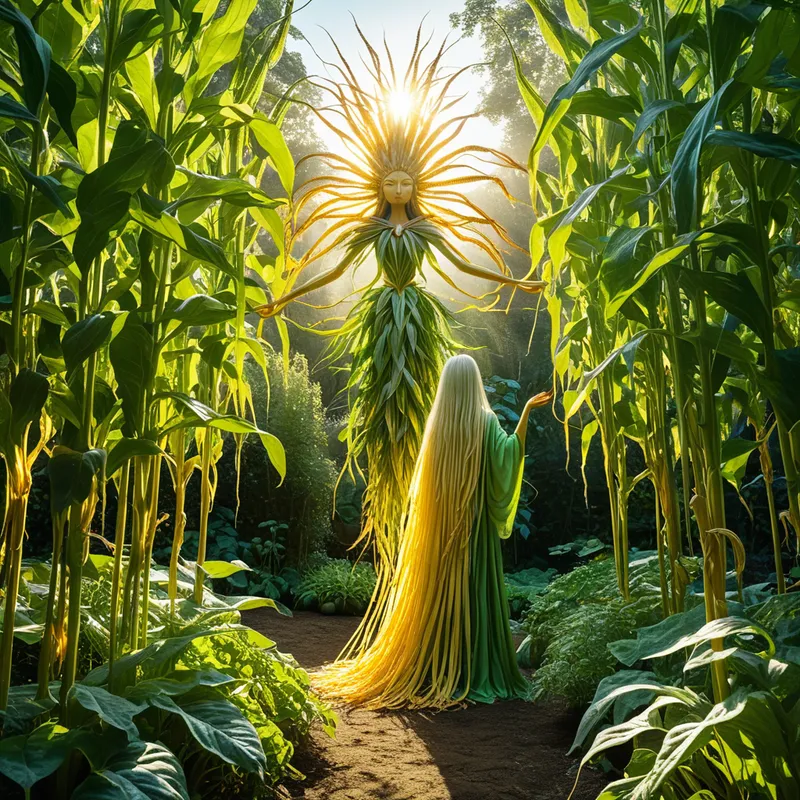
The eldest was a spirit of towering grace, her body straight and true, her hair a crown of sun-kissed silk. She was Corn. She reached for the sky, gathering the light of Grandfather Sun into her being, growing strong and golden. But for all her height, she stood alone, and the winds that raced across the open land would whisper threats, promising to lay her low.
The middle sister was of a different nature. She was slender and full of a restless, reaching energy. She was Bean. Where Corn reached up, Bean reached out, her spirit a questing vine, a seeker of connection. Yet without a guide, her seeking was a wandering, a tangle upon the ground, vulnerable to what crawled in the shadows.
The youngest sister was broad and generous, her spirit a great, leafy cloak. She was Squash. She did not seek the sky nor wander; she embraced the earth. Her broad leaves spread like a blanket, her roots drank deeply. But her cloak, for all its size, could not protect her from the scorching sun that baked the bare ground.
Each sister, in her own plot of earth, struggled. Corn swayed dangerously in the wind. Bean crawled in confusion. Squash thirsted. Their loneliness was a cold root in each of their hearts. They sang their sorrow to the earth, and the earth carried their song to the Great Mystery.
Then came a dream, a vision shared in the depth of a single, dewy night. It was not a voice of command, but a knowing that bloomed within them simultaneously: Alone, you are vulnerable. Together, you become a sanctuary.
With the next planting moon, they made a pact. Corn, the eldest, would stand firm in the center of the mound. “Sister,” she said to Bean, “climb upon me. Use my strength as your ladder to the sun.” And Bean, with her tendrils like gentle fingers, did so, winding her way up Corn’s sturdy stalk, no longer lost.
“And I,” said Squash, the youngest, “will spread my cloak at your feet.” She stretched her broad, spiked leaves over the soil, a living mulch that held the moisture, shaded the roots, and with her prickles, discouraged the hungry ones who came too close.
And so, they planted themselves as one. Corn gave her body as a pole. Bean gave her gift of taking life from the air and weaving it into the earth, feeding Corn and Squash. Squash gave her sheltering embrace, a living blanket that conserved and protected. The wind blew, but Corn stood firm, anchored by her sisters. The sun beat down, but the soil remained cool and damp under Squash’s leaves. Together, they did not just survive; they thrived. They created a world within a world—a circle of mutual giving where every gift offered was a gift received. From their sacred pact, the People learned to live.
Cultural Origins & Context
The myth of The Three Sisters is not a single, frozen story from one nation, but a living, breathing agricultural principle and cosmological narrative shared across many Haudenosaunee (Iroquois), Anishinaabe, and other Eastern Woodlands cultures. It was not merely a “story” told for entertainment, but the foundational text of a civilization. It was passed down orally, from elder to child, in tandem with the physical act of planting. The story was sown with the seeds.
Its tellers were the knowledge-keepers, the grandmothers and grandfathers who understood the language of the soil. Its societal function was profound and practical: it encoded a complete, sustainable agricultural system. The myth taught how to plant (in complementary mounds), when to plant (by lunar and seasonal cycles), and, most importantly, why this method was sacred. It framed agriculture not as dominion over nature, but as participation in a sacred, reciprocal relationship. The garden became a temple; the act of cultivation, a prayer of partnership with these spiritual beings. This myth was the bedrock of a worldview that saw community, symbiosis, and gratitude as the essential laws of life.
Symbolic Architecture
On the surface, this is a story of companion planting. At its soul, it is a blueprint for consciousness. Each sister represents a fundamental aspect of a complete psyche or a healthy community.
Corn is the spine, the principle of structure and aspiration. She is the upright ego, the conscious mind that seeks the light of awareness and purpose. She provides the framework, the “why” we grow.
Bean is the connective tissue, the principle of relationship and nourishment. She is the feeling function, the libido that seeks union, the networks of the unconscious and of community. She takes the intangible (air/emotion/spirit) and makes it tangible (soil/nourishment/support).
Squash is the container, the principle of grounding and protection. She is the body, the instinctual self, the shadow that covers and conserves. She represents the necessary boundaries and the nourishing darkness from which all growth springs.
The myth teaches that no aspect of the self is whole alone. Aspiration without connection becomes brittle pride. Relationship without structure becomes chaotic enmeshment. Grounding without aspiration becomes stagnant decay.
Their union is a perfect system of psychic ecology. The ego (Corn) is strengthened not by isolation, but by offering itself as support for the connecting feelings (Bean). Those feelings, in turn, nourish the very foundation (the soil/psyche) that supports the ego. And the protective, grounding instinct (Squash) creates the safe container where this vulnerable exchange can occur. The “prickles” of Squash are crucial—they are the healthy boundaries that protect the tender, growing self from psychic predation.
The Dreamer’s Resonance
When this triad appears in modern dreams, it rarely manifests as literal corn, beans, and squash. Instead, the dreamer encounters the pattern of the Three Sisters. One may dream of three figures—perhaps two friends and the dreamer—working in perfect, silent harmony on a task. One may dream of a machine with three interlocking gears, each turning the others. One may dream of a heart, a brain, and a pair of hands, connected by glowing threads.
The somatic experience is often one of profound relief, a deep sigh from the soul. It signifies the unconscious orchestrating a resolution to a state of fragmented striving. Perhaps the dreamer has been over-identifying with Corn—pushing for achievement while feeling isolated and brittle. The dream introduces the Bean and Squash elements, offering a vision of supported strength. The process at work is integration. The psyche is dreaming its way out of isolation and into a state of inner community. It is a dream of the self learning to mother itself, to become its own nurturing, symbiotic garden.
Alchemical Translation
The individuation process, the journey toward psychic wholeness, is not a solitary hero’s quest to slay a dragon. The Three Sisters model a different, perhaps more profound, alchemy: the transmutation through symbiotic alliance.
The initial state is the separated sisters: our dissociated psychological functions. The ambitious drive is cut off from feeling. The capacity for relationship has no structure. The protective instincts run wild or lie dormant. This is the prima materia of our inner conflict—fertile, but chaotic and unproductive.
The catalyst for change is the shared “dream,” the call from the Self (the Great Mystery within). It is the intuitive, non-verbal knowing that the current mode of being is unsustainable. This sparks the conscious decision to re-order one’s inner world.
The alchemical operation is not a violent conquest, but a deliberate, sacred arrangement. One must plant the Corn of one’s purpose, then willingly invite the Bean of one’s vulnerability to climb upon it, and finally, spread the Squash of one’s self-care and boundaries at the base.
The “fixed” result is the hermetic garden: a self-sustaining psychic system. The ego is no longer a lonely tyrant or a fragile reed, but a sturdy pole supported by the nourishing vines of its own deep feelings and protected by the broad leaves of self-compassion. The “gold” produced is not a singular trophy, but a continuous, thriving harvest of resilience, creativity, and authentic connection. One becomes both the gardener and the garden, participating in the sacred reciprocity of one’s own being. This is the ultimate teaching of the Sisters: that we are healed not by becoming singular heroes, but by becoming sacred, symbiotic communities within ourselves.
Associated Symbols
Explore related symbols from the CaleaDream lexicon: