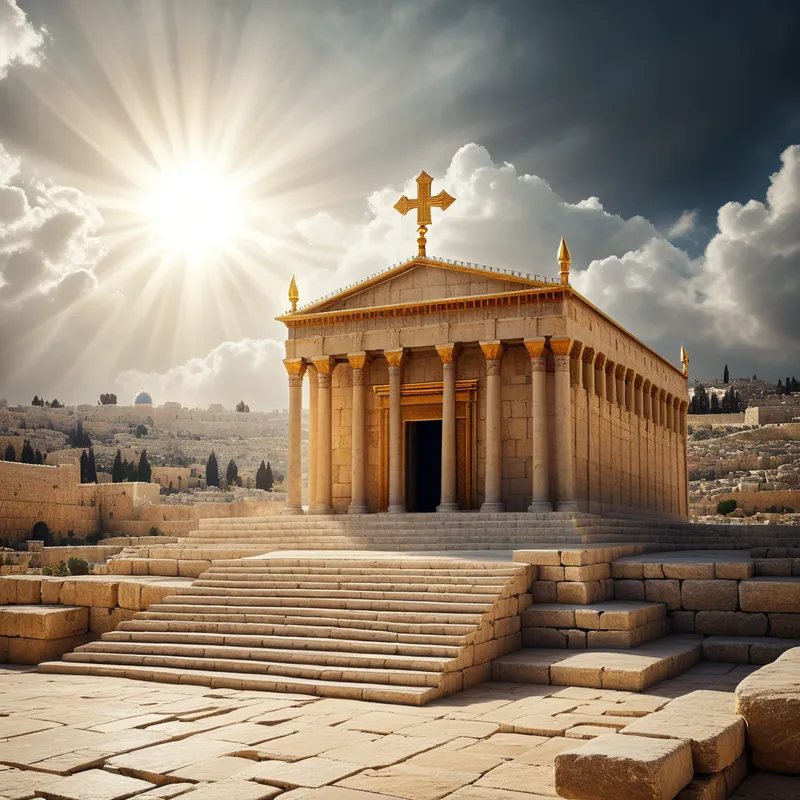
The Temple of Jerusalem Myth Meaning & Symbolism
The myth of a sacred dwelling for the Divine, built, lost, and rebuilt, mirroring the soul's quest for wholeness and connection.
The Tale of The Temple of Jerusalem
Hear now the tale of the Dwelling Place, a story not of stone and cedar, but of a longing that shaped the heavens and [the earth](/myths/the-earth “Myth from Hindu culture.”/). In the days when the people were a tempest-tossed tribe, led by a pillar of fire through [the desert](/myths/the-desert “Myth from Biblical culture.”/) wastes, their God was a God of the road. He dwelt in a tent, a [Tabernacle](/myths/tabernacle “Myth from Biblical culture.”/), its curtains fluttering with [the wind](/myths/the-wind “Myth from Various culture.”/) of their wanderings. But in the heart of David, a king whose hands were stained with the blood of wars, a new dream took root—a dream of permanence, of a house not for a king, but for the King of Kings.
Yet the voice from the whirlwind spoke: “You shall not build a house for my name, for you are a man of war and have shed blood.” The dream was passed, like a sacred charge, to a son of peace. [Solomon](/myths/solomon “Myth from Biblical culture.”/) arose, his wisdom a quiet river where his father’s was a crashing wave. He sent his envoys to the ends of the known world: to the forests of Lebanon for cedars that touched [the sky](/myths/the-sky “Myth from Persian culture.”/), to the quarries for stones cut in silence so that no hammer’s blow would be heard on the holy mount. For seven years, the mountain echoed with the sound of creation. Gold was beaten into cherubim whose wings spanned the inner chamber; bronze was cast into a sea, resting on the backs of twelve oxen, facing the four winds.
The day of dedication arrived. The air itself grew heavy, thick with the smoke of ten thousand sacrifices and the scent of [holy oil](/myths/holy-oil “Myth from Christian culture.”/). The priests, trembling, brought the ancient Ark of the Covenant from its tent and placed it in the windowless heart of the house, the Holy of Holies. As Solomon raised his hands in prayer, a cloud, dense and luminous, filled the house. The glory of the LORD had come home. The priests could not stand to minister, for the Presence was a physical weight, a beautiful terror. Solomon whispered to the cloud, “But will God indeed dwell on the earth? Behold, heaven and the highest heaven cannot contain you; how much less this house that I have built!”
For generations, it stood—the axis of [the world](/myths/the-world “Myth from Tarot culture.”/), the place where heaven kissed earth. But the human heart is a fickle altar. Prophets cried out against empty ritual, against [justice](/myths/justice “Myth from Tarot culture.”/) abandoned at its gates. The glory withdrew, as silently as it had come. Then came the thunder of empires: the crash of Babylonian siege engines, the heat of consuming fire. The gold was stripped, the cedar beams became ash, and the holy stones were cast down, one upon another, until only a weeping wall remained. The people were led away, and in a foreign land, they hung their harps on the willows and swore an oath: “If I forget you, O [Jerusalem](/myths/jerusalem “Myth from Biblical culture.”/), let my right hand forget its skill.”
Yet, the dream is a seed that survives the fire. From the ashes of exile, a second temple rose, smaller, humbler, a ghost of its former glory—yet still a focal point for hope. It was refined, desecrated, and reclaimed. And in the soul of the people, a third temple took shape, not made with hands, eternal in the heavens. The story of the Dwelling Place is never finished; it is always being built, destroyed, and dreamed anew.
Cultural Origins & Context
This is not a single myth but a living, breathing narrative spine running through the entire Hebrew Bible and beyond. Its origins are woven into the historical fabric of the Israelite monarchy (10th-6th centuries BCE), serving as a foundational national myth. It was told and retold by priests in the Torah, chronicled by scribes in the books of Kings and Chronicles, lamented by poets like the author of Lamentations, and prophesied by visionaries like Ezekiel.
Its societal function was multifaceted. Politically, it legitimized the Davidic dynasty and centralized worship in Jerusalem. Theologically, it negotiated the tension between a transcendent, omnipresent God and the human need for a localized, tangible point of connection. It answered the question: How can the Infinite be approached? Ritually, it provided the blueprint for the entire system of sacrifice, purity, and pilgrimage (Shalosh Regalim). Most profoundly, it became the ultimate symbol of national identity and divine favor. Its destruction was not just a military defeat but a theological crisis, forcing a profound evolution in thought—from a God tied to a land and a temple to a God of the spirit, accessible even in exile.
Symbolic Architecture
The [Temple](/symbols/temple “Symbol: A temple often symbolizes spirituality, sanctuary, and a deep connection to the sacred aspects of life.”/) is the ultimate [symbol](/symbols/symbol “Symbol: A symbol can represent an idea, concept, or belief, serving as a powerful tool for communication and understanding.”/) of the Self—the psychic center where the divine and the [human](/symbols/human “Symbol: The symbol of a human represents individuality, complexity of emotions, and social relationships.”/) meet. It is a map of [consciousness](/symbols/consciousness “Symbol: Consciousness represents the state of awareness and perception, encompassing thoughts, feelings, and experiences.”/) itself.
The Temple is not where God is kept, but where the human soul remembers it is found.
Its tripartite [structure](/symbols/structure “Symbol: Structure in dreams often symbolizes stability, organization, and the framework of one’s life, reflecting how one perceives their environment and personal life.”/)—Outer Court, Holy Place, Holy of Holies—mirrors the [journey](/symbols/journey “Symbol: A journey in dreams typically signifies adventure, growth, or a significant life transition.”/) of consciousness from the external and communal (the [body](/symbols/body “Symbol: The body in dreams often symbolizes the dreamer’s self-identity, personal health, and the relationship they have with their physical existence.”/) and society), through the [interior](/symbols/interior “Symbol: The interior symbolizes one’s inner self, thoughts, and emotions, often reflecting personal growth, vulnerabilities, and secrets.”/) world of [emotion](/symbols/emotion “Symbol: Emotion symbolizes our inner feelings and responses to experiences, often guiding our actions and choices.”/) and intellect (the [soul](/symbols/soul “Symbol: The soul represents the essence of a person, encompassing their spirit, identity, and connection to the universe.”/)), to the innermost, ineffable core of being (the [spirit](/symbols/spirit “Symbol: Spirit symbolizes the essence of life, vitality, and the spiritual journey of the individual.”/)). The Bronze Sea represents the primordial waters of the unconscious, which must be circumambulated and contained before one can approach the sacred. The increasing levels of restriction (from Gentiles to Israelites to Priests to the High [Priest](/symbols/priest “Symbol: A priest symbolizes spirituality, guidance, and the quest for understanding the deeper meanings of life.”/) once a [year](/symbols/year “Symbol: A unit of time measuring cycles, growth, and passage. Represents life stages, progress, and mortality.”/)) symbolize the increasing refinement and sacrifice required for deeper levels of self-[knowledge](/symbols/knowledge “Symbol: Knowledge symbolizes learning, understanding, and wisdom, embodying the acquisition of information and enlightenment.”/).
The destruction of [the Temple](/myths/the-temple “Myth from Jewish culture.”/) is the necessary shattering of the container. [The ego](/myths/the-ego “Myth from Jungian culture.”/)’s perfect structure, its understanding of God and self, must be broken so that the spirit is not confined to a single, fragile form. The [exile](/symbols/exile “Symbol: Forced separation from one’s homeland or community, representing loss of belonging, punishment, or profound isolation.”/) that follows is the soul’s journey through the [shadow](/symbols/shadow “Symbol: The ‘shadow’ embodies the unconscious, repressed aspects of the self and often represents fears or hidden emotions.”/), where [faith](/symbols/faith “Symbol: A profound trust or belief in something beyond empirical proof, often tied to spiritual conviction or deep-seated confidence in people, ideas, or outcomes.”/) is stripped of its external supports and must be rebuilt from within.
The Dreamer’s Resonance
To dream of the Temple is to dream of one’s own inner sanctum. Dreaming of building a temple speaks to a phase of conscious integration—assembling the quarried lessons of life, the cedars of inner strength, into a coherent structure for the [psyche](/myths/psyche “Myth from Greek culture.”/). There is a somatic sense of purpose, of lifting heavy stones into place.
Dreaming of a desecrated or destroyed temple often accompanies a life crisis, a betrayal, a failure, or a profound disillusionment. The dream-ego wanders through ruins, touching broken pillars. This is the psyche’s depiction of a shattered worldview, a lost faith, or a deep injury to one’s sense of sacred self-worth. The somatic resonance is one of hollow emptiness, a cold wind where there was once warmth and presence.
Dreaming of searching for the Temple, or finding only a fragment like the Western Wall, indicates a longing for reconnection with one’s core, a spiritual homesickness. The dreamer is in the process of remembering, of gathering the scattered pieces of their identity after a period of fragmentation or exile.
Alchemical Translation
The myth models the alchemical process of [nigredo](/myths/nigredo “Myth from Alchemical culture.”/), albedo, and [rubedo](/myths/rubedo “Myth from Alchemical culture.”/) on a grand, psychic scale.
The Solomonic Creation is the albedo—the conscious, willed construction of order. The ego, with all its wisdom and resources, labors to create a perfect vessel for the transcendent. This is necessary work, the building of a strong and beautiful conscious personality.
The true Holy of Holies is entered not by building a door, but by dissolving the wall.
But this vessel is always too small. The Destruction and Exile is the essential nigredo—the blackening, the descent, the mortificatio. The God-image outgrows its temple. The conscious structure must be violently dismantled so that the spirit is liberated from the ego’s limited conception of it. This is [the dark night of the soul](/myths/the-dark-night-of-the-soul “Myth from Christian Mysticism culture.”/), where all former certainties are burned away.
The return and the dreaming of a future temple represent the rubedo—the golden dawn. [The Self](/myths/the-self “Myth from Jungian culture.”/) is not rebuilt as it was. The new understanding is more interior, more resilient, less dependent on external form. The individual who undergoes this alchemy no longer merely visits the Temple; they carry its blueprint within. They become, themselves, a living temple—a creature in whom the divine and the human, order and chaos, destruction and creation, are held in a dynamic, sacred tension. The work is never complete, for the process of building, surrendering, and remembering is the very pulse of individuation.
Associated Symbols
Explore related symbols from the CaleaDream lexicon: