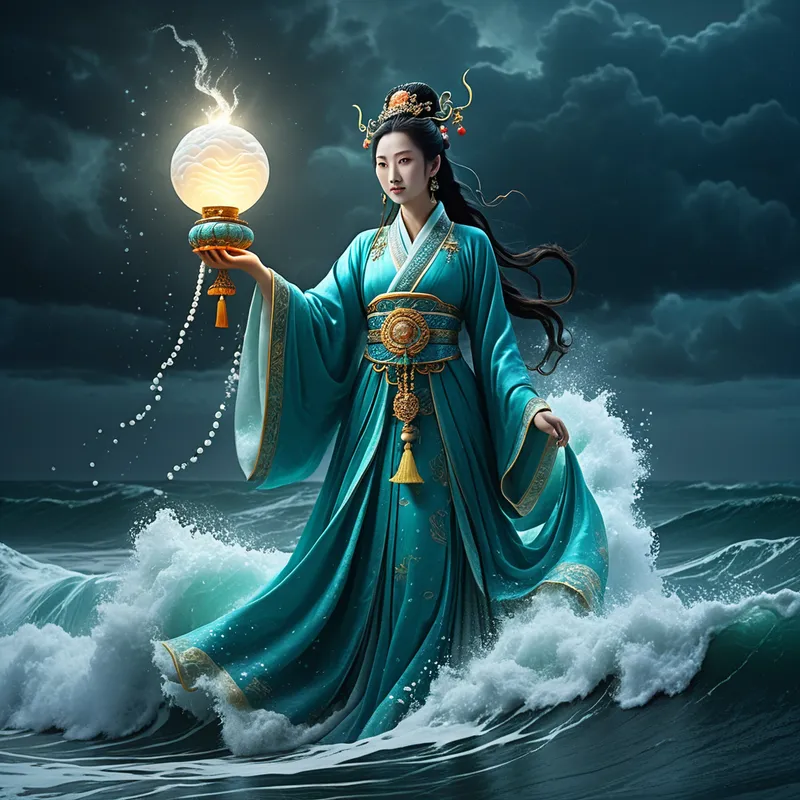
The Tears of Mazu Myth Meaning & Symbolism
A goddess weeps for the suffering of sailors, her tears transforming into pearls of protection that calm the seas and guide the lost.
The Tale of The Tears of Mazu
Listen, and hear the tale of the salt and the sorrow, of the deep that hungers and the light that answers.
In the time when the Donghai was a capricious dragon, its moods shifting from glassy calm to roaring fury in the span of a single breath, the people of the coast lived by a fragile thread. Their lives were written in net and sail, their fates entrusted to the mercy of winds they could not name. Fathers, sons, and brothers would vanish into the grey maw of [the horizon](/myths/the-horizon “Myth from Various culture.”/), leaving behind only the silent vigil of women on the shore, their eyes scouring the empty line where sea met sky.
And from this line of longing, a presence was born. Not from the thunder, but from the silence that follows it. She was Mazu, once a mortal girl named Lin Mo, whose spirit had refined itself through compassion into something luminous and watchful. She did not rule the waves from a distant throne; she walked upon them. Her feet, clad in light, did not sink but glided over the crests of the swells, her robes the color of twilight meeting the deep ocean blue.
One evening, as the sun drowned in a bed of bruised clouds, she felt a shiver pass through the waters—a vibration of pure terror. Far out, beyond the sight of land, a fishing boat, a tiny shell of wood, was being toyed with by the rising storm. [The wind](/myths/the-wind “Myth from Various culture.”/) screamed through its rigging; black [water](/myths/water “Myth from Chinese culture.”/) crashed over its bow. The men aboard, their prayers torn from their lips by the gale, fought a losing battle with the ropes and the relentless sea.
Mazu stood upon a high, unseen wave and watched. She saw not just the boat, but the intricate web of lives tethered to it: the wife mending a net by a solitary lamp, [the child](/myths/the-child “Myth from Alchemy culture.”/) awaiting a father’s return, the old mother whose eyes had grown dim from scanning the horizon. She felt their collective dread, a sharp, cold needle in the heart of [the world](/myths/the-world “Myth from Tarot culture.”/). A profound helplessness washed over her, a deity’s anguish. For all her power to navigate and foresee, she could not simply still the ancient dragon of the storm; its rage was a natural force, a chaotic breath of the world itself.
And so, she wept.
Her tears were not of water, but of condensed starlight and compassion. They fell from her cheeks like liquid diamonds, heavy with the weight of mortal suffering she chose to fully embody. Each tear did not dissolve into the salty spray. Instead, as they touched the chaotic surface of [the sea](/myths/the-sea “Myth from Greek culture.”/), they hardened, transformed, becoming luminous pearls of pure, calming energy.
These pearls—Mazu’s Tears—sank into the tumult. Where they fell, the roaring softened to a murmur. The frantic waves gentled into rolling swells. The wind, as if ashamed, unraveled its knotted fury into a steady, guiding breeze. The pearls’ light penetrated the dark water, creating paths of shimmering clarity that led unerringly back to the safety of the harbor. The sailors, grasping their battered boat, followed these glowing trails home, guided by a sorrow that had become their salvation.
From that night on, the legend was born. When the storms gather and [the way](/myths/the-way “Myth from Taoist culture.”/) is lost, it is said the goddess weeps for her children, and her tears become the beacons that guide them through the dark.

Cultural Origins & Context
The myth of Mazu’s tears is woven into the vast tapestry of the Mazu belief system, which originated in the 10th-11th centuries during the Song Dynasty. Rooted in the historical figure of Lin Moniang, a kind-hearted shamaness from Meizhou Island in Fujian province, the cult evolved from local folk veneration into a state-recognized religion. The myth was not codified in a single sacred text but was passed down orally through generations of fishermen, sailors, and their families. It was told on docksides, in temple courtyards, and in family homes, serving as a vital narrative of hope and explanation.
Its primary societal function was twofold. First, it provided a theological framework for inexplicable survivals at sea—the sudden calming of a storm, the unexpected glimpse of light in the fog. These were not random acts of nature but the direct, compassionate intervention of a maternal deity. Second, and perhaps more profoundly, it validated and sacralized the emotional world of the coastal communities. The grief, anxiety, and helplessness felt by those on shore were not merely human weaknesses; they were shared and amplified by the goddess herself, transformed into the very mechanism of salvation. The myth taught that profound feeling, even sorrow, was not an obstacle to divinity but its very substance.
Symbolic Architecture
At its core, the myth presents a powerful [alchemy](/symbols/alchemy “Symbol: A transformative process of purification and creation, often symbolizing personal or spiritual evolution through difficult stages.”/) of affect. The tears are the central [symbol](/symbols/symbol “Symbol: A symbol can represent an idea, concept, or belief, serving as a powerful tool for communication and understanding.”/)—not as a sign of defeat, but as the raw [material](/symbols/material “Symbol: Material signifies the tangible aspects of life, often representing physical resources, desires, and the physical world’s influence on our existence.”/) of transcendence.
The deepest compassion is not merely feeling for another, but allowing the world’s suffering to pass through you, to be metabolized in the vessel of the soul, and returned as a gift of clarity.
Mazu’s tears represent the ultimate empathetic act: the conscious, full-bodied intake of another’s [agony](/symbols/agony “Symbol: Intense physical or emotional suffering, often representing unresolved pain, internal conflict, or profound transformation.”/). She does not deflect the pain of the sailors; she drinks it in. The [pearl](/symbols/pearl “Symbol: The pearl symbolizes purity, wisdom, and the beauty derived from overcoming adversity.”/), formed from [grit](/symbols/grit “Symbol: Grit symbolizes perseverance, resilience, and sustained passion for long-term goals despite obstacles and adversity.”/) and [irritation](/symbols/irritation “Symbol: A state of annoyance or agitation, often signaling unmet needs, unresolved conflicts, or internal disharmony in dreams.”/) in the mundane world, is here formed from spiritual [grit](/symbols/grit “Symbol: Grit symbolizes perseverance, resilience, and sustained passion for long-term goals despite obstacles and adversity.”/)—the acute [friction](/symbols/friction “Symbol: Friction represents resistance, conflict, or the necessary tension required for movement and transformation in dreams.”/) between unbearable suffering and boundless love. The transformation from tear to [pearl](/symbols/pearl “Symbol: The pearl symbolizes purity, wisdom, and the beauty derived from overcoming adversity.”/) symbolizes the process whereby raw, overwhelming [emotion](/symbols/emotion “Symbol: Emotion symbolizes our inner feelings and responses to experiences, often guiding our actions and choices.”/) ([grief](/symbols/grief “Symbol: A profound emotional response to loss, often manifesting as deep sorrow, yearning, and a sense of emptiness.”/), fear, [helplessness](/symbols/helplessness “Symbol: A state of powerlessness and inability to act, often linked to vulnerability, loss of control, and emotional paralysis.”/)) is contained, pressurized by conscious [awareness](/symbols/awareness “Symbol: Conscious perception of self, surroundings, or internal states. Often signifies awakening, insight, or heightened sensitivity.”/), and crystallized into a tool of [guidance](/symbols/guidance “Symbol: The act of receiving or seeking direction, advice, or leadership in a dream, often representing a need for clarity, support, or a higher purpose on one’s life path.”/) and protection.
Psychologically, Mazu embodies the [Caregiver](/symbols/caregiver “Symbol: A spiritual or mythical figure representing nurturing, protection, and unconditional support, often embodying divine or archetypal parental energy.”/) [archetype](/symbols/archetype “Symbol: A universal, primordial pattern or prototype in the collective unconscious that shapes human experience, behavior, and creative expression.”/) in its most evolved, non-personal form. She is not a [mother](/symbols/mother “Symbol: The symbol of ‘Mother’ represents nurturing, protection, and the foundational aspect of one’s emotional being, often associated with comfort and unconditional love.”/) protecting only her own, but the [anima](/symbols/anima “Symbol: The feminine archetype within the male unconscious, representing soul, creativity, and connection to the inner world.”/) mundi—the world [soul](/symbols/soul “Symbol: The soul represents the essence of a person, encompassing their spirit, identity, and connection to the universe.”/)—responding to distress anywhere within its [body](/symbols/body “Symbol: The body in dreams often symbolizes the dreamer’s self-identity, personal health, and the relationship they have with their physical existence.”/). Her struggle is the divine dilemma: how to help without overriding the natural law and free will of the world. Her [solution](/symbols/solution “Symbol: A solution symbolizes resolution, clarity, and the overcoming of obstacles, often representing a sense of accomplishment.”/) is not to control the storm, but to change the [relationship](/symbols/relationship “Symbol: A representation of connections we have with others in our lives, often reflecting our emotional state.”/) between the sufferer and the storm, offering a lighted [path](/symbols/path “Symbol: The ‘path’ symbolizes a journey, choices, and the direction one’s life is taking, often representing individual growth and exploration.”/) through it.

The Dreamer’s Resonance
When this myth pattern stirs in the modern dreamer, it often signals a profound somatic and psychological process: the conscious descent into contained despair. One may dream of being in a chaotic, overwhelming situation—a flood, a stormy sea, a crumbling structure—feeling utterly helpless. Then, a profound sadness arises, not as a further burden, but as a strange, warm clarity. The dreamer might begin to weep, and their tears become objects of power: glowing stones, keys, lenses, or pearls that illuminate the way forward or calm the surrounding chaos.
This dream experience points to the [psyche](/myths/psyche “Myth from Greek culture.”/)’s innate intelligence in processing collective or personal trauma. The storm represents an unconscious complex, a life crisis, or a tidal wave of emotion that feels life-threatening. The dream-ego’s initial helplessness mirrors our modern condition when faced with vast, systemic, or internal turmoil. The act of weeping in the dream is critical—it is the somatic surrender to the feeling, rather than continued resistance or frantic action. The transformation of tears signifies the moment the psyche begins to alchemize pure affect into symbolic insight. The dream is modeling that our deepest grief, when fully felt and contained, can crystallize into our most reliable inner guide.

Alchemical Translation
The individuation journey modeled by Mazu’s tears is not one of heroic conquest, but of sacred receptivity and transmutation. The modern individual is perpetually beset by storms: the chaos of the outer world, the tempests of anxiety, the gales of loss and change. The instinct is often to build higher walls, find a stronger engine, or curse the wind—to fight the storm on its own terms.
Mazu’s myth proposes a different path. The first alchemical stage is [Nigredo](/myths/nigredo “Myth from Alchemical culture.”/): the blackening, the storm, the overwhelming flood of helplessness and sorrow. One must stand, as Mazu did, and fully acknowledge the reality of the suffering, both personal and perceived in others, without immediate recourse to a solution.
The second stage is Albedo: the weeping. This is the conscious, willing dissolution of [the ego](/myths/the-ego “Myth from Jungian culture.”/)’s defenses. It is allowing the pain to penetrate one’s core, to become the tear—the liquid, formless essence of compassion. This is not wallowing; it is the sacred act of holding the tension.
The pearl of the soul is formed in the gritty wound of the world, layered in the silent, pressurized depth where feeling is given time to become form.
The final stage is the revelation of the [Pearl](/myths/pearl “Myth from Chinese culture.”/) itself: [Rubedo](/myths/rubedo “Myth from Alchemical culture.”/). The transformed affect. The grief that becomes profound empathy. The anxiety that crystallizes into heightened intuition. The personal despair that, once fully metabolized, grants one the ability to guide others through their own darkness. The individual no longer seeks to escape their storms or the storms of the world. Instead, they learn to generate from within the calm, guiding light that makes navigation possible. They do not become the master of the sea, but the unwavering beacon upon it, having transmuted their deepest tears into a legacy of guidance.
Associated Symbols
Explore related symbols from the CaleaDream lexicon: