The Tavern of Love Myth Meaning & Symbolism
A weary traveler seeks refuge in a ruinous tavern, only to be served a wine that dissolves his worldly self, revealing the Beloved within.
The Tale of The Tavern of Love
The desert wind was a thief of memory, scouring the face of the world until all landmarks were sand and all paths were lost. Upon this ocean of forgetting walked a man—a scholar, a merchant, a king in his own mind—now reduced to a silhouette of thirst. His name, his titles, the heavy coins of his identity, had been stripped from him by the relentless sun. He was simply a traveler, and his journey had become a circle of despair.
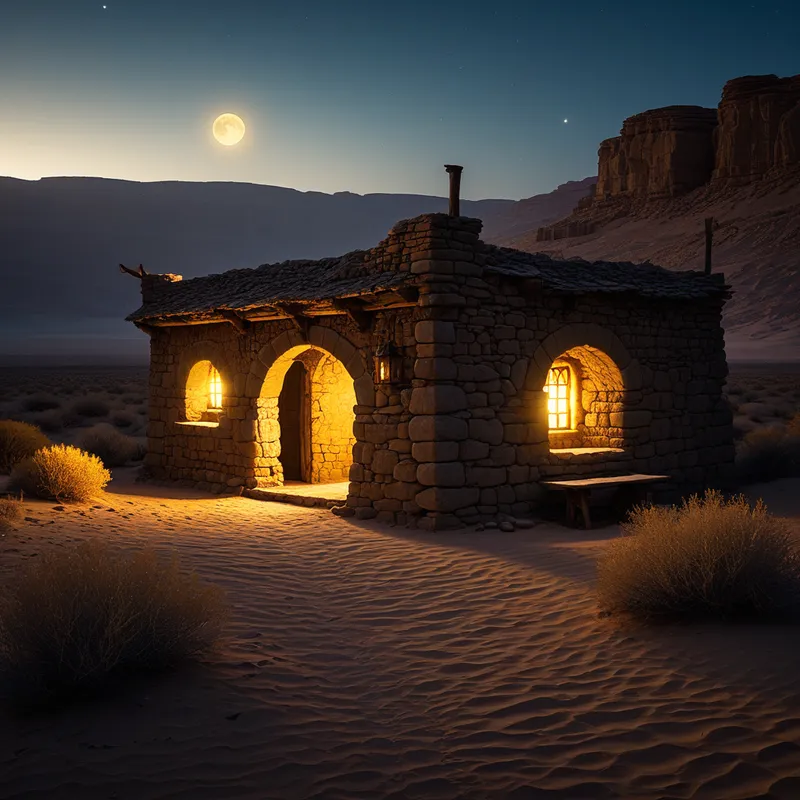
Just as the last star of his hope was guttering out, he saw it. Not an oasis, but a ruin. A low, crumbling structure of ancient stone, half-buried by the dunes. No sign swung above its door, yet a strange, honeyed light spilled from its single window, and the scent of roses and damp earth—a scent utterly alien to the desolate waste—wound through the air. It was a place that should not exist.
Pushing open the heavy, unlatched door, he entered. The air inside was cool and thick, humming with a silence that felt like a held breath. The tavern was empty, yet not abandoned. Dust motes danced in shafts of that inexplicable golden light, illuminating rough-hewn tables scarred by time. At the far end, behind a simple counter, stood the Keeper. His form was indistinct, wrapped in simple robes, his face a mystery in the shadow of his hood. He moved not a muscle, yet the traveler felt seen to the core of his soul.
“Water,” the traveler croaked, his voice a rusted hinge. “For the love of God, just water.”
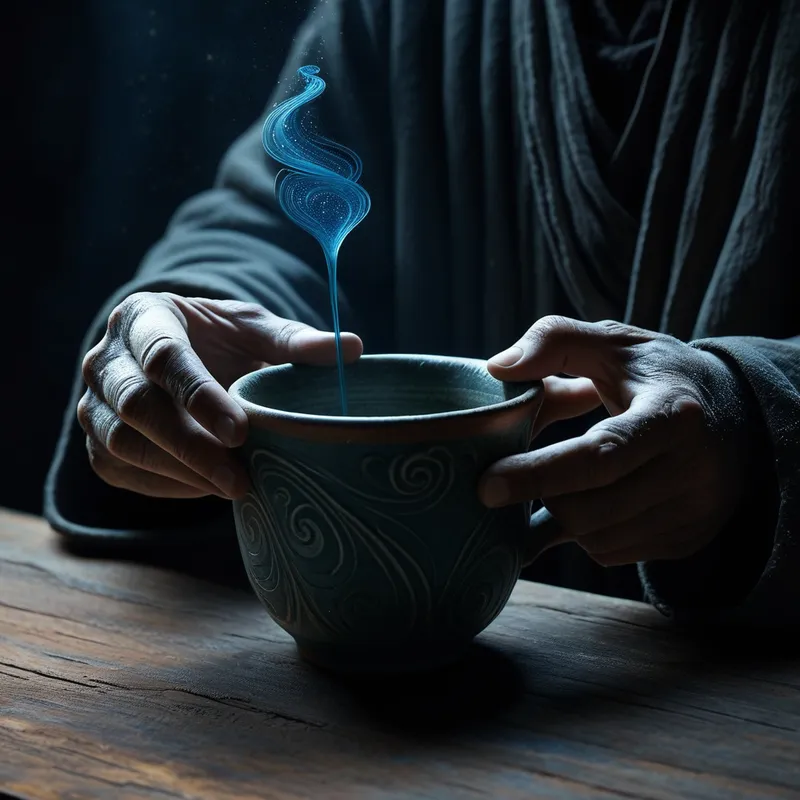
The Keeper was silent for a long moment. Then, without a word, he reached below the counter and produced not a waterskin, but a humble clay Cup. It was empty. The traveler’s heart sank into a well of fresh despair. But then the Keeper raised his hand, and from the very air, from the silence itself, a deep, ruby liquid began to pour—a cascade with no source—filling the cup to its brim. It was wine, but unlike any wine; it held the depth of midnight and the spark of a thousand stars.
“This is the only vintage I serve,” the Keeper said, his voice like distant thunder over mountains. “The Wine of Truth. Drink, and remember. Refuse, and continue your circling.”
Trembling, caught between terror and a yearning he could not name, the traveler took the cup. The first sip was fire, a conflagration that raced through his veins. It burned away the dust of the road, the fatigue in his bones. The second sip was ice, a clarity so sharp it felt like dying. He saw the illusions of his life—his pride, his fear, his cherished sorrows—dissolve like sugar in water.
With the third sip, the tavern itself began to change. The crumbling walls shimmered and fell away, not into ruin, but into transparency. The roof vanished, revealing not the desert sky, but the infinite, star-dusted vault of the cosmos. The rough tables and chairs melted into pools of light. He was no longer in a place, but at the center of a Mystery.
And the Keeper… the Keeper’s hood fell back. The face revealed was his own. Not the face he knew from mirrors, worn by time and worry, but his face as it existed in the eye of the Beloved: timeless, serene, radiant with a love that had crafted the worlds. The Cup was now a mirror, and in its depths, he saw not his reflection, but the Beloved gazing back at him. The traveler, the wine, the tavern, and the Keeper were not separate. They were one single, glorious act of recognition. He had arrived, by becoming utterly lost.
Cultural Origins & Context
The myth of the Tavern of Love is not a single, codified story but a pervasive and fluid motif woven through centuries of Sufi poetry and teaching tales. It finds its most famous expressions in the works of poets like Jalāl al-Dīn Rūmī and Ḥāfeẓ, for whom the tavern (kharabat) is a central symbol. This was not mere metaphor but a radical, lived allegory.
In a historical context where formal religious orthodoxy could be rigid, the tavern represented a counter-cultural space—a ruin outside the city walls of conventional piety and social order. It was the place where the rules of the marketplace and the mosque did not apply. The stories were passed down orally in khānaqāhs (Sufi lodges) and through poetic recitation, often accompanied by dhikr and sacred music. Their societal function was subversive and therapeutic: to model the path of fanā (annihilation) and baqā (subsistence). They provided a symbolic roadmap for the disciple (sālik) showing that the goal was not pious perfection, but a drunken, ruinous love that obliterates the seeker to reveal the Sought.
Symbolic Architecture
The myth is a perfect map of the Sufi psycho-spiritual journey. The weary Traveler is the nafs—the commanding, worldly soul—exhausted by its own projects and isolated in the desert of materialism and intellectualism.
The tavern is not a building, but a state of consciousness where all that you have built yourself to be must fall into ruin, so that what you eternally are can be revealed.
The Keeper is the Murshid, the divine guide, who is ultimately recognized as the true Self, the Heart. The Wine is the intoxicating grace of divine love (‘ishq), which is not comfort but a solvent. Its purpose is not to entertain the ego but to dismantle it. The moment of recognition—seeing the Beloved in the mirror of the cup—is the experience of tawḥīd, the foundational principle of Islam understood experientially. The traveler’s journey ends because the dichotomy of seeker and sought collapses.
The Dreamer's Resonance
When this myth stirs in the modern Dream, it often manifests as dreams of finding hidden rooms, forgotten basements, or enigmatic bars in the midst of familiar landscapes. The dreamer may encounter a mysterious bartender who serves them a strange drink. The somatic experience upon waking can be one of profound disorientation, a spiritual hangover.
Psychologically, this signals a critical juncture in the process of Individuation. The ego has been on a long, arduous journey (career, relationships, self-improvement) and has reached a point of existential exhaustion—the desert. The dream presents the Tavern, the invitation to stop doing and start dissolving. The anxiety in the dream mirrors the soul’s resistance to ego-death. To dream of drinking the wine and surviving is to symbolically accept the painful, liberating process of letting one’s constructed identity be unmade for the sake of a deeper, more authentic existence.
Alchemical Translation
The myth models the alchemy of the soul with precise elegance. The base metal is the traveler’s leaden, burdened ego. The desert journey is the nigredo—the blackening, the calcination by life’s trials that reduces everything to ash and essence.
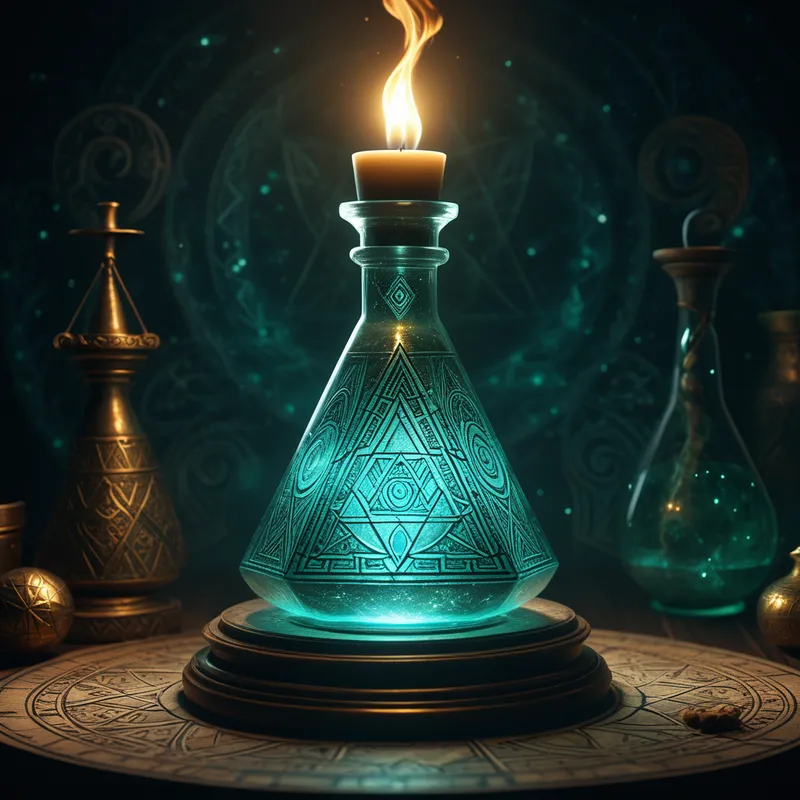
The wine is the alchemical aqua vitae, the mercurial spirit that simultaneously dissolves and coagulates, destroying form to reveal the golden essence hidden within.
The tavern itself is the alchemical vessel, the sealed vas hermeticum where this sacred, interior operation occurs, safe from the interference of the outer world. The transformation is not an addition, but a subtraction. The solve (dissolution) is the drinking of the wine, the utter breakdown of persona and complexes. The coagula (recombination) is the stunning moment of recognition, where the dissolved elements reunite not as the old ego, but as the Self in union with the Beloved—the philosopher’s stone, the gold of psychological and spiritual integration. For the modern individual, this translates to the courage to enter one’s own inner ruin—the neglected grief, the abandoned creativity, the spiritual longing—and to accept the intoxicating, terrifying grace that heals not by fixing, but by transforming.
Associated Symbols
Explore related symbols from the CaleaDream lexicon:
- Cup — The human heart as the vessel made to receive the intoxicating wine of divine love, which both fills and shatters it to reveal its true capacity.
- Wine — The ecstatic, transformative grace of the Beloved that dissolves the ego’s boundaries, inducing a spiritual intoxication beyond reason.
- Desert — The arid landscape of the soul exhausted by worldly pursuits and intellectual knowledge, where all false supports are stripped away.
- Door — The threshold of surrender, the moment of choice where the seeker must leave the known world to enter the mysterious space of transformation.
- Mirror — The polished heart or consciousness that, when cleansed by the wine, reflects not the ego’s image but the face of the Beloved.
- Key — The act of sincere longing or the guidance of the inner Keeper that unlocks the hidden tavern within the soul’s wasteland.
- Fire — The purifying agony of divine love that burns away attachments and illusions, leaving only essential truth.
- Mask — The constructed identity of the traveler—scholar, merchant, king—which must be removed or dissolved in the tavern to see the true face beneath.
- Heart — The central organ of spiritual perception, which is both the destination of the journey and the tavern where the union occurs.
- Journey — The soul’s inevitable movement through life experience toward the crisis point where the only path forward is inward, into the ruin.
- Shadow — All that the traveler carries within him that is unknown and burdensome, which the light of the tavern reveals and integrates.
- Beloved — The ultimate divine reality, the source of the wine and the face in the mirror, which is the seeker’s own deepest and most authentic self.