The Tansu Craftsmen Myth Meaning & Symbolism
A myth of master woodworkers who learn that a perfect chest is not a container for objects, but a vessel for the soul's hidden architecture.
The Tale of The Tansu Craftsmen
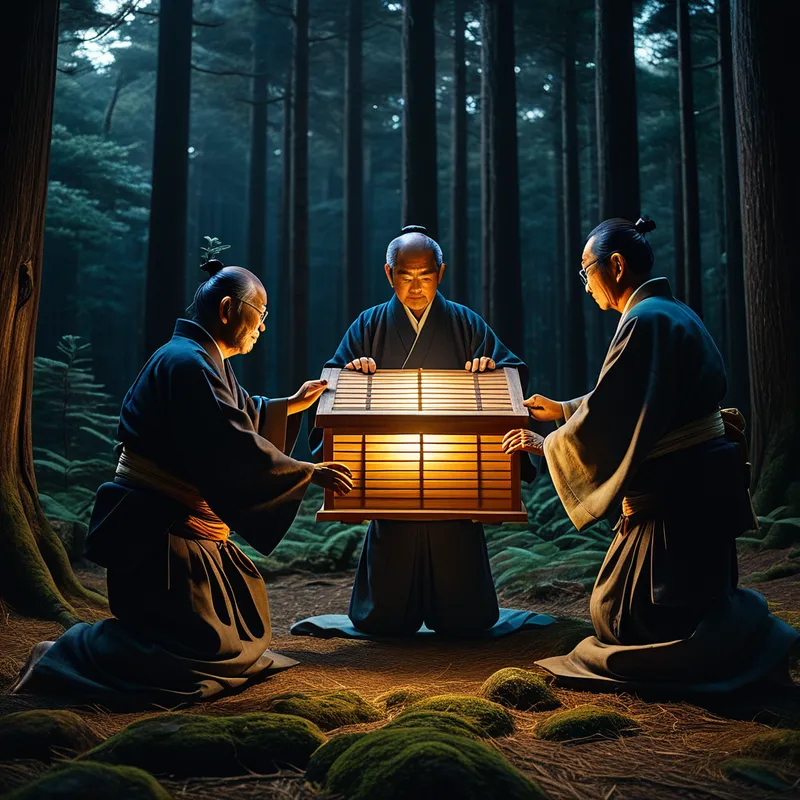
Listen, and hear the whisper of the grain. In the deep, green heart of Yamato, where [the mist](/myths/the-mist “Myth from Celtic culture.”/) clings to the shoulders of the mountains like a priest’s robe, there lived not one, but three brothers. They were not warriors, nor farmers, nor priests. Their hands were calloused with a different devotion: they were craftsmen of wood. Their names are lost to the cedar-scented wind, but their legacy is the sigh of a perfectly fitted drawer, the song of a hinge that has never known complaint.
Their father, a man whose soul was half-rooted in [the earth](/myths/the-earth “Myth from Hindu culture.”/), taught them that wood is not dead. It sleeps. It dreams of its life as a tree, of sun and storm. To shape it is to converse with that dream. The brothers learned of kanawa tsugi and ki no kokoro. Yet, for all their skill, their chests and cabinets were merely beautiful. They were silent.
A great restlessness took them. They journeyed to the most ancient forest, a place where the kami of the trees were old as stone. There, they made a vow under the cold eye of [the moon](/myths/the-moon “Myth from Tarot culture.”/). They would not eat, nor sleep, nor speak until they had created not a container for silks or rice, but a vessel worthy of a god’s secret. For seven days and seven nights, they worked in sacred silence. The first brother, with eyes like a hawk, measured and planed until the wood was smooth as still [water](/myths/water “Myth from Chinese culture.”/). The second, with the patience of the earth itself, cut the joints—dovetails and mortises so precise that not a sliver of light could pass between them.
But the chest, when assembled, was a tomb. It was perfect, and it was dead.
The third brother, the youngest, whose heart had always heard the weeping in the rain and the laughter in the creek, looked upon their cold masterpiece and despaired. As dawn of the eighth day bled into [the sky](/myths/the-sky “Myth from Persian culture.”/), he did the unthinkable. He took their creation, this monument to silent skill, and with a cry that came from the marrow of his bones, he struck it against the great root of the eldest cedar.
A crack echoed through the forest, not of breaking, but of awakening.
From the fissure in the perfect wood, not splinters, but light emerged. And from the ancient tree, a presence descended—not with form, but with a voice like the rustling of ten thousand leaves. “You have built a cage of perfection,” the kami whispered. “But a soul is not a measured [thing](/myths/thing “Myth from Norse culture.”/). It is knot and stream, shadow and heartwood. To house it, you must give a piece of your own.”
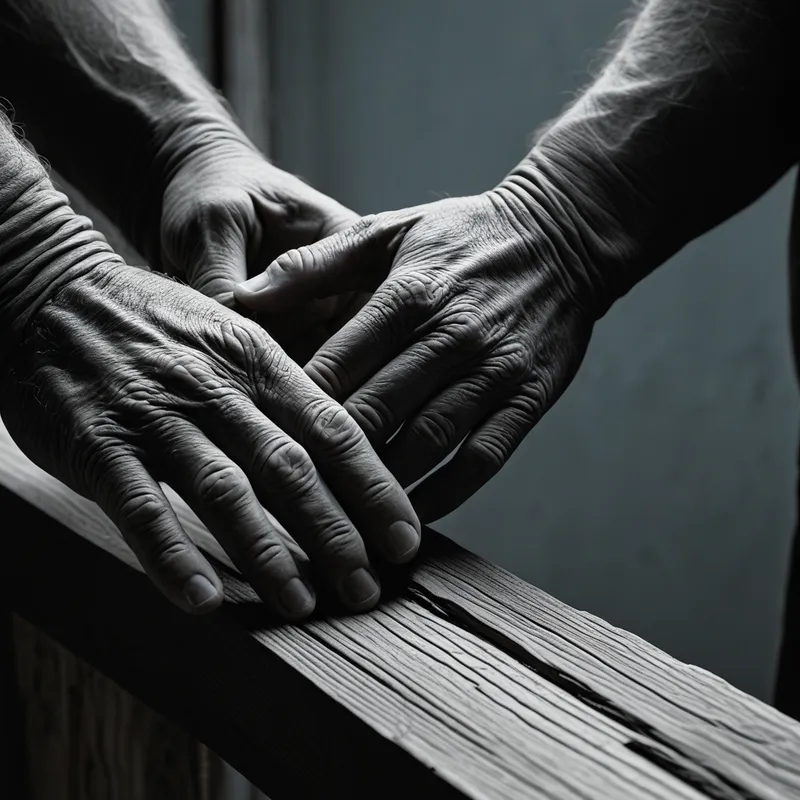
The youngest understood. He placed his palm upon the crack. He did not think of repair, but of offering. He poured into that fracture his loneliness, his hope, his quiet fears—the hidden grain of his own spirit. His brothers, awestruck, followed. The stern elder offered his rigidity. The patient one offered his deep, unspoken sorrow. Their essences, raw and human, flowed into the wood.
The crack did not vanish. It transformed. It became the central line, the heart joint of the chest. The wood, once silent, now hummed with a subtle warmth. The drawers, when opened, sighed with the soft breath of a sleeping child. They had not built a [tansu](/myths/tansu “Myth from Japanese culture.”/). They had midwifed a yorishiro. It was a living geometry, a secret made manifest. They named it Ikigushitsu, and it was said that to whisper a truth into its drawers was to have it kept for all time, and to whisper a question, to have it answered in dreams.
Cultural Origins & Context
This myth finds its roots not in the grand imperial chronicles like the Kojiki, but in the oral traditions of the shokunin. Passed down in woodworking families, guilds, and atelia, it served as a foundational parable of the shokunin’s code: shokunin no michi. It was told not to glorify a hero, but to initiate an apprentice into the sacred psychology of their vocation.
The tale emerged during the Edo period, a time of relative peace when aesthetic refinement and meticulous craft flourished. The tansu itself, a mobile chest for storing a household’s most precious items—kimonos, documents, heirlooms—became a central artifact of merchant and [samurai](/myths/samurai “Myth from Japanese culture.”/) class life. The myth provided a spiritual etiology for this everyday object, elevating craft from a technical skill to a cosmological act. It taught that true mastery requires a confrontation with [the self](/myths/the-self “Myth from Jungian culture.”/), and that the final, indispensable tool is not the chisel or the plane, but the vulnerable human heart.
Symbolic Architecture
At its core, the myth is a [blueprint](/symbols/blueprint “Symbol: A blueprint represents the foundational plan or design for something, often symbolizing potential, structure, and the mapping of one’s inner self or future.”/) of the [psyche](/myths/psyche “Myth from Greek culture.”/). The Tansu is the ego—the beautifully constructed, functional container we present to [the world](/myths/the-world “Myth from Tarot culture.”/). Its perfect joinery represents our competencies, our polished personas, our attempts to create order and [security](/symbols/security “Symbol: Security denotes safety, stability, and protection in one’s personal and emotional life.”/).
The perfect joinery of the ego is also its prison; it is in the deliberate, sacred crack that the soul’s light enters and exits.
The three brothers represent a trinity of psychic faculties: Intellect (measurement, [precision](/symbols/precision “Symbol: The quality of being exact, accurate, and meticulous. It represents control, clarity, and the elimination of error in thought or action.”/)), Will (patience, persistence), and Feeling ([intuition](/symbols/intuition “Symbol: The immediate, non-rational understanding of truth or insight, often described as a ‘gut feeling’ or inner knowing that bypasses conscious reasoning.”/), [empathy](/symbols/empathy “Symbol: The capacity to understand and share the feelings of others, often manifesting as emotional resonance or intuitive connection in dreams.”/)). The initial failure reveals that a psyche built only from intellect and will is a sterile, lifeless [structure](/symbols/structure “Symbol: Structure in dreams often symbolizes stability, organization, and the framework of one’s life, reflecting how one perceives their environment and personal life.”/). The vital, integrating force is feeling—the [brother](/symbols/brother “Symbol: In dreams, a brother often symbolizes kinship, support, loyalty, and shared experiences, reflecting the importance of familial and social bonds.”/) who hears the [wood](/symbols/wood “Symbol: Wood symbolizes strength, growth, and the connection to nature and the environment.”/)’s dream. The kami of the [forest](/symbols/forest “Symbol: The forest symbolizes a complex domain of the unconscious mind, representing both mystery and potential for personal growth.”/) is the Self, the deep, ancient, and guiding totality of the psyche that exists beyond [the ego](/myths/the-ego “Myth from Jungian culture.”/)’s designs. Its instruction—“you must give a [piece](/symbols/piece “Symbol: A ‘piece’ in dreams often symbolizes a fragment of the self or a situation that requires integration, reflection, or understanding.”/) of your own”—is [the law](/symbols/the-law “Symbol: Represents external rules, societal order, moral boundaries, and the tension between personal freedom and collective structure.”/) of psychological wholeness.
The crack, therefore, is the critical [symbol](/symbols/symbol “Symbol: A symbol can represent an idea, concept, or belief, serving as a powerful tool for communication and understanding.”/). It is the wound, the flaw, the admission of imperfection and limitation. It is the [rupture](/symbols/rupture “Symbol: A sudden break or tear in continuity, often representing abrupt change, separation, or the shattering of established patterns.”/) of the ego’s perfect project. Yet, it is only through this rupture that communion with the deeper Self becomes possible. The crack becomes the [heart](/symbols/heart “Symbol: The heart symbolizes love, emotion, and the core of one’s existence, representing deep connections with others and self.”/) [joint](/symbols/joint “Symbol: A joint typically symbolizes relaxation, socialization, and the breaking of barriers in a communal or personal context, often linked to cannabis consumption.”/), the central, integrating principle that transforms a dead container into a living [vessel](/symbols/vessel “Symbol: A container or structure that holds, transports, or protects something essential, representing the self, emotions, or life journey.”/). The offered emotions—[loneliness](/symbols/loneliness “Symbol: A profound emotional state of perceived isolation, often signaling a need for connection or self-reflection.”/), rigidity, sorrow—are the raw [material](/symbols/material “Symbol: Material signifies the tangible aspects of life, often representing physical resources, desires, and the physical world’s influence on our existence.”/) of the [shadow](/symbols/shadow “Symbol: The ‘shadow’ embodies the unconscious, repressed aspects of the self and often represents fears or hidden emotions.”/). By consciously offering them, they are not discarded, but alchemized into the very structure of the [soul](/symbols/soul “Symbol: The soul represents the essence of a person, encompassing their spirit, identity, and connection to the universe.”/)’s home.
The Dreamer’s Resonance
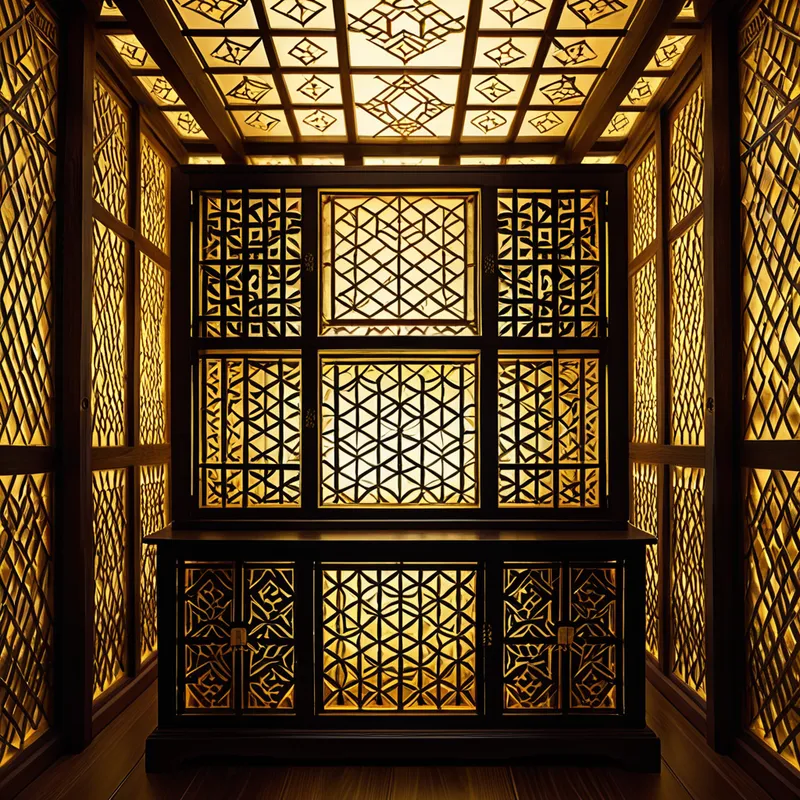
When this myth stirs in the modern dreamer, it often manifests as dreams of intricate boxes, locked rooms within the self, or the frustrating assembly of complex, fragile objects. One may dream of a beautifully crafted cabinet whose drawers are impossibly stuck, or of a room in one’s own house that one never knew existed, filled with strange, forgotten artifacts.
Somatically, this can feel like a constriction in the chest—a literal feeling of being “boxed in” by one’s own life structures, career, or identity. Psychologically, it signals a critical phase where one’s carefully constructed life, however successful, feels devoid of meaning or vitality. The dream is the psyche’s insistence that the current “container” is insufficient. It is a call to perform the symbolic act of the third brother: to willingly introduce a conscious fracture into one’s perfectionism, control, or emotional detachment. The process underway is the painful, necessary breakdown of an old ego-structure to make space for a more authentic, soul-infused way of being.

Alchemical Translation
The journey of the Tansu Craftsmen is a masterful map of individuation. It begins in the [nigredo](/myths/nigredo “Myth from Alchemical culture.”/), the blackening: the brothers’ restless despair with mere beauty, their ascetic vow in the dark forest. This is the initial disillusionment that launches the spiritual quest.
The meticulous crafting is the albedo, the whitening: the intense, conscious effort of analysis, discipline, and skill-building. We spend much of our lives here, polishing our personas. The resulting “perfect but dead” chest is the stark revelation of the albedo’s limit—the brilliant but sterile consciousness.
The transmutation does not occur in the flawless joint, but in the courageous admission of the flaw. The gold of the spirit is forged in the furnace of acknowledged brokenness.
The shattering strike is the violent onset of the [rubedo](/myths/rubedo “Myth from Alchemical culture.”/), the reddening. It is the emotional crisis, the failure, the heartbreak that cracks open the ego. This is not a mistake, but a sacred necessity. The offering of one’s inner shadow material—the loneliness, the rigidity—into that crack is the true alchemical operation. It is the coniunctio oppositorum, [the sacred marriage](/myths/the-sacred-marriage “Myth from Various culture.”/) of conscious skill and unconscious raw material, of perfection and flaw, of human and kami.
The final product, the Ikigushitsu, is the aurum philosophicum, the philosophical gold. It represents the achieved Self—a personality that is no longer just a container, but a living, breathing vessel. It is functional in the world, yet intimately connected to the divine. Its drawers hold not just contents, but meanings; it answers not with logic, but with dreams. For the modern individual, the myth teaches that our life’s work is not to build an impregnable, flawless identity. It is to craft, with great skill and greater humility, a vessel resilient and porous enough to house both our humanity and our glimpse of the divine, allowing each to breathe through the sacred, self-made crack.
Associated Symbols
Explore related symbols from the CaleaDream lexicon: