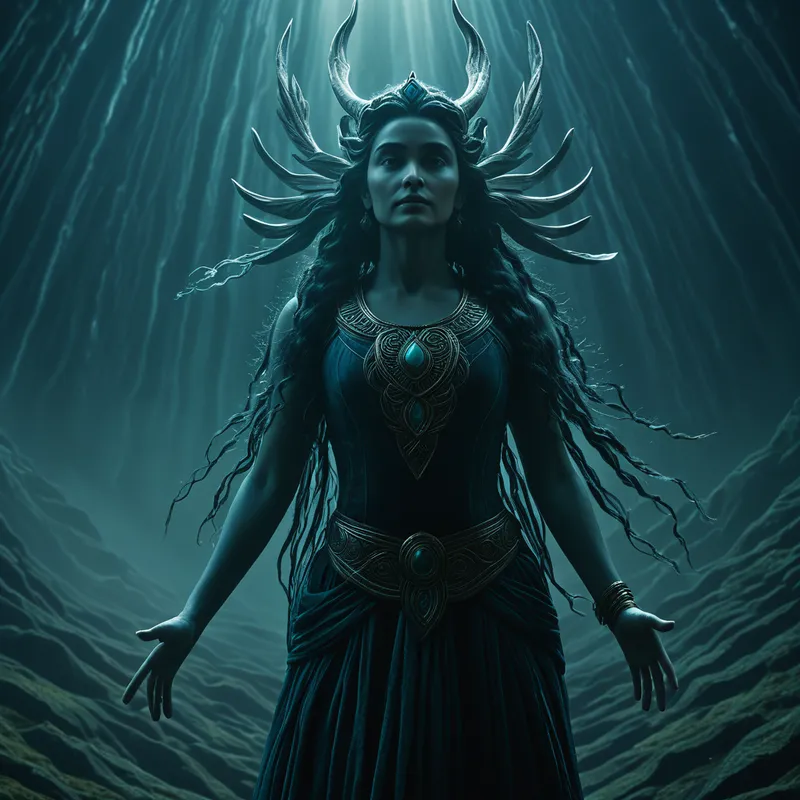
The Tale of the Fisherman and the Jinn
A fisherman accidentally releases a powerful, angry jinn from a sealed jar and must use his intelligence to outwit the supernatural being and save his own life.
The Tale of The Tale of the Fisherman and the Jinn
In a time woven into the fabric of desert nights and the shimmer of [the sea](/myths/the-sea “Myth from Greek culture.”/), there lived a poor fisherman. Each dawn, he cast his net into the indifferent waves, his life a fragile thread dependent on the ocean’s whim. One fateful morning, after three fruitless casts that yielded only seaweed and old wood, he hauled his net a final time. Its weight promised bounty, but brought forth only a heavy, sealed jar of yellow copper, stamped with the seal of Sulayman.
Hope, that flickering flame in the human heart, kindled within him. Perhaps it held treasure. With his knife, he pried away the leaden seal. A thick smoke erupted, coiling into [the sky](/myths/the-sky “Myth from Persian culture.”/) like a vengeful serpent, coalescing into a monstrous form that blotted out the sun. It was a jinn of awesome and terrible power.
[The jinn](/myths/the-jinn “Myth from Pre-Islamic Arabian / Islamic culture.”/)’s voice was the rumble of a collapsing mountain. “Rejoice, for I bring you tidings of your [death](/myths/death “Myth from Tarot culture.”/)! I am one of the rebellious spirits sealed by Sulayman. For centuries I swore that if ever freed, I would grant my savior a choice of deaths. Now, choose your manner of demise!”
The fisherman’s world shrank to the space between the towering jinn and the vast, uncaring sea. Despair threatened to drown him. But in the depths of that terror, a cunning light awoke—the ancient human weapon of the mind against brute force. With a humility that masked his racing thoughts, the fisherman spoke.
“Before you kill me, mighty spirit, I beg one answer, to die without confusion. Can you truly fit inside this small jar? My eyes must be deceiving me, for such a magnificent being could not possibly be contained by it.”
Flattered and inflamed by the implied challenge to its power, the jinn roared, “You doubt me? Behold!” It dissolved once more into smoke and streamed back into the narrow neck of the jar. The fisherman, with a speed born of desperation, slammed the sealed cap back into place.
Trapped once more, the jinn’s rage turned to pleading, then to bargaining. From this vessel of its imprisonment, it now promised untold riches. But the fisherman, the sage of his own survival, had learned the nature of promises made in fear. He declared he would cast the jar back into the deep, a warning to all who followed.
Only when the jinn swore binding oaths in the most sacred of names, promising true safety and reward, did the fisherman relent. Upon release, the humbled spirit led him to a secret, enchanted lake. There, the fisherman caught four wondrous fish—red, white, blue, and yellow—which he presented to the king. This act unraveled a greater mystery: a bewitched city and a petrified prince, all liberated by the pursuit of the fish’s origin. The jinn, its oath fulfilled, vanished. The fisherman, rewarded with gold, lived out his days in prosperity, not merely by chance, but by the wealth earned through his exercised wit.
Cultural Origins & Context
This tale is a jewel in the vast mosaic of the One Thousand and One Nights (often known in the West as the Arabian Nights). Its roots are planted deep in the pre-Islamic and early Islamic soil of the Middle East, a world where the tangible and the supernatural coexisted in daily consciousness. The jinn are not mere fantasy but integral beings of Islamic cosmology, created from smokeless fire, possessing free will, and inhabiting a parallel world to humanity.
The narrative embodies a core ethos of the folk tale tradition across desert and oasis: the [triumph](/myths/triumph “Myth from Roman culture.”/) of the seemingly powerless through intellect. In a hierarchical society, the fisherman represents the common man, whose only capital is his mental acuity. His victory is not one of muscle or magic, but of psychological insight—he understands the jinn’s pride, its essential nature, and uses that as his lever. The story also reflects a profound relationship with fate (Qadar). The fisherman’s initial poverty, the chance catch of the jar, and his eventual riches are all seen as threads in a larger tapestry. Yet, the story emphasizes that within the bounds of divine decree, human agency—particularly the agency of a clever mind—is the critical factor that determines how one’s fate unfolds.
Symbolic Architecture
The myth is built upon a [foundation](/symbols/foundation “Symbol: A foundation symbolizes the underlying support systems, values, and beliefs that shape one’s life, serving as the bedrock for growth and development.”/) of potent, opposing symbols. The Jar is the [womb](/symbols/womb “Symbol: A symbol of origin, potential, and profound transformation, representing the beginning of life’s journey and the unconscious source of creation.”/) and the tomb, a [vessel](/symbols/vessel “Symbol: A container or structure that holds, transports, or protects something essential, representing the self, emotions, or life journey.”/) of latent potential and suffocating containment. It holds the unintegrated, explosive power of the unconscious—the repressed rage, genius, or [trauma](/symbols/trauma “Symbol: A deeply distressing or disturbing experience that overwhelms the psyche, often manifesting in dreams as unresolved emotional wounds or psychological injury.”/) that, if released blindly, can destroy [the self](/myths/the-self “Myth from Jungian culture.”/). The [Fisherman](/symbols/fisherman “Symbol: Represents exploration of emotional depths and the pursuit of desires, often reflecting patience and skill.”/) is [consciousness](/symbols/consciousness “Symbol: Consciousness represents the state of awareness and perception, encompassing thoughts, feelings, and experiences.”/) itself, cast adrift on the sea of the unknown, using the net of [attention](/symbols/attention “Symbol: Attention in dreams signifies focus, awareness, and the priorities in one’s life, often indicating where the dreamer’s energy is invested.”/) to gather sustenance from the [depths](/symbols/depths “Symbol: Represents the subconscious, hidden emotions, or foundational aspects of the self, often linked to primal fears or profound truths.”/).
The sea is the vast, undifferentiated psyche. The fisherman’s daily cast is the ego’s attempt to bring contents of the unconscious (the fish) into the light of day for sustenance. The jar is the traumatic complex, sealed away by a greater ordering principle (Sulayman’s seal), which the fragile ego stumbles upon and, in its hunger, opens prematurely.
The Jinn symbolizes the autonomous complex, a bundle of psychic [energy](/symbols/energy “Symbol: Energy symbolizes vitality, motivation, and the drive that fuels actions and ambitions.”/) with a will of its own. Its immediate murderous intent reflects how unassimilated psychic [material](/symbols/material “Symbol: Material signifies the tangible aspects of life, often representing physical resources, desires, and the physical world’s influence on our existence.”/), when suddenly released, can be experienced as self-annihilating. The fisherman’s cunning represents the necessary function of consciousness: not to fight the complex with equal force, but to outmaneuver it, to re-contain it until a new [relationship](/symbols/relationship “Symbol: A representation of connections we have with others in our lives, often reflecting our emotional state.”/) can be negotiated. The final enchanted [lake](/symbols/lake “Symbol: A lake often symbolizes a place of reflection, emotional depth, and the subconscious mind, representing both tranquility and potential turmoil.”/) and the four colored fish signify the reward of engaging the depths: access to a transformative, numinous [layer](/symbols/layer “Symbol: Layers often symbolize complexity, depth, and protection in dreams, representing the various aspects of the self or situations.”/) of the [psyche](/myths/psyche “Myth from Greek culture.”/) that leads to the healing of a deeper, collective disturbance (the bewitched [city](/symbols/city “Symbol: A city often symbolizes community, social connection, and the complexities of modern life, reflecting the dreamer’s relationships and societal integration.”/)).
The Dreamer’s Resonance
To encounter this tale in a dream, or to feel its echo in one’s soul, is to recognize a moment of profound psychological crisis and opportunity. The “fisherman” is that part of us going through the motions of survival, feeling the emptiness of “stale air” and “stale bread”—a life devoid of meaning. The sudden, terrifying eruption of the jinn is the upwelling of what has been long-buried: a volcanic rage, a forgotten grief, a shamed desire, or a potent creative force that first appears as a threat to our orderly existence.
The dreamer is at [the crossroads](/myths/the-crossroads “Myth from Celtic culture.”/). One can be annihilated by the content—succumb to the depression, be consumed by the anger. Or, one can engage the fisherman’s sage-like cunning. This is not manipulation of others, but the intelligent engagement of the self: questioning the nature of the threat, appealing to its pride (its need for recognition), and finding a way to temporarily re-stabilize the situation. The ultimate goal is not eternal imprisonment of the jinn, but the establishment of a new [covenant](/myths/covenant “Myth from Christian culture.”/). The oath-swearing is the moment of integration, where the raw, destructive power agrees to serve the larger psyche, leading to the discovery of the “enchanted lake”—a newfound source of vitality, diversity (the colored fish), and connection to a world beyond one’s petty struggles.

Alchemical Translation
In the alchemical vessel of the soul, this tale maps the perilous process of confronting the [nigredo](/myths/nigredo “Myth from Alchemical culture.”/). The fisherman’s poverty is the initial state of [prima materia](/myths/prima-materia “Myth from Alchemical culture.”/), the leaden, worthless existence. The sealed jar is the [vas hermeticum](/myths/vas-hermeticum “Myth from Alchemical culture.”/) containing the volatile, fiery spirit (the jinn as [spiritus](/myths/spiritus “Myth from Alchemical culture.”/) mercurialis).
The critical operation is the caput mortuum—the “death’s head.” The fisherman’s feigned disbelief is the coagulatio that causes the volatile spirit to re-coagulate into its vessel. This is the mastery of spirit by mind, the fixing of the volatile, without which the work is destroyed. The resulting humble oath is the beginning of the conjunctio, the marriage of conscious intelligence and unconscious power.
The journey to the secret lake is the [albedo](/myths/albedo “Myth from Alchemical culture.”/), the whitening, where the purified waters yield their miraculous, multi-hued bounty (the [cauda pavonis](/myths/cauda-pavonis “Myth from Alchemical culture.”/), the peacock’s tail, signifying the appearance of multiple colors and possibilities). Presenting the fish to the king is the offering of the transformed self to the ruling principle of consciousness, which in turn initiates the healing of a deeper, archetypal paralysis (the petrified prince, the bewitched city)—the final stage of redemption and [rubedo](/myths/rubedo “Myth from Alchemical culture.”/), the golden dawn of a new, integrated existence.
Associated Symbols
Explore related symbols from the CaleaDream lexicon:
- Fisherman — The archetypal seeker on the surface of the vast unconscious, whose survival and prosperity depend on skillful engagement with the depths.
- [Djinn](/myths/djinn “Myth from Islamic culture.”/) — An autonomous psychic force, created from the fire of passion or trauma, capable of immense destruction or grantation when properly related to.
- Fate (Urðr / Wyrd) — The woven tapestry of destiny, into which the individual’s thread of cunning and choice is actively integrated, altering the pattern.
- [Water](/myths/water “Myth from Chinese culture.”/) — The primordial, feminine realm of the unconscious, the source of all life and hidden treasures, upon which the conscious ego navigates.
- Jar — [The vessel](/myths/the-vessel “Myth from Alchemical culture.”/) of containment, representing both the prison of repression and the sacred vas necessary for psychological transformation.
- Circle — The seal of Sulayman, symbolizing containment, wholeness, and the magical boundary that separates order from chaotic power.
- Key — The fisherman’s cunning, which is not a physical tool but the mental key that unlocks both peril and potential, opening [the way](/myths/the-way “Myth from Taoist culture.”/) to a new covenant.
- Trickster — The aspect of the fisherman that uses wit, deception, and psychological insight to overturn a seemingly absolute power dynamic.
- Oath — The sacred bond that transforms a relationship from one of annihilation to one of service, symbolizing the integration of a complex.
- Fish — The numinous contents of the deep unconscious, brought to light, often multicolored and miraculous, signifying psychic nourishment and revelation.
- Bone — The underlying, enduring structure of the self—the fisherman’s persistent will to live—that persists through the ordeal of confronting shadowy powers.
- Tales of the Unknown — The myth itself, a narrative vessel that carries the wisdom of confronting the terrifying and marvelous unknowns within the psyche.