The Standard of the Legions Myth Meaning & Symbolism
A Roman legion's sacred Standard is lost, plunging its soldiers into shame until a hero journeys into darkness to reclaim their collective soul.
The Tale of The Standard of the Legions
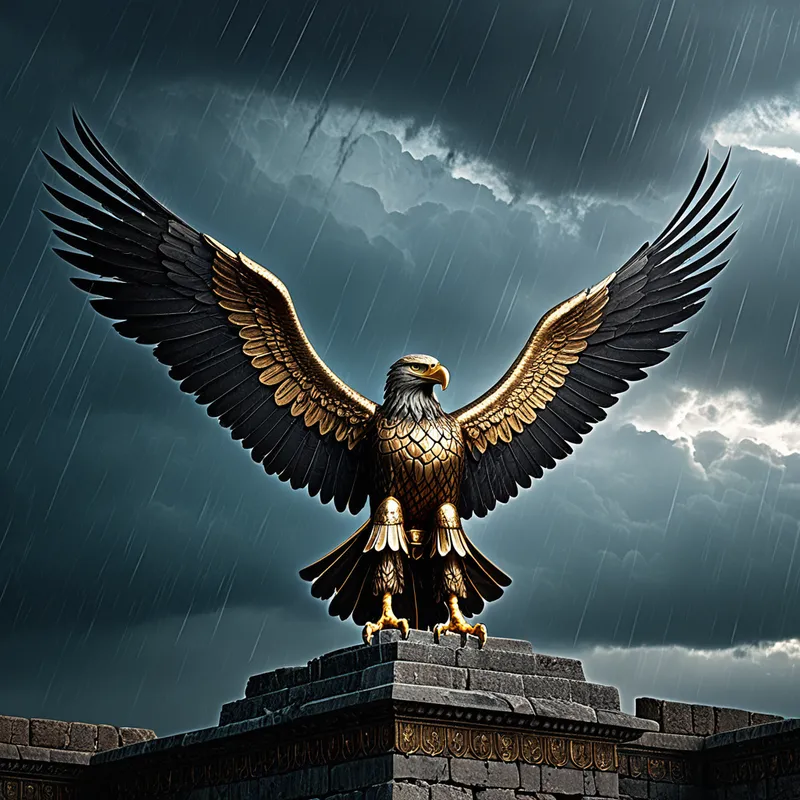
Hear now the tale not of a god, but of the soul of men bound by iron and oath. It begins not in the sun-drenched Forum, but in the dripping, primordial dark of the Silva Hercynia. The Seventeenth Legion marched, a river of scarlet and bronze flowing between the black trunks of ancient oaks. At its heart, borne by the aquilifer, was its soul: the Aquila. This was no mere flagpole; it was Jupiter’s own bird cast in gold, wings outstretched as if to seize the sky itself. In its shadow, every soldier stood taller. It was their pride, their guardian, the silent witness to their valor.
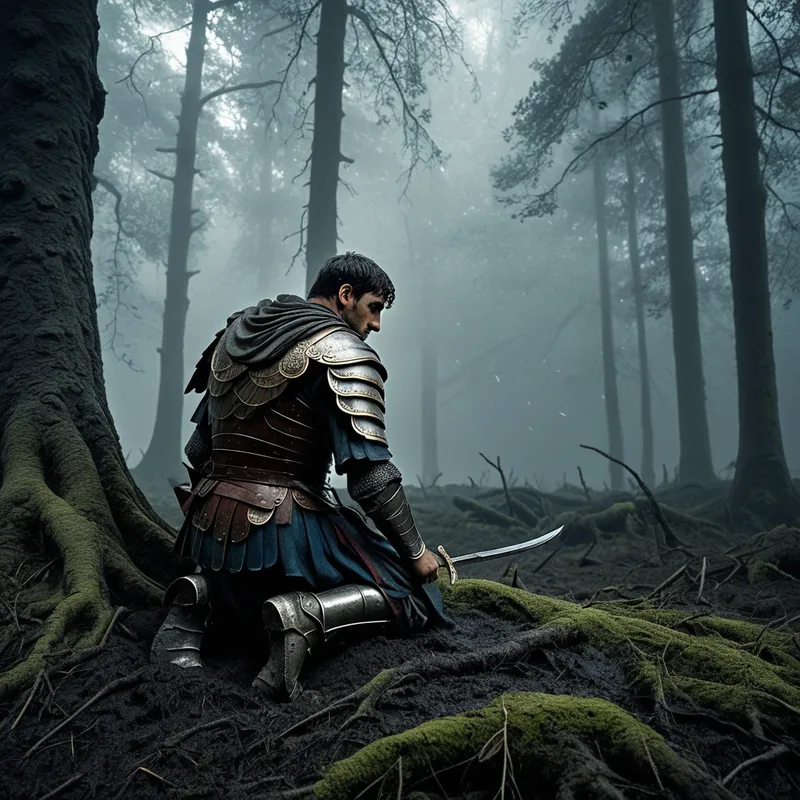
Then came the ambush. Not with a roar, but with a whisper of arrows from the unseen gloom. Chaos, a tempest of screams and splintering shields. The disciplined river shattered into desperate eddies of men. In the heart of the storm, the aquilifer fell, a spear in his side. The golden eagle tumbled from his grasp, striking the mossy earth with a dull, final thud. A painted warrior of the Cherusci emerged from the mist, seized the standard, and vanished back into the forest’s endless green mouth.
The battle ended. The legion, bloodied, held the field. But they had lost. A silence colder than the German winter settled upon them. They had lost their Aquila. To lose a battle was misfortune. To lose the Standard was a spiritual catastrophe, a stain upon their honor that no victory could wash clean. The legion was cast into disgrace. In Rome, the Senate spoke their name with averted eyes. The soldiers themselves moved like ghosts, their heads bowed, their genius of the legion seemingly extinguished. They were a body without a heart, a brotherhood shrouded in shame.
Years passed. The disgrace festered. Then, from among the ghosts, a figure arose. Not an emperor, but a soldier—some tales name him a centurion, others a tribune scarred by that same day. He stood before his silent comrades and spoke a simple, dangerous vow. He would go. He would find the lost soul of the Seventeenth, or die in the attempt. Alone, or with a handful of the most desperate volunteers, he turned his back on the camp and walked into the forest from which no light seemed to escape.
His journey was an odyssey through the underworld of the living world. He navigated by rumors traded for silver in filthy frontier taverns, by the fear in the eyes of captured scouts. He passed through villages where the eagle was said to be a trophy in a chieftain’s hall, only to find crude replicas. He descended into bogs that clutched at his legs, scaled mountains that scraped the leaden sky, and faced beasts both animal and human. The forest tested not just his strength, but his very Roman-ness, stripping away the comfort of order and exposing the raw, primal man beneath the armor.
Finally, guided by a traitor’s whisper or a god’s faint sign, he found it. The Cherusci, grown bold and careless with time, had placed the Aquila in a sacred grove, a trophy to their gods of wood and stream. It was not in a hall of gold, but lashed to the trunk of a lightning-blasted oak, surrounded by crude totems and the bones of sacrifices. The gold was dulled by grime and weather, but the eagle’s form remained, a fragment of another world imprisoned in this one.
What followed was not a grand battle, but a act of sacred theft, a silent struggle in the holy dark. Perhaps he fought the lone guardian. Perhaps he simply cut the bonds under a moonless sky, his heart hammering against his ribs like a prisoner seeking escape. His hands closed around the cold, familiar shaft. He pulled it free from the grasping roots and the weight of years. Then he ran, or fought his way back, the recovered soul of his legion a blazing burden in his hands.
His return was not to trumpets, but to a breath held for years. As he staggered into the camp, mud-caked and bleeding, holding aloft the tarnished eagle, a sound began. It started as a gasp, then a murmur, then a roar that shook the very palisade walls. It was the sound of a ghost becoming a man again, of shame transforming into a fury of pride. The legion was whole. The hero, having descended into the place of loss, had returned with what was stolen, and in doing so, he did not just recover a symbol—he resurrected the spirit of ten thousand men.
Cultural Origins & Context
The myth of the Lost Standard is not a single story from a specific text like the Aeneid, but a powerful narrative pattern woven from historical trauma and cultural imperative. Its origins lie in the profound Roman reverence for military symbols, particularly the Aquila. Introduced by Consul Gaius Marius in the late 2nd century BCE, the eagle standard became the literal and spiritual focal point of a legion. To lose it in battle was the ultimate disgrace, often resulting in the disbandment of the unit.
This narrative was born from real, searing events—the catastrophic defeats like the Clades Variana (the Varian Disaster) in the Teutoburg Forest, where three legions, their eagles lost, were erased. The subsequent campaigns of Germanicus to recover those eagles, as recounted by historians like Tacitus, provided the historical skeleton for the myth. The story was passed down not by bards, but by historians, soldiers’ tales, and imperial propaganda. It functioned as a societal corrective: a terrifying lesson in the consequences of failure and a redemptive blueprint for restoring honor. It reinforced the idea that collective identity (Res Publica) was fragile, a sacred trust that could be lost and must be heroically reclaimed.
Symbolic Architecture
At its core, the myth is not about a flag, but about the Self of a collective. The Standard represents the integrated, conscious identity of the group—its pride, purpose, and connection to the divine (Jupiter). Its loss to the chaotic, “barbaric” forest represents a traumatic fragmentation, where conscious order is overwhelmed by the unconscious, the shadowy, and the unknown.
The lost Standard is the soul held hostage by the unresolved past, the un-faced shame, the collective trauma that haunts the halls of identity.
The Germanic forest is the psychological katabasis, the realm of the shadow. It is everything Rome—structured, civilized, luminous—defines itself against. The hero’s journey is thus an ego-consciousness venturing into the personal and collective unconscious to retrieve a vital, lost aspect of the Self. The recovery is not a simple retrieval, but a re-consecration. The Standard returns changed—tarnished, tested—and in that process, the group’s identity is not merely restored, but deepened, having integrated the reality of loss and the struggle of redemption.

The Dreamer’s Resonance
When this myth stirs in the modern dreamer, it often manifests as dreams of profound loss, shame, or a fractured sense of self. One might dream of a cherished heirloom stolen, a house with a central room collapsed, or a team or family from which the dreamer is exiled in disgrace. The somatic feeling is one of hollow dread, a weight in the chest, a literal “loss of heart.”
This dream pattern signals that a core aspect of the dreamer’s identity—a value, a talent, a sense of integrity or belonging—has been “captured” by unconscious complexes. Perhaps a childhood humiliation (the “ambush”) caused them to disown their confidence. Perhaps a failure led them to bury their ambition. The dream is the psyche highlighting that this lost “Standard” is not gone; it is held in the internal “forest”—the tangled undergrowth of repressed memory, shame, and old wounds. The psychological process underway is the ego’s nascent, often fearful, recognition that to become whole, it must turn and face the very terrain of its defeat.
Alchemical Translation
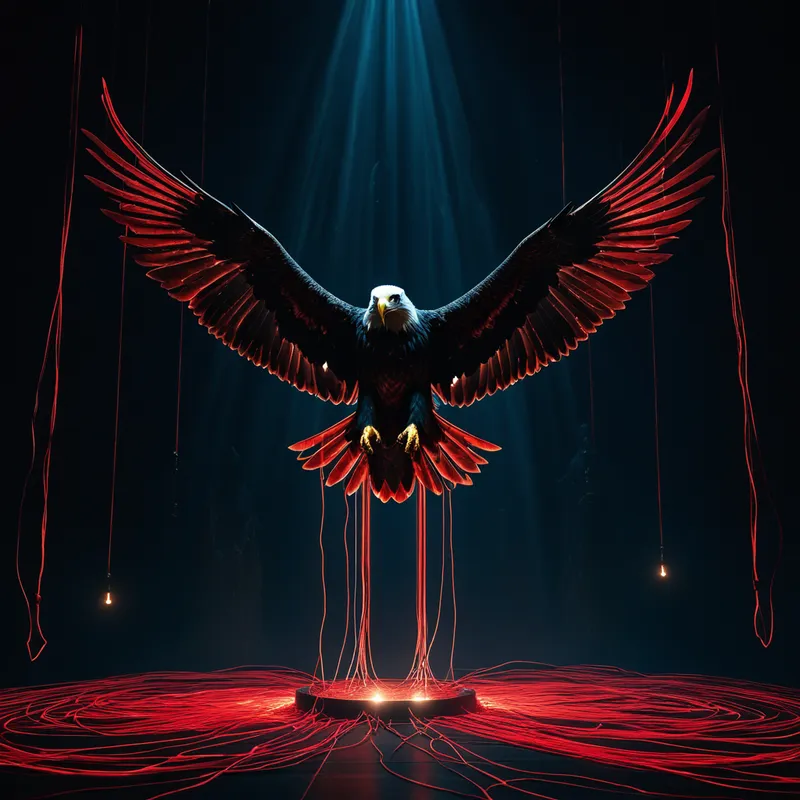
The alchemical journey of this myth is a perfect map for the process of individuation. The starting state (Nigredo) is the legion in disgrace: the conscious personality depressed, fragmented, and identified with its failure (the lead).
The hero’s vow is the first stirring of the ego toward the Self, a commitment to undertake the Magnum Opus no matter the personal cost.
The descent into the forest is the Solutio and Separatio, where the old, rigid identity dissolves in the waters of the unconscious, and one must separate personal truth from internalized “barbaric” chaos. Finding the tarnished Standard is the Coniunctio—the moment of recognition and re-connection with the lost Self. The return is the Rubedo. The gold of the eagle is not pristine; it is now alloyed with the experience of the journey, the mud of the forest, the memory of shame. This is the true gold of individuation: not a perfect, untested ideal, but a resilient, integrated identity forged in the confrontation with darkness. The modern individual completes this alchemy not by retrieving a physical object, but by reclaiming disowned passion, courage, or self-worth from the grip of past trauma, thereby transforming personal history from a story of defeat into one of sacred return.
Associated Symbols
Explore related symbols from the CaleaDream lexicon: