The Spirit Possession Ceremony Myth Meaning & Symbolism
A myth where the human vessel surrenders to the divine current, becoming a bridge between worlds for healing, prophecy, and ancestral communion.
The Tale of The Spirit Possession Ceremony
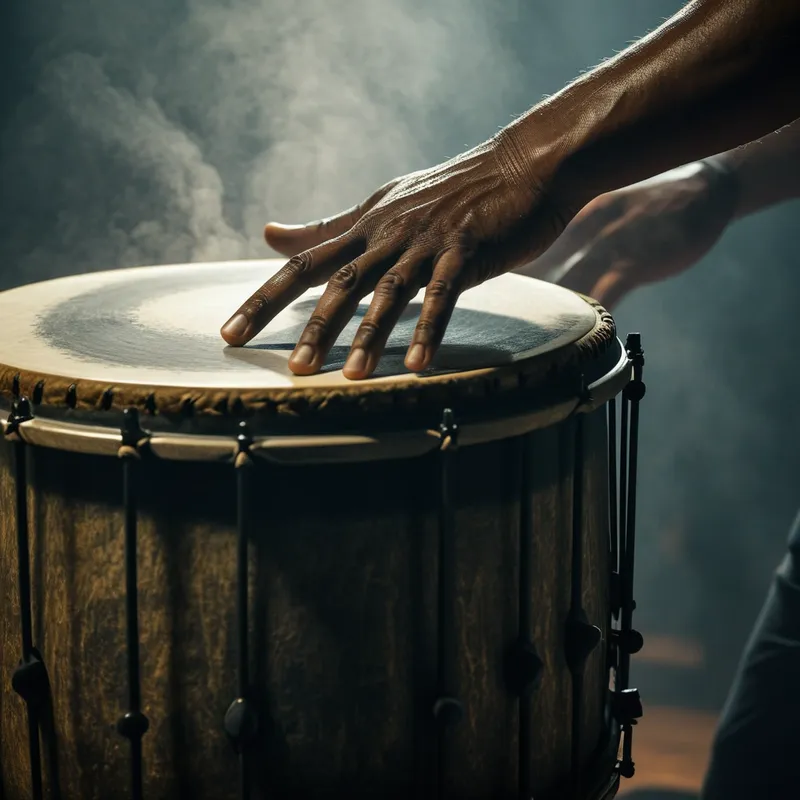
Listen. The air is not still. It hums with a memory older than iron, a pulse felt in the womb of the world. In the sacred terreiro, beneath the watchful eyes of the Egungun, the people gather. Their feet know the earth as a living skin. The drummers, their hands calloused maps of devotion, approach the atabaques. This is not mere music; it is a coded language, a sonic key turning in the lock of the unseen world.
First, a heartbeat. The rumble of the largest drum, the rum, is the deep, patient pulse of the Earth herself. Then, the middle rumpi answers, the rhythm of the River of time. Finally, the high, chattering lé cuts through, the voice of the Bird carrying prayers skyward. Together, they become a living, breathing staircase of sound, descending from the realm of the Orishas and ascending from the deep well of the ancestors.
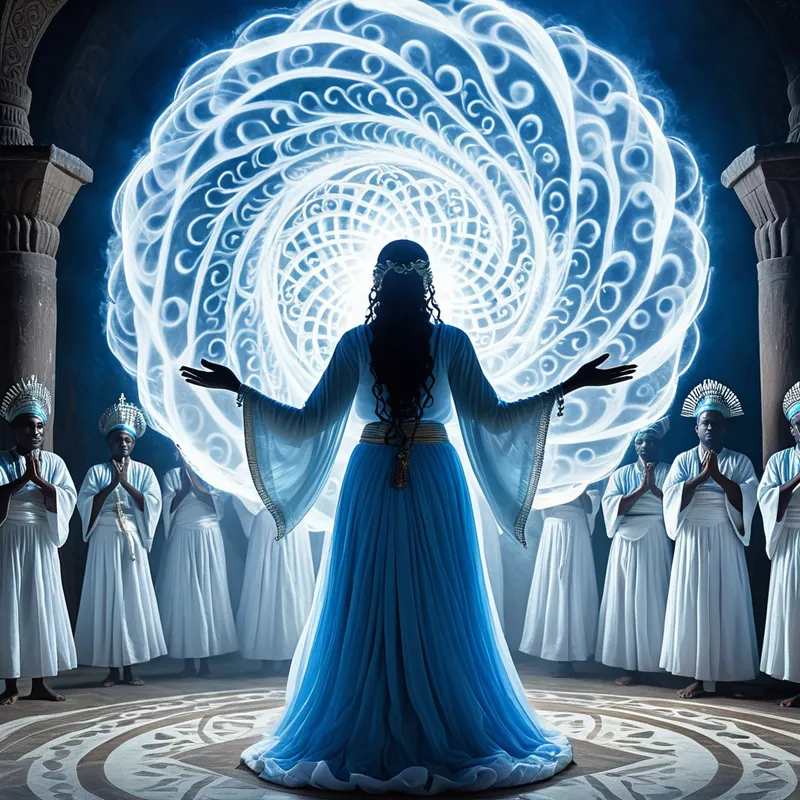
In the center stands the horse. Let us call her Adunbi. She has fasted. She has prayed. Her white clothes are a surrender, a blank page. The rhythms find the hollows of her bones. They do not ask for her mind; they seek the deeper memory, the one written in Bone and Blood. Her shoulders begin to twitch, not from her own will, but as if plucked by invisible strings. The world tilts. The faces of the community blur into a single, expectant gaze.
The conflict is not against a monster, but against the fortress of the solitary self. Her ego, that proud captain, clings to the helm. “This is my body,” it insists. But the drums are a tidal wave, and the chants are the wind that drives it. A great heat rises from her core—not a fire of destruction, but the Fire of forging. She trembles, a leaf in a hurricane of spirit. This is the moment of breaking: will she anchor herself in fear, or cut the rope and set sail into the divine storm?
She chooses the storm.
With a cry that is not her own, a sound ripped from the throat of the world, she surrenders. Her conscious self steps aside, not into nothingness, but into the wings of the great Temple. Her body, the surrendered vessel, is now mounted. The rhythms settle into a new, powerful cadence. The trembling ceases, replaced by a formidable, grounded stillness. When Adunbi’s eyes open, they see with a thousand-year gaze. The walk is different—a rolling gait like ocean waves, or a fierce, leonine stride. The voice that speaks is layered, ancient, and direct. It is Yemanjá who has arrived, her presence cool and vast as the Ocean. She blesses children, diagnoses hidden ailments with a glance, and offers prophecies that taste of salt and wisdom. The community leans in, weeping, laughing, presenting their troubles. The Ceremony is complete. The spirit has crossed the Bridge. Healing flows. And when the drums slowly shift their pattern, signaling departure, the mighty presence recedes like a tide. Adunbi slumps, caught by tender hands, returned to herself—hollowed out, exhausted, but her spirit etched with a new, indelible signature of the divine.
Cultural Origins & Context
This is not a single myth from a single book. It is a living, breathing practice at the heart of African Diasporic religions like Haitian Vodou, Brazilian Candomblé and Umbanda, Cuban Santería (Lucumí), and Obeah traditions. Born from the unspeakable trauma of the Middle Passage and chattel slavery, these traditions performed a profound act of spiritual alchemy. They disguised the worship of African deities (Orishas, Lwa) behind the icons of Catholic saints, preserving a sacred worldview in the belly of the beast.
The possession ceremony was the engine of this preservation. It was not mere theater; it was direct revelation. In a world where the body was owned, the spirit proclaimed its ultimate sovereignty by temporarily claiming it for a higher purpose. The ceremony was societal glue, a court of justice, a clinic, and a direct hotline to divine order (Aṣẹ in Yoruba). It was passed down not through texts, but through embodied lineage—the elder’s watchful eye, the drummer’s taught rhythm, the initiate’s disciplined body—creating an unbroken chain of memory that refused annihilation.
Symbolic Architecture
At its core, this myth is a master [blueprint](/symbols/blueprint “Symbol: A blueprint represents the foundational plan or design for something, often symbolizing potential, structure, and the mapping of one’s inner self or future.”/) for the [dissolution](/symbols/dissolution “Symbol: The process of breaking down, dispersing, or losing form, often representing transformation, release, or the end of a state of being.”/) of the ego and a sacred encounter with the Other. The individual is not erased but becomes a conscious [conduit](/symbols/conduit “Symbol: A passage or channel that transfers energy, information, or substance from one place to another, often hidden or structural.”/).
The greatest power lies not in willful assertion, but in conscious surrender to a current greater than oneself.
The Horse represents the ego-complex, the everyday [identity](/symbols/identity “Symbol: Identity represents the sense of self, encompassing personal beliefs, cultural background, and social roles.”/). The [Spirit](/symbols/spirit “Symbol: Spirit symbolizes the essence of life, vitality, and the spiritual journey of the individual.”/) is the autonomous archetypal force from the [collective unconscious](/symbols/collective-unconscious “Symbol: The Collective Unconscious refers to the part of the unconscious mind shared among beings of the same species, embodying universal experiences and archetypes.”/)—the [Goddess](/symbols/goddess “Symbol: The goddess symbolizes feminine power, divinity, and the nurturing aspects of life, embodying creation and wisdom.”/), the [warrior](/symbols/warrior “Symbol: A spiritual archetype representing inner strength, discipline, and the struggle for higher purpose or self-mastery.”/), the [trickster](/symbols/trickster “Symbol: A boundary-crossing archetype representing chaos, transformation, and the subversion of norms through cunning and humor.”/). The Drum is the catalyzing agent, the rhythmic key that synchronizes the [heartbeat](/symbols/heartbeat “Symbol: The heartbeat represents life, vitality, and the essence of being alive, symbolizing emotional connectivity and personal integrity.”/) of the individual with the [pulse](/symbols/pulse “Symbol: Represents life force, vitality, and the rhythm of existence. It symbolizes connection to one’s own body and the passage of time.”/) of the archetypal [realm](/symbols/realm “Symbol: The symbol of ‘Realm’ often signifies the boundaries of one’s consciousness, experiences, or emotional states, suggesting aspects of reality that are either explored or ignored.”/). The [Temple](/symbols/temple “Symbol: A temple often symbolizes spirituality, sanctuary, and a deep connection to the sacred aspects of life.”/)/Terreiro is the temenos, the protected [ritual](/symbols/ritual “Symbol: Rituals signify structured, meaningful actions carried out regularly, reflecting cultural beliefs and emotional needs.”/) [space](/symbols/space “Symbol: Dreaming of ‘Space’ often symbolizes the vastness of potential, personal freedom, or feelings of isolation and exploration in one’s life.”/) where this dangerous and sacred [operation](/symbols/operation “Symbol: An operation signifies a process of change or transformation that often requires deliberate effort and planning.”/) can safely occur.
The terrifying “breaking” of the horse is the symbolic [Death](/symbols/death “Symbol: Symbolizes transformation, endings, and new beginnings; often associated with fear of the unknown.”/) of the ego’s totalitarian control. What emerges is not a [loss](/symbols/loss “Symbol: Loss often symbolizes change, grief, and transformation in dreams, representing the emotional or psychological detachment from something or someone significant.”/) of self, but an expanded self—a self that can [host](/symbols/host “Symbol: The symbol of a ‘host’ often represents nurturing, hospitality, or the willingness to offer support and guidance to others.”/) the [universe](/symbols/universe “Symbol: The universe symbolizes vastness, interconnectedness, and the mysteries of existence beyond the individual self.”/) without claiming to be it. The possessed one becomes a Bridge and a Mirror, showing the [community](/symbols/community “Symbol: Community in dreams symbolizes connection, support, and the need for belonging.”/) a [reflection](/symbols/reflection “Symbol: Reflection signifies self-examination, awareness, and the search for truth within oneself.”/) of its own divine potential and hidden wounds.
The Dreamer’s Resonance
When this mythic pattern stirs in modern dreams, it often signals a profound psychological incursion. You may dream of being overtaken by a powerful force—a wave, a wind, an animal spirit, or a mysterious presence. You might feel your body moving without your consent in a Dance, or hear a compelling, overwhelming rhythm.
Somatically, this reflects the psyche’s attempt to break through a rigid ego-structure that is stifling growth. The conscious mind has perhaps become too fortified, too defended against the depths. The unconscious, in its wisdom, sends an archetypal “spirit”—a burst of creative energy, a long-buried rage, a tidal wave of grief, or an ancestral Spirit Guide—to mount the dreamer’s awareness. It is an involuntary, yet ultimately healing, process of possession by a disowned part of the self. The dreamer is not going mad; they are being prepared, through the dream Ceremony, to integrate a greater wholeness.

Alchemical Translation
For the modern individual navigating the path of individuation, this myth models the alchemical stage of solutio—dissolution. Our culture prizes control, autonomy, and the bounded, separate self. The Spirit Possession Ceremony proposes a radical alternative: true empowerment comes through a disciplined, sacred surrender.
Individuation is not about building a taller fortress of the self, but about becoming a more permeable, conscious vessel for the totality of the psyche.
The “drumbeat” we must learn to hear is the authentic rhythm of our own deepest nature, often drowned out by the noise of the persona. The “initiation” is the often-painful process of letting our fixed identities be broken open by what we have excluded—our Shadow, our creative daimon, our ancestral legacy. The goal is not permanent possession, but the capacity for conscious communion. We learn to let the “spirit” of our deepest creativity, our wild intuition, or our necessary grief, speak and act through us for a time, before we consciously reintegrate that energy into our waking lives. We become, like the adept in the terreiro, a skilled navigator of inner states, able to host the gods and ghosts within without being permanently overthrown by them. We achieve a Rebirth not into a new personality, but into a more fluid and authentic relationship with the entire psyche’s pantheon.
Associated Symbols
Explore related symbols from the CaleaDream lexicon:
- Spirit — The autonomous, archetypal force from the collective unconscious that temporarily inhabits the vessel, representing a direct encounter with the divine or the deep self.
- Drum — The catalyzing rhythm that synchronizes human consciousness with archetypal realms, serving as the sonic key that unlocks the door between worlds.
- Horse — The human vessel or ego-complex that must be “mounted” and surrendered, symbolizing the body and individual identity offered up for a higher purpose.
- Bridge — The state of the possessed one, who becomes a living connection between the community and the spirit world, the conscious and the unconscious.
- Ocean — Represents the vast, collective unconscious from which the spirits emerge, particularly deities like Yemanjá, embodying depth, emotion, and the source of life.
- Temple — The sacred, protected ritual space (the terreiro) where this dangerous alchemical operation of possession can safely occur, a container for transformation.
- Fire — The purifying and transformative heat that rises in the vessel during the mounting, forging a new connection and burning away resistance.
- Mask — The transformed visage and demeanor of the possessed, which both conceals the individual and reveals the spirit, a symbol of sacred role and revelation.
- Death — The symbolic death of the ego’s total control during the “breaking” of the horse, a necessary end for a new, expanded state of being to emerge.
- Ceremony — The entire structured, ritualized process that makes the dangerous act of possession safe, sacred, and beneficial for the individual and community.
- Ancestral Spirit — A specific type of possessing force, representing the living wisdom, memory, and unresolved matters of the lineage flowing through the vessel.
- Rebirth — The ultimate outcome for the vessel, who returns to themselves not diminished, but etched with a new, indelible signature of the divine, renewed and expanded.