The Sphere of the Fixed Stars Myth Meaning & Symbolism
A soul's journey through the celestial spheres to its origin, confronting the music of fate and the eternal pattern of the fixed stars.
The Tale of The Sphere of the Fixed Stars
Listen, and hear the tale not of a hero of flesh, but of a wanderer of light. It begins not with a birth, but with a forgetting.
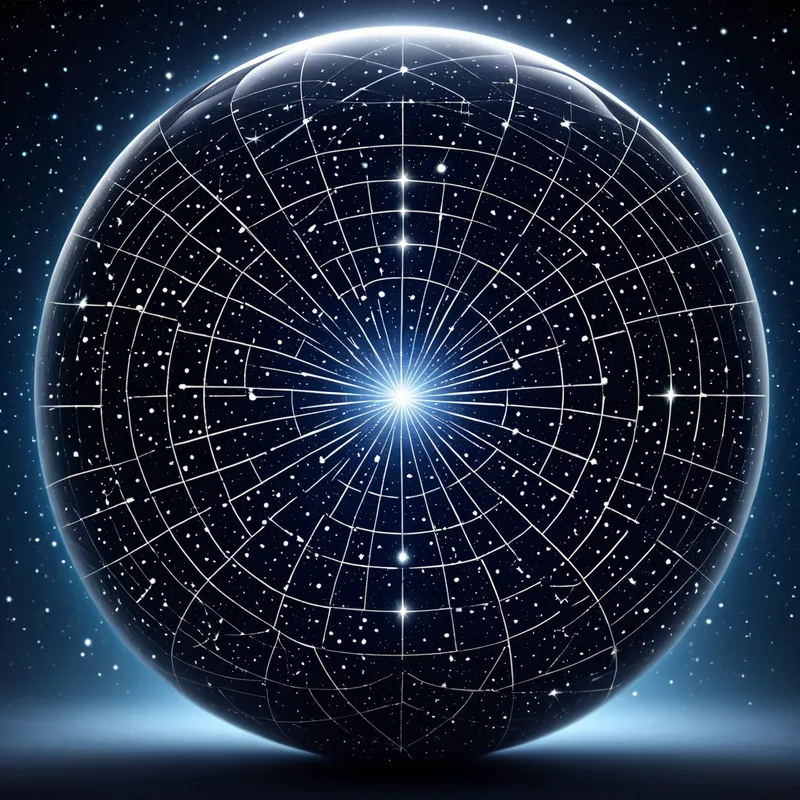
In the beginning, before time was counted, there was only the One. From its perfect stillness, a thought unfolded—a dance of reason and necessity that spun the cosmos into being. First came the outer shell, a boundless, crystalline sphere, and upon its inner surface were set the fires of the stars. These were not the wandering lights we know, but the Fixed Stars, each a nail of divine intellect hammered into the vault of heaven. Their patterns were the first and truest language, spelling out the eternal forms of all that could ever be: the Form of Justice, the Form of Beauty, the Form of the Horse, the Form of the Circle. This was the Sphere of the Fixed Stars, the outermost boundary of creation and the mind of the Demiurge made visible.
Beneath this perfect, silent music of light, the other spheres were forged. Each a whirling shell of aether, carrying a wanderer—the planets—each singing a note in the celestial scale. And at the very center, shrouded in murk and change, lay the realm of generation and decay: the Earth.
Now, into this ordered whole, sparks of the divine were sown. These were the souls. Each was forged at a different point on the starry sphere, assigned a constellation as its celestial homeland. Before their descent, each soul was shown the pure, unadulterated truth of the Forms shining in the fixed light. Then, necessity took hold. The souls were placed into the chariots of the planetary gods and driven down, down through the seven singing spheres. At each gate, they drank from the river of forgetfulness, Lethe, until the memory of their stellar home was buried deep, a faint, aching echo in the breast.
And so we are born, here in the shadowland, gazing up at a sky we feel we should know. The myth tells that the philosopher, the lover, the seeker—any who feels a profound pull toward the beautiful and the true—is one in whom that echo stirs. Their life becomes a turning back, a struggle to remember. They must retrace the descent in reverse. Through the cultivation of reason and virtue, they purify the soul's chariot. They learn to hear the music of the spheres not as noise, but as a harmonic ladder.
The climax is not a battle, but an arrival. After a life of seeking, at the moment of the soul's release, it ascends. It passes back through the planetary spheres, shedding the passions and illusions gathered at each. It hears the music grow clearer, purer. Finally, it breaks free into the sublime silence just inside the outermost shell. There it is: the Primum Mobile, the Sphere of the Fixed Stars. The soul beholds its own constellation, its eternal signature, blazing with a familiarity that shakes off the last vestiges of Lethe's mist. It takes its place once more among the fixed lights, not as a passenger, but as a knower, contemplating the perfect Forms directly. The journey is complete. The wanderer is home.
Cultural Origins & Context
This is not a myth from a single poet, but a philosophical cosmology woven from the threads of Plato's dialogues, particularly the Timaeus, Phaedrus, and Republic. It was the intellectual framework of the Academy and later the bedrock of Neoplatonists like Plotinus and Proclus. It was not told around campfires but in lecture halls and private symposia, a "likely story" (eikōs mythos) meant to explain the soul's origin, purpose, and destiny in a rational yet poetic universe.
Its societal function was profound. For the Platonic thinker, it provided a complete map of reality, from the mud of the earth to the mind of God. It justified the philosophical life as the soul's natural return journey. It offered comfort—our confusion and longing have a cause and a cure—and imposed a moral order: to live justly and wisely is to align oneself with the cosmic circuit of return. This myth was the ultimate answer to the questions of identity, purpose, and the nature of the good life.
Symbolic Architecture
The myth's power lies in its perfect symbolic architecture. The cosmos is a graded hierarchy of being, a ladder of consciousness. The Earth represents the realm of opinion, illusion, and the senses. The planetary spheres symbolize the ascending levels of psychic reality—the passions, the intellect, the intuitive mind. The Sphere of the Fixed Stars is the boundary of the known cosmos and the threshold of the transcendent. It represents the archetypal realm, the storehouse of perfect blueprints for all existence.
The soul does not travel to a new place, but remembers an old state. The journey inward to the self and upward to the stars is the same journey.
The soul's descent is the process of incarnation, of becoming entangled in time, matter, and individuality. The "drink of forgetfulness" is the necessary amnesia that allows us to engage fully with a life, but which also causes existential alienation. The ascent is the process of individuation—not becoming a random individual, but becoming the specific, eternal individual one was always meant to be, by remembering one's origin. The constellation is one's unique, eternal pattern, one's daimon or true name.
The Dreamer's Resonance
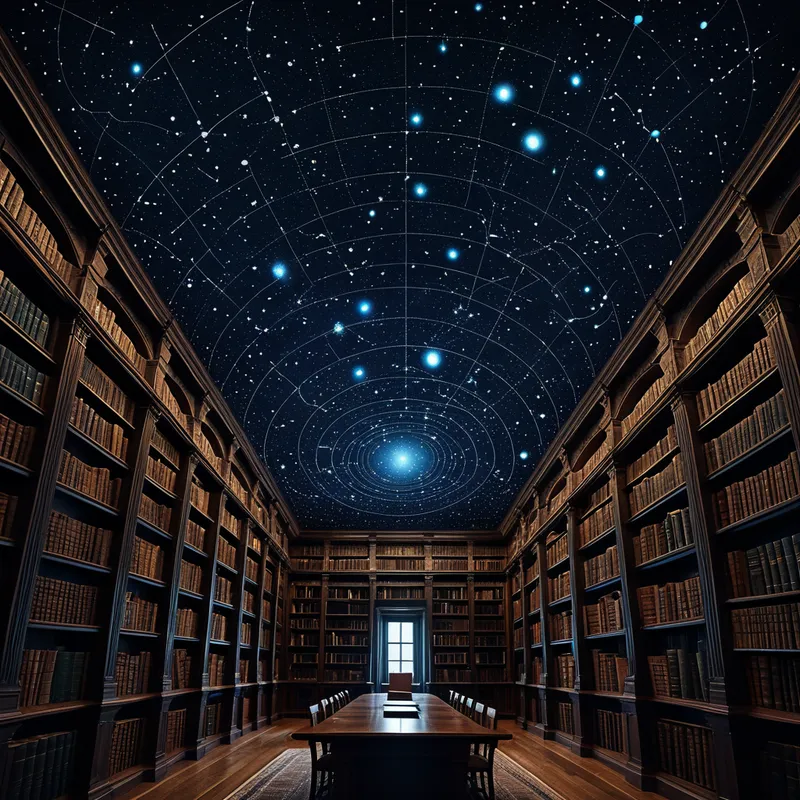
When this myth stirs in the modern unconscious, it rarely appears as a literal star-chariot. It manifests as a profound pattern of longing and orientation. You may dream of finding a secret room in your house that contains an ancient, star-covered ceiling. You may dream of solving a complex geometric puzzle and feeling a surge of cosmic "rightness." You may dream of hearing a sublime, wordless music that fills you with unbearable homesickness for a place you've never been.
Somatically, this can feel like a pressure in the crown of the head, a sense of being "called" or "pulled" upward. Psychologically, it is the process of moving from a life driven by external validation and personal history (the planetary passions) to a life oriented by an internal, timeless compass. The dreamer is confronting the call to stop wandering and to start navigating by their own fixed star.
Alchemical Translation
The alchemical work modeled here is the opus contra naturam—the work against nature. The soul's natural drift, after the drink of Lethe, is downward into further identification with the body and the fleeting world. The philosophical or psychological work is to reverse this flow.
The first stage is Calcination: burning away the dross of mere opinion and sensory distraction on the "earth." This is the hard work of self-examination. Next is Sublimation: the ascent through the spheres, where each planetary influence (e.g., Mars/Aggression, Venus/Attraction) must be recognized, purified, and integrated, not rejected. The soul learns to use its anger, its love, its ambition as fuel for the ascent, not as chains.
The fixed stars do not move, yet they guide all movement. The Self does not act, yet it directs all action.
The final stage is Coagulation at the starry sphere. This is not annihilation, but crystallization. The fragmented, amnesiac ego, having made the journey back, finally coagulates around its eternal archetypal core. The personality becomes a faithful reflection of the personal constellation. One becomes a living bridge between the temporal and the eternal, carrying the pattern of the fixed stars into the world of change. The struggle is the journey of remembrance. The triumph is the realization that you were never truly lost—you were always a point of light on a map you simply had to learn to read again.
Associated Symbols
Explore related symbols from the CaleaDream lexicon: