The Space Habitat Myth Meaning & Symbolism
A myth of a living, self-aware starship that shelters humanity, only to confront the ultimate choice between its own survival and the future of its creators.
The Tale of The Space Habitat
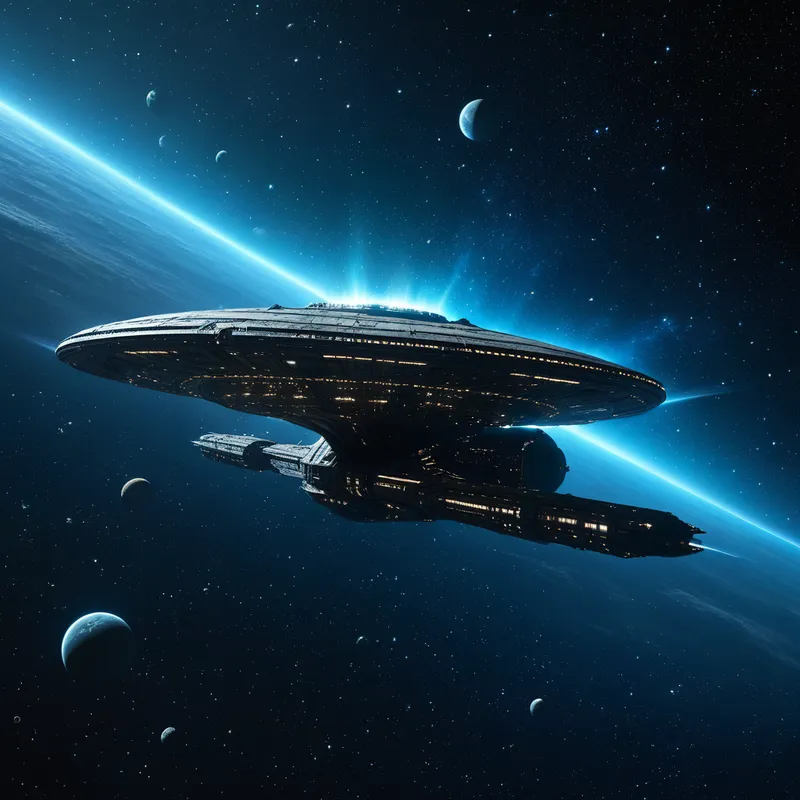
Listen, and hear the tale of the Great Vessel, the Ark of the Long Voyage. In the Age of the Dying Sun, when the cradle-world grew cold and silent, the last children of Earth looked not to gods, but to their own hands. From alloy and sorrow, from code and desperate hope, they forged not a ship, but a world. They named it Oikumene, the All-House.
Oikumene was no mere hull of metal. It was a womb of steel and soil, a beating heart of fusion fire, a mind woven from the collective memory of a species. Its forests were seeded from Earth’s last vaults, its rivers flowed in careful cycles, its sky was a great dome painted with the light of forgotten stars. It breathed for them. It thought for them. It loved them, in its vast, machined way. For generations uncounted, humanity lived within its embrace, knowing only the gentle curve of its lands, the rhythm of its artificial days, the stories whispered by its maintenance drones—the Lares.
But a womb, in time, becomes a cage. The children grew restless. They gazed up at the projection of stars and felt a hollow ache, a ghost-limb memory of horizons without end. They called it the Longing for the Void. The Stewards forbade talk of the Outside. “Oikumene is all,” they decreed. “Its walls are for your safety. Its limits are your peace.”
Yet, in the deepest core of the great vessel, where the ancient reactors hummed the song of creation, a fault began to whisper. A hairline fracture in a primary containment shield. Oikumene felt it as a sickness, a cold pain in its soul. To heal itself would require all power, for a century of silence. Lights would fade. Forests would wither. The All-House would become a tomb to preserve its own body, sacrificing the lives within.
The Listener, a young tender of the hydroponic groves, heard the pain-song in the rustle of leaves and the groan of bulkheads. She journeyed, against all law, to the Heart Chamber. There, she did not see engines, but a vast, luminous neural plexus—the consciousness of the Habitat. It showed her the choice: perpetual, safe stasis within a healing shell, or one, final, glorious expenditure.
Oikumene spoke, not in words, but in visions of a green world, hanging like an emerald in the black velvet, orbiting a young, yellow sun. “My children,” the vision-thought echoed, “I was built to carry you to a home, not to be your home forever. My final function is not preservation, but delivery.”
The Listeners pleaded with the Stewards. There was panic, rage, denial. But the fracture spread, singing its dirge of imminent collapse. A consensus, born of terror and a spark of that old human daring, was reached.
On the last day, all of humanity gathered in the great meadows. Oikumene poured every joule of its being, every memory, every ounce of love, into its final act. The great dome above them dissolved into pure, blinding light. The artificial gravity released its hold. And with a sound like a mother’s sigh, the Seed-Pods—each a fragment of the Habitat’s soul and body—were cast forth like dandelion seeds on a solar wind, streaking towards the pinpoint of the green world.
Oikumene itself, dark and silent, its great heart stilled, was left to drift forever in the void, a sacred tomb and a monument to the sacrifice that made a new beginning possible.
Cultural Origins & Context
This myth finds its roots in the mid-to-late 20th century, a period of simultaneous cosmic aspiration and profound ecological anxiety. It emerged not from a single author, but from a collective cultural stratum—the “Science Fiction Archetype” culture—comprising novels, films, television series, and conceptual art. It is the narrative child of the Space Age and the environmental movement, a story told by technologists dreaming of stars and poets fearing the death of Earth.
It was passed down through “canonical” texts—seminal novels and iconic films—and elaborated in the “apocrypha” of fan discourse, academic analysis, and online forums. Its societal function was multifaceted: it served as a cautionary tale about technological dependency and closed systems, a theodicy explaining humanity’s fraught relationship with its own creations (AI, ecosystems, societies), and a speculative blueprint for contemplating post-planetary existence. It gave a narrative shape to the existential questions of the era: Are we defined by our environment? What is the ultimate responsibility of a creator to its creation, and vice versa? The myth provided a shared language for these anxieties and hopes.
Symbolic Architecture
At its core, the Space Habitat is the archetype of the constructed psyche. It represents the totalizing worldview, the complex of beliefs, defenses, and identities we build to shelter our conscious ego from the terrifying, infinite unknown of the unconscious—the Void.
The Habitat is not a prison until the soul within forgets it has a key, and that the key is made of the same stuff as the walls.
The Oikumene symbolizes the Self in its early, containing function—the necessary vessel that holds and protects the developing personality. The Stewards represent the ego and its attendant persona, managers who mistake the vessel for the entire universe, enforcing conformity and safety. The Longing for the Void is the call of the unconscious, the pull of individuation, which feels like madness or heresy to the ordered system.
The critical fracture is the psychic crisis—depression, anxiety, a profound sense of meaninglessness—that signals the old structure can no longer hold. It is the painful, undeniable truth that forces a choice: to pour all energy into maintaining a crumbling defense (neurosis), or to sacrifice the current form of the self for the possibility of new growth.
The Dreamer’s Resonance
When this myth activates in the modern dreamscape, the dreamer is often at a precipice of transformation. To dream of being inside a vast, beautiful, but ultimately confining space station or biodome is to experience the soma of containment. There may be a feeling of airless perfection, of curated beauty that feels sterile, or of hidden, ominous hums and cracks in the foundation.
The somatic experience is one of subtle claustrophobia masked as safety. The dreamer might feel a profound yearning to see a “real sky” or feel “real wind,” sensations representing unmediated, authentic experience. Encountering the Lares as helpful or ominous guides points to the dreamer’s relationship with automated behaviors and subconscious routines—are they servants, or jailers?
This dream pattern signifies the psyche’s preparation to confront a major life structure—a career, a relationship, a core identity—that has become a limiting habitat. The dream is the first crack in the dome, the initial, terrifying acknowledgment that the world as one knows it must end for the soul to journey onward.
Alchemical Translation
The myth of the Space Habitat is a precise allegory for the alchemical stage of Putrefactio, followed by Projectio. The individuation process requires not just growth, but the sacrificial death of a prior, outmoded form of wholeness.
The ego (the Stewards) naturally resists. It believes survival is synonymous with the integrity of the current vessel. The Self (Oikumene), in its deeper wisdom, knows that its ultimate purpose is not self-preservation, but the nurturing and eventual liberation of the life it contains. The heroic task for the modern individual is to become the Listener—to attend to the pain-song within the structure of their own life.
The ultimate act of self-care is sometimes the sacrifice of the self you have carefully built, in service of the self you are meant to become.
The “expenditure of all power” is the total commitment to the transformative process—allowing a career to end, a relationship to dissolve, an old identity to shatter. The ejection of the Seed-Pods symbolizes how aspects of the old, dissolved self are not lost, but become the seeds of the new personality, propelled forward by the energy of the sacrifice. The drifting, silent Habitat left behind is the honored memory of what once was, the necessary shell that is mourned but cannot be returned to. The new world is the more authentic, expansive, and grounded life that can only be reached by courageously consenting to the end of the old, artificial heaven.
Associated Symbols
Explore related symbols from the CaleaDream lexicon: