The Solar Disc Myth Meaning & Symbolism
The myth of the celestial Solar Disc, stolen by the Anzu bird, and the divine struggle to restore cosmic order and illuminate the world.
The Tale of The Solar Disc
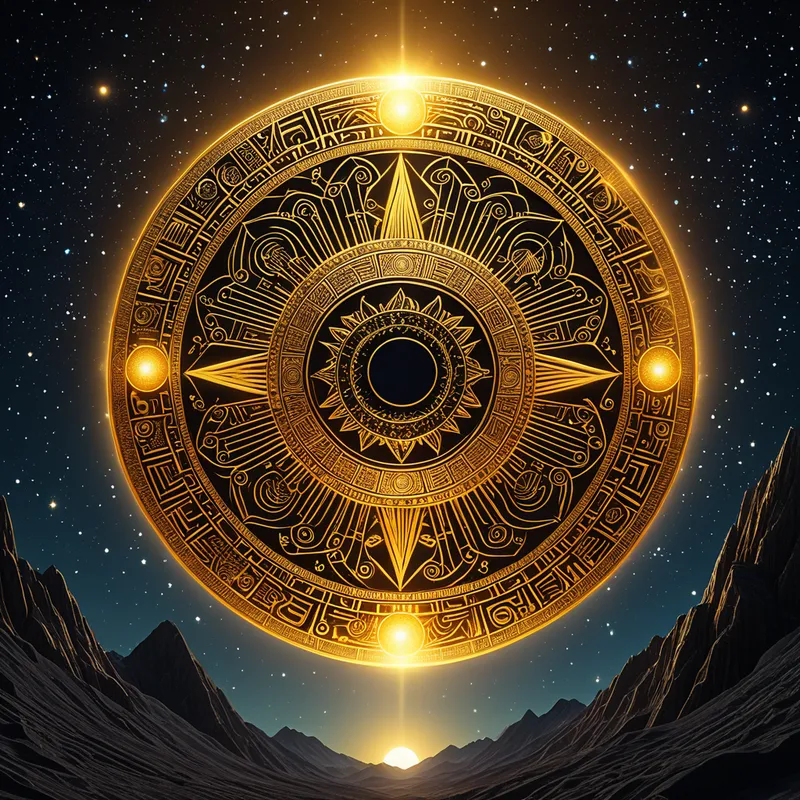
Listen, and let the breath of the ancient world fill your lungs. In the time before time, when the heavens were newly forged and [the earth](/myths/the-earth “Myth from Hindu culture.”/) was still soft with potential, there existed a perfect order. At the heart of this order was the Tablet of Destinies, and from its power flowed the light of [the world](/myths/the-world “Myth from Tarot culture.”/)—the Solar Disc. It was not merely a sun, but the very embodiment of divine authority, the radiant decree that separated day from night, law from chaos, and gave rhythm to all creation.
This Disc hung in the celestial vault, entrusted to the great god Anu. Its light was administered by Shamash, who each day would harness its power to ride across [the sky](/myths/the-sky “Myth from Persian culture.”/) in his chariot, bringing vision, [justice](/myths/justice “Myth from Tarot culture.”/), and warmth to the land between the two rivers. The world thrived under this predictable, golden gaze.
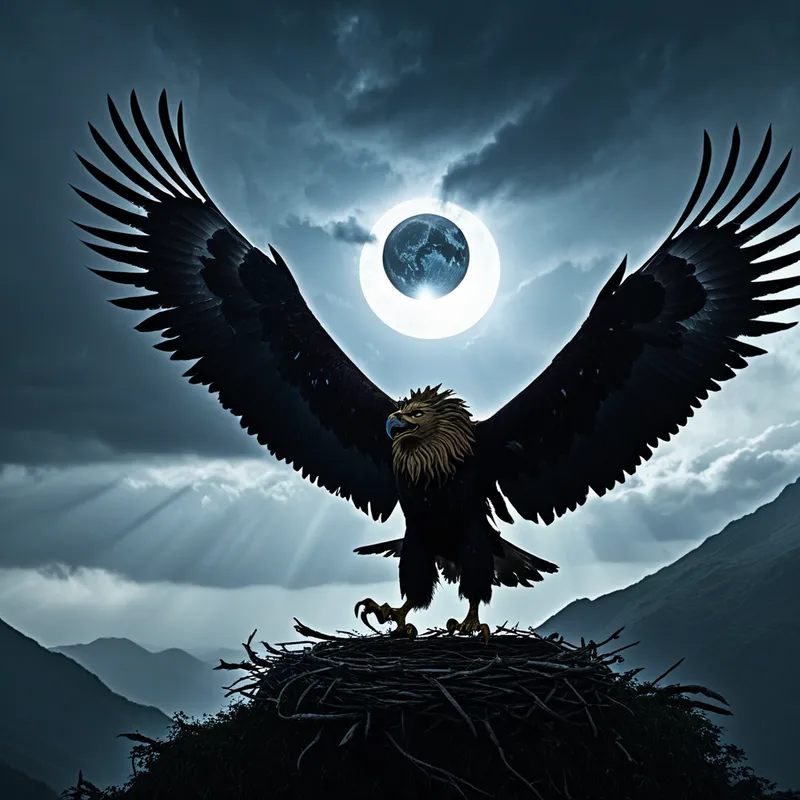
But in the high, inaccessible mountains, a covetous heart beat. The Anzu bird, a being of immense strength and primordial cunning, served as a guardian. It watched the Disc, not with reverence, but with a growing, shadowy hunger. It saw not illumination, but absolute power. One fateful moment, as the divine order turned its attention elsewhere, Anzu struck. With a shriek that tore the fabric of the sky, it descended, its talons seizing the blazing Disc from its rightful place. The world plunged into a terrible, grey twilight. The rhythm was broken. Time itself seemed to stutter and slow.
Chaos, the old enemy, began to stir in the shadows. Without the Disc’s decree, laws lost their meaning. The boundaries between realms grew thin. A great lament rose from the gods themselves, for who could wrest the Disc from the monster’s mountain fortress? The warrior god Ninurta stepped forward, his heart filled with the fury of a coming storm. The air grew heavy with the scent of ozone and dust as he ascended the treacherous slopes, his weapons gleaming dully in the stolen half-light.
The battle was a cataclysm that shook the roots of the mountains. Anzu, empowered by the stolen light, unleashed winds that could flay stone and a voice that could shatter resolve. Ninurta’s arrows were turned aside, his spear seemed to strike mist. The hero faltered, his strength bleeding into the chaotic gale. It was his father, Ea, the deep well of cunning, who intervened. Ea whispered a strategy into the winds, a secret of the monster’s own nature. He instructed Ninurta to sever the pinions of the great bird’s wings, to ground the symbol of its stolen ascent.
With this wisdom, Ninurta renewed his assault. He did not meet chaos with brute force alone, but with directed, intelligent action. He aimed not for the heart shielded by light, but for the wings that gave it flight. One by one, the great feathers were cut. The Anzu bird’s shrieks turned from [triumph](/myths/triumph “Myth from Roman culture.”/) to despair as it spiraled down from its high perch. The Solar Disc, released from its grasp, blazed forth anew, its light rushing over the peaks and valleys like a golden tide, scouring the shadows and restoring the sacred boundaries. Ninurta returned the Disc to the assembly of the gods. Order was restored, not by the old, static power, but by a power tested, earned, and made wise through conflict. The world breathed again, its rhythm secured by a hero’s struggle.
Cultural Origins & Context
This myth, woven from strands found in fragments of Akkadian and Sumerian literature, such as the Anzu myth and the lore surrounding Ninurta and [the Tablet of Destinies](/myths/the-tablet-of-destinies “Myth from Mesopotamian culture.”/), was not mere entertainment. It was a foundational narrative for the Mesopotamian worldview, recited by priests and scribes in temple complexes that served as [the axis mundi](/myths/the-axis-mundi “Myth from Chinese culture.”/) connecting heaven and earth. In a land defined by the unpredictable floods of [the Tigris and Euphrates](/myths/the-tigris-and-euphrates “Myth from Mesopotamian culture.”/) and the relentless sun, the concept of me (divine decrees or fundamental principles of civilization) was paramount. The Solar Disc symbolized the supreme me of kingship and cosmic order.
The story functioned as a theodicy—an explanation for the presence of chaos and evil—and a legitimization of divine and royal authority. Just as Ninurta restored order, so too must the king, the shepherd of the people, combat chaos (famine, invasion, lawlessness) to uphold the divine mandate. The myth was performed to reinforce this sacred contract, reminding the community that the light of society—justice, agriculture, law—was a hard-won prize, constantly under threat from forces of entropy and must be vigilantly protected through both courage and wisdom.
Symbolic Architecture
At its core, the myth of the Solar [Disc](/symbols/disc “Symbol: A disc often symbolizes cycles, continuity, and wholeness, reflecting the interconnectedness of experiences and the self.”/) is an archetypal [drama](/symbols/drama “Symbol: Drama signifies narratives, emotional expression, and the exploration of human experiences.”/) of the [psyche](/myths/psyche “Myth from Greek culture.”/)’s centralizing function. The [Disc](/symbols/disc “Symbol: A disc often symbolizes cycles, continuity, and wholeness, reflecting the interconnectedness of experiences and the self.”/) is not just a celestial [body](/symbols/body “Symbol: The body in dreams often symbolizes the dreamer’s self-identity, personal health, and the relationship they have with their physical existence.”/); it is the Self, the luminous core of individual and cosmic order. It represents the organizing principle that gives [life](/symbols/life “Symbol: The symbol of ‘Life’ represents a journey of growth, interconnectedness, and existential meaning, encompassing both the joys and challenges that define human experience.”/) meaning, [direction](/symbols/direction “Symbol: Direction in dreams often relates to life choices, guidance, and the path one is following, emphasizing the importance of navigation in personal journeys.”/), and coherence.
The theft of the light is the inevitable descent into chaos that precedes any real growth. One must lose the naive, inherited order to forge a conscious one.
The Anzu [bird](/symbols/bird “Symbol: Birds symbolize freedom, perspective, and the connection between the earthly and spiritual realms, often representing the soul’s aspirations or personal growth.”/) embodies the shadowy, autonomous complex that can seize control of the [personality](/symbols/personality “Symbol: Personality in dreams often symbolizes the traits and characteristics of the dreamer, reflecting how they perceive themselves and how they believe they are perceived by others.”/). It is the potent, often destructive, [aspect](/symbols/aspect “Symbol: A distinct feature, quality, or perspective of something, often representing a partial view of a larger whole.”/) of the psyche—ambition, envy, or raw instinct—that recognizes the power of the central Self and attempts to claim it for its own aggrandizement, divorcing it from its integrative function. This leads to a state of inner “[twilight](/symbols/twilight “Symbol: A liminal period between day and night symbolizing transition, ambiguity, and the blending of opposites.”/),” where one feels disconnected, purposeless, and ruled by a monolithic, selfish drive.
Ninurta represents the heroic ego-[consciousness](/symbols/consciousness “Symbol: Consciousness represents the state of awareness and perception, encompassing thoughts, feelings, and experiences.”/) that must engage in the struggle for restitution. His initial failure signifies that brute willpower is insufficient against a complex rooted in the unconscious. Ea, the god of the watery deeps and wisdom, symbolizes the guiding [insight](/symbols/insight “Symbol: A sudden, deep understanding of a complex situation or truth, often arriving unexpectedly and illuminating hidden connections.”/) that arises from the unconscious itself when approached with respect. The [strategy](/symbols/strategy “Symbol: A plan of action designed to achieve a long-term or overall aim, often involving competition, resource management, and foresight.”/) to “clip the wings” is profoundly symbolic: it means to ground the inflated complex, to take away its [ability](/symbols/ability “Symbol: In dreams, ‘ability’ often denotes a recognition of skills or potential that one possesses, whether acknowledged or suppressed.”/) to “fly” into grandiose fantasies or tyrannical control, rendering it manageable.
The Dreamer’s Resonance
When this myth stirs in the modern dreamer, it often manifests as a profound sense of something vital being stolen or obscured. One may dream of a precious, glowing object—a gem, a key, a child—being taken by a bird of prey or a shadowy thief. The dream landscape feels muted, grey, and stagnant. Alternatively, the dreamer might be the Anzu bird, hiding in a high, lonely place with a treasure that feels both powerful and isolating, filled with a guilty, defensive pride.
Somatically, this can correlate with feelings of chronic fatigue (the stolen light), anxiety (the unsettled chaos), or a rigid, defensive posture (guarding the complex). Psychologically, the dreamer is experiencing a state where a powerful complex—perhaps a driven ambition, a consuming resentment, or an addictive pattern—has hijacked the individual’s central energy and purpose. The conscious personality feels powerless, living in [the shadow](/myths/the-shadow “Myth from Jungian culture.”/) of this autonomous “monster” that lives in the mountainous terrain of their own unconscious.

Alchemical Translation
The journey of the Solar Disc is a perfect map for the alchemical process of individuation. The initial state is the [prima materia](/myths/prima-materia “Myth from Alchemical culture.”/): a naive, taken-for-granted wholeness (the Disc in Anu’s keeping). The necessary first stage is the [nigredo](/myths/nigredo “Myth from Alchemical culture.”/), the blackening: the theft by Anzu. This is the painful but essential dissolution of the old, unconscious personality structure. The light is not destroyed; it is merely hidden in the shadow, forcing a crisis.
The hero’s battle is not to destroy the shadow, but to separate its stolen light from its chaotic form. The monster must be transformed, not slain.
Ninurta’s engagement is the albedo, the whitening—the conscious struggle for clarity. His failure and Ea’s counsel represent the crucial dialogue between [the ego](/myths/the-ego “Myth from Jungian culture.”/) and the deeper wisdom of the unconscious (the [Solutio](/myths/solutio “Myth from Alchemical culture.”/)). The solution comes not from above, but from below, from the watery realm of Ea, symbolizing fluid insight and adaptive intelligence.
The grounding of Anzu—clipping its wings—is the citrinitas, the yellowing, where the raw power of the complex is tamed and its energy made available. Finally, the restoration of the Disc is the [rubedo](/myths/rubedo “Myth from Alchemical culture.”/), the reddening. This is not a return to the beginning, but the achievement of a new, conscious wholeness. [The Self](/myths/the-self “Myth from Jungian culture.”/) is reinstated at the center, but now the ego has experienced the struggle. It knows the cost of order and the nature of chaos. The light is the same, but the one who sees it has been forever changed. The modern individual undergoing this process moves from being a passive holder of an identity to an active steward of their own sovereignty, having rescued their purpose from the tyrannical complexes that sought to claim it.
Associated Symbols
Explore related symbols from the CaleaDream lexicon: