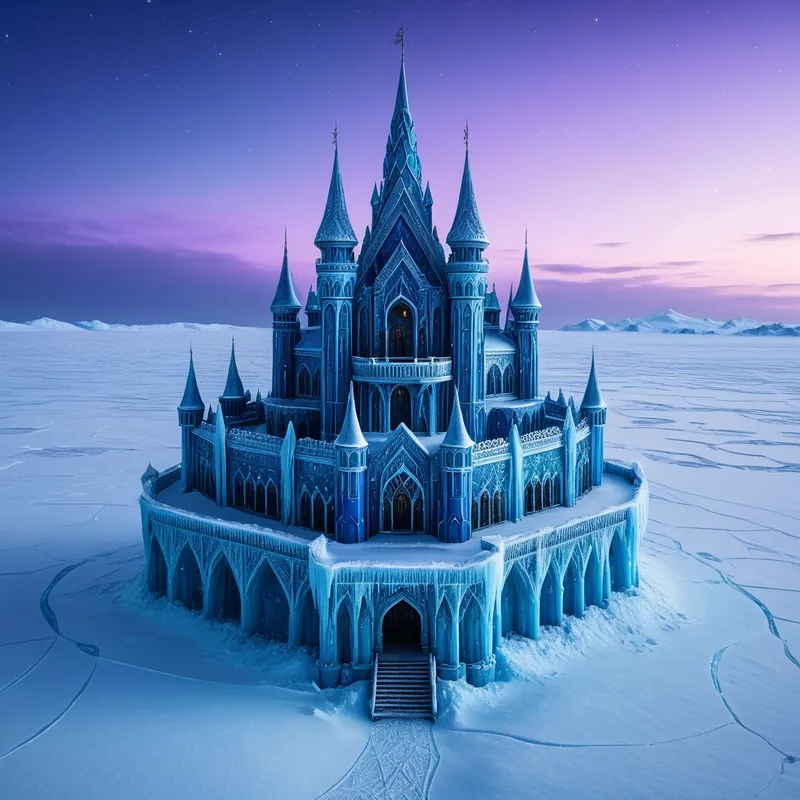
The Snow Queen's Palace Myth Meaning & Symbolism
A hero journeys to a palace of eternal winter to rescue a captive heart, confronting a queen of ice to reclaim warmth and wholeness.
The Tale of The Snow Queen’s Palace
Listen, and let the cold wind carry you to a time when winter was not a season, but a kingdom. In a land of hearth-smoke and laughter, there lived two souls bound by a bond purer than spring water. One was bright-eyed and full of song; the other, thoughtful, with a heart like a sun-warmed stone. But the world is not made only of warmth.
From the farthest North, where the sun forgets to rise, she came. The Snow Queen rode the blizzard, a woman wrought of moonlight and hoarfrost, beautiful as a crack in the sky and just as merciless. Her gaze was a shard of the black mirror at the world’s edge, and where it fell, warmth died. With a kiss colder than the grave, she touched the thoughtful one’s heart. Not a kiss of malice, but of absolute negation. In an instant, the world of firelight and friendship turned grey and distant. The heart did not break; it simply… stilled, encased in a shell of perfect, logical ice.
The bright-eyed one watched their companion become a stranger, eyes empty as polished quartz, speaking only of the perfect, cold geometry of snowflakes. Then, the Queen returned on a gust of wind, and the enchanted one went willingly, drawn to the source of the chill that now defined them. The palace awaited—a fortress of solitude built from the tears of forgotten summers, its spires piercing a sky the color of a bruise.
And so the journey began. The one left behind, the one who still felt, cast off their childhood cloak and stepped into the white waste. This was no land for maps. They faced the Wind That Whispers Lies, which tried to bury their purpose under drifts of doubt. They bargained with the Woman of the Firs, who gave them a clue written in the pattern of pine needles. They crossed the Plain of Forgetting Silence, where each step threatened to become the last.
Finally, it rose from the glacial plain: The Snow Queen’s Palace. Its gates were open, for cold fears no thief. Inside, the air did not move. In the throne room of eternal frost, their lost friend sat, pale and beautiful, fitting shards of ice into a cold, intellectual puzzle, oblivious to all else. The Queen smiled, a crack in a glacier. “You see? He is content. He sees the world as it truly is: perfect, clear, and cold.”
But the rescuer did not fight with a sword. They fought with memory. They spoke of the smell of baking bread, the stupid joke that made milk come out of a nose, the shared blanket on a chilly evening—small, fragile, warm things. The frozen one did not hear. Despairing, the traveler began to weep, hot tears falling onto the icy floor and their companion’s stiff hands. And as those tears fell, as love expressed its pure, somatic truth, the spell of perfect cold met its only antidote. The ice in the heart did not shatter; it sighed, and turned to water. The eyes thawed, filling with recognition, then horror, then warmth. The puzzle of ice was forgotten. Together, hand in now-warm hand, they walked out of the palace, and as they crossed its threshold, a sound like a million sighs rose behind them. The palace of eternal winter, its reason for being melted away, began to dissolve into a spring mist.
Cultural Origins & Context
This tale, in its myriad forms, is woven deeply into the fabric of French contes merveilleux (wondrous tales). Unlike the more courtly contes de fées of the 17th-century salons, this story carries the older, rougher grain of folk tradition, passed down by the hearth in regions where winter was a tangible, formidable presence—the Alps, the Pyrenees, the harsh landscapes of the north. It was a story told by grandparents to children shivering by the fire, a narrative that gave form and agency to the very real fear of the cold that could steal livestock, crops, and life itself.
The figure of the Reine des Neiges (Queen of the Snows) exists in a liminal space between a natural force and a fairy being. She is not inherently evil in the moralistic sense; she is a sovereign of her own domain, representing an absolute principle—Winter, Stasis, Intellectual Detachment. The storytellers, often women, used her to articulate a profound understanding: that the greatest danger is not always a monster of heat and rage, but the slow, seductive creep of coldness into the human soul. The tale served as a societal warning against emotional isolation and a celebration of the resilient, active warmth of community and devoted love, which were essential for survival in both a physical and psychological sense.
Symbolic Architecture
At its core, the myth is a profound map of a psychic schism and its repair. The two friends represent a unified human wholeness that has been split. One embodies the feeling function, the connected, relational, warm heart. The other embodies the thinking function, which, when severed from feeling, becomes a cold, analytical, and detached intellect.
The kiss of the Snow Queen is not an attack, but an enchantment: it is the seduction of the intellect by its own brilliance, divorced from the messiness of the heart.
The Palace of Ice is the symbolic embodiment of this state. It is beautiful, orderly, and dead. It represents a psychological complex of superiority-in-isolation, where the individual feels perfectly clear and in control, yet is utterly cut off from the flow of life, relationship, and transformation. The journey, then, is not to slay a dragon, but to remember and re-feel. The hero’s weapons—memory, story, and ultimately, tears—are the tools of the heart. The tears are particularly alchemical; they are somatic, salt-water, the ocean of feeling breaking upon the shore of intellect, initiating a thaw.
The Dreamer’s Resonance
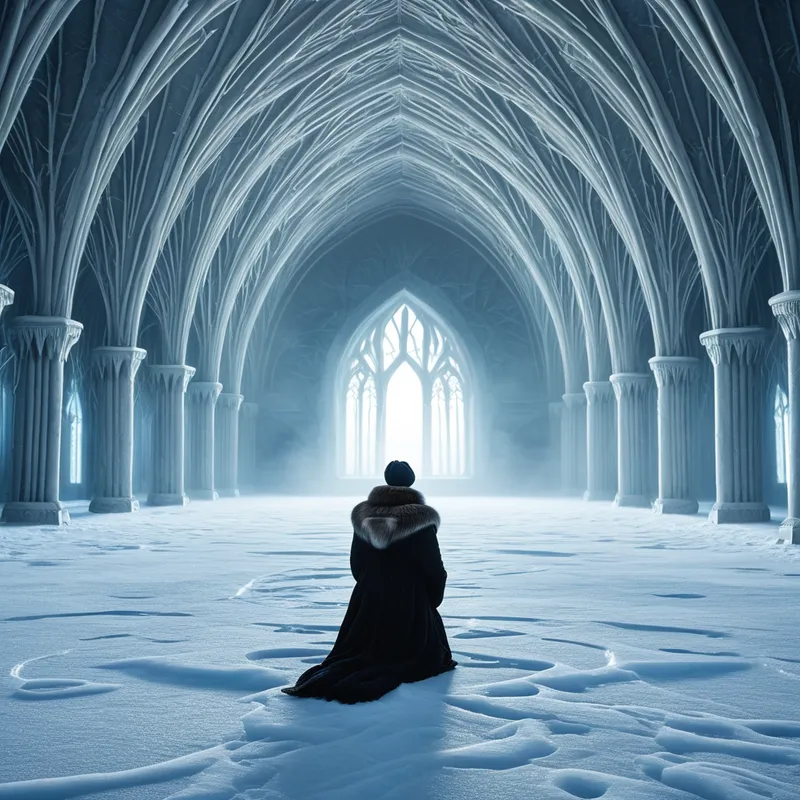
When this myth stirs in the modern dreamscape, it often signals a confrontation with what we might call a “frozen complex.” A dreamer may find themselves in endless, beautiful hallways of glass or ice, feeling calm but profoundly lonely. They may encounter a loved one who is physically present but emotionally distant, their eyes blank. Or they may be the one trying to speak, but their words turn to frost in the air.
Somatically, this can correlate with experiences of dissociation, a sense of being “frostbitten” emotionally, or a rigid, cold tension in the body—often in the chest or heart space. Psychologically, it is the process of recognizing where in one’s life the warmth has gone out. Where have we, perhaps proudly, built a palace of intellectual justification, career obsession, or emotional withdrawal? The dream is the psyche’s attempt to send the “feeling function,” the inner hero, on the journey to that frozen place to begin the work of re-integration.

Alchemical Translation
The individuation process, the journey toward psychic wholeness, is perfectly modeled in this tale. The initial state is one of naive unity (the two friends). The separatio is the Snow Queen’s kiss—the necessary, if painful, differentiation of the intellect from the undifferentiated emotional mass. This creates the conscious mind but risks its total identification with cold logic (the captive in the palace).
The hero’s journey is the arduous nigredo of the feeling function descending into the frozen underworld of its opposite. The confrontation in the throne room is the coniunctio oppositorum—the conjunction of opposites. Here, feeling (tears) does not battle thinking; it melts it. It does not destroy the ice, but transforms it, returning it to its fluid state.
The triumph is not the death of winter, but the restoration of the cycle. The melted ice becomes the water of life, able to flow again, to nurture, to connect.
For the modern individual, this translates to the healing of the mind-heart split. It is the process of allowing genuine, vulnerable emotion (grief, love, longing) to touch our most rigidly held intellectual positions, our frozen traumas, or our isolated identities. The “palace” that dissolves is the ego’s fortress of cold self-sufficiency. What remains is not a return to childish warmth, but a mature, flowing wholeness where thought is informed by feeling, and feeling is given clarity by thought—a self that can withstand winter’s chill without becoming ice.
Associated Symbols
Explore related symbols from the CaleaDream lexicon: