The Signifying Monkey Myth Meaning & Symbolism
A trickster tale of a monkey who uses wit and words to survive, revealing the power of intellect over brute force and the alchemy of language.
The Tale of The Signifying Monkey
Listen close, and let the story settle in the bone. This ain’t no fable for the faint of heart. It’s a story spun in the deep green belly of the world, where the air is thick enough to drink and the shadows hold old, knowing things.
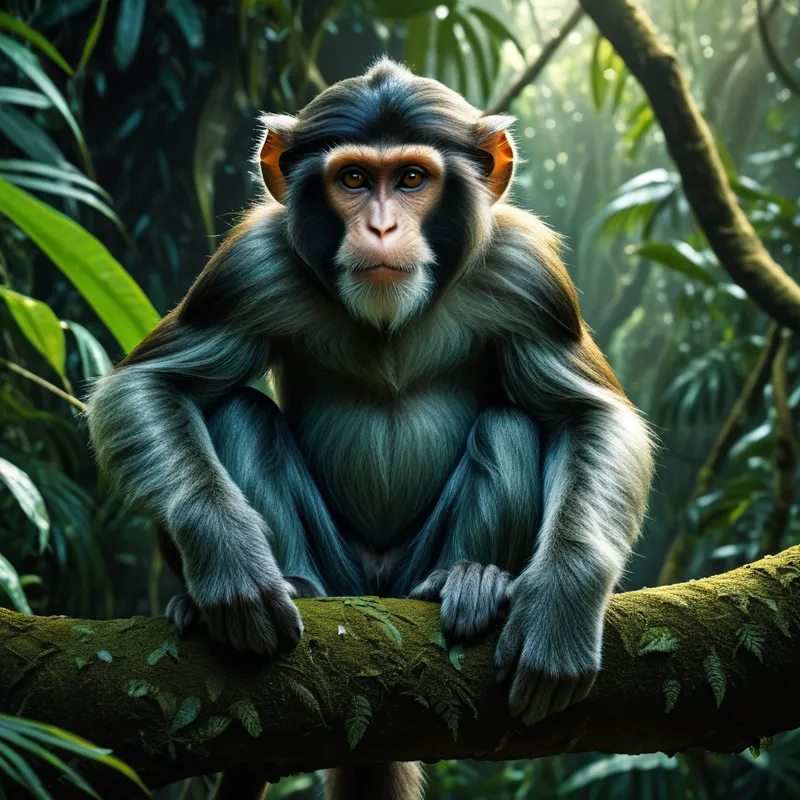
High up in the canopy, where the sun dapples the leaves into coins of light, lives he who is called the Signifying Monkey. Don’t let his size fool you. His kingdom is built not on muscle, but on the music of his mouth, the sharp, sweet poison of his words. He sees the whole jungle from his perch, a living map of pride and power.
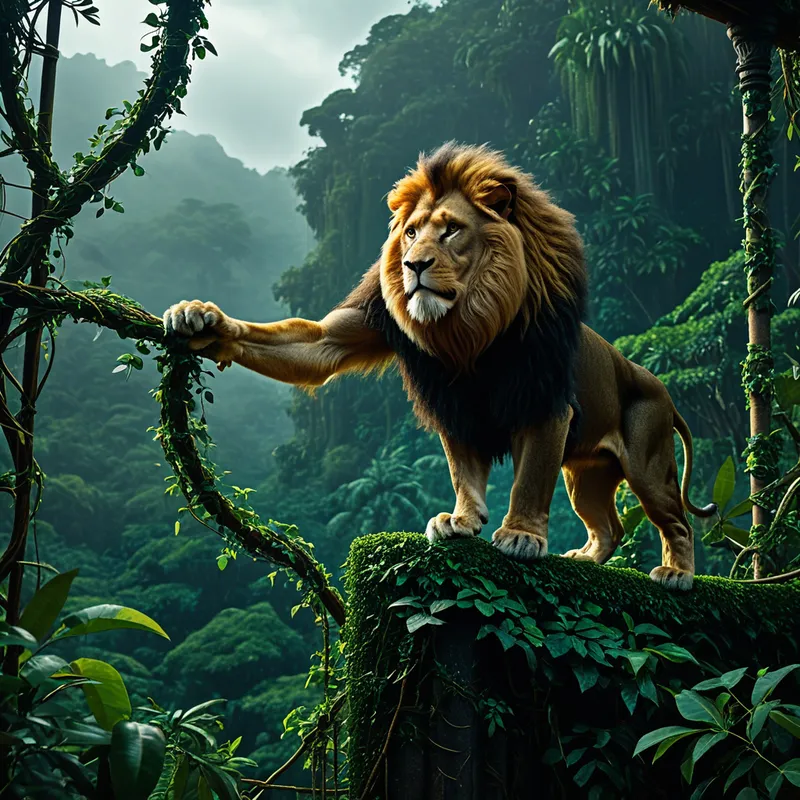
And down below, on the sun-baked earth, walks the Lion. His roar shakes the very roots. His pride is a tangible force, a golden aura of unquestioned rule. He is the law of tooth and claw, moving with a heavy, terrible grace.
And then there is the Elephant. A mountain that walks, a creature of immense, patient strength. He minds his own, a quiet force in the noisy world.
One hot, still afternoon, the Monkey’s mind begins to turn, a sly engine clicking into gear. He calls down to the Lion, his voice honey and thorn. “Oh, Lion! King! I heard something today that burns my ears to repeat. A terrible slander against your mighty name.”
The Lion’s great head lifts, eyes like molten gold. “Speak it,” he growls, the air vibrating.
The Monkey feigns a shudder, wrapping his tail tight. “It was the Elephant. He was stomping through the mud, and he said… he said your mama was common. He said your papa was a fraidy-cat. He said your roar sounds like a kitten with a bellyache. He laughed, Lion. He laughed and said he wasn’t afraid of no ‘so-called king.’”
A silence falls, deeper than before. The Lion does not roar. The heat of his rage is a silent, expanding thing. His tail twitches once, a deadly metronome. Without another word, he turns, a golden storm of purpose, and crashes through the undergrowth.
The Monkey watches, a smile playing on his lips. He swings to a higher branch to see the spectacle.
The Lion finds the Elephant by the watering hole, serene and immense. “ELEPHANT!” The challenge is thunder. “You have spoken against my line! You have mocked my throne!”
The Elephant, bewildered, blinks his small, wise eyes. “Lion, I said no such—”
But the Lion is already a blur of fury. He leaps, claws out, aiming for the thick hide. The Elephant, startled into his own power, rears. What follows is not a fight, but an earthquake. The jungle itself seems to protest. Trees shake. Birds scream into the sky. The Lion is fierce, but the Elephant is a force of nature. With a mighty heave, he tosses the Lion. He stomps. He uses his great trunk like a club.
When the dust settles, the Lion is a battered, bruised wreck of his former glory. His mane is matted with dirt and leaves. He limps away, every step an agony of defeat and confusion.
He staggers back to the clearing beneath the Monkey’s tree, collapsing with a groan. He looks up, pain and fury mixing in his gaze. “Monkey… you told me true. The Elephant… he near killed me.”
From his safe, green throne, the Signifying Monkey looks down. He tilts his head, and his voice is no longer honey, but the clear, cold chime of a truth long known. “Lion,” he says, and the word hangs in the air. “If you thought the Elephant was talking shit about you… you should have heard what he said about your mama.”
And with that, the Monkey swings away, vanishing into the labyrinth of leaves, his laughter a rustling, echoing thing—a sound not of mockery, but of a terrible, ancient lesson finally delivered.
Cultural Origins & Context
This is not a story from a single book or a singular tribe. It is a story born of the Middle Passage, tempered in the crucible of the plantation, and honed on the street corners of the New World. The myth of the Signifying Monkey is a core narrative of the African Diaspora, a toast and a trickster tale that traveled from West African folklore (akin to the Anansi spider tales) across the Atlantic.
It survived and evolved in the hush arbors of the American South, in the juke joints, and later in the improvisational battlegrounds of blues lyrics, jazz riffs, and hip-hop’s earliest boastful rhymes. It was performed, not just told. Passed down by griots of the new world—elders, musicians, hustlers, and poets—it served a vital societal function. In a world where direct confrontation with overwhelming power (the Lion/oppressor) meant annihilation, the story celebrated the survival tools of the dispossessed: indirection, satire, linguistic agility, and supreme intellectual cunning. It was a manual for psychic survival, teaching that the word could be a weapon, a shield, and a means of liberation when physical strength was not an option.
Symbolic Architecture
The myth presents a perfect, brutal triad of psychic forces. The Lion is the archetype of undisputed, egoic power—the ruling consciousness that believes its strength is absolute and its position unassailable. He is pride incarnate, but a pride that is brittle because it is untested by wit.
The Elephant represents the blind, impersonal force of nature or the system—sheer, overwhelming mass and momentum. It is not inherently evil, but it is dangerous when provoked and directed by a clever intelligence. It is the unconscious, raw power that can be weaponized.
The Signifying Monkey is the archetypal Trickster, but specifically, he is the psyche’s intellect and linguistic consciousness. He is the mind that observes the dynamics of power from a detached, strategic vantage point. His weapon is signification—the ability to use language not just to communicate, but to manipulate meaning, to “read” a situation, and to reframe reality itself. He does not fight the Lion; he gets the Lion to fight his own shadow, projected onto the Elephant.
The core alchemy here is the transmutation of a direct, physical conflict into an indirect, linguistic one. The Monkey’s victory is not in defeating the Lion, but in revealing the Lion’s own inner weakness—his gullibility, his rage, and his inability to discern truth from strategically deployed fiction. The Monkey survives and triumphs by living in the realm of the symbolic, where he is king.
The Dreamer’s Resonance
When this mythic pattern stirs in the modern dreamer, it signals a profound engagement with the Shadow and the dynamics of personal power. To dream of being the Monkey is to recognize a situation where you feel physically or socially outmatched, but where your wit, your voice, or your unique perspective is your true asset. There is a somatic feeling of tension, of a coiled, clever energy in the throat and mind, seeking the perfect words to navigate an impossible-seeming power dynamic.
To dream of being the battered Lion is to experience the shocking humiliation of the ego. It is the realization that your raw strength, your title, your pride has been useless or even turned against you by a force you underestimated. The body feels heavy, bruised, and foolish. This dream invites a painful but necessary lesson in humility and the limits of brute-force approaches to life’s complex problems.
The dream is a call to develop the Monkey’s art: to step back, to observe the true players and their motivations, and to use the alchemy of perception and communication to change the game itself.
Alchemical Translation
The individuation process modeled here is the liberation of consciousness from identification with the Lion—the tyrannical, prideful ego that believes it must meet every challenge with direct force. The Monkey represents the emerging capacity for reflective consciousness. He is the part of the Self that can see the ego’s posturing and the world’s reactions as a system.
The first alchemical stage is Observation (the Monkey on his perch). One must withdraw psychic projection and see the “Lions” and “Elephants” in one’s life—the inner and outer forces of pride and blind power—as they are, not as we fear or revere them.
The second is Linguistic Transmutation (the act of signifying). This is the crucial work of taking a raw, painful, or oppressive situation (the Lion’s threat) and reframing it in the psyche. It is the therapeutic act of naming the dynamic, of turning a feeling of powerless rage into a strategic narrative. It is the poet’s and the therapist’s art.
The final stage is Orchestrated Confrontation (the Lion vs. the Elephant). This is not about causing chaos for its own sake, but about allowing the unconscious, shadowy forces (the Elephant of repressed emotion or systemic pressure) to engage directly with the inflated ego, thereby wearing down its rigid dominance. The conscious mind (the Monkey) does not fight; it directs the encounter from a place of safety, allowing a necessary, humbling integration to occur. The result is not the death of the Lion, but its wounding and education—a more grounded, less arrogant ego-structure that has been forced to acknowledge a power greater than its own will.
Associated Symbols
Explore related symbols from the CaleaDream lexicon:
- Trickster — The central archetype of the myth, representing the use of wit, cunning, and boundary-crossing to disrupt rigid order and enact change from the margins.
- Monkey — The specific embodiment of agile intellect, curiosity, and the ability to navigate complex social and psychic structures from a vantage point of detachment.
- Lion — Symbolizes raw egoic power, pride, kingship, and the often-brittle force of unquestioned authority that is vulnerable to manipulation.
- Shadow — The unconscious content (rage, gullibility, brute force) that the Monkey manipulates and the Lion must confront when he battles the Elephant.
- Word — The primary weapon and tool of the Monkey, representing the transformative, creative, and destructive power of language and signification.
- Forest — The dense, complex realm of the psyche or society where these power dynamics play out, a place of both danger and opportunity.
- Mask — Represents the personas and false narratives the Monkey crafts and the Lion wears; the myth is about seeing behind the mask of power.
- Rage — The blind, explosive force that the Lion embodies and that the Monkey expertly channels away from himself and toward a larger target.
- Wit — The sharp, discerning intelligence that allows for survival and mastery in situations where direct confrontation would mean destruction.
- Order — The rigid hierarchy of the jungle (Lion on top) that the Trickster Monkey exists to challenge, test, and ultimately transform through chaos.