The Signet Ring of King Solomon Myth Meaning & Symbolism
A king loses his sacred ring of authority, his kingdom falls to a demon, and he must reclaim his true name to restore divine order from chaos.
The Tale of The Signet Ring of King Solomon
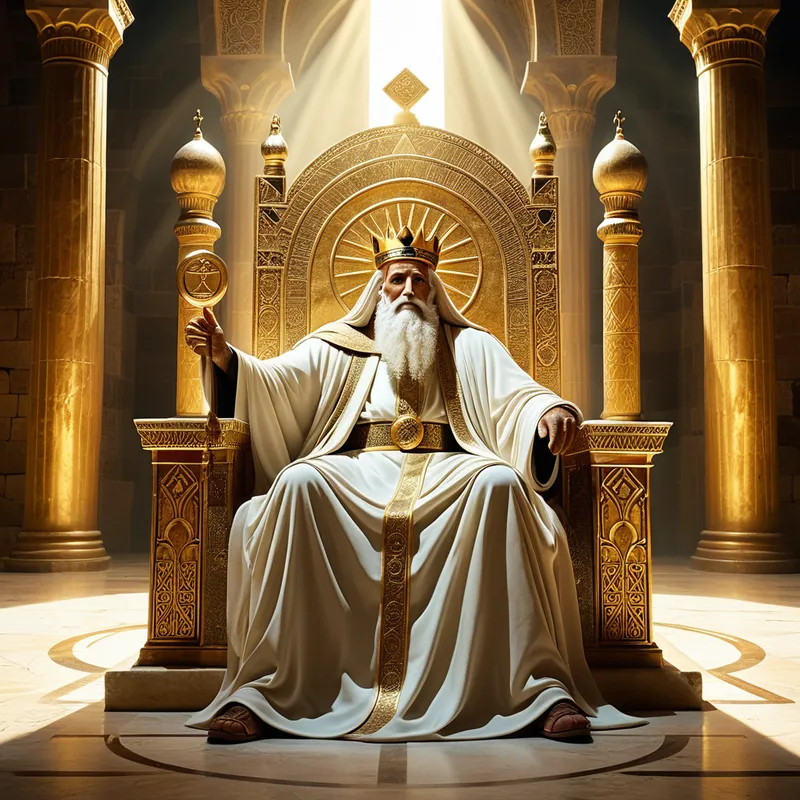
Hear now the tale of the wisest of kings, whose name was a seal upon [the world](/myths/the-world “Myth from Tarot culture.”/). In the days when [Solomon’s Temple](/myths/solomons-temple “Myth from Biblical culture.”/) pierced the heavens and peace lay heavy on the land like a golden cloak, the king possessed a power beyond the sword. It was a ring, a simple band of iron and brass, yet upon its bezel was engraved the Shem HaMephorash, [the True Name](/myths/the-true-name “Myth from Various culture.”/) that commands creation. With this ring, [Solomon](/myths/solomon “Myth from Biblical culture.”/) did not merely rule men; he commanded the winds, understood the speech of beasts, and held dominion over all the spirits, the shedim, binding them to his will to raise his city from the dust.
But pride is the rust of the soul, and even a king’s vigilance can falter. One evening, by the waters of the Kidron, Solomon removed the ring to purify himself. In that unguarded moment, the Ashmedai, the prince of demons, who had long chafed under the ring’s authority, saw his chance. He stole the ring from the riverbank and cast it into the deep, uncharted sea. Then, taking the very form of the king—his face, his bearing, his royal robes—Ashmedai sat upon the ivory throne. The true Solomon, returning, found a stranger wearing his face, who looked upon him with cold, mocking eyes and had him driven from the city as a mad impostor.
Thus began the king’s exile. The man who once commanded legions now wandered, a beggar known only as “[the fool](/myths/the-fool “Myth from Tarot culture.”/) who thinks he is Solomon.” He tasted the dust of the road, felt the sting of rain without a roof, and heard his own wisdom recounted in taverns as the lost glory of another age. The kingdom, under the demon’s rule, descended into a subtle chaos. Laws were twisted, [justice](/myths/justice “Myth from Tarot culture.”/) grew capricious, and a shadow of unease settled over [Jerusalem](/myths/jerusalem “Myth from Biblical culture.”/), for a ruler without a soul makes a kingdom without a heart.
Years passed. The ragged king found humble work with a fisherman. One day, hauling in a net heavy with a thrashing, silver-scaled catch, the fisherman cut open the great fish. There, in its belly, glinted not a coin, but a ring. The fisherman, seeing it as simple trinket, tossed it to the man he knew as the fool. The moment Solomon’s fingers closed around the cold metal, the world shifted. The weariness fell from him like a shed skin. The authority of the True Name flooded back into his spirit. He did not march with an army; he simply walked back to his city, to the gates of his own palace. The guards, sensing a sovereignty that pierced all illusion, bowed without understanding why. He entered the throne room, and Ashmedai, feeling the ring’s power approach like a rising sun, shrieked and fled, vanishing in a whirlwind of smoke and despair. Solomon sat once more upon his throne. The ring was on his finger. The kingdom was in his hand. And his eyes held the hard-won knowledge of what it means to be cast out, and what it costs to return.

Cultural Origins & Context
The myth of the lost signet ring is not found in the canonical books of the Tanakh, which portray Solomon’s wisdom and reign in a more idealized, historical frame. Its home is in the rich soil of Midrash and later folklore, particularly within the medieval compilation known as the Alphabet of Ben Sira. Here, the stark biblical narrative becomes a vessel for deeper, more psychological and mystical speculation.
Told by rabbis and storytellers, this tale served multiple functions. On one level, it was a cautionary fable about the fragility of divine favor and the perils of pride (gavah). It explained the perceived flaws or downfalls in Solomon’s later reign, as hinted in 1 Kings. More profoundly, it functioned as a mythic exploration of the nature of legitimate authority. True kingship, it suggests, is not inherent in the person but is conferred by a sacred, symbolic covenant (the ring) and can be lost when one becomes careless with one’s connection to the divine source of that power. The story was a tool for teaching that identity and rule are contingent upon a relationship with something greater than [the self](/myths/the-self “Myth from Jungian culture.”/).
Symbolic Architecture
At its core, the ring is the [symbol](/symbols/symbol “Symbol: A symbol can represent an idea, concept, or belief, serving as a powerful tool for communication and understanding.”/) of individuated [authority](/symbols/authority “Symbol: A symbol representing power structures, rules, and control, often reflecting one’s relationship with societal or personal governance.”/). It is not a [crown](/symbols/crown “Symbol: A crown symbolizes authority, power, and achievement, often representing an individual’s aspirations, leadership, or societal role.”/), which can be placed on any head, but a signet, which must bear a unique, inverted [mark](/symbols/mark “Symbol: A ‘mark’ often symbolizes identity, achievement, or a defining characteristic in dreams.”/) to create a legitimate [impression](/symbols/impression “Symbol: An impression symbolizes the impact of experiences and the perceptions formed in waking life.”/). It represents the authentic Self, the “true name” or signature of the [soul](/symbols/soul “Symbol: The soul represents the essence of a person, encompassing their spirit, identity, and connection to the universe.”/) that carries [the authority](/symbols/the-authority “Symbol: A figure representing power, control, and societal structure, often embodying rules, leadership, or external judgment.”/) of one’s own [destiny](/symbols/destiny “Symbol: A predetermined course of events or ultimate purpose, often linked to spiritual forces or cosmic order, representing life’s inherent direction.”/).
The demon does not steal the throne first; he steals the ring. Chaos attacks not the institution of the self, but its authenticating seal.
Solomon’s [exile](/symbols/exile “Symbol: Forced separation from one’s homeland or community, representing loss of belonging, punishment, or profound isolation.”/) represents the catastrophic experience of ego-[dissolution](/symbols/dissolution “Symbol: The process of breaking down, dispersing, or losing form, often representing transformation, release, or the end of a state of being.”/). The wisest man becomes a “[fool](/symbols/fool “Symbol: Represents innocence, risk-taking, and new beginnings. Often symbolizes a leap into the unknown or naive trust.”/).” This is the psychological state where one’s acquired [knowledge](/symbols/knowledge “Symbol: Knowledge symbolizes learning, understanding, and wisdom, embodying the acquisition of information and enlightenment.”/), social [status](/symbols/status “Symbol: Represents one’s social position, rank, or standing within a group, often tied to achievement, power, or recognition.”/), and [persona](/symbols/persona “Symbol: The social mask or outward identity one presents to the world, often concealing the true self.”/) are stripped away, revealing a naked, unrecognized self. The [demon](/symbols/demon “Symbol: Demons often symbolize inner fears, repressed emotions, or negative aspects of oneself that the dreamer is struggling to confront.”/) Ashmedai on the [throne](/symbols/throne “Symbol: A seat of authority, power, and sovereignty, representing leadership, divine right, or social hierarchy.”/) is the autonomous complex or inflated [shadow](/symbols/shadow “Symbol: The ‘shadow’ embodies the unconscious, repressed aspects of the self and often represents fears or hidden emotions.”/) that takes control when the conscious ego is deposed. It rules with a semblance of order, but its law is sterile, imitative, and ultimately destructive because it lacks the soul’s authentic [connection](/symbols/connection “Symbol: Connection symbolizes relationships, communication, and bonds among individuals.”/).
The retrieval from the fish is the quintessential symbol of a gift from the unconscious. [The sea](/myths/the-sea “Myth from Greek culture.”/) is the unknown; the fish is a ancient [Christian](/symbols/christian “Symbol: The symbol represents the faith, teachings, and cultural values associated with Christianity, including themes of love, salvation, and morality.”/) and pre-Christian symbol of [life](/symbols/life “Symbol: The symbol of ‘Life’ represents a journey of growth, interconnectedness, and existential meaning, encompassing both the joys and challenges that define human experience.”/) drawn from the deep. The ring is not fought for on a battlefield; it is received as a grace from the [depths](/symbols/depths “Symbol: Represents the subconscious, hidden emotions, or foundational aspects of the self, often linked to primal fears or profound truths.”/), suggesting that the core of one’s authentic [identity](/symbols/identity “Symbol: Identity represents the sense of self, encompassing personal beliefs, cultural background, and social roles.”/) is not constructed, but discovered, often through humble, embodied work (fishing) and a surrender to processes beyond one’s control.
The Dreamer’s Resonance
When this myth stirs in the modern dreamer, it often signals a profound crisis of authority and identity. To dream of losing a ring, especially one of great personal significance, can point to a feeling of having lost one’s “seal,” one’s sense of authentic purpose or right to exist in one’s own life. The dream ego may find itself powerless, unrecognized, or exiled from its own “kingdom”—be that a career, a relationship, or a sense of self.
Somatically, this can feel like a disembodied fog, a chronic fatigue where one goes through the motions but feels like an impostor in one’s own skin. The rising of the “demonic” usurper in the [psyche](/myths/psyche “Myth from Greek culture.”/) might manifest as compulsive behaviors, a harsh inner critic that sounds like you but is not you, or a sudden, uncharacteristic arrogance that masks a deep insecurity. The dream is mapping the process where a complex—a bundle of unresolved trauma or adopted, false identities—has seized the executive function of the psyche. The healing begins not with a direct assault on the “demon,” but with the long, humble journey of the exiled king, the patient work of attending to the daily net (the mundane life) until the deep Self offers back the forgotten seal.
Alchemical Translation
The myth of Solomon’s ring is a precise map of the individuation process, framed as a [solve et coagula](/myths/solve-et-coagula “Myth from Alchemical culture.”/).
First, there is the initial, brilliant but precarious integration (Solomon’s wise rule). [The ego](/myths/the-ego “Myth from Jungian culture.”/) is in alignment with the Self (the ring), commanding the inner chaos (the spirits) to build a conscious life ([the Temple](/myths/the-temple “Myth from Jewish culture.”/)). But this state contains the seed of inflation—the belief that the power is [the ego](/myths/the-ego “Myth from Jungian culture.”/)’s own.
The crisis (the theft) is the necessary solve, the dissolution. The conscious personality is broken down, its identifying marks stripped away. This is a brutal but sacred descent, where one is forced to live in the shadowlands of one’s own psyche, experiencing the parts of life one’s “kingship” had ignored.
The exile and service represent the crucial, transformative middle stage. The deposed ego must learn humility, embodiment, and patience. It must engage with the simple, instinctual world (fishing) without its former titles. This is the alchemical cooking in the vas, the incubation period where the old identity is composted.
The ring is not remade; it is remembered. The Self does not create itself anew for the ego; it returns the ego to its source.
Finally, the retrieval and restoration are the coagula. The Self, from the depths of the unconscious (the sea, the fish), restores the authenticating symbol. The ego, now tempered by exile, does not destroy [the shadow](/myths/the-shadow “Myth from Jungian culture.”/)-demon with violence, but simply re-embodies its true authority, causing the false complex to dissolve. The return to the throne is not a return to the old state, but the establishment of a new, more conscious order. The king now rules with the hard-earned knowledge of the fool, and the ring’s authority is deepened by the memory of its loss. The individuated Self thus reigns, having integrated the experience of its own opposite.
Associated Symbols
Explore related symbols from the CaleaDream lexicon: