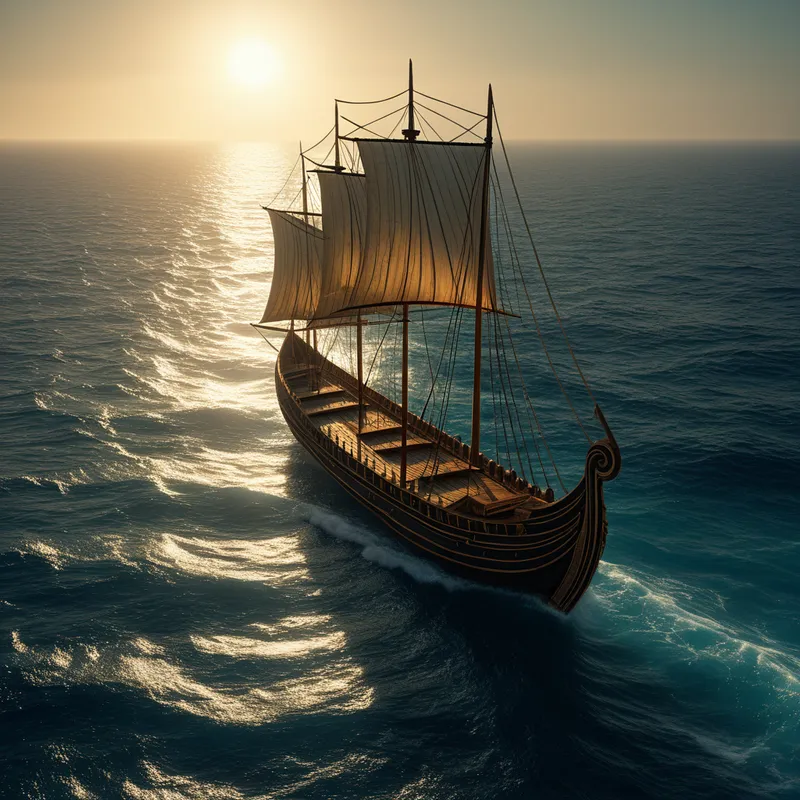
The Ship of Theseus Myth Meaning & Symbolism
A philosophical tale of a ship preserved plank by plank, questioning the nature of identity, continuity, and the self through perpetual renewal.
The Tale of The Ship of Theseus
Listen. The sea does not remember, but the people must. In the great harbor of Athens, where the salt air tastes of victory and memory, there rested a vessel that was more than wood and rope. It was the ship of the king, the hero, the slayer of the Minotaur. Theseus had sailed it home, his sails stained with the sorrow of a forgotten white flag, his hull echoing with the sighs of the youths he saved. The city, in its gratitude, vowed to preserve this sacred relic for all time.
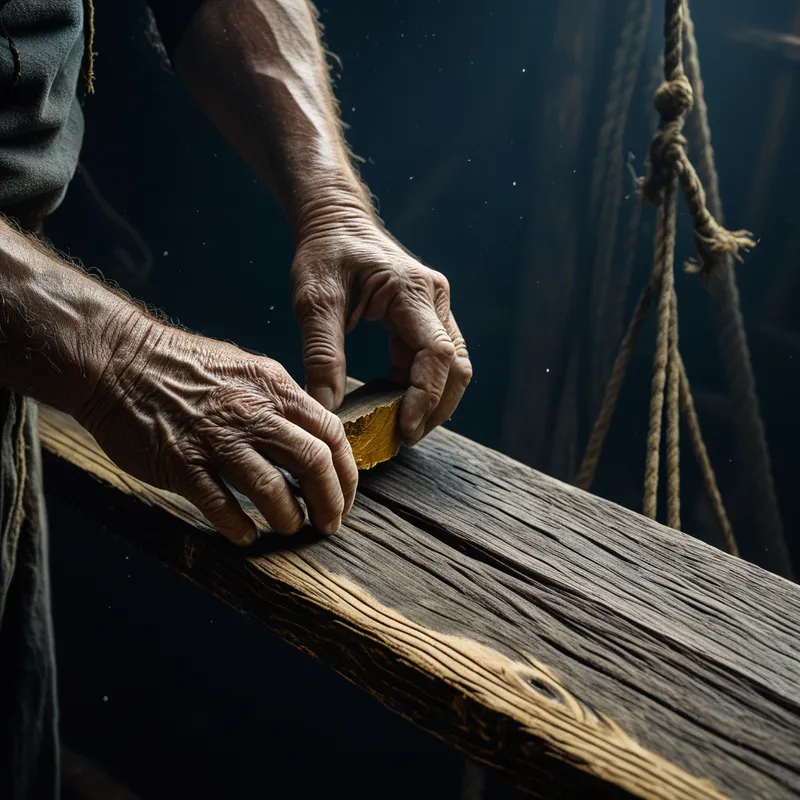
So the ship sat in its honored berth, a monument to courage. The sun baked its decks; the winter storms gnawed at its seams. The first plank to rot was a solemn occasion. The elders gathered, not as engineers, but as priests of continuity. With reverence, they pried the soft, worm-eaten timber from its place. They did not discard it, but laid it in a sacred storehouse, a temple of fragments. In its stead, they fitted a new plank of stout oak, oiled and strong. The ship looked unchanged to the eye.
Seasons turned into years, years into decades. One by one, the original timbers were retired. A rib here, a deck beam there, a mast replaced after a squall. Each old piece joined its brothers in the growing pile of sacred lumber. Each new piece was sworn in with the same ritual. The ship never ceased to be the Ship of Theseus. It was paraded on feast days, its story told to wide-eyed children who touched its—now largely new—hull.
Then came the philosopher, a man who saw the world in questions. He walked the docks, his gaze shifting from the proud ship in the water to the vast collection of aged timber in the shed. He pointed, his voice cutting through the certainty of tradition. “Behold,” he said. “If every piece of the original ship is now stored there, assembled, which is the true vessel? The one that sailed, or the one that sits? If identity lies in the material, then the relic is the pile. If it lies in the form and function, then it is the ship that sails. But they cannot both be the Ship.”
Silence fell, deeper than the harbor’s depths. The sailors looked at their hands, the priests at their rituals. No one had an answer. The question hung in the air, as permanent and unsettling as the ship itself, now sailing on a sea of paradox.
Cultural Origins & Context
This is not a myth of gods and monsters, but of the human mind grappling with its own constructs. The tale emerges from the fertile ground of Hellenistic philosophy, recorded not by poets like Homer, but by thinkers like Plutarch and later, Chrysippus. It was a thought experiment, a paradox wielded in dialogues and schools to probe the nature of identity, change, and ousia.
Its societal function was not to prescribe ritual but to ignite debate. In the agora and the lecture hall, it served as a tool to dissect concepts of the self, the state, and the soul. Was the city of Athens the same city after all its citizens had been replaced over generations? Was a man the same person from childhood to old age? Passed down through philosophical texts, it transcended its Greek origins to become a universal cognitive artifact, a story belonging to “Global/Universal” culture because it addresses a fundamental, human anxiety about permanence in a world of flux.
Symbolic Architecture
The ship is the ego, the “I” we present to the world and believe ourselves to be. The voyage of Theseus represents the heroic journey, the formative trials that initially shape this self. The harbor of preservation is our desperate, human desire for continuity, to fix our identity in time.
The Self is not the planks, but the voyage. The soul is not the memory, but the one who remembers.
The decaying planks are the outmoded beliefs, the childhood traumas, the coping strategies, and the physical cells that compose us but are in constant, invisible replacement. The new timbers are the insights gained, the healing integrated, the new experiences that gradually reshape our being. The sacred storehouse of old parts is the personal unconscious, where we relegate our past selves, our shames, and our outgrown identities. The philosopher’s question is the awakening of the individuation process, the moment the psyche asks: “What, at the core, persists?”
The Dreamer’s Resonance
When this myth stirs in the modern dreamscape, it manifests as dreams of shifting houses where rooms are perpetually being renovated, or of one’s own body being repaired with mechanical or alien parts. You may dream of meeting a younger version of yourself and not recognizing them, or of trying to assemble a crucial object from scattered, mismatched pieces.
Somatically, this can coincide with periods of profound life transition—a career change, the end of a relationship, recovery from illness, or simply the unsettling passage into a new decade of life. The psychological process is one of deintegration. The dream ego is sensing that the old “ship” of its identity is no longer seaworthy; parts of the self feel rotten or inauthentic. The dream work is the unconscious labor of replacement, often felt as anxiety because the conscious mind fears that if too much is changed, “I” will cease to exist. The dream asks the dreamer to sit with the paradox, to feel the continuity of the process itself, rather than clinging to the material of any single plank.
Alchemical Translation
The alchemical process mirrored here is solutio (dissolution) and coagulatio (coagulation). The psychic journey begins with the dissolution of the assumed, rigid identity. We must allow the salted timbers of our past triumphs and wounds to be respectfully removed—not denied, but honored and stored in memory. This is the shadow work of acknowledging what once was essential but is now decayed.
Individuation is the courage to sail a vessel you are simultaneously dismantling and rebuilding, trusting the horizon more than the harbor.
Then comes the coagulation: the conscious, careful integration of new material. This is not haphazard change, but the sacred ritual of choosing sturdier timber—healthier boundaries, more authentic passions, forgiven versions of old stories. The ultimate alchemical gold is not an answer to the philosopher’s question, but the realization that the quest for a static, material “true self” is the illusion. The triumph is in becoming the process of sailing. The lapis philosophorum (Philosopher’s Stone) is the enduring pattern of consciousness that witnesses both the ship in the water and the planks in the shed, and understands they are both true expressions of a single, ongoing story. You achieve psychic transmutation when you can point to both your past sorrows and your present self and say, “All of this is my ship, and I am its endless, willing sea.”
Associated Symbols
Explore related symbols from the CaleaDream lexicon: