The Shepherd's Crook Myth Meaning & Symbolism
A myth of divine guidance and human vulnerability, where a simple crook becomes the instrument of salvation and the burden of ultimate responsibility.
The Tale of The Shepherd’s Crook
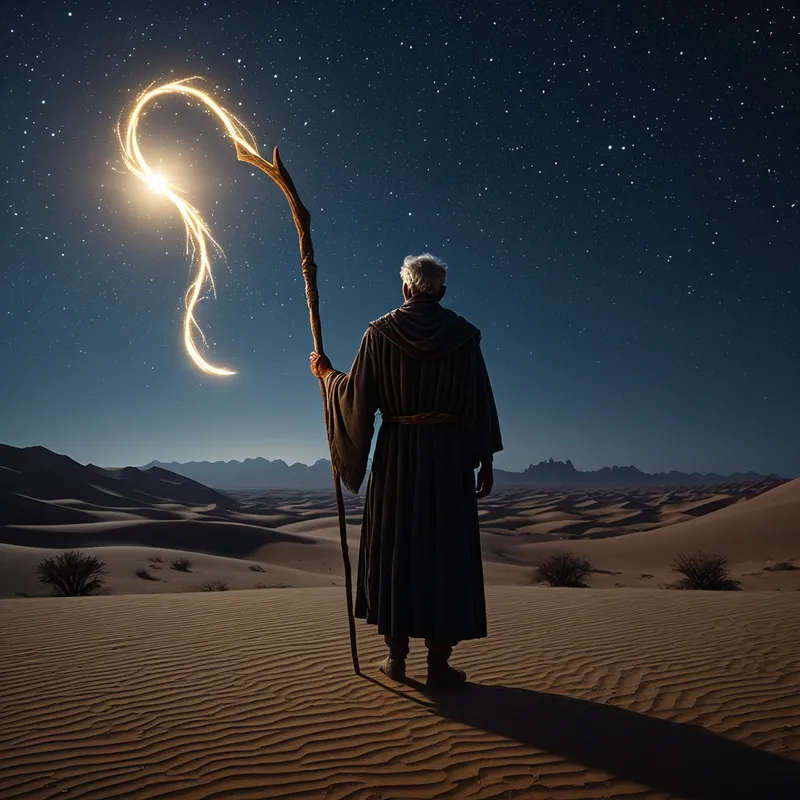
Listen. Before kings and temples, there was the dust, [the wind](/myths/the-wind “Myth from Various culture.”/), and the flock. In a land of burning stone and sudden, life-giving springs, the story begins not with a crown, but with a staff. It was a simple [thing](/myths/thing “Myth from Norse culture.”/), this crook—a length of gnarled almond or oak, worn smooth by a palm and shaped by fire to hold a hook at its end. It was the tool of the forgotten, the symbol of [the wanderer](/myths/the-wanderer “Myth from Taoist culture.”/).
Our figure is not born in a palace, but is drawn from the deep silence of [the wilderness](/myths/the-wilderness “Myth from Biblical culture.”/). He is a keeper of sheep, his world defined by the plaintive bleat, the scent of wool in the rain, the constant vigil against the prowling shadow and the precipice’s edge. His crook is his scepter and his spear: it pulls the newborn lamb from the thicket, it guides the stubborn ram back to the path, it rests against his shoulder as he watches the stars wheel above.
Then comes the voice. Not from the mountain, but from a bush that burns and is not consumed—a rupture in the fabric of the ordinary. The voice names him. It calls him from his flock to a flock of nations. The shepherd’s heart quails; he is a man of stumbling words, of dust. “Who am I to go?” The answer is not a promise of armies, but a sign: “What is that in your hand?”
He looks down. The crook. The humble, sweat-stained tool of his insignificance.
“Throw it on the ground.”
He obeys. And the wood writhes, becomes a serpent, a coil of primal terror in the dust. He recoils. But the voice commands again: “Take it by the tail.” A act of supreme, terrifying trust. He reaches, his hand closing not on the safe head, but on the dangerous, thrashing tail. And in his grip, it stiffens, reverts—becomes the staff once more. But it is changed. No longer just a tool, it is now a theophany, a rod of God. With it, he will challenge the empire built on bricks. With it, he will strike [the river](/myths/the-river “Myth from Buddhist culture.”/) and watch it bleed. With it, he will hold out his arms over a sea, and the waters will part like flocks before the crook.
The journey is long. The people are a flock more stubborn than any ram, yearning for the leeks of Egypt, dancing before golden calves. The shepherd’s crook becomes a rod of judgment, striking rock to bring forth [water](/myths/water “Myth from Chinese culture.”/), but also a symbol of his own failing patience. He leads them to the brink of a land flowing with milk and honey, a promise held for forty years in the wilderness. And there, on the mountain, looking across the Jordan, the shepherd lays down his task. He passes the crook—now the authority of law and leadership—to another. He dies alone, with the land before him, buried by God’s own hand in an unknown grave. The crook is taken up, but the first shepherd’s story ends in the quiet of the mountain, his work complete, his ultimate homecoming not a land, but a return to the one who called him from the flame.
Cultural Origins & Context
This is the mythos of [Moses](/myths/moses “Myth from Biblical culture.”/) and his staff, deeply embedded in the Hebraic roots of Christian culture. It is a foundational narrative from [the Torah](/myths/the-torah “Myth from Jewish culture.”/), the Book of Exodus, told and retold for millennia around fires, in synagogues, and later, in churches. It was not merely history but identity-forming myth, explaining the origins of a people as a chosen flock and their deity as the ultimate Good Shepherd.
Its societal function was multifaceted. For a people often in exile or under oppression, it was a story of divine election and liberation, where the most humble instrument becomes the means of overthrowing tyranny. For leaders, it was a parable of vocation: authority derives not from birthright but from a terrifying divine encounter and is exercised as a service of guidance and protection, with profound accountability. The transmission was liturgical and pedagogical, ensuring each generation understood itself as sheep who had been led from the house of bondage.
Symbolic Architecture
The [Shepherd](/symbols/shepherd “Symbol: A shepherd symbolizes guidance, protection, and the nurturing aspects of leadership, often reflecting the dreamer’s desire for direction or support.”/)’s Crook is perhaps the most potent [symbol](/symbols/symbol “Symbol: A symbol can represent an idea, concept, or belief, serving as a powerful tool for communication and understanding.”/) of paradoxical power in the Western mythic imagination. It represents the point of contact between the [human](/symbols/human “Symbol: The symbol of a human represents individuality, complexity of emotions, and social relationships.”/) and the divine, the natural and the supernatural.
The tool of the mundane becomes the instrument of the miraculous only when it is first surrendered to the ground of being, to its own serpentine nature.
The crook itself is rich. Its hook is for rescuing—pulling the lost from the [thicket](/symbols/thicket “Symbol: A thicket represents a natural enclosure, often symbolizing protection and the primal need for a safe haven.”/) of [error](/symbols/error “Symbol: A dream symbol representing internal conflict, perceived failure, or a mismatch between expectations and reality.”/) or [despair](/symbols/despair “Symbol: A profound emotional state of hopelessness and loss, often signaling a need for transformation or surrender to deeper truths.”/). Its [shaft](/symbols/shaft “Symbol: A vertical passage or structural element, often representing transition, connection, or hidden depths in dreams.”/) is for supporting—leaning on during the long watch. Its point is for prodding—urging the reluctant forward. Psychologically, it represents [the ego](/myths/the-ego “Myth from Jungian culture.”/)’s [capacity](/symbols/capacity “Symbol: A measure of one’s potential, limits, or ability to contain, process, or achieve something, often reflecting self-assessment or external demands.”/) for [guidance](/symbols/guidance “Symbol: The act of receiving or seeking direction, advice, or leadership in a dream, often representing a need for clarity, support, or a higher purpose on one’s life path.”/), which must first be confronted with its own [shadow](/symbols/shadow “Symbol: The ‘shadow’ embodies the unconscious, repressed aspects of the self and often represents fears or hidden emotions.”/) (the [serpent](/symbols/serpent “Symbol: A powerful symbol of transformation, wisdom, and primal energy, often representing hidden knowledge, healing, or temptation.”/)) and integrated (“take it by the [tail](/symbols/tail “Symbol: A tail in dreams can symbolize instincts, connection to one’s roots, or the hidden aspects of personality.”/)”) before it can be used transpersonally. The shepherd is the [psychopomp](/myths/psychopomp “Myth from Greek culture.”/) [archetype](/symbols/archetype “Symbol: A universal, primordial pattern or prototype in the collective unconscious that shapes human experience, behavior, and creative expression.”/), but one who is himself guided. He does not own the flock; he tends it on behalf of another. This models the healthy [psyche](/myths/psyche “Myth from Greek culture.”/): the conscious mind (the shepherd) does not create the [life](/symbols/life “Symbol: The symbol of ‘Life’ represents a journey of growth, interconnectedness, and existential meaning, encompassing both the joys and challenges that define human experience.”/) force (the flock) but is responsible for its conscious [guidance](/symbols/guidance “Symbol: The act of receiving or seeking direction, advice, or leadership in a dream, often representing a need for clarity, support, or a higher purpose on one’s life path.”/) and protection, following a deeper, often terrifying, instinct or calling (the voice from the [bush](/symbols/bush “Symbol: The bush symbolizes hidden knowledge, nature’s beauty, and life cycles, often representing personal growth or challenges.”/)).
The Dreamer’s Resonance
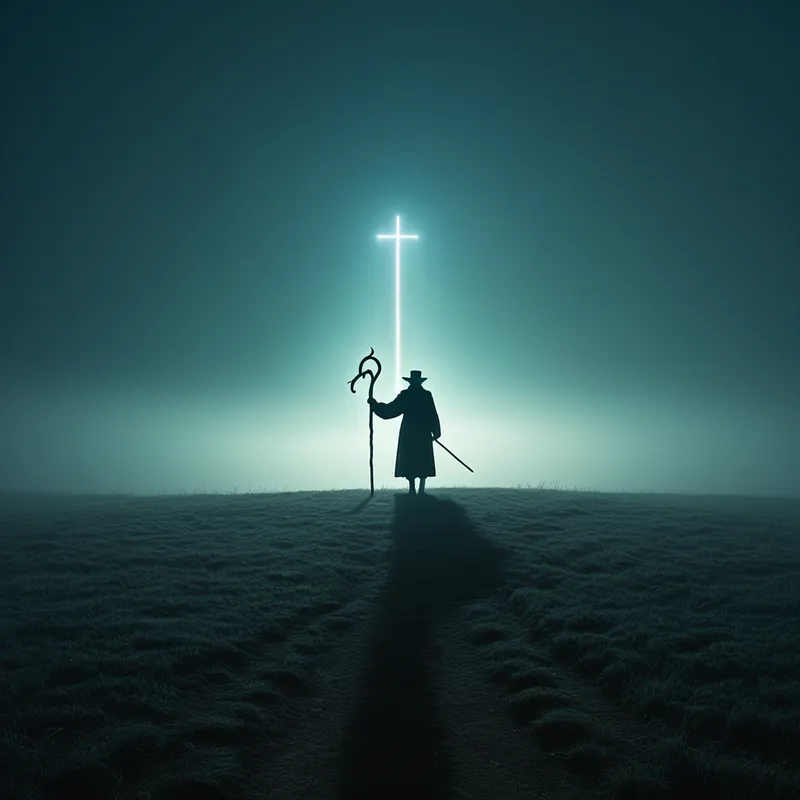
When the Shepherd’s Crook appears in modern dreams, it seldom manifests as a biblical artifact. It may appear as a walking stick on a foggy path, a teacher’s pointer, a conductor’s baton, or even the curved handle of a tool. The dreamer is typically at a crossroads of responsibility or moral guidance.
The somatic feeling is often one of weight—the crook is surprisingly heavy, or it vibrates with energy. Alternatively, it may feel fragile, as if it might snap. These sensations point to the dreamer’s relationship with their own authority and capacity to guide—either feeling overburdened by a responsibility they did not choose, or feeling ill-equipped for a leadership role they must assume. Dreaming of losing the crook speaks to a crisis of vocation or moral direction. Dreaming of the crook turning into a serpent is a direct confrontation with [the shadow](/myths/the-shadow “Myth from Jungian culture.”/) side of one’s power—the manipulative, fearful, or poisonous aspects of leadership that must be faced and reclaimed. The dream is an invitation from the unconscious to examine who or what you are shepherding (a project, a family, your own soul) and to question the source and nature of your guiding principle.
Alchemical Translation
The myth of the Crook is a perfect map for the alchemical process of individuation. It begins with the [prima materia](/myths/prima-materia “Myth from Alchemical culture.”/): the ordinary life, the “flock” of one’s inherited instincts and daily duties (the [nigredo](/myths/nigredo “Myth from Alchemical culture.”/)). The encounter with [the burning bush](/myths/the-burning-bush “Myth from Christian culture.”/) is the call, the eruption of [the Self](/myths/the-self “Myth from Jungian culture.”/) that shatters the comfortable identity of the ego-shepherd.
The crucible of transformation is the moment of surrender, when the ego’s prized tool—its competence, its identity—is thrown down and seen in its true, chthonic form.
The throwing down of the staff is the necessary mortificatio—the death of the ego’s simple utility. Seeing it as a serpent is the confrontation with the shadow, the personal and collective unconscious in its terrifying aspect. The command to “take it by the tail” is the supreme act of courage that begins the albedo, the whitening. One must integrate this shadow-power, not by controlling its head (conscious domination), but by accepting its totality, its dangerous end. This integration transmutes the base metal of simple skill into the gold of authentic, grounded authority. The returned staff is now the [lapis philosophorum](/myths/lapis-philosophorum “Myth from Alchemical culture.”/), the philosopher’s stone—the integrated personality that can perform the “miracles” of true creativity, healing, and guidance. The final act, dying on the mountain overlooking [the Promised Land](/myths/the-promised-land “Myth from Biblical culture.”/), completes the cycle. It signifies that the individuated Self does not seek personal possession of the promised wholeness (the land), but finds completion in having fulfilled its transpersonal vocation. The work is passed on; the shepherd is gathered to the source. The individual is dissolved back into the Self, having fully realized the pattern of the caregiver, not through weakness, but through strength that has been tempered by terror and trust.
Associated Symbols
Explore related symbols from the CaleaDream lexicon: