The Shamrock Myth Meaning & Symbolism
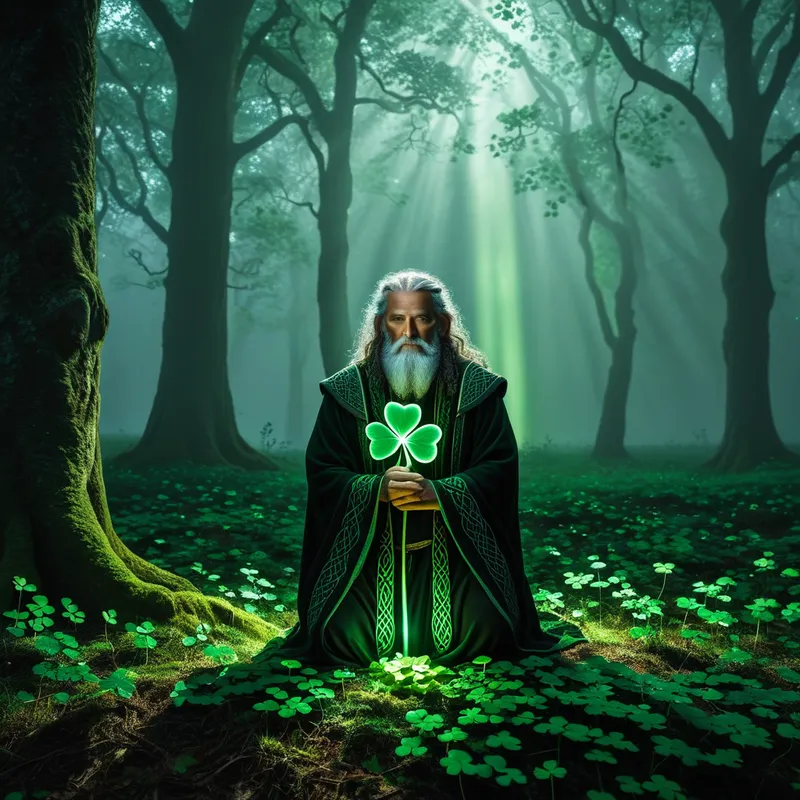
A druid seeks the soul of the land, finding it in a three-leafed plant that binds the divine realms into a sacred, living unity.
The Tale of The Shamrock
Listen now, by the fire’s glow, to a tale not of heroes and swords, but of a quieter, deeper magic. It is a tale from the time when [the world](/myths/the-world “Myth from Tarot culture.”/) was a whispered conversation between the Druid and the land itself.
In the days when the great oak was king and [the mist](/myths/the-mist “Myth from Celtic culture.”/) clung to the hills like a memory, there lived a Druid named Dara. His task was not to rule men, but to listen—to interpret the sigh of [the wind](/myths/the-wind “Myth from Various culture.”/) through the stones, the secret language of the rivers, and the slow, dreaming thoughts of [the earth](/myths/the-earth “Myth from Hindu culture.”/). Yet, a silence had fallen over the tribe of the Érainn. The chieftain was strong, the harvest was ample, but a disquiet lived in the marrow of their bones. The people felt separate—from the land, from each other, from the [Sídhe](/myths/sdhe “Myth from Celtic / Irish culture.”/). The sovereignty of the tribe, that sacred bond between people and place, was fraying, thin as a winter thread.
Dara took his staff of [hawthorn](/myths/hawthorn “Myth from Celtic culture.”/) and walked into the heart of the wild. For nine days and nine nights, he fasted beneath the Council of Stars. He drank only dew and listened. He heard the roar of [the sea](/myths/the-sea “Myth from Greek culture.”/), the [Manannán mac Lir](/myths/manannn-mac-lir “Myth from Celtic culture.”/), a voice of fathomless depth and change. He felt the solid, nurturing presence of the Earth, the Ériu, beneath his feet. He breathed the shifting, invisible breath of [the Sky](/myths/the-sky “Myth from Persian culture.”/), the domain of Dagda. Three great powers, three distinct voices, yet the harmony that should bind them was absent. The land felt silent at its core.
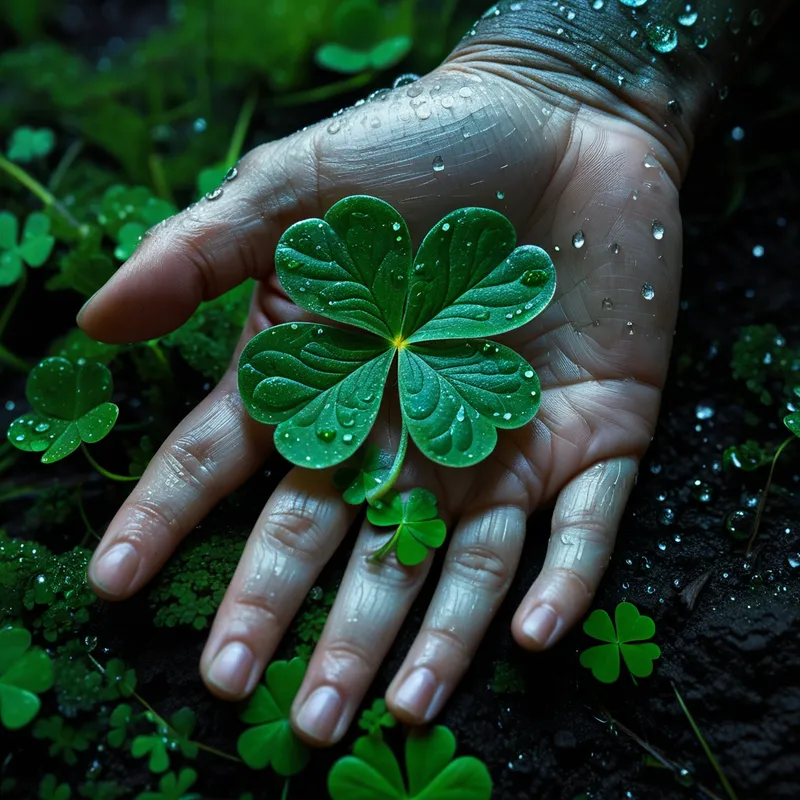
On the dawn of the tenth day, exhausted and hollow, Dara collapsed upon a rain-softened bank. His vision blurred, the world dissolving into a tapestry of green. As his sight cleared, he saw it. Not a mighty oak or a towering stone, but a humble, three-leafed plant, its form perfect against the dark soil. Each leaf was a heart, a shield, a world unto itself, yet all three sprang from a single, slender stem. Dew clung to it like crystal, and in the first golden light of the sun, the droplet on each leaf seemed to hold a different vision: one reflected the solid brown of the earth, one the shimmering blue of the sea, one the endless pale of the sky.
In that moment, the silence broke. A knowledge, not heard but known, flooded Dara. This was no common clover. This was the soul of the land made visible—the sacred knot that bound Ériu, Manannán, and Dagda into one inseparable life. The three realms were not separate kingdoms; they were one being, expressed in three forms. The [shamrock](/myths/shamrock “Myth from Celtic culture.”/) was the contract, the living sigil of true sovereignty. He had not found an answer to the land; he had found the answer of the land.
With trembling, reverent hands, he did not pick it. He simply touched its leaves, feeling the truth resonate up his arm and into his heart. He returned to his people not with a proclamation, but with a story woven around this simple, profound shape. And as the story was told, the disquiet in the tribe’s marrow began to still. They understood their place not as rulers of the land, but as children born from that sacred, three-fold unity.
Cultural Origins & Context
The story of the shamrock, as a discrete mythological narrative, is elusive in the ancient texts. Unlike the grand epics of the Táin Bó Cúailnge, its power resides in the oral, pedagogical tradition of [the Druids](/myths/the-druids “Myth from Celtic culture.”/). It is less a chronicled epic and more a fénnid, a teaching tale. Its primary function was ontological—to explain the nature of reality and the individual’s place within it.
The triadic principle was the foundational architecture of Celtic thought. The world was perceived through sacred threes: Land, Sea, and Sky; Past, Present, and Future; the three realms of existence (this world, [the otherworld](/myths/the-otherworld “Myth from Celtic culture.”/), and the world between). The Druids, as the philosophers and judges, used natural symbols to encode this complex cosmology for the tribe. The shamrock, a ubiquitous and resilient plant, became a perfect living metaphor. Its teaching was likely imparted not in grand assemblies, but in quiet moments of instruction—a Druid pointing to the plant at their feet to explain the unity of the gods, the structure of society, or the tripartite nature of the human soul (body, mind, and spirit).
This myth served a critical societal function: it anchored the concept of sacred kingship and tribal sovereignty. A true king was not merely a warrior; he was the human embodiment of that unity, married to the goddess of the land. The shamrock was a reminder that his legitimacy flowed from maintaining the balance between the three realms he governed.
Symbolic Architecture
At its core, the shamrock myth is a map of [integration](/symbols/integration “Symbol: The process of unifying disparate parts of the self or experience into a cohesive whole, often representing psychological wholeness or resolution of internal conflict.”/). It symbolizes the [resolution](/symbols/resolution “Symbol: In arts and music, resolution refers to the movement from dissonance to consonance, creating a sense of completion, release, or finality in a composition.”/) of perceived [separation](/symbols/separation “Symbol: A spiritual or mythic division between realms, states of being, or consciousness, often marking a transition or loss of connection.”/) into experienced wholeness.
The triad is not a hierarchy but a conversation; the stem is the silent fourth, the self from which all diversity springs.
The Three Leaves represent the fundamental archetypal forces that often appear in conflict within the [psyche](/myths/psyche “Myth from Greek culture.”/) and the world: the Solid & Nurturing ([Earth](/symbols/earth “Symbol: The symbol of Earth often represents grounding, stability, and the physical realm, embodying a connection to nature and the innate support it provides.”/)/[Mother](/symbols/mother “Symbol: The symbol of ‘Mother’ represents nurturing, protection, and the foundational aspect of one’s emotional being, often associated with comfort and unconditional love.”/)), the Fluid & Emotional (Sea/Unconscious), and the Intellectual & Aspirational (Sky/[Father](/symbols/father “Symbol: The father figure in dreams often symbolizes authority, protection, guidance, and the quest for approval or validation.”/)). In the myth, their separation causes the “disquiet,” the modern [anxiety](/symbols/anxiety “Symbol: Anxiety in dreams reflects internal conflicts, fears of the unknown, or stress from waking life, often demonstrating the subconscious mind’s struggle for peace.”/) of [fragmentation](/symbols/fragmentation “Symbol: The experience of breaking apart, losing cohesion, or being separated into pieces. Often represents disintegration of self, relationships, or reality.”/). The Single Stem is the crucial, often overlooked [symbol](/symbols/symbol “Symbol: A symbol can represent an idea, concept, or belief, serving as a powerful tool for communication and understanding.”/) of the unified Self, the central [axis](/symbols/axis “Symbol: A central line or principle around which things revolve, representing stability, orientation, and the fundamental structure of reality or consciousness.”/) of [consciousness](/symbols/consciousness “Symbol: Consciousness represents the state of awareness and perception, encompassing thoughts, feelings, and experiences.”/) from which these aspects emanate and to which they must return for integrity.
The [Druid](/symbols/druid “Symbol: Druids are ancient spiritual leaders in Celtic mythology, associated with nature, wisdom, and magic.”/)’s [quest](/symbols/quest “Symbol: A quest symbolizes a journey or search for purpose, fulfillment, or knowledge, often representing life’s challenges and adventures.”/) models the psychological [movement](/symbols/movement “Symbol: Movement symbolizes change, progress, and the dynamics of personal growth, reflecting an individual’s desire or need to transform their circumstances.”/) from a state of alienation (the tribe’s unease) to a state of symbolic [vision](/symbols/vision “Symbol: Vision reflects perception, insight, and clarity — often signifying the ability to foresee or understand deeper truths.”/). His exhaustion and hollowing out are a necessary kenosis—an emptying of preconceived notions—that makes him receptive to the [revelation](/symbols/revelation “Symbol: A sudden, profound disclosure of truth or insight, often through artistic or musical means, that transforms understanding.”/) in the humble, not the grandiose. The myth teaches that wholeness (sovereignty) is not achieved by conquering one [aspect](/symbols/aspect “Symbol: A distinct feature, quality, or perspective of something, often representing a partial view of a larger whole.”/) with another, but by perceiving the underlying unity that has always been present.
The Dreamer’s Resonance
When this myth pattern activates in the modern psyche, it often manifests in dreams of searching for a core truth or feeling a fundamental disconnect. One might dream of being lost in a beautiful but fragmented landscape—a stunning mountain here, a vast ocean there, a brilliant sky above, with no path connecting them. There is beauty, but no peace; diversity, but no home.
Somatically, this can feel like a low-grade tension, a sense of being pulled in three different directions—the demands of the body (earth), the tides of emotion (sea), and the pressures of ambition or thought (sky). The dreamer is experiencing the “fraying sovereignty” of their own inner kingdom.
A dream featuring a shamrock, a three-fold pattern, or a humble plant glowing with significance is a profound signal from the unconscious. It indicates that the integrative process has begun. The psyche is presenting its own symbol of unity, its own “answer of the land.” It is an invitation to stop seeking complex external solutions and to recognize the simple, foundational pattern that can restore inner order. The feeling upon waking from such a dream is often not excitement, but a deep, quiet calm—the stillness that followed Dara’s story.
Alchemical Translation
The alchemical journey mirrored in this myth is the opus contra naturum—the work against our habitual, fragmented nature—leading to the unio mentalis, the mental union. For the modern individual, the “land” is our physical and instinctual reality; the “sea” is our dynamic, often chaotic emotional and unconscious life; the “sky” is our ideals, thoughts, and spiritual aspirations.
Individuation is not about becoming one thing, but about becoming the one thing that holds the three.
[The first stage](/myths/the-first-stage “Myth from Alchemical culture.”/) is the Recognized Disquiet (the tribe’s unease). We feel the conflict between career, family, and personal passion; between body, heart, and mind. The second stage is the Druid’s Journey—the conscious decision to engage in inner work, to fast from old identities, and to listen deeply to the psyche’s own language. This is shadow work, meditation, therapy, or any disciplined introspection.
The critical third stage is the Revelation of the Humble. The integrating symbol offered by the unconscious is rarely dramatic. It is not a golden crown, but a green shoot. It might be a recurring memory, a simple image, a somatic sensation, or a newfound appreciation for something ordinary. This is the shamrock moment: the realization that these conflicting parts are not enemies, but expressions of a single, striving life force—your essential Self.
The final alchemical stage is Returning with the Story. Integration is not a private possession. True sovereignty is enacted by living from this unified center. It is translating the inner revelation into a new way of being in the outer world—making choices, engaging in relationships, and pursuing goals from a place of wholeness rather than fragmentation. You become the stem, and your life becomes the expression of the three leaves, in harmony. You don’t just have a revelation; you become the story that heals the disquiet.
Associated Symbols
Explore related symbols from the CaleaDream lexicon: