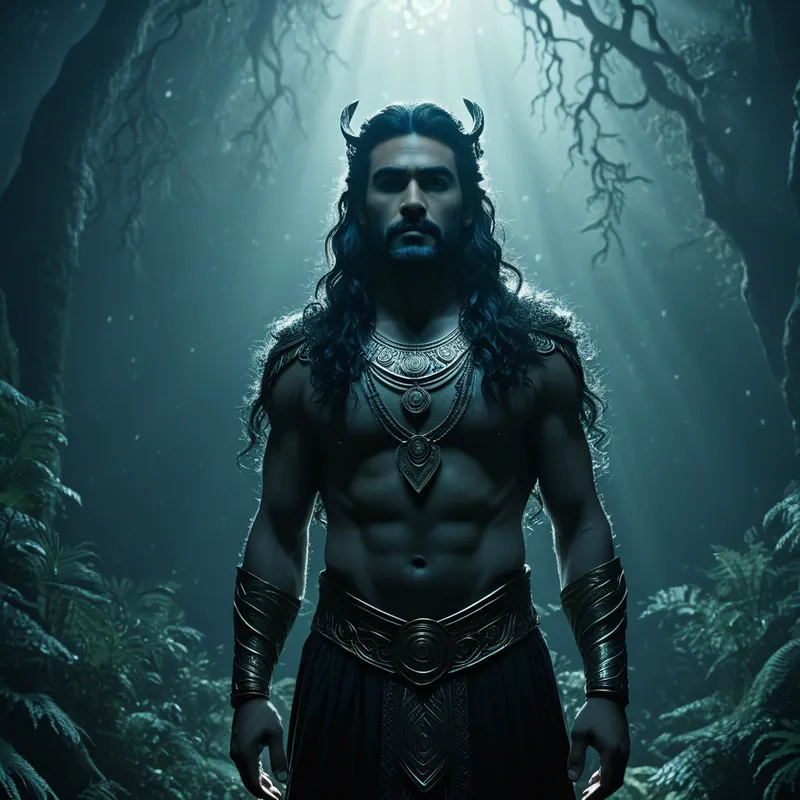
The Shaman's Soul Journey
A Siberian shaman embarks on a dangerous spiritual voyage to heal the community, navigating spirit realms and confronting supernatural forces.
The Tale of The Shaman’s Soul Journey
[The world](/myths/the-world “Myth from Tarot culture.”/) is sick. The rivers run thin, the reindeer grow listless, and a cough rattles in the chest of every child in the camp. The people know the cause: a sickness of the soul, a tear in the fabric that connects the human world to the spirit world. The threads of life are fraying. Only [the shaman](/myths/the-shaman “Myth from Siberian culture.”/) can mend them.
In the smoke-filled darkness of the chum, the shaman prepares. [The drum](/myths/the-drum “Myth from West African / Diasporic culture.”/), made from the hide of a sacred reindeer and stretched over a frame of living larch, is more than an instrument; it is a steed. Its steady, hypnotic beat is the sound of a galloping heart, the pulse of the universe itself. Adorned with iron pendants that clink like frozen stars—representing the bones of the cosmos and the armor needed for the voyage—the shaman begins to dance. The rhythm takes hold, pulling consciousness from its earthly moorings. The shaman’s soul, often visualized as a small bird or a breath of wind, slips free from the body, which now lies inert, a vacant vessel guarded by attentive helpers.
The journey begins with a descent, not an ascent. The shaman must travel to the Lower World, a shadowy reflection of the earthly realm, where the stolen or sickened soul-fragments of the patient are held captive. The path is treacherous, down through a tunnel, a cave’s mouth, or the roots of [the World Tree](/myths/the-world-tree “Myth from Celtic culture.”/). Here, in the murk, lurk the first guardians: amorphous spirits of disease, jealous ancestors, or the monstrous Abasy and Üör. The shaman does not fight with physical strength but with spiritual authority, bargaining, singing power-songs (algys), and wielding the drum’s sound as a shield and a whip.
Success in the Lower World means retrieving the lost soul-essence, often imagined as a tiny, glowing insect or a wisp of fog, and securing it safely—sometimes in a symbolic container held in the shaman’s mouth. But the quest is only half complete. Balance demands a corresponding ascent to the Upper World. The shaman’s soul now climbs, riding the drumbeat up the trunk of the [World Tree](/myths/world-tree “Myth from Global culture.”/), its branches scraping the belly of [the sky](/myths/the-sky “Myth from Persian culture.”/). Here, the dangers are of a different order: the dizzying vastness, the seductive beauty that could make one forget the mission, and the stern scrutiny of the high gods like Ülgen.
The shaman must petition these celestial powers, presenting offerings carried in spirit, and seek their blessing, their power (kut), to fully heal the patient and restore harmony. This is not a prayer of supplication but a negotiation between equals, for the shaman is the ambassador of humanity in the cosmic council.
Finally, with the soul-fragment secured and celestial power invoked, the shaman begins the perilous return. The journey back is as dangerous as the departure; a misstep, a broken rhythm, could mean the soul loses its way, condemning both shaman and patient. The drumbeat quickens, a calling home. With a final, shuddering gasp, the shaman’s soul slams back into the body. The shaman sits up, often exhausted to the point of collapse, and in a trembling voice, narrates the voyage. The healing is enacted—the soul-fragment blown back into the patient, a ritual binding performed. The cosmic balance, for now, is restored.
Cultural Origins & Context
This soul journey, or kamlanije, is the central act of Siberian shamanism, a practice woven into the fabric of life across the taiga and tundra, from the Nenets and Khanty of the west to the Evenki and Sakha (Yakut) of the east. It emerges from an animistic worldview where everything—rock, river, tree, animal—possesses spirit (ichchi). Health is a state of spiritual equilibrium, and illness is a symptom of disconnection, soul-loss, or spirit-offense.
The shaman (kam in Turkic languages, oyun in Yakut) is not a priest who prays to the gods, but a wounded healer, a technician of the sacred. Typically chosen by spirits through a traumatic initiatory illness—a symbolic [death](/myths/death “Myth from Tarot culture.”/) and dismemberment—the shaman’s authority is hard-won and deeply personal. Their role is that of a mediator, a repairer of the invisible threads between the community, the natural environment, and the layered spirit worlds. The journey is not undertaken lightly; it is a service performed at great personal risk, a direct engagement with the chaotic and ordered forces that govern existence.
Symbolic Architecture
The [journey](/symbols/journey “Symbol: A journey in dreams typically signifies adventure, growth, or a significant life transition.”/)’s [structure](/symbols/structure “Symbol: Structure in dreams often symbolizes stability, organization, and the framework of one’s life, reflecting how one perceives their environment and personal life.”/) is a profound map of the [psyche](/myths/psyche “Myth from Greek culture.”/). The three worlds—Lower, Middle ([Earth](/symbols/earth “Symbol: The symbol of Earth often represents grounding, stability, and the physical realm, embodying a connection to nature and the innate support it provides.”/)), and Upper—mirror the [depths](/symbols/depths “Symbol: Represents the subconscious, hidden emotions, or foundational aspects of the self, often linked to primal fears or profound truths.”/) of the unconscious, the [realm](/symbols/realm “Symbol: The symbol of ‘Realm’ often signifies the boundaries of one’s consciousness, experiences, or emotional states, suggesting aspects of reality that are either explored or ignored.”/) of conscious ego, and the [heights](/symbols/heights “Symbol: Represents ambition, fear, or spiritual elevation. Often symbolizes life challenges or a desire for perspective.”/) of the superconscious or spiritual aspiration. The [shaman](/symbols/shaman “Symbol: A spiritual mediator who bridges the human and spirit worlds, often through altered states, healing, and guidance.”/)’s voyage is a descent into the personal and collective [shadow](/symbols/shadow “Symbol: The ‘shadow’ embodies the unconscious, repressed aspects of the self and often represents fears or hidden emotions.”/) to retrieve vital [energy](/symbols/energy “Symbol: Energy symbolizes vitality, motivation, and the drive that fuels actions and ambitions.”/) that has been lost to [trauma](/symbols/trauma “Symbol: A deeply distressing or disturbing experience that overwhelms the psyche, often manifesting in dreams as unresolved emotional wounds or psychological injury.”/) or repression (the illness), followed by an [ascent](/symbols/ascent “Symbol: Symbolizes upward movement, progress, spiritual elevation, or striving toward higher goals, often representing personal growth or transcendence.”/) to integrate higher wisdom and [purpose](/symbols/purpose “Symbol: Purpose signifies direction, meaning, and intention in life, often reflecting personal ambitions and core values.”/).
The shaman’s dismemberment in initiation is not a destruction of the self, but a necessary unmaking. The old, profane identity—bound by ordinary perception—must be shattered so that the world can be reassembled with spiritual sight. The iron bones they later wear are the new, resilient structure of a consciousness that has touched death and returned.
The drum is the quintessential [symbol](/symbols/symbol “Symbol: A symbol can represent an idea, concept, or belief, serving as a powerful tool for communication and understanding.”/) of this process. Its circular frame is the [cosmos](/symbols/cosmos “Symbol: The entire universe as an ordered, harmonious system, often representing the totality of existence, spiritual connection, and the unknown.”/); its single head, the [membrane](/symbols/membrane “Symbol: A thin, flexible barrier that separates, protects, or connects different spaces or states of being.”/) between worlds. The beat is the rhythmic will that navigates the formless, the [heartbeat](/symbols/heartbeat “Symbol: The heartbeat represents life, vitality, and the essence of being alive, symbolizing emotional connectivity and personal integrity.”/) of the journey itself. It represents the focused [consciousness](/symbols/consciousness “Symbol: Consciousness represents the state of awareness and perception, encompassing thoughts, feelings, and experiences.”/) required to traverse the chaotic waters of the unconscious without dissolving into them.
The Dreamer’s Resonance
For the modern dreamer, the shaman’s journey resonates as a powerful metaphor for inner work. It speaks to the necessity of venturing into our own psychological underworlds—the places of grief, shame, fear, and forgotten trauma—to recover lost parts of ourselves. We all experience a form of “soul-loss” through heartbreak, betrayal, or life’s abrasions. The myth tells us that healing requires an active, courageous quest, not passive waiting.
The ascent to the Upper World mirrors our search for meaning, for connection to something greater than the isolated ego. It is the drive for inspiration, for a “vision” that re-contextualizes our suffering and guides our path. The shaman’s round-trip voyage is the complete arc of individuation: facing the depths, integrating the heights, and returning to the community of [the self](/myths/the-self “Myth from Jungian culture.”/), whole and empowered.

Alchemical Translation
In alchemical terms, the shaman’s ritual is the opus magnum. The dark, chaotic Lower World is the [nigredo](/myths/nigredo “Myth from Alchemical culture.”/)—the initial blackening, the confrontation with the [prima materia](/myths/prima-materia “Myth from Alchemical culture.”/) of suffering and psychic decay. The retrieval of the soul is the extraction of the precious spark from the dross. The ascent to the celestial realm is the [albedo](/myths/albedo “Myth from Alchemical culture.”/), the whitening, where the material is purified by spirit, infused with celestial insight.
The shaman’s body, lying in a trance, is the alchemical vessel, the vas hermeticum. It is the sealed container where the great work takes place, where the spirit travels through fire and water to effect a transformation. The community’s illness is the base metal; the shaman’s journey is the process; the restored balance is the gold.
The ultimate goal is not transcendence of the earthly, but its redemption. The shaman returns to the Middle World, the realm of human life, and applies the earned wisdom. This is the [rubedo](/myths/rubedo “Myth from Alchemical culture.”/), the reddening, where the spiritual gold is made manifest in healing, in restored relationship, in the vibrant life of the community. The process is cyclical, never complete, reflecting the ongoing work of maintaining psychic and cosmic equilibrium.
Associated Symbols
Explore related symbols from the CaleaDream lexicon:
- [Shamanic Journey](/myths/shamanic-journey “Myth from Siberian culture.”/) — The archetypal voyage between worlds, a disciplined trance-state undertaken to restore balance, retrieve knowledge, or heal a profound rupture in the fabric of life.
- Soul — The essential, non-physical essence of a being, perceived as a fragile, separable entity that can be lost, stolen, or healed, requiring vigilant guardianship.
- Drum — The sacred instrument and vehicle; its steady beat is the heartbeat of the cosmos, the horse that carries the traveler, and [the anchor](/myths/the-anchor “Myth from Christian culture.”/) that ensures a safe return.
- World Tree — The central axis connecting [the underworld](/myths/the-underworld “Myth from Greek culture.”/), earth, and sky; it is the ladder of the journey, the structure of reality, and a symbol of the interconnectedness of all realms of existence.
- Cave — The entrance to the [underworld](/myths/underworld “Myth from Greek culture.”/), the place of descent into the unconscious, representing both [the womb](/myths/the-womb “Myth from Various culture.”/) of potential transformation and the daunting mouth of the unknown.
- Bridge — The perilous crossing between realms or states of being, a narrow path over chaotic waters that requires perfect balance and spiritual surety to traverse.
- Spirit — The animating force in all things, the invisible population of the worlds with whom the shaman must negotiate, confront, and collaborate.
- Transformation Cocoon — The shaman’s trance state itself, a liminal space where the ordinary self is dissolved so a journey of radical change can occur.
- Wounded Soul — The initial condition that necessitates the journey; a state of fragmentation, illness, or disconnection that calls for a perilous quest to seek wholeness.
- Healing — The ultimate purpose of the voyage; not merely the alleviation of symptoms, but the restoration of cosmic and psychic equilibrium, mending the relationship between the individual and the universe.
- Mask — The ritual [persona](/myths/persona “Myth from Greek culture.”/) adopted by the shaman, a conduit for spirit forces and a protective boundary that allows the ordinary identity to step aside for the sacred work.
- Return — The critical, often overlooked phase of the journey; the difficult reintegration into ordinary reality, bearing the gifts and burdens of [the otherworld](/myths/the-otherworld “Myth from Celtic culture.”/).