The Shaman Fights the Disease Spirit Myth Meaning & Symbolism
A Siberian shaman journeys into the spirit world to confront the embodiment of illness, wrestling for the soul of the afflicted in a primal ritual of healing.
The Tale of The Shaman Fights the Disease Spirit
Listen. In the time when the world was thin, when the veil between the breath of the living and the whisper of the ancestors was no thicker than birch bark, sickness did not come as a mere chill or a fever. It came as a thief. A spirit-thief, hungry and cold, born from the forgotten places where light does not reach.
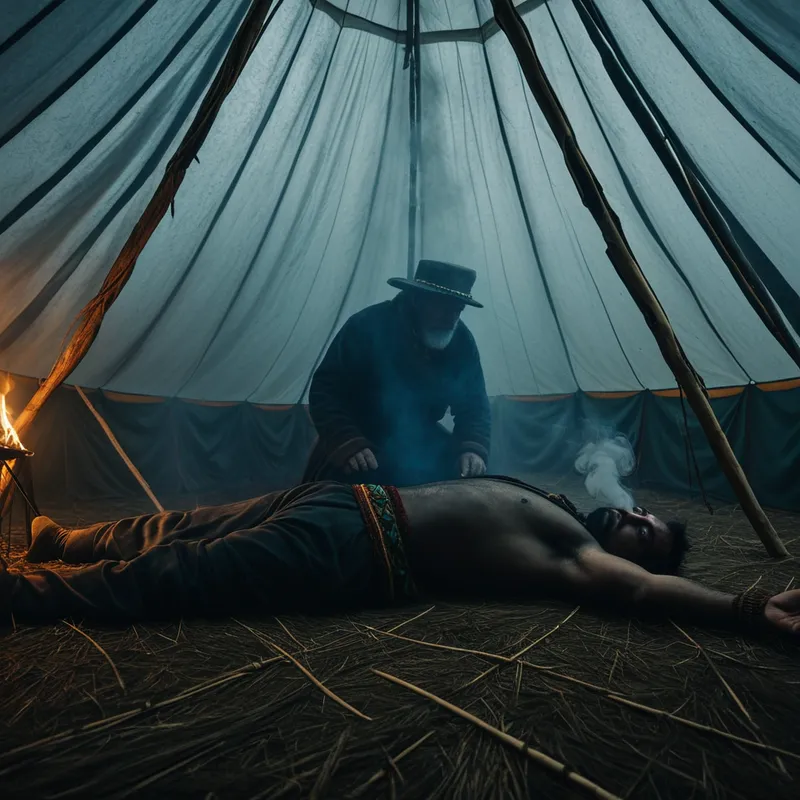
It begins in the chum, where the air grows heavy with the scent of damp earth and labored breath. A person lies on the furs, their skin hot, their spirit flickering like a guttering candle flame. The community knows this sign. This is not a simple ailment; it is a capture. The Disease Spirit has slithered from the lower world, has wrapped its invisible coils around the soul of the one who sleeps, and is slowly drawing it down into the cold mud.
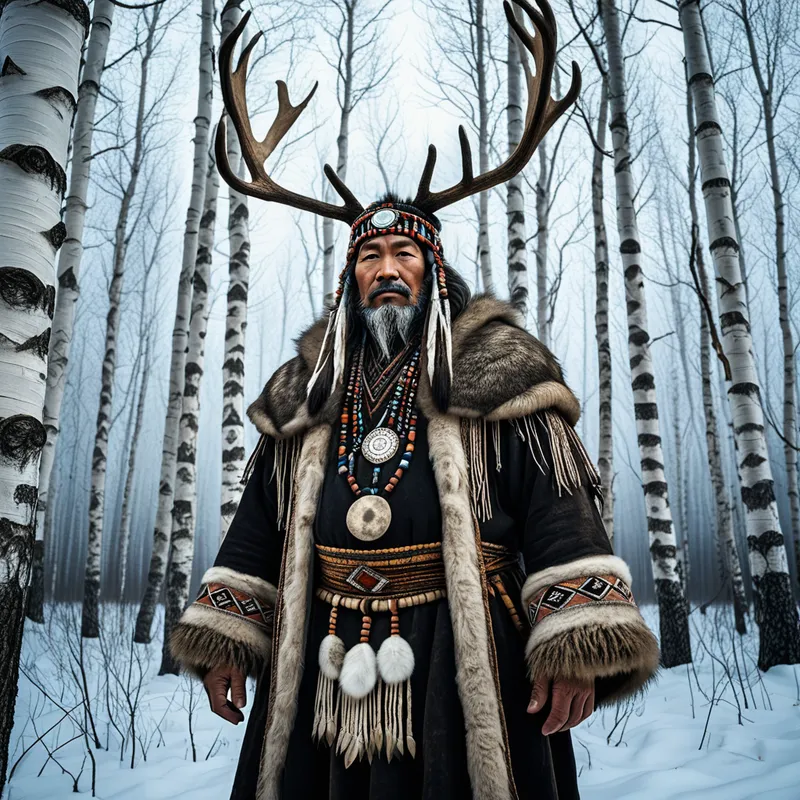
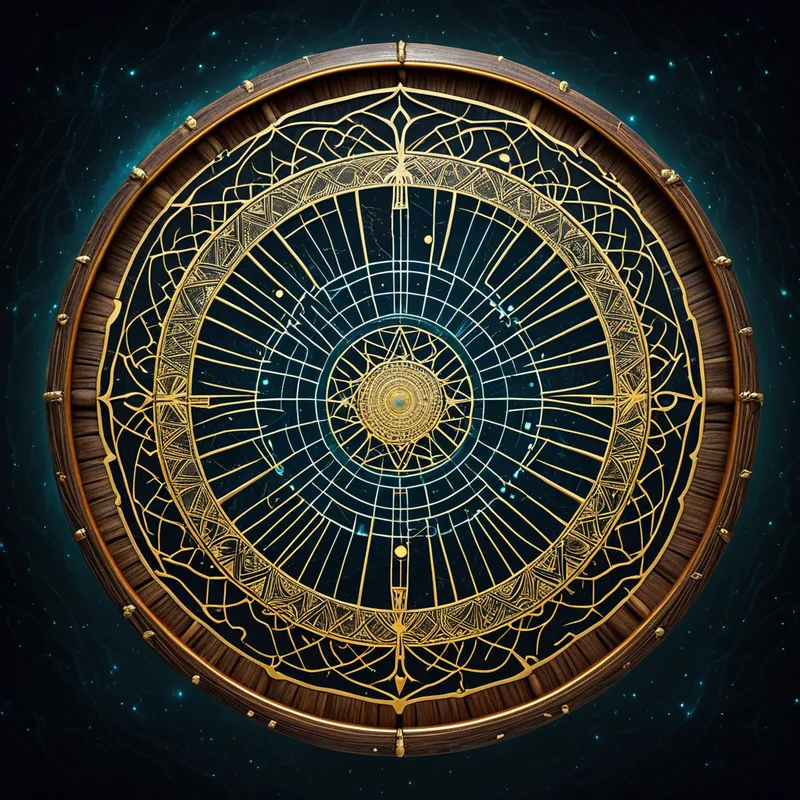
The call goes out. The shaman hears it in the wind, feels it in the tremor of the earth. He prepares. He dons his coat, heavy with iron pendants that jangle like frozen rain—a suit of armor for a war fought in a realm without form. Upon his head rests the crown of antlers, the branching testament to his ability to climb the World Tree. In his hand, he takes the drum. Not an instrument, but a steed. Its hide, stretched tight, is the skin of the world itself.
The fire is banked. The people gather, their faces pools of shadow and concern. The shaman begins. The rhythm starts, a heartbeat older than humanity—boom… boom… boom—a pulse that syncs not with his own heart, but with the heart of the world. He sings, his voice not his own, but a channel for the voices of his spirit helpers: the bear’s growl, the eagle’s cry, the wolf’s keen. The air crackles. The familiar world of the chum dissolves. The painted figures on his drum seem to swim and move. He is riding the sound, falling upward into the drum’s world, crossing the threshold.
He descends. Down through the roots of the great tree, into the Underworld, a landscape of grays and murky waters. Here, the air is thick with mourning and miasma. And there, in a hollow, he finds it: the Disease Spirit. It has no fixed shape. It is a clot of shadow, a nest of writhing tendrils, a coldness that drinks light. At its core, he can see the faint, captive glow of the stolen soul-fragment of the sick one.
The battle is not of claw and tooth, but of will and song. The shaman confronts the spirit. He challenges it, not with anger, but with the authority of one who knows the true names of things. He calls upon his helpers. The bear spirit lends its immense strength to push back the clinging darkness. The eagle spirit gives its piercing sight to find the core of the malady. The shaman wrestles with the entity, a desperate, silent struggle in the gelid silence of the spirit world. He may be bitten by the spirit’s venomous essence, feeling a wave of the very sickness he fights wash through his own spiritual body—the cost of engagement.
Finally, with a great invocation, he seizes the luminous soul-fragment. He tugs it free from the spirit’s grasp. The Disease Spirit shrieks, a soundless rupture in the fabric of that place, and retreats into the deeper gloom, defeated for now, but never destroyed. The shaman turns. He must return, and the journey back is perilous. He climbs, the recovered soul-light held carefully in his cupped hands, pursued by the echoes of the spirit’s rage. He follows the sound of his own drumbeat, now a lifeline thrown from the world of the living.
Back in the chum, the drumming reaches a frenzied peak and then stops, abruptly. Silence. The shaman slumps, exhausted, drenched in a sweat that is not entirely of this world. He moves to the sick person, breathes over them, gestures as if placing something back into their chest. A sigh escapes the afflicted one. The fever breaks. The spirit-thief has been fought off. The soul has been brought home.
Cultural Origins & Context
This narrative pattern is not a single, codified myth but a living ritual drama central to the shamanic complexes across Siberia, from the Evenki and Nenets to the Sakha. It was performed, not merely told. The shaman was the narrator, the actor, and the special effect. The myth was enacted in real-time during healing ceremonies, making the community both audience and participants in a sacred theatre of survival.
Its societal function was profound and pragmatic. In an environment of extreme hardship, where illness could doom an entire family group, the shaman provided a cosmological explanation for suffering (theft by a spirit) and an active, communal process for addressing it. The ritual reaffirmed the cosmic order, demonstrated the shaman’s hard-won power to navigate the spirit world, and most importantly, mobilized hope. It transformed passive suffering into an observable, dramatic conflict with a potential for victory. The story was passed down not in books, but in the training of apprentices, in the rhythms of the drum, and in the collective memory of ceremonies witnessed.
Symbolic Architecture
At its core, this myth maps the [interior](/symbols/interior “Symbol: The interior symbolizes one’s inner self, thoughts, and emotions, often reflecting personal growth, vulnerabilities, and secrets.”/) [landscape](/symbols/landscape “Symbol: Landscapes in dreams are powerful symbols representing the dreamer’s emotional state, personal journey, and the broader context of life situations.”/) of [crisis](/symbols/crisis “Symbol: A crisis symbolizes turmoil, urgent challenges, and the need for immediate resolution or change.”/) and healing. The [Disease](/symbols/disease “Symbol: Disease represents turmoil, issues of control, or unresolved personal conflicts manifesting as physical or emotional suffering.”/) [Spirit](/symbols/spirit “Symbol: Spirit symbolizes the essence of life, vitality, and the spiritual journey of the individual.”/) represents the psychic embodiment of affliction. It is not a germ, but the experience of [disintegration](/symbols/disintegration “Symbol: A symbol of breakdown, loss of form, or fragmentation, often reflecting anxiety about personal identity, control, or stability.”/), the [shadow](/symbols/shadow “Symbol: The ‘shadow’ embodies the unconscious, repressed aspects of the self and often represents fears or hidden emotions.”/) of [helplessness](/symbols/helplessness “Symbol: A state of powerlessness and inability to act, often linked to vulnerability, loss of control, and emotional paralysis.”/) and decay that attaches itself to the [soul](/symbols/soul “Symbol: The soul represents the essence of a person, encompassing their spirit, identity, and connection to the universe.”/) during [trauma](/symbols/trauma “Symbol: A deeply distressing or disturbing experience that overwhelms the psyche, often manifesting in dreams as unresolved emotional wounds or psychological injury.”/) or sickness.
The true battle is never against the body’s failure, but against the spirit of despair that seeks to claim the story of one’s life.
The [shaman](/symbols/shaman “Symbol: A spiritual mediator who bridges the human and spirit worlds, often through altered states, healing, and guidance.”/) symbolizes the integrated, awakened [consciousness](/symbols/consciousness “Symbol: Consciousness represents the state of awareness and perception, encompassing thoughts, feelings, and experiences.”/) capable of journeying into the chaotic [depths](/symbols/depths “Symbol: Represents the subconscious, hidden emotions, or foundational aspects of the self, often linked to primal fears or profound truths.”/) of the unconscious (the Lower World) to retrieve what has been lost or captured. His antlers connect him to the World [Tree](/symbols/tree “Symbol: In dreams, the tree often symbolizes growth, stability, and the interconnectedness of life.”/), the [symbol](/symbols/symbol “Symbol: A symbol can represent an idea, concept, or belief, serving as a powerful tool for communication and understanding.”/) of the ordered [cosmos](/symbols/cosmos “Symbol: The entire universe as an ordered, harmonious system, often representing the totality of existence, spiritual connection, and the unknown.”/) and the Self. His struggle and potential “poisoning” during the fight signify the immense risk of engaging directly with one’s own or another’s psychic pain—the [healer](/symbols/healer “Symbol: A figure representing restoration, transformation, and the integration of physical, emotional, or spiritual wounds. Often symbolizes a need for care or a latent ability to mend.”/) must be willing to be wounded.
The recovered “soul-fragment” is the vital essence—joy, will, [identity](/symbols/identity “Symbol: Identity represents the sense of self, encompassing personal beliefs, cultural background, and social roles.”/)—that is often severed during periods of profound suffering. The entire [journey](/symbols/journey “Symbol: A journey in dreams typically signifies adventure, growth, or a significant life transition.”/) models the process of confronting the shadowy, neglected, or traumatized parts of the psyche and reclaiming agency from them.
The Dreamer’s Resonance
When this mythic pattern stirs in modern dreams, it rarely appears as a literal shaman. Instead, one might dream of being lost in a labyrinthine hospital (the sterile Underworld), fighting a faceless, oppressive force in a dark room, or desperately searching for a precious, glowing object in a murky swamp. The somatic experience is often one of struggle, resistance, and immense effort against a suffocating or draining presence.
Psychologically, this signals a profound process of “soul retrieval” happening autonomously within the psyche. The dreamer is, at an unconscious level, engaging in a fight for their own wholeness. They are confronting a “disease spirit” of their own: perhaps a chronic pattern of depression (a spirit of heaviness), an addiction (a spirit of consumption), or a core wound of abandonment (a spirit of cold isolation). The dream is the internal drama of the Self organizing its resources to face this entrenched, parasitic complex and reclaim the energy and identity bound within it.
Alchemical Translation
For the modern individual, the myth provides a timeless blueprint for psychic transmutation, or individuation. The “sickness” is any complex that dominates the personality, siphoning off life force. The alchemical operation begins with the Calling—the recognition that one cannot heal alone, that one needs the “shamanic” function, the deeper Self.
The Descent is the courageous, often terrifying, act of turning inward—through therapy, meditation, or creative expression—to explore the underworld of one’s pain, trauma, and shadow. The Confrontation is the heart of shadow-work: directly facing the “disease spirit” of one’s grief, rage, or shame, not to exterminate it, but to wrest its stolen power.
The spirit of disease is a teacher in monstrous guise; it holds the very piece of you required for your completion.
The Retrieval is the insight, the released emotion, the reclaimed memory that was trapped in the complex. Finally, the Return is the integration of this reclaimed essence back into daily life, healing the rift between the suffering self and the whole self. One becomes, in a sense, both the afflicted and the shaman—the one who is wounded and the one who undertakes the journey to seek the cure. The ritual drumbeat becomes the disciplined, rhythmic practice of attention that guides the entire process.
Associated Symbols
Explore related symbols from the CaleaDream lexicon:
- Shaman — The archetypal mediator and healer, representing the aspect of the Self that can consciously navigate between different states of being and confront psychic illness.
- Disease Spirit — The embodiment of affliction, symbolizing a psychic complex or autonomous negative pattern that captures and consumes vital life energy.
- Spirit World — The vast, non-ordinary reality of the unconscious, where the logic of dreams and archetypes reigns, and where the roots of illness and healing are found.
- Journey — The essential process of leaving the ordinary world to venture into the unknown depths, representing the path of introspection, crisis, and transformation.
- Drum — The shaman’s vehicle and heartbeat of the ritual, symbolizing the rhythmic focus, trance state, and connection to primordial forces necessary for deep psychological work.
- Underworld — The lower realm of the psyche, a landscape of shadow, forgotten trauma, potential illness, and the raw materials for rebirth.
- Soul — The essential, core identity and vitality that can be fragmented or stolen by trauma, and which must be sought and reintegrated for wholeness.
- Shadow — The repressed, denied, or unconscious aspects of the personality, which in their unattended state can manifest as destructive, “disease-like” complexes.
- Healing — The ultimate goal of the mythic struggle, representing the restoration of balance, the recovery of lost parts, and the return to a state of integrity.
- Sacrifice — The shaman’s willingness to be wounded in the fight, representing the necessary cost of engaging deeply with pain, both one’s own and another’s.
- Tree — The World Tree or axis mundi, symbolizing the connection between all realms of experience (unconscious, conscious, transcendent) and the stable structure of the Self.
- Spirit Guide — The helping figures, often in animal form, that assist the shaman, representing innate psychic resources, instincts, and wisdom that aid in the healing journey.