The Seven Lucky Gods Myth Meaning & Symbolism
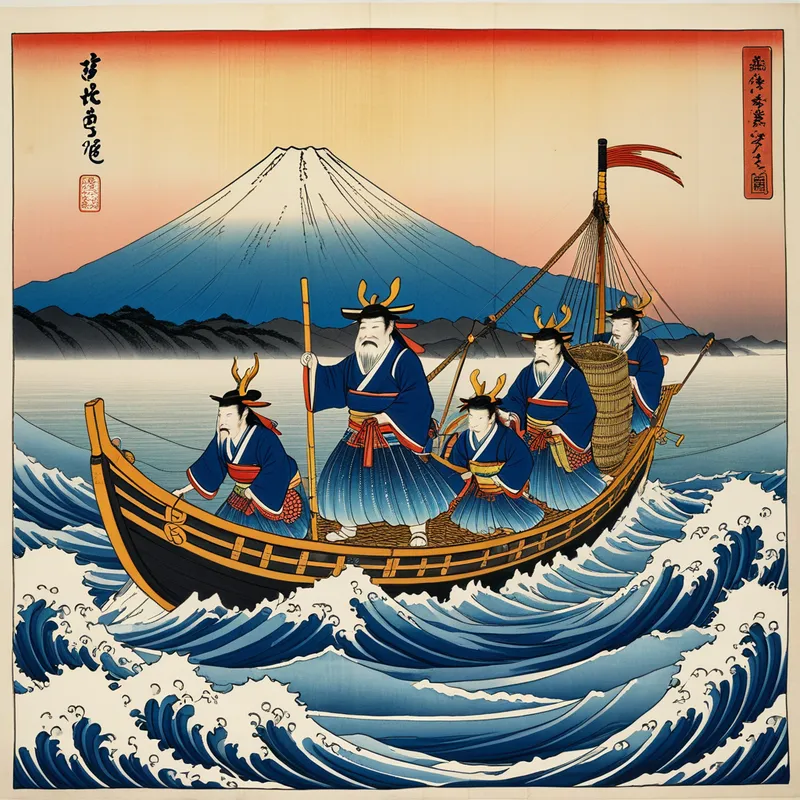
A celestial ship carries seven diverse deities across the sea, embodying the collective blessings needed for a fortunate and complete human life.
The Tale of The Seven Lucky Gods
Listen, and let your mind sail to the edge of the world, where the sea meets the sky in a silver seam. It is the deepest hour of the night, the time when the year itself holds its breath. This is Ōmisoka. The world is still, hushed under a blanket of frost, waiting.
From the mist where dreams are born, a shape emerges. It is the Takarabune, the Treasure Ship. Its hull is of ancient, fragrant wood, and its single, square sail is filled with a wind that carries the scent of plum blossoms and distant, unseen islands. It does not sail on the water you know, but on the sea of potential, on the collective hopes of a slumbering world.
And upon its deck, a council of fortune rests. First, Ebisu, his smile as wide as the sea, holds a glistening tai. He is the anchor, the blessing of honest labor and its tangible reward. Beside him sits Daikokuten, perched upon bales of rich rice, his magic mallet ready to tap out abundance from the very air. He is the warmth of the hearth, the fullness of the storehouse.
Standing guard is Bishamonten, clad in splendid armor, a miniature pagoda in one hand, a spear in the other. His gaze is fierce, a bulwark against misfortune. Then, the air is sweetened by a melody—Benzaiten plucks the strings of her biwa, and the notes fall like clear water, weaving wisdom and artistic grace into the ship’s wake.
The elders of wisdom complete the company. Fukurokuju contemplates a long, unfurled scroll, the knowledge of ages in his quiet eyes. Hotei laughs, a sound like rolling thunder that promises joy, his great cloth bag holding endless treasures of the spirit. And Jurojin, with his gentle deer, holds a staff from which dangles a scroll of sacred verses, the very essence of a life long and well-lived.
They do not speak in words. Their presence is the conversation—a symphony of rustling rice, plucked strings, lapping waves, and contented sighs. Their journey is not to a destination, but through the threshold of the turning year. They sail the border between the old and the new, the spent and the nascent. As the first sliver of the sun’s light cracks the horizon, their ship glides into the harbors of belief, into the homes of those who have prepared, into the hearts that are open. They leave no physical coins, but a more profound currency: the integrated blessings for a whole life. Then, as dawn fully breaks, the Takarabune dissolves back into the mist from whence it came, its cargo delivered, waiting to sail again when the world next stands on the cusp of becoming.
Cultural Origins & Context
The Shichifukujin are not a myth from a single, ancient text, but a living tapestry woven from many threads. Their formation began in the Muromachi period, crystallizing by the Edo period. This was no accident. Edo society, with its burgeoning merchant class and popular culture, craved deities that reflected not just imperial or aristocratic concerns, but the aspirations of everyday life: health, wealth, talent, and a full belly.
The myth is thus a syncretic masterpiece, a uniquely Japanese fusion. Only Ebisu is native to the Shinto pantheon. The others are imports, primarily from Chinese Taoist and Buddhist traditions, who were adopted, adapted, and naturalized. Daikokuten and Bishamonten are Buddhist guardian kings. Benzaiten is a form of the Hindu goddess Saraswati. The three gods of longevity have deep roots in Taoist star worship and folk belief.
This assembly was propagated not by priests in grand temples first, but by artists, storytellers, and merchants. Woodblock prints (ukiyo-e) depicting the gods aboard their ship were immensely popular talismans, especially for the New Year. People would place the print under their pillow on Ōmisoka to induce a “first dream” (hatsuyume) of the ship, guaranteeing a lucky year. The myth functioned as a societal dream, a collective visualization of prosperity and completeness accessible to all, binding diverse spiritual currents into a single, hopeful narrative for the common person.
Symbolic Architecture
The power of the Seven Lucky Gods lies not in any one of them, but in their collective voyage. They represent the archetypal blessings required for a harmonious and fortunate existence, but on a deeper level, they symbolize the integration of the complete self.
The ship is the psyche itself, and the seven deities are the disparate, often conflicting, aspects of our being that must be brought aboard and reconciled for a successful life journey.
Ebisu is the foundational Self, the instinctual being rooted in the physical world and its honest exchanges. Daikokuten is the Nurturer, the capacity to generate and hold resources, both material and emotional. Bishamonten is the Protector, the necessary boundaries and moral courage that defend the psyche’s integrity. Benzaiten is the Connector, the flow of inspiration, communication, and eros that beautifies life.
The three elders—Fukurokuju, Hotei, and Jurojin—represent the transcendent functions: Wisdom (knowing what is true), Joy (knowing what is valuable beyond utility), and Longevity (the perspective of time, the legacy of the soul). The Takarabune sails only when all are present. A life with only wealth (Daikokuten) but no joy (Hotei) is barren. A life of protection (Bishamonten) without flow (Benzaiten) is rigid. The myth is a blueprint for psychological wholeness.
The Dreamer’s Resonance
When the imagery of the Seven Lucky Gods or their ship surfaces in a modern dream, it rarely appears as a literal picture-postcard. The psyche translates the myth into its own vernacular. One might dream of a committee of seven distinct but familiar figures arriving to make a decision, or of a vehicle (a car, a bus, a spaceship) containing seven crucial items needed for a journey.
The somatic feeling in such dreams is often one of anticipatory fullness or relieved integration. There may be a sense of gathering, of preparing to cross a threshold (a new year, a new job, a new stage of life). The dream is signaling that the dreamer is assembling, often unconsciously, the various internal resources needed to navigate this transition. Conversely, if one of the “gods” is missing or fighting in the dream—if the Warrior is raging without the Muse to calm him, or the Merchant is hoarding while the Elder of Joy is absent—it points to a specific imbalance. The psyche is highlighting which archetypal blessing is lacking in the dreamer’s current life equation, creating a state of psychic poverty despite outer circumstances.
Alchemical Translation
The individuation process, the alchemical work of becoming whole, is perfectly modeled by the nocturnal voyage of the Takarabune. Our initial state is one of fragmentation. We identify only with the Merchant (our career), or only with the Warrior (our defenses), disowning the Laughing Fat Man (our simple joy) or the Flowing Goddess (our creativity).
The alchemical operation is to invite all seven into the vessel of the self, to let them sail together through the dark night of the soul, which is the Ōmisoka of our personal transformation.
First, we must recognize our inner Ebisu—our basic, instinctual worth. We build our hull from that honest wood. Then we must summon Daikokuten to fill our hold with the riches of our experience, both good and bad. We call upon Bishamonten to guard our nascent wholeness from old, self-sabotaging habits. We allow Benzaiten’s stream to flow through us, connecting these parts with feeling and expression.
The final and most delicate operation is integrating the transcendent three. We must consult Fukurokuju’s scroll for inner wisdom, not just external knowledge. We must empty Hotei’s bag not of material gifts, but of laughter, generosity, and the capacity to hold things lightly. We must lean on Jurojin’s staff, gaining the long view, seeing our life as a coherent story. When all seven are aboard and sailing in concert, the treasure they bring is not external luck, but an internal state of fortified, resilient, and abundant being. The ship arrives at no foreign port because it has become its own destination—a complete and self-blessed psyche.
Associated Symbols
Explore related symbols from the CaleaDream lexicon:
- Ship — The Takarabune is the vessel of the integrated psyche, carrying the complete set of archetypal blessings across the sea of the unconscious toward consciousness.
- Water — Represents the flow of life, the unconscious mind, and potentiality upon which the ship of the self must sail, navigated by the combined wisdom of the seven deities.
- Journey — The core action of the myth is a cyclical, threshold-crossing voyage that models the lifelong process of psychological integration and seeking wholeness.
- Treasure — Not merely gold, but the combined, non-material blessings of health, wisdom, joy, skill, and longevity that constitute true fortune and a complete life.
- Circle — The seven gods form a complete, self-sufficient mandala of human aspiration, with no single point dominating; each blessing is part of a circular, interdependent whole.
- Dream — The primary medium through which this myth was traditionally engaged, with the hatsuyume of the ship serving as a direct channel for its auspicious power into the dreamer’s year.
- Mountain — Often faintly visible in depictions (like Mount Fuji), representing the stable, enduring earthly anchor and spiritual goal that the ship’s blessings help one to approach.
- Star — Connected to the Taoist origins of some deities as stellar gods of longevity, symbolizing the transcendent, guiding light of wisdom and fate that oversees the human journey.
- Goddess — Embodied by Benzaiten, representing the essential feminine principle of flow, connection, artistry, and emotional intelligence required for balance.
- God — The collective masculine principle, diversified into the specific forms of labor, protection, abundance, and wisdom, showing the multifaceted nature of divine blessing.
- Shinto Shrine — The native spiritual home of Ebisu and the cultural container that naturalized the other six, representing the grounded, worldly context for this syncretic spiritual vision.