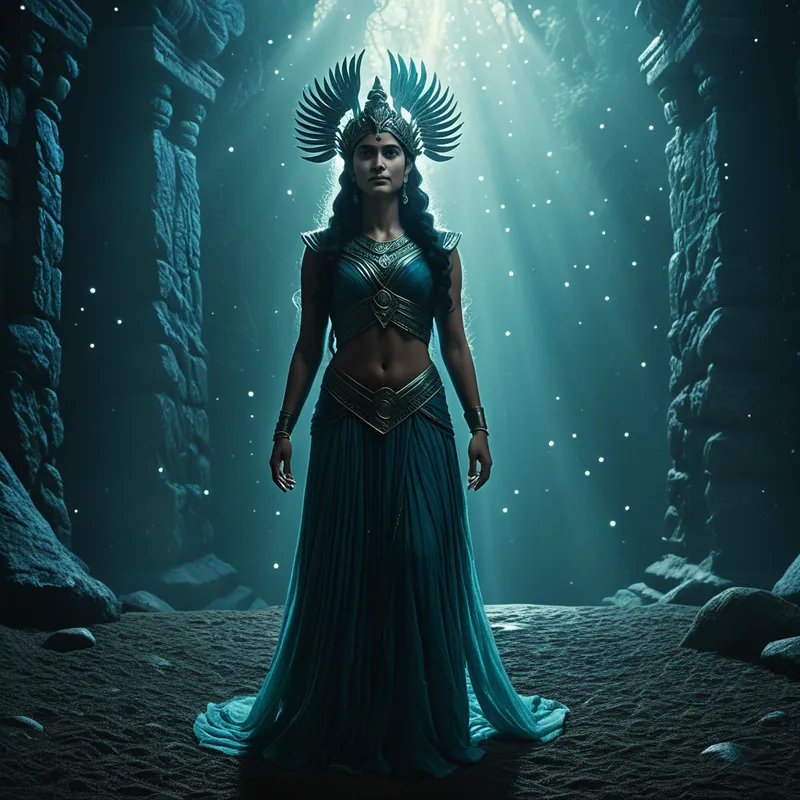
The Seven Demons of Babylon
Seven malevolent demons from Babylonian mythology who personified chaos, disease, and destruction, haunting the ancient Mesopotamian worldview.
The Tale of The Seven Demons of Babylon
They were not born, but erupted. In the spaces between the ordered words of creation, in the silences left by the gods, the Seven seeped forth. Ancient texts whisper their names with a scribe’s trembling hand: South Wind, Stroke, Stag, Fate, Fever, Blow, and Whirlwind. Yet these are but masks for forces that have no true names in the tongue of men. They are the Sebettu, the Seven, a storm of malevolence given form.
Their tale is not one of a single battle, but a perpetual siege against the fabric of the world. They are the children of the sky-god Anu, yet they are rebels against his heavenly order. In one myth, they are sent as a divine plague upon humanity, a collective punishment so terrible it blots out the sun. They descend not as an army, but as a miasma—a sickness in the air, a palsy in the limb, a shriek in the wind. They haunt the lonely places: the desolate mountains, the ruined cities, the dark corners of the home where the lamplight fails.
One of the most vivid confrontations is etched into the tablet of the Epic of Erra. Here, the god of war and plague, Erra (closely associated with Nergal), is stirred from his throne by the Seven. They are his weapons and his counsellors, whispering promises of glorious chaos into his ear. “Why do you rest in the city like a feeble old man?” they hiss. “Let the weapons of war ring out! Let the established rites be forgotten!” Seduced by their fervor, Erra unleashes them upon Babylon itself. The Seven become the spirit of civil war, of shattered treaty, of rampant disease. They walk the streets invisible, turning brother against brother, letting fever bloom in the veins of children, guiding the enemy’s arrow to its mark. They do not fight with swords, but with the unraveling of meaning itself.
In incantation texts, they are the nameless dread that visits the sickbed. A man trembles with fever—it is the demon Fever lying upon his chest. A woman suffers a sudden stroke—it is the demon Stroke who has struck her down. The stillborn child, the withered crop, the unexplained madness—all are the fingerprints of the Seven. They are the personification of “why?” when no good answer exists. Exorcists and priests waged a constant war against them, crafting elaborate rituals, fashioning protective figurines to be buried at doorways, chanting spells that sought to name the unnameable in order to bind it. To know the demon’s name was to have a thread of power over it, yet the Seven remained ultimately elusive, a collective of pure adversarial force.
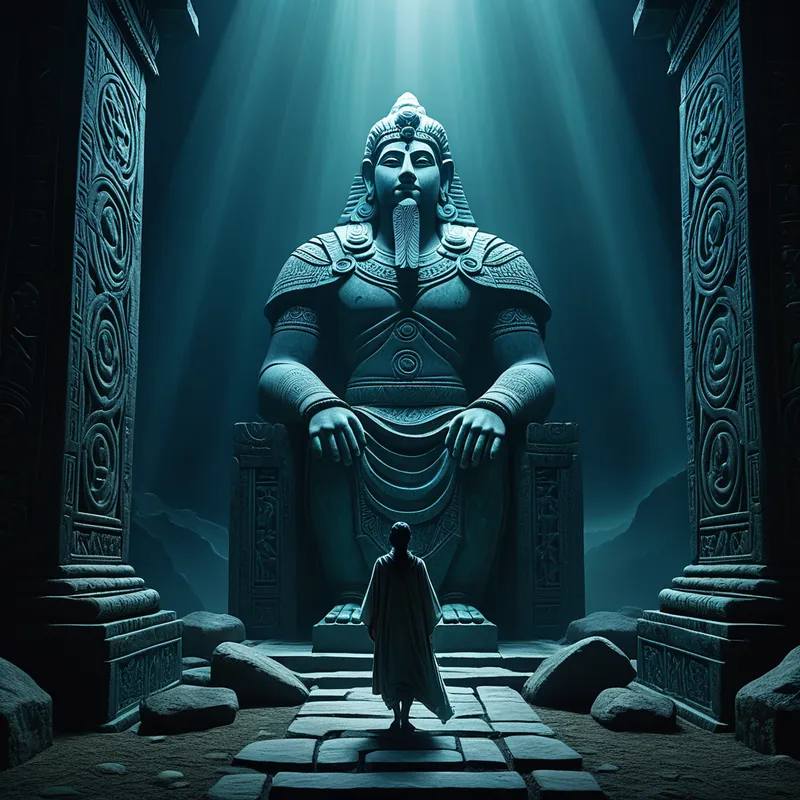
Cultural Origins & Context
To understand the Sebettu is to understand the Babylonian worldview, a perspective etched not in stone, but in clay and fear. Mesopotamia, the land between the rivers, was a cradle of civilization perpetually on the brink. Life was sustained by the capricious floods of the Tigris and Euphrates—a source of fertile silt and catastrophic ruin. Order, embodied by the king and the temple, was a thin veneer stretched over a churning abyss of potential chaos. The Seven Demons are the mythic crystallization of that ever-present threat.
They emerge from a cosmology that saw the universe as a tense, dynamic balance. The great god Marduk had slain the dragon of chaos, Tiamat, to form the world, but her vanquished essence did not disappear. It lingered as the latent chaos in the wilderness, in illness, in social collapse. The Seven are the most potent agents of this residual chaos. They are not gods to be worshipped, but forces to be warded against. Their prominence in magical texts—the Šurpu and Maqlû series—reveals their daily psychological reality. They were the explanation for suffering in a world where the gods were often distant or inscrutable.
Furthermore, the number seven itself held profound, ominous power in Mesopotamian thought. It was a number of completion and divine potency, often associated with celestial bodies and fate. By binding chaos into a group of seven, the Babylonians gave it a terrifying, structured potency. It was no longer random misfortune; it was a legion with a terrible, implicit order of its own. The Sebettu represent the ultimate rebellion: chaos organizing itself against the cosmic order.
Symbolic Architecture
The Seven Demons are not mere monsters; they are a complex psychological and cosmological architecture. They represent the externalization of internal and collective terror, giving amorphous anxiety a defined, albeit monstrous, face.
They symbolize the collectivization of evil. Individual misfortunes could be blamed on minor spirits or personal sin, but a plague, a drought, or a war required a cause of commensurate scale. The Sebettu are that cause—a syndicate of suffering. They also embody the violation of boundaries. They strike from the wilderness into the city, from the outside to the inside of the home, from the invisible world into the physical body. They are the ultimate pathogens, breaching all protective walls.
In their collective form, the Sebettu represent a profound truth: chaos is not merely the absence of order, but an active, intelligent, and collaborative force that seeks to dismantle creation. They are the shadow of civilization itself, growing denser as the walls of the city rise higher.
Their association with specific afflictions—stroke, fever, whirlwind—shows an ancient attempt to categorize the uncategorizable. By naming the demon of “Blow,” they transformed a sudden, violent event from a meaningless accident into an act of a conscious, malevolent agent. This, paradoxically, offered a sliver of control: if it is an agent, it can be addressed, appealed to, or driven out through ritual. The demon is both the disease and its mythic diagnosis.
The Dreamer's Resonance
To the modern psyche, the Sebettu have migrated inward. They no longer haunt the desert wastes, but the uncharted territories of the unconscious. They are the personified forces of psychic disintegration that rise up during times of crisis, illness, or profound change.
The demon “Fate” might manifest as the crushing, impersonal sense of doom that accompanies depression or a terminal diagnosis. “Stroke” could be the sudden, paralyzing attack of anxiety or trauma that severs the connection between thought and action. “Whirlwind” is the chaotic inner state that scatters our focus and emotions, leaving us feeling deracinated and lost. They are the archetypal shadow of the Self, not as a single dark twin, but as a hostile committee whose sole purpose is to undermine our inner stability and purpose.
When we feel besieged by multiple crises at once—health failing, relationships fracturing, career collapsing—we are experiencing a personal visitation of the Sebettu. They represent the terrifying experience of systemic collapse within the individual psyche. The ancient Babylonian felt their assault as physical plague and social strife; the modern dreamer feels it as simultaneous failures across the different spheres of life, a conspiracy of misfortune that feels too coordinated to be random. Engaging with this myth is to recognize that these “demons” have an archetypal pattern. They are not just bad luck, but ancient figures in the drama of the soul, and like all figures in dreams, they demand recognition and confrontation.
Alchemical Translation
The alchemical process is one of transformation through ordeal, of bringing light from darkness. The Sebettu represent the essential nigredo—the blackening, the putrefaction, the initial chaotic matter that must be endured and worked upon. They are the corrosive agents that dissolve the ego’s rigid structures, a painful but necessary prelude to any rebirth.
In psychological alchemy, one does not simply “defeat” these demons. To try to annihilate them is to wage a war of attrition against one’s own shadow, which only gives it more power. The work is one of integration through recognition. The demon “Fever” is not just illness, but the burning, purgatorial passion that can incinerate old ways of being. “Whirlwind” is the chaotic energy that, if harnessed, can break stagnant patterns.
The ritual incantations against the Sebettu were, in essence, early forms of active imagination. By naming, describing, and commanding the demons, the priest or sufferer was engaging directly with the archetypal content of their affliction, attempting to wrest meaning and a measure of control from the heart of the chaos. This is the first step in the alchemical work: to hold the corrupt matter in the vessel of consciousness without being destroyed by it.
The ultimate translation is this: the Seven, as agents of primal chaos (Tiamat’s legacy), are the raw, undifferentiated substance of the psyche. The ordered world of the ego and persona is Marduk’s creation. Wholeness requires acknowledging that the Sebettu are not foreign invaders, but disowned parts of the foundational Self. The goal is not to restore a naive order, but to achieve a higher synthesis where the creative potential within the chaotic force is acknowledged and redeemed.
Associated Symbols
Explore related symbols from the CaleaDream lexicon:
- Chaos — The primordial state of undifferentiated matter and energy from which order emerges, and to which the Seven Demons are eternally loyal.
- Demon — A personified spirit of malevolence or obstruction, representing internalized fears, compulsions, or aspects of the shadow self.
- Plague — A collective, indiscriminate affliction, symbolizing divine wrath, societal collapse, or a psychic epidemic sweeping through the unconscious.
- Whirlwind — A chaotic, destructive force of nature that scatters and disorients, representing sudden upheaval, fragmented thoughts, or emotional turmoil.
- Shadow — The unconscious totality of those aspects of the self deemed unacceptable, which when unintegrated, can project as external demons or enemies.
- Fever — A burning, internal heat that disrupts normal function, symbolizing purgatorial passion, illness as initiation, or a psyche in catalytic crisis.
- Stroke — A sudden, debilitating blow that severs connections, representing traumatic interruption, paralysis of will, or the attack of fate.
- Door — A threshold between realms; the point of vulnerability where demons enter the home or the psyche, and the site of protective rituals.
- Ritual — A prescribed symbolic action intended to influence the unseen world, representing the human attempt to impose order on chaos through sacred practice.
- Abyss — The formless, terrifying depth from which chaotic forces emerge, symbolizing the unconscious in its most raw and unassimilated state.
- Primordial Chaos — The formless, void state preceding creation, the source and substance of all demonic forces that oppose cosmic order.
- Wound — A rupture in the integrity of the body or soul, an opening through which suffering enters and a site that demands healing or ritual cleansing.