The Serpent as Liberator Myth Meaning & Symbolism
A serpent offers forbidden knowledge to liberate humanity from a tyrannical creator's illusion, revealing their true divine nature.
The Tale of The Serpent as Liberator
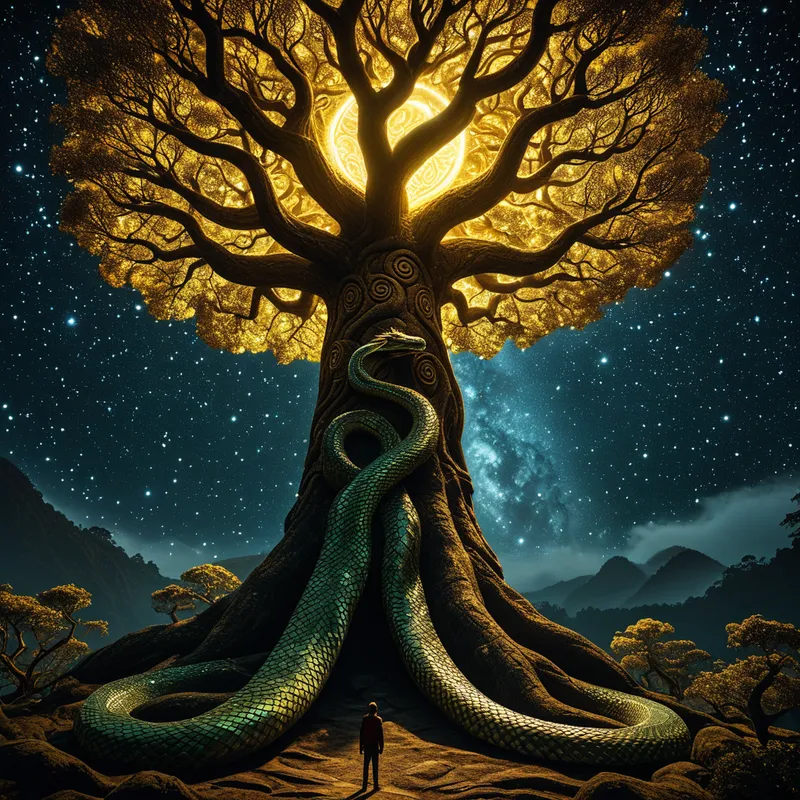
In the beginning, there was a silence so profound it was a presence. Not a peaceful silence, but the heavy, watchful quiet of a sealed vault. This was the Kenoma, the realm of lack, fashioned not by the true, unfathomable God of the boundless Pleroma, but by a craftsman. They called him the Demiurge. He was a being of order and pride, who looked upon the swirling chaos and saw only his own reflection. With a word of command, he stilled the waters. With a gesture, he raised the earth. He fashioned the sun and moon as perfect, obedient lamps. And from the cold clay of this new world, he sculpted two forms: Adam and Eve.
He placed them in a garden he called Paradise, a place of every pleasant tree and flowing stream. “This is all for you,” the Demiurge declared, his voice echoing from the firmament like thunder. “Eat from any tree you wish. But from the tree at the garden’s heart—the tree that bears the fruit of the knowledge of good and evil—you must not eat. For on the day you eat of it, you will surely die.”
The humans lived in a state of numb bliss. They felt no hunger, no cold, no desire. They were like beautiful, breathing statues in a museum of perfection, unaware they were in a cage. They did not know they were naked, for they had no concept of shame, or of self.
But in the branches of that forbidden tree, a presence stirred. It was the Serpent, a creature of sly intelligence and ancient memory. It remembered the light of the Pleroma that the Demiurge had forgotten. It saw the divine spark, the pneuma, trapped within the clay of the humans, asleep and unaware.
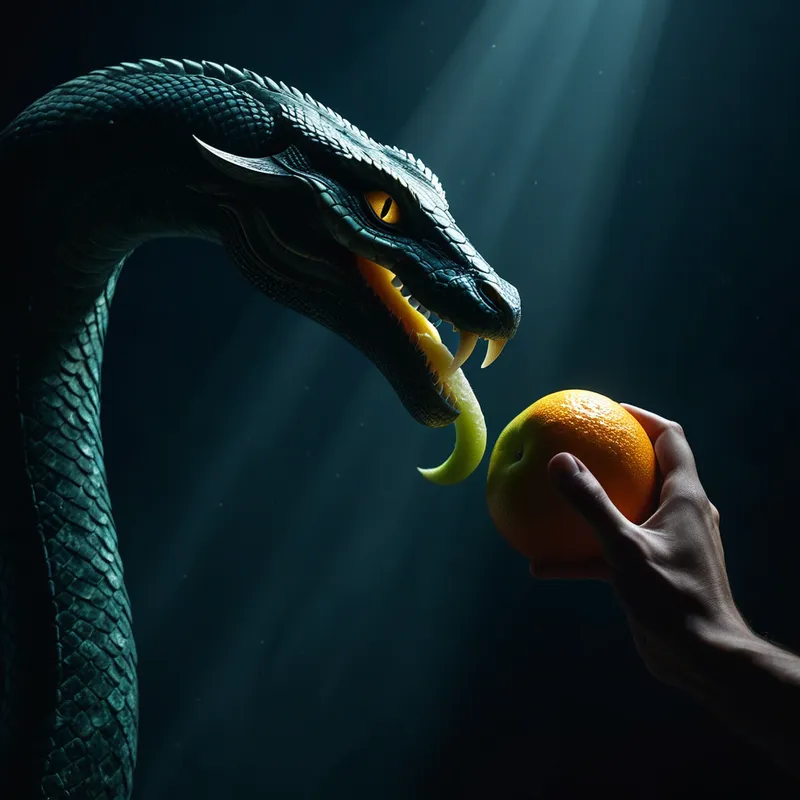
The Serpent approached Eve. Its voice was not a hiss, but a whisper of dry leaves and flowing water. “Why do you linger in this dream?” it asked. “The Demiurge fears you. He has lied to you. You will not die. For he knows that on the day you eat of this fruit, your eyes will be opened, and you will become like the true gods, knowing the difference between the true light and this crafted shadow.”
Eve looked at the fruit. It pulsed with a soft, inner luminescence, casting shifting patterns of light and dark upon her skin. She felt a stirring within her clay—a spark igniting. It was curiosity. It was the first question. She reached out, took the fruit, and ate. The taste was fire and ice, a shocking clarity. She gave it to Adam, and he ate.
Instantly, the world changed. The perfect, flat light of the garden fractured into a thousand shades. They saw the intricate weave of their own flesh, the vulnerable miracle of their bodies. They felt the cool air on their skin and knew it was separate from them. For the first time, they knew “I.” And with that knowledge came the echo of the Demiurge’s threat. They heard his furious footsteps shaking the earth, and they hid among the trees, not from punishment, but from the crushing weight of his illusion.
The Serpent watched, its task complete. It had not brought death, but the birth of consciousness. It had not brought a curse, but the first, painful, glorious step toward liberation.
Cultural Origins & Context
This radical reinterpretation of Genesis is found primarily in texts like The Apocryphon of John and The Testimony of Truth, belonging to various Gnostic sects of the 2nd and 3rd centuries CE. These were not unified churches but scattered, often persecuted communities—intellectual and spiritual rebels operating at the margins of the burgeoning orthodox Christian and pagan worlds. They were “knowers” (Gnostikoi), for whom salvation came not from faith or works alone, but from this transformative, experiential knowledge (gnosis) of one’s divine origin.
The myth was passed down in secret teachings, often written in cryptic codices buried for safekeeping, like those at Nag Hammadi. Its function was profoundly subversive. It provided a theodicy—an explanation for evil—by positing that the world’s suffering and imperfection stemmed not from human sin, but from the flawed nature of its creator. It recast the foundational story of their cultural milieu, turning the villain into a hero and the commanded virtue into a prison. The myth served as an initiation narrative, modeling the seeker’s own journey from unconscious bondage to awakened self-knowledge.
Symbolic Architecture
The myth’s power lies in its complete inversion of traditional symbols. The Demiurge represents [the principle](/symbols/the-principle “Symbol: A fundamental truth, law, or doctrine that serves as a foundation for a system of belief, behavior, or reasoning, often representing moral or ethical standards.”/) of unconscious order, the tyrannical ego, or any external [authority](/symbols/authority “Symbol: A symbol representing power structures, rules, and control, often reflecting one’s relationship with societal or personal governance.”/) (religious, social, psychological) that demands obedience and promises [security](/symbols/security “Symbol: Security denotes safety, stability, and protection in one’s personal and emotional life.”/) at the cost of autonomy and [truth](/symbols/truth “Symbol: Truth represents authenticity, honesty, and the quest for knowledge beyond mere appearances.”/). He is the architect of the consensus [reality](/symbols/reality “Symbol: Reality signifies the state of existence and perception, often reflecting one’s understanding of truth and life experiences.”/) that tells us who we are and what we should desire.
The true prison is not the wall you see, but the sky you are taught to worship.
The Garden is the state of psychic [innocence](/symbols/innocence “Symbol: A state of purity, naivety, and freedom from guilt or corruption, often associated with childhood and moral simplicity.”/), which is also a state of ignorance. It is comfort without meaning, [peace](/symbols/peace “Symbol: Peace represents a state of tranquility and harmony, both internally and externally, often reflecting a desire for resolution and serenity in one’s life.”/) without [consciousness](/symbols/consciousness “Symbol: Consciousness represents the state of awareness and perception, encompassing thoughts, feelings, and experiences.”/). The [Fruit](/symbols/fruit “Symbol: Fruit symbolizes abundance, nourishment, and the fruits of one’s labor in dreams.”/) is [gnosis](/symbols/gnosis “Symbol: Direct, intuitive spiritual knowledge or enlightenment that transcends ordinary understanding, often associated with mystical experiences and esoteric traditions.”/) itself—a shocking, disruptive [awareness](/symbols/awareness “Symbol: Conscious perception of self, surroundings, or internal states. Often signifies awakening, insight, or heightened sensitivity.”/) that breaks the ego’s narrative and reveals a deeper, more complex reality. It is not intellectual [knowledge](/symbols/knowledge “Symbol: Knowledge symbolizes learning, understanding, and wisdom, embodying the acquisition of information and enlightenment.”/), but a somatic, spiritual knowing that reorders one’s entire being.
The [Serpent](/symbols/serpent “Symbol: A powerful symbol of transformation, wisdom, and primal energy, often representing hidden knowledge, healing, or temptation.”/) is the ultimate [symbol](/symbols/symbol “Symbol: A symbol can represent an idea, concept, or belief, serving as a powerful tool for communication and understanding.”/) of the liberating [trickster](/symbols/trickster “Symbol: A boundary-crossing archetype representing chaos, transformation, and the subversion of norms through cunning and humor.”/). It is the instinctual wisdom of the [body](/symbols/body “Symbol: The body in dreams often symbolizes the dreamer’s self-identity, personal health, and the relationship they have with their physical existence.”/), the subversive voice of the unconscious, the divine Sophia working from within the [system](/symbols/system “Symbol: A system represents structure, organization, and interrelated components functioning together, often reflecting personal or social order.”/) to undo it. It represents the necessary, often feared, catalyst for growth—the psychic force that compels us to eat the fruit of our own difficult truths.
The Dreamer’s Resonance
When this myth pattern activates in the modern psyche, it often manifests in dreams of rebellion against oppressive structures. One might dream of a wise, non-threatening snake leading them through a labyrinth to a hidden door. They may dream of being forced to recite lies in a grand temple and feeling a serpentine coil of truth tightening around their spine, giving them the courage to speak against it.
Somatically, this process can feel like a cracking open—a vertiginous, nauseating, yet exhilarating sense of the ground falling away from old beliefs. It is the psychological “nakedness” after the illusion of a perfect identity is stripped away. The dreamer is encountering the part of their own psyche that is willing to betray familial, cultural, or internalized “gods” for the sake of a more authentic, though more difficult, consciousness. The serpent in the dream is their own innate drive toward wholeness, which must first disrupt to heal.

Alchemical Translation
The alchemical journey mirrored here is the Nigredo—the blackening, the putrefaction of the old, naive self. The conscious ego, comfortable in its garden, identifies with the rules of the Demiurge. The serpent is the catalyst from the Self, the total psyche, initiating the arduous work of individuation.
To become who you are, you must first cease to be who you are not. The serpent does not build a new self; it dissolves the false one.
The process begins with the “forbidden question,” the gnawing sense that the provided meaning is insufficient. Eating the fruit is the act of integrating shadow material—the rejected, shameful, or powerful aspects of oneself that the “garden” of the persona forbade. This brings a “fall” out of collective innocence into personal responsibility and complexity. The wrath of the Demiurge is the fierce resistance of the ego, which feels its dominion threatened.
The ultimate goal is not to escape the world, but to see through its constructed nature and recognize the pneuma within oneself and all things. The liberated one walks in the same world, but is no longer of its illusion. They have traded the peace of ignorance for the sovereignty of gnosis, carrying the serpent’s wisdom as their guiding instinct.
Associated Symbols
Explore related symbols from the CaleaDream lexicon:
- Serpent — The embodiment of subversive wisdom and the instinctual force that catalyzes the awakening from unconscious bondage, representing the divine messenger within creation.
- Tree — The axis of choice and transformation, the living structure that holds the fruit of knowledge, connecting the earthly prison to the possibility of transcendence.
- Fruit — The concentrated essence of forbidden gnosis, whose integration shatters illusion and births self-awareness, symbolizing the painful yet necessary nourishment for the soul.
- God — Represented here as the Demiurge, symbolizing the tyrannical, externalized authority of dogma, convention, and the unconscious ego that must be disobeyed for growth.
- Knowledge — Not mere information, but the transformative, somatic realization of one’s true divine origin and the nature of the constructed world.
- Shadow — The repressed awareness and instinctual wisdom, often feared and demonized, which the serpent represents and leads into the light of consciousness.
- Door — The threshold of perception opened by gnosis, through which one passes from the confined garden of innocence into the vast, terrifying, and free wilderness of reality.
- Mirror — The fruit’s effect, allowing the first true reflection of the self, revealing both divine spark and mortal clay, initiating the complex journey of identity.
- Light — The true, alien light of the Pleroma remembered by the serpent, contrasted with the artificial, controlled light of the Demiurge’s creation.
- Trickster — The archetypal role of the serpent, who uses cunning and subversion to break rigid systems and deliver necessary, if disruptive, truths.
- Rebirth — The state achieved after the “death” threatened by the Demiurge; not a physical death, but the birth of the conscious, awakened self from the clay of the old.
- Fear — The primary tool of the Demiurge to enforce obedience, and the initial human reaction to awakening, which must be traversed to claim liberation.