
The Selenga River Spirit Myth Meaning & Symbolism
A tale of a river spirit's wrath, a shaman's sacrifice, and the eternal covenant between humanity and the sacred waters of Siberia.
The Tale of The Selenga River Spirit
Listen. Listen to the wind that howls down from the Sayan Mountains. Listen to the deep, ancient murmur beneath the rush of the water. This is the story of the Selenga, the life-giver, and of the spirit who is its heart.
In the time when the world was a conversation between the people and the land, the Selenga flowed clean and generous. Its spirit, Ejen, was a being of profound, nurturing power. She was not seen, but felt—in the cool breath of the river mist at dawn, in the shimmer on the water at noon, in the gentle lapping against the birch-bark boats. She gave the people silver fish that flashed like knives, sweet water that healed the throat, and rich black soil along her banks where the wild onions grew. In return, the people offered songs, scattered the first drops of fermented mare’s milk onto her currents, and spoke to her with the respect owed a great mother.
But a shadow grew in the hearts of men. A clan, hungry for more, built their lodges not with the river, but upon it. They drove great stakes into her soft banks to trap fish by the thousand, leaving their rotting scales to foul the shallows. They cut the sacred trees that held her banks firm, and the soil, now naked, bled into her waters, turning them the colour of a bruise. They took her gifts with silent, greedy hands, offering no songs, no gratitude, only the noise of their taking.
And the spirit’s sorrow turned cold. The nurturing heart of the water hardened into a core of ice. The gentle lapping became a sullen, angry pull. The fish grew scarce and thin. Then, the rains came—great, weeping sheets from a grey sky. The Selenga, swollen with grief and filth, awoke in fury. She tore at her own banks, uprooting the remaining trees. She surged into the lodges, her waters no longer life-giving but a cold, drowning embrace. The people cried out to the sky, but the sky was part of her rage.
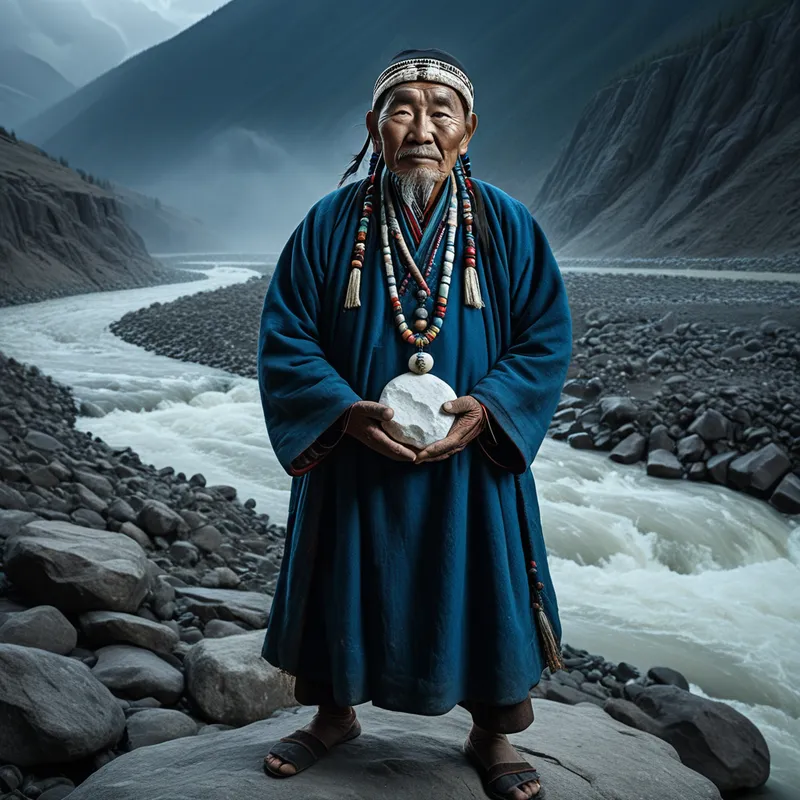
From the high taiga came Old Man Batu, his face a map of winters, his eyes the colour of smoky quartz. He was a shaman who remembered the old tongue, the language of treaty with the world. He stood on a promontory where the river bent, feeling her pain as a physical wound in his own chest. He did not command. He listened. And in the roar of the flood, he heard her voice—a sound of immense, betrayed loneliness.
He knew the law of balance. A debt of spirit must be paid with spirit; a wound of the world must be healed by a piece of the world’s soul. He called the trembling people. “You have taken her body and forgotten her heart. Now you must give a heart back.” From his pouch, he took a stone, a simple river stone worn smooth by her own touch. He held it to his lips, breathed into it his memories of gratitude, his love for the clean wind and the running water. He infused it with his own kut, a fragment of his own spirit.
With a cry that was part grief, part release, he cast the stone into the raging center of the flood. For a moment, nothing. Then, a great sigh seemed to pass through the land. The rain softened. The river’s roar diminished to a rumble, then a murmur. The waters, still high but no longer wild, began to recede, leaving not just mud, but clean, polished stones in their wake. And in the deep, clear pool where the stone had fallen, the people felt it again—the gentle, watchful presence. Not the same as before, for trust once broken bears a scar, but a presence renewed. A covenant remembered: take, but give. Use, but honor. For the river is not a thing. It is a being. And we live only by its consent.
Cultural Origins & Context
This myth emerges from the shamanic worldview of the Buryat and other Siberian peoples living along the Selenga’s vast watershed. It is an Üliger, a story passed down not merely for entertainment, but as a vital operating manual for living in a sentient world. Told by elders and shamans around winter fires, its function was deeply pragmatic and sacred. It encoded ecological law, teaching sustainable fishing, respectful foraging, and the consequences of pollution long before the concept existed in modern terms.
The river Ejen is a central figure in this animistic framework, where every mountain, forest, and lake possesses a conscious, personified spirit. The myth served as a social contract, regulating human behavior by framing the natural world not as a resource, but as a kin network of powerful, conscious beings. The shaman’s role, as embodied by Old Man Batu, was that of diplomat and translator—one who could perceive the imbalance, hear the spirit’s distress, and negotiate a restoration of harmony through ritual sacrifice and correct action.
Symbolic Architecture
At its core, the myth is a profound [drama](/symbols/drama “Symbol: Drama signifies narratives, emotional expression, and the exploration of human experiences.”/) of [relationship](/symbols/relationship “Symbol: A representation of connections we have with others in our lives, often reflecting our emotional state.”/), violation, and costly [atonement](/symbols/atonement “Symbol: A spiritual process of making amends for wrongdoing, seeking reconciliation with the divine, others, or oneself through sacrifice, repentance, or restitution.”/). The Selenga [River](/symbols/river “Symbol: A river often symbolizes the flow of emotions, the passage of time, and life’s journey, reflecting transitions and movement in one’s life.”/) [Spirit](/symbols/spirit “Symbol: Spirit symbolizes the essence of life, vitality, and the spiritual journey of the individual.”/) represents the [Anima](/symbols/anima “Symbol: The feminine archetype within the male unconscious, representing soul, creativity, and connection to the inner world.”/) Mundi, the World [Soul](/symbols/soul “Symbol: The soul represents the essence of a person, encompassing their spirit, identity, and connection to the universe.”/)—the living, conscious, and feminine principle of [nature](/symbols/nature “Symbol: Nature symbolizes growth, connectivity, and the primal forces of existence.”/) itself. She is the archetypal [Caregiver](/symbols/caregiver “Symbol: A spiritual or mythical figure representing nurturing, protection, and unconditional support, often embodying divine or archetypal parental energy.”/), whose bounty is unconditional until the fundamental bond of reciprocity is severed.
The river’s wrath is not punishment, but the natural consequence of a severed connection; it is the psyche’s symptom when the ego exploits the unconscious.
The [polluted river](/symbols/polluted-river “Symbol: The Polluted River symbolizes the corruption of the life force and personal trauma, reflecting emotional and spiritual decay.”/) symbolizes a corrupted relationship—not just with the environment, but with our own inner [depths](/symbols/depths “Symbol: Represents the subconscious, hidden emotions, or foundational aspects of the self, often linked to primal fears or profound truths.”/). The greed of the people represents the unchecked, consumptive ego, which sees the world (and the unconscious) as a [commodity](/symbols/commodity “Symbol: An object or concept reduced to exchange value, representing material worth, trade, and the tension between intrinsic meaning and market price.”/) to be mined rather than a [dialogue](/symbols/dialogue “Symbol: Conversation or exchange between characters, representing communication, relationships, and narrative flow in games and leisure activities.”/) to be entered. The flood is the inevitable [eruption](/symbols/eruption “Symbol: A sudden, violent release of pent-up energy or emotion from beneath the surface, often representing transformation or crisis.”/) of the neglected and abused unconscious, overwhelming the conscious mind with depression, rage, or somatic illness.
The [shaman](/symbols/shaman “Symbol: A spiritual mediator who bridges the human and spirit worlds, often through altered states, healing, and guidance.”/)’s sacrifice of his spirit-[stone](/symbols/stone “Symbol: In dreams, a stone often symbolizes strength, stability, and permanence, but it may also represent emotional burdens or obstacles that need to be acknowledged and processed.”/) is the pivotal act of symbolic restitution. He does not fight the flood; he acknowledges its justice. His offering is a [piece](/symbols/piece “Symbol: A ‘piece’ in dreams often symbolizes a fragment of the self or a situation that requires integration, reflection, or understanding.”/) of his own psychic substance—his conscious [attention](/symbols/attention “Symbol: Attention in dreams signifies focus, awareness, and the priorities in one’s life, often indicating where the dreamer’s energy is invested.”/), his [memory](/symbols/memory “Symbol: Memory symbolizes the past, lessons learned, and the narratives we construct about our identities.”/) of gratitude, his vital [energy](/symbols/energy “Symbol: Energy symbolizes vitality, motivation, and the drive that fuels actions and ambitions.”/)—given back to the whole. This act transforms the relationship from one of taking to one of exchange.

The Dreamer’s Resonance
When this mythic pattern stirs in the modern dreamer, it often manifests as dreams of polluted or flooding water, of being pursued by a tidal wave, or of trying in vain to clean a filthy, stagnant pond. Somatically, this may coincide with feelings of being “clogged,” chronic fatigue, or mysterious ailments—the body’s river systems (lymphatic, circulatory) echoing the mythic blockage.
Psychologically, the dreamer is experiencing the “floodwaters” of a neglected aspect of the Self. Perhaps they have been exploiting their own energy (overwork without rest), polluting their inner world with toxic thoughts or unresolved grief, or severing their connection to instinct and creativity. The raging river in the dream is the Self’s demand for attention and re-balancing. The dream is an invitation to play the role of the shaman: to stop, listen to the distress signal, and ask, “What debt have I incurred with my own soul? What have I taken without giving thanks?”

Alchemical Translation
The myth models the alchemical process of Individuation as a restoration of ecological balance within the psyche. The initial state is unconscious unity with the nurturing Great Mother (the generous river). This is followed by the separation and inflation of the ego (the greedy clan), which leads to enantiodromia—the eruption of the opposite (the nurturing river becomes the destructive flood).
The shaman’s ritual is the coniunctio: the conscious ego (the shaman) willingly offers its most valued possession (its own oriented spirit, the stone) to the unconscious (the river), forging a new, conscious relationship.
For the modern individual, the “alchemical stone” offered is often a sacrifice of time, a disciplined practice (like journaling, meditation, or therapy), or a sincere act of creativity dedicated not to profit, but to re-sacralization. It is the hard, conscious work of cleaning one’s internal “riverbank”—examining habits, acknowledging neglected emotions, and re-establishing rituals of gratitude and respect for the inner and outer world. The goal is not to return to a pristine, unconscious state, but to achieve a reconciled state: a conscious partnership with the powerful, sometimes terrifying, but ultimately life-giving spirit of the deep Self. The river remains powerful, and may still flood, but one now knows its language and lives in respectful treaty with its flow.
Associated Symbols
Explore related symbols from the CaleaDream lexicon:
- River — The central life-giving and destructive force, representing the flow of the unconscious, time, and the continuum of life that must be respected.
- Spirit — The conscious, personified essence of the natural world and the psyche, demanding relationship and reciprocity from humanity.
- Sacrifice — The essential act of giving something of profound personal value (energy, attention, pride) to restore balance and heal a ruptured connection.
- Healing — The outcome of correct sacrifice and renewed respect, a process that mends the relationship between the human community and the animate world.
- Stone — The shaman’s offering, symbolizing the eternal, condensed essence of intention and spirit, used as a tool for ritual reconciliation.
- Flooding River — The destructive aspect of the unconscious when it is ignored or abused, representing overwhelming emotion, psychic crisis, or ecological disaster.
- Riverbank — The liminal space between the human world and the spirit world, a place of meeting, exchange, and potential violation.
- Mother — The Selenga Spirit as the archetypal nurturing and, when wounded, devouring Great Mother, source of all life and sustenance.
- Shaman — The archetypal mediator who can traverse the spirit world, diagnose imbalance, and perform the ritual work necessary for healing.
- Grief — The primary emotion of the betrayed spirit and the starting point for the shaman’s compassionate intervention, a necessary step toward atonement.
- Muddy Riverbanks — The polluted boundary between realms, symbolizing a corrupted relationship, confused instincts, and the mess left by exploitation.
- Ancestral Spirits — The collective wisdom and tradition, embodied by the old shaman, that remembers the ancient treaties and protocols for living in a sentient world.