The Seder Night Myth Myth Meaning & Symbolism
A ritual re-enactment of Exodus, where storytelling, symbolic foods, and questions transform historical memory into a living, liberating present.
The Tale of The Seder Night Myth
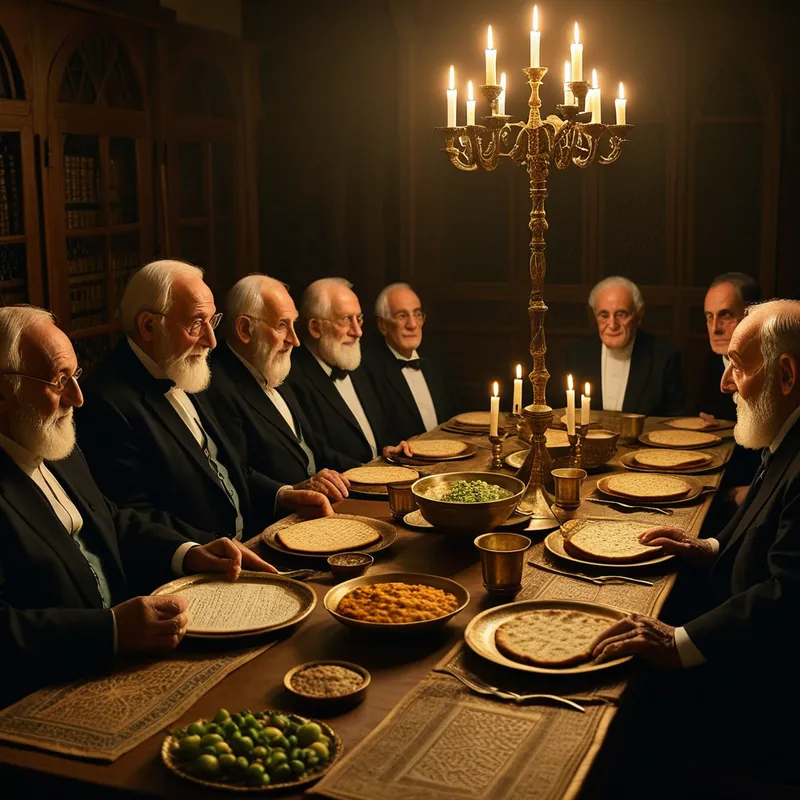
Listen. The night is not like other nights. It is a night of watching, a night when the membrane between then and now grows thin as parchment. The house has been scoured, not for dust, but for the leaven of forgetfulness. The table is set not for a meal, but for a journey.
The youngest child, whose eyes are still pools of why, leans forward. “How is this night different?” The question hangs in the candlelit air, a key turning in a lock no one saw. And so it begins.
The elder, whose voice is a riverbed worn smooth by stories, begins to speak. He does not say, “Once upon a time.” He says, “We were slaves.” He speaks of the mud and straw, of the crushing weight of the sun on bent backs, of a spirit so compressed it could barely whisper its own name. He speaks of the cry that rose not from one throat, but from the collective soul, a sound that finally pierced the heavens.
Then, the telling becomes a summoning. The plagues are not merely recounted; they are tasted—a drop of wine spilled for each diminishment of life, a sweetening of the cup made bitter by remembrance. The charoset is the mortar of memory; the maror is the sharp shock of suffering, eaten here, now, on your own tongue.
The story builds like a drumbeat: the lamb’s blood on the doorpost, a sign and a shield; the hurried, fearful meal; the standing ready, loins girded. And then, the moment of rupture—the great sigh of the sea parting, walls of water standing as mountains of possibility, a path opening in the heart of the impossible. The dry ground beneath the feet of the fleeing, the thunder of chariots swallowed, the first breath of free air, terrifying and vast.
But the tale does not end on the far shore. It turns back upon itself. “In every generation,” the elder intones, his eyes holding each person, “a person must see themselves as if they personally went out from Egypt.” The past tense collapses. The matzah is broken. The cup for the prophet Elijah is filled, a space held open for the promise of a future redemption. The night is a spiral, not a line. We were slaves. We are freed. We are freeing.

Cultural Origins & Context
This is not a myth found in a single, sacred text, but a myth enacted. Its primary vessel is the Haggadah, a living script that has evolved for over two millennia, weaving together biblical verses, rabbinic commentary, medieval poetry, and folk songs. It is performed in the home, not the temple, making every household a sanctuary of memory and every parent a storyteller.
Its societal function is profound: it is the primary mechanism of galut (exile) identity formation. In the absence of a land or a temple for centuries, the Seder night became the portable homeland. It answered the existential threat of assimilation by annually answering the child’s question, “What does this mean to you?” It transforms history from a fact into an identity, from a memory into a mandate. The ritual is egalitarian—the wise, the wicked, the simple, and the one who does not know how to ask are all addressed, acknowledging the different psychological states within every community and every individual.
Symbolic Architecture
At its core, the Seder myth is an alchemy of time and consciousness. It is a ritual technology for converting historical narrative into embodied, psychological reality.
The journey from slavery to freedom is not a one-time historical event, but the perpetual motion of the human soul awakening from the tyranny of the unconscious.
The central symbols are not mere reminders but transformational tools. Egypt (Mitzrayim) is the constricted self, bound by internalized oppression, habit, and trauma. Pharaoh is the tyrannical inner voice, the rigid ego, or the collective shadow that demands conformity. The Exodus is the individuation impulse, the painful, necessary rupture from familiar bondage into the terrifying wilderness of authentic being.
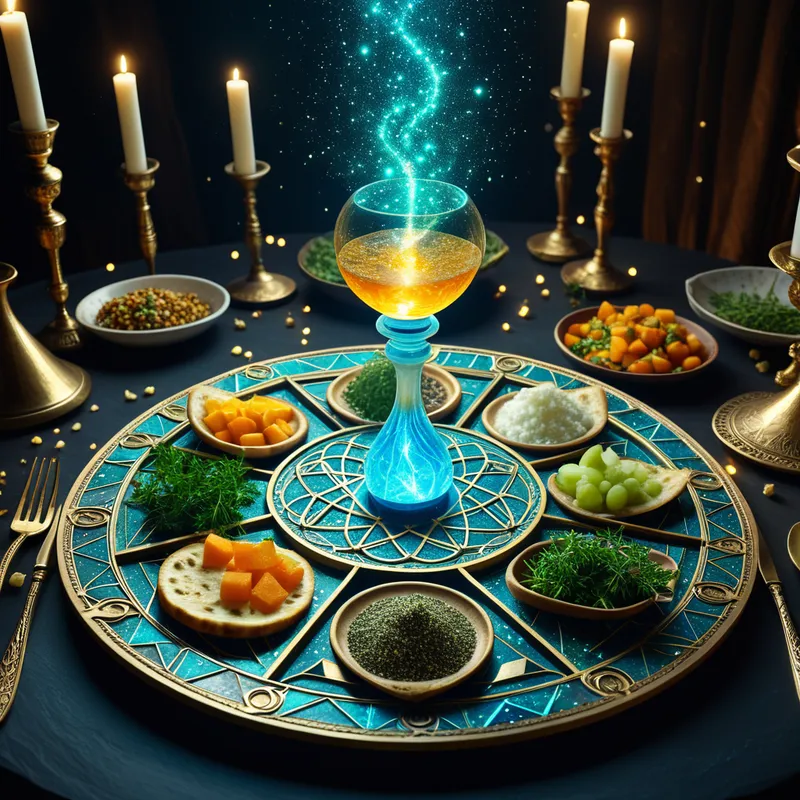
The Seder plate is a mandala of the psyche. Each item maps a part of the journey: the bitter herbs (suffering made conscious), the salt water (tears of release), the sweet charoset (the capacity to find meaning and sweetness even in hardship), the shank bone (the cost of liberation, the sacrificed lamb), and the egg (the potential for cyclical rebirth). The eating of these in a prescribed order is a somatic reprogramming, a way of tasting one’s own transformation.
The Dreamer’s Resonance
When this myth appears in modern dreams, it rarely manifests as a literal Passover scene. Instead, one dreams of constricted spaces—being trapped in a narrow corridor, a small room, or a repetitive, meaningless task (the slavery of Egypt). There is often a figure of unjust authority (Pharaoh) or a feeling of being owned by a system, a job, or a relationship.
The turning point is the dream of a sudden doorway or a path opening in water. This is the moment of psychic exodus. The dreamer may experience this as a profound somatic release—a feeling of lungs expanding after being compressed, or of walking with new strength. However, the wilderness that follows is fraught. Dreams of wandering in a vast, featureless desert under a baking sun reflect the anxiety and disorientation of newfound freedom. Where is the nourishment? Where is the direction? The dream asks the Seder’s central question: “You have left the narrow place, but who are you now?”

Alchemical Translation
The Seder night is a masterful model for psychic transmutation. It does not bypass the shadow (suffering, bitterness, plague) but incorporates it into the ritual. The first alchemical step is Narratio—the telling. The ego must consciously articulate its state of bondage. “I am enslaved by this pattern, this fear, this past.”
Individuation begins not with an answer, but with a question posed from the place of innocent curiosity within.
The second step is Participatio—the embodied tasting. One must consciously “eat” the bitterness and the sweetness, to fully integrate the shadow’s lessons without being identified with it. Spilling the wine for the plagues acknowledges the destruction inherent in any radical change, even a liberating one.
The third and crucial step is Identificatio—“as if you yourself went out.” This is the ritual’s genius. It forces a psychological projection into the mythic event, collapsing the distance between archetype and ego. You are not learning about freedom; you are, for the duration of the ritual, in the process of freeing yourself. The dry matzah becomes the “bread of affliction” and the “bread of liberation,” holding the paradox of the journey.
Finally, the ritual points beyond itself with the cup for Elijah. This represents the opus contra naturam—the work against nature, which is the work of continual becoming. Liberation is not a final state but a direction. The door is opened for the prophet, symbolizing an ongoing receptivity to future revelations, future stages of the self yet unknown. The night of watching is, ultimately, a vigil for the next emergence of one’s own potential.
Associated Symbols
Explore related symbols from the CaleaDream lexicon:
- Door — The lintel marked with blood, the threshold between bondage and freedom, and the opened door for Elijah; it represents the critical point of psychic transition and the invitation to the future self.
- Night — The “night of watching,” a time set apart from ordinary time when deep memory is activated and the unconscious becomes accessible for transformation.
- Journey — The core narrative arc from the narrow place (Egypt) through the wilderness to potential promised land, mirroring the soul’s path of individuation.
- Sacrifice — Represented by the Paschal lamb and the spilled wine; it signifies the necessary cost of liberation, the old identity or comfort that must be relinquished.
- Water — Appearing as the Red Sea, a barrier that becomes a path, and as salt water for dipping, representing the amniotic waters of rebirth and the tears of both suffering and release.
- Ritual — The Seder itself; the structured, symbolic actions that containerize the chaotic process of transformation, making the myth safe to inhabit and real to experience.
- Memory — The entire purpose of the “telling” (Haggadah); not just recollection, but the active re-membering of the fractured self into a liberated whole by integrating ancestral and personal story.
- Order — The prescribed 15 steps of the Seder; the necessary psychic structure that provides a vessel for the powerful, chaotic forces of liberation and rebirth.
- Liberation — The ultimate goal and promise of the Exodus story, translated psychologically as freedom from internal Pharaohs and the compulsive patterns of the unconscious.
- Child — The one who asks the four questions, representing the innate, curious, questioning Self that initiates the entire process of awakening and remembrance.
- Bitter Herbs — The conscious tasting of suffering (Maror), a crucial step where pain is acknowledged and metabolized rather than repressed, essential for true healing.
- Cup — The Cup of Elijah, left full and untouched; it symbolizes the unrealized potential, the future redemption, and the space held open within the psyche for what is yet to come.