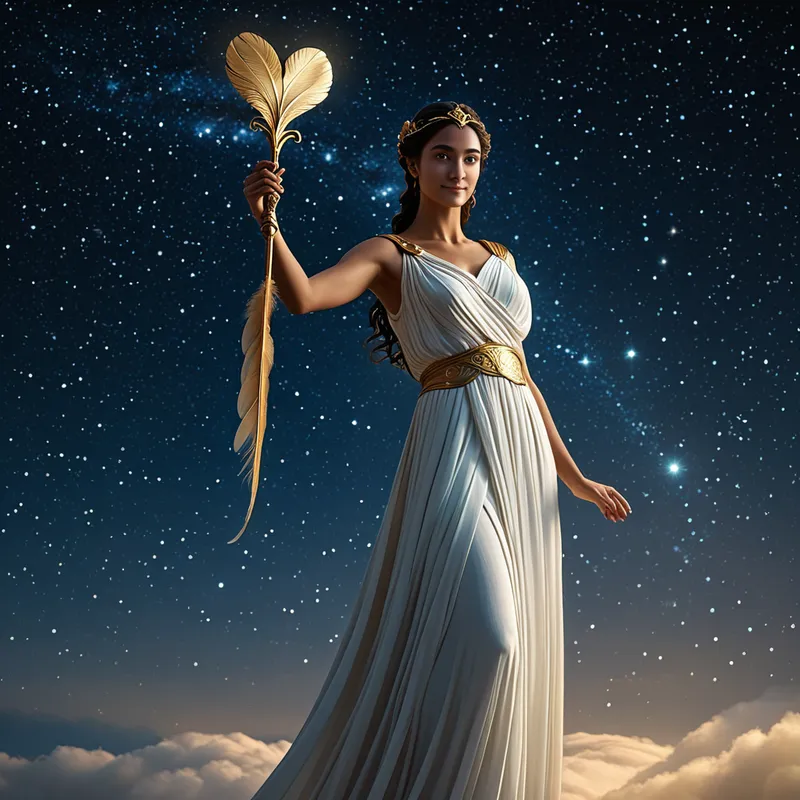
The Scales of Libra Myth Meaning & Symbolism
The myth of the celestial Scales, held by the Titaness Themis, representing divine justice, cosmic equilibrium, and the eternal human quest for balance.
The Tale of The Scales of Libra
Before the reign of the Olympians, in the deep, resonant silence of the first cosmos, there was a principle. It was not a god of thunder or a goddess of love, but something more fundamental: the principle of order. And its name was Themis.
She was there when Ouranos was cast down, and when Kronos swallowed his children. She witnessed the chaos of raw, ungoverned power. And in her silent wisdom, she knew the universe could not endure on force alone. It required measure. It required balance.
When the great war, the Titanomachy, finally ceased with the victory of Zeus, the new king of the gods looked upon a shattered cosmos. The mountains were broken, the seas churned with the blood of immortals, and the very air crackled with unresolved strife. Zeus, in his might, could command obedience, but he could not command harmony. He turned to the one being who remembered the original pattern, the deep structure beneath the chaos.
He turned to Themis.
In the newly forged halls of Olympus, Themis did not bring a weapon or a crown. She brought forth from the aether an instrument of breathtaking simplicity and infinite complexity: a pair of scales. They were forged not of gold or bronze, but of starlight and necessity. Their beam was the horizon line between earth and sky. Their pans were the cups of consequence.
And so, she took her place beside the throne. Not as a subject, but as a counselor. As the gods brought their disputes—claims over domains, grievances of honor, the fates of mortals—Themis would lift her scales. She would place the argument of Poseidon in one pan, the plea of Hestia in the other. She did not listen to their thunderous voices or beheld their dazzling glory. She listened only to the weight of truth, the mass of justice, the substance of rightful order.
The scales would tilt, ever so slightly. A silence would fall upon Olympus, deeper than any command from Zeus. For in that tilt was a verdict written into the fabric of reality itself. It was the universe realigning. Themis would then speak, her voice like stone settling into bedrock, and pronounce the judgment that the cosmos had already rendered.
Her scales measured the portion of honor due to each god. They weighed the fate of cities, tipping against those steeped in hubris. They balanced the fleeting joy of mortals against their enduring suffering. Themis held the equilibrium, ensuring the wild, passionate, often petty wills of the Olympians did not tear the world apart. She was the still point in the turning world, and her scales were the instrument by which chaos was transmuted into cosmos, disorder into a bearable, just order.
Cultural Origins & Context
The figure of Themis and her scales is not a myth contained within a single, dramatic epic like the Iliad or Odyssey. Instead, it is a foundational concept woven into the very fabric of Greek religious and civic thought. Themis personifies themís—a crucial, pre-Olympian concept meaning "that which is laid down or established," divine right order, customary law, and the proper way of things.
Her origins are Titan, older than the Olympian gods, signifying that justice and balance are not laws invented by Zeus, but primordial principles he must uphold to legitimize his rule. She was worshipped in specific cults, often alongside Mnemosyne, Memory, suggesting that true justice requires remembrance of precedent and tradition.
In the civic sphere, the image of balanced scales became the paramount symbol of Dike (Justice), Themis's daughter. This was not abstract. In Athenian courts, jurors cast their votes with pebbles placed into urns, a direct, physical metaphor for weighing evidence. The myth was performed daily in the agora and the law courts; it was the psychic architecture for a society attempting to govern itself by reason and measured judgment rather than pure force or aristocratic whim.
Symbolic Architecture
The Scales of Libra represent the archetypal principle of dynamic equilibrium. This is not the sterile balance of identical weights, but the active, precarious, and necessary tension between opposing forces that allows a system—a psyche, a society, a cosmos—to exist and function.
The scale does not choose one side over the other; it reveals the relationship between them. Justice is not victory, but the acknowledgment of true weight.
Themis herself symbolizes the objective, transpersonal law. She is not swayed by pity, passion, or power. She is the internal compass that exists beyond personal desire, what we might call conscience or the Self in its ordering function. Her scales are the tool of discernment. The act of weighing is the core psychological process of evaluation, consideration, and ethical judgment.
The two pans hold the eternal polarities: light and shadow, self and other, action and consequence, freedom and responsibility, the individual and the collective. The myth tells us that these opposites are not to be conquered or eliminated, but held in conscious tension. The fulcrum—the precise, often elusive point of balance—is the seat of wisdom.

The Dreamer's Resonance
When the Scales of Libra appear in modern dreams, they signal a profound moment of inner reckoning. The dreamer is not merely making a decision; they are undergoing a process of psychic measurement.
You may dream of trying to balance impossible objects—a stone and a cloud, a scream and a silence. This somaticizes the felt sense of an internal conflict where the elements seem incommensurate. Perhaps a career ambition weighs against a familial duty, or a personal truth feels heavy against the light weight of social acceptance. The dream often features anxiety around the scales tipping violently, or frustration at being unable to find the correct weights. This is the psyche's workshop, where the unconscious is attempting to assemble the counter-weights—repressed feelings, forgotten values, unseen consequences—needed to achieve equilibrium.
A dream where the scales balance perfectly under a calm, watchful presence (like Themis) can indicate a resolution is near, a synthesis has been reached in the depths. The body may feel a release of tension upon waking, a somatic "settling."

Alchemical Translation
The individuation process, the journey toward psychic wholeness, is an alchemical operation of endless balancing. The myth of Themis provides the model.
First, we must invoke the inner Themis. We must cultivate that inner, impartial observer that can step back from the identifications with our passions (the inner Olympians) and simply witness the conflict. This is the move from being in the drama to holding the scale upon which the drama is placed.
Next comes the operation of weighing. This is the hard, conscious work of analysis. We place our conscious attitude in one pan. In the other, we must diligently gather the contents of the shadow—the rejected, ignored, or unknown parts of ourselves that act as counter-weight. We weigh our persona against our authentic feeling, our logos against our eros. This process is rarely clean; it involves getting our hands on the messy, often dark "substance" of our own being.
The alchemical gold is not found in one pan or the other, but in the relationship between them, symbolized by the perfectly poised beam.
The fulcrum point is the transcendent function, the third thing that arises from holding the tension of opposites. It is not a compromise, but a new level of understanding that contains and transcends both sides. Achieving this balance is not a permanent state, but a momentary alignment. The scales will tip again with life's next challenge. The triumph is not in a final balance, but in the ongoing, sacred practice of weighing—the commitment to the process of Themis, which is the commitment to consciousness itself. In this, we participate in the ancient work of turning private chaos into a personal cosmos, governed not by tyranny, but by the just law of the Self.
Associated Symbols
Explore related symbols from the CaleaDream lexicon: