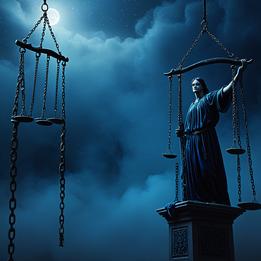
Verdict
A formal judgment or decision, often legal or moral, representing closure, accountability, and societal evaluation.
Verdict Dream Meaning
A formal judgment or decision, often legal or moral, representing closure, accountability, and societal evaluation.
Interpretive Themes
Justice and Accountability
highDreams may process guilt or fairness.
Fear of Judgment
highReflects social pressure or self-criticism.
Closure and Resolution
mediumDesire to end uncertainty or conflict.
Authority and Power
mediumFeelings of powerlessness or control.
Identity
lowSubconscious assessment of life choices.
Mythological Resonance
The Scales of Themis
GreekThe goddess of divine law and order holds scales to weigh evidence, delivering verdicts that balance justice and fate.
The Weighing of the Heart
EgyptianIn the Duat, the heart of the deceased is weighed against the feather of Ma'at, with Osiris rendering a verdict of purity or damnation.
Cultural Lenses
Jungian Perspective
View Context →Represents the Self's judgment integrating unconscious shadow aspects; verdicts symbolize individuation where psyche evaluates conflicting archetypes for wholeness and moral alignment.
Freudian Perspective
View Context →Manifests superego's punishment of id desires; verdicts reflect repressed guilt over taboo wishes, often sexual or aggressive, with courtroom as parental authority figure.
Gestalt Perspective
View Context →Projects internal conflicts onto external judgment; each part of the verdict dream represents unintegrated aspects of self needing acknowledgment and dialogue for resolution.
Cognitive Perspective
View Context →Processes real-life decision-making anxiety; verdicts mirror brain's threat assessment about social rejection or failure, reinforcing schemas about justice and consequence.
Evolutionary Perspective
View Context →Rooted in tribal exclusion fears; verdicts activate ancient survival mechanisms where group judgment determined banishment or acceptance, linking to modern social belonging anxiety.
Global/Universal Perspective
View Context →Cross-cultural symbol of societal order; from ancient codes like Hammurabi's to modern courts, verdicts represent universal human need for fairness, closure, and moral boundaries.
East Asian Perspective
View Context →In Confucian societies, verdicts emphasize collective harmony over individuality; historical imperial judgments balanced legalism with filial piety, modern contexts stress social face preservation.
South Asian Perspective
View Context →Tied to karma and dharma; verdicts reflect cosmic justice (karmic judgment) where actions reap consequences across lifetimes, blending legal systems with spiritual accountability.
Middle Eastern Perspective
View Context →In Islamic tradition, verdicts (hukm) connect divine judgment (Day of Judgment) with sharia courts; historically, qadis' rulings balanced community welfare with religious law.
European Perspective
View Context →Evolved from medieval trial-by-ordeal to Enlightenment legal systems; verdicts symbolize social contract ideals, with modern emphasis on human rights and procedural fairness.
African Perspective
View Context →In many traditions, verdicts involve communal elders or ancestors; Ubuntu philosophy emphasizes restorative justice where judgments rebuild relationships rather than punish individuals.
North American Perspective
View Context →Shaped by adversarial legal systems and media trials; verdicts reflect cultural tensions between individual rights and collective safety, amplified by high-profile celebrity cases.
Historical Authorities
Want a deeper analysis?
Get a personalized interpretation of your entire dream including this symbol.
Interpret My DreamThe Oracle's Prediction
Combine multiple symbolsA long-standing inner conflict will reach a decisive resolution, bringing profound clarity.
Timeframe
Seasonal (~3 Months)
Intensity
Deep
A project or proposal will receive a definitive outcome, altering your professional path.
Timeframe
Lunation (~29 Days)
Intensity
Deep
Common Appearances & Contexts
| Context | Emotion | Interpretation |
|---|---|---|
| Context Courtroom trial | Emotion Fear | Interpretation Facing external judgment. |
| Context Receiving verdict | Emotion Relief | Interpretation Resolution of anxiety. |
| Context Announcing verdict | Emotion Power | Interpretation Exercising authority. |
| Context Appealing verdict | Emotion Frustration | Interpretation Rejecting judgment. |
| Context Waiting verdict | Emotion Anxiety | Interpretation Uncertainty about outcome. |
| Context Overturned verdict | Emotion Joy | Interpretation Redemption or vindication. |
| Context Unjust verdict | Emotion Anger | Interpretation Perceived injustice. |
| Context Historical verdict | Emotion Shame | Interpretation Past actions judged. |
| Context Moral verdict | Emotion Guilt | Interpretation Internal ethical conflict. |
| Context Public verdict | Emotion Humiliation | Interpretation Social exposure. |
| Context Divine verdict | Emotion Awe | Interpretation Spiritual judgment. |
| Context Self-verdict | Emotion Regret | Interpretation Personal condemnation. |
Interpret Your Full Dream
Beyond this symbol, every dream carries a unique story. Share your dream for a personalized AI-powered interpretation.