The Samurai Sword Myth Meaning & Symbolism
A myth where a master smith, guided by a kami, forges a blade by fusing his own spirit with steel, creating a soul in a sword.
The Tale of The Samurai Sword
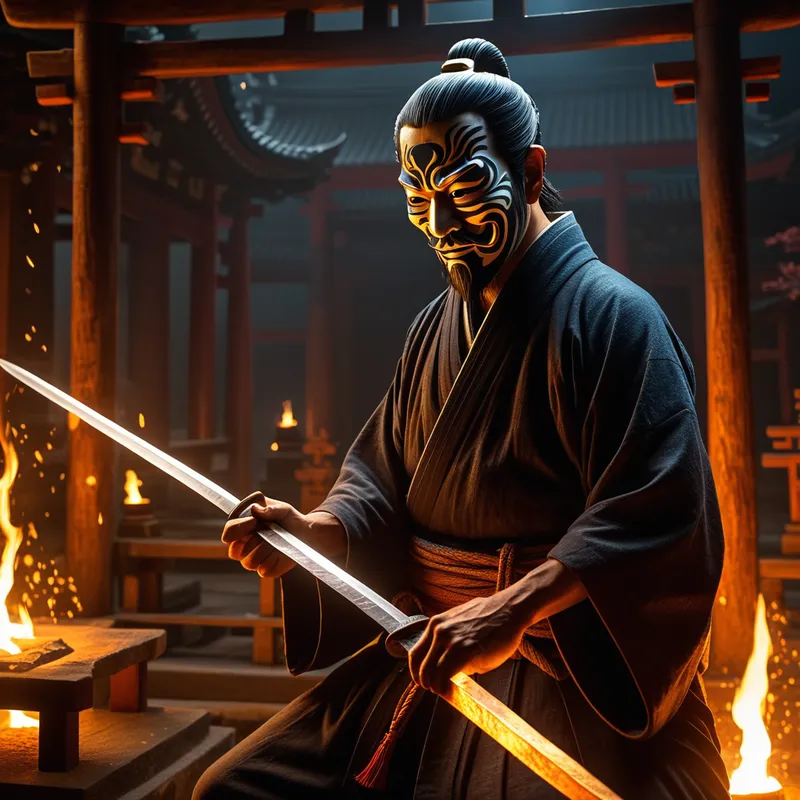
Listen. In the age when [the world](/myths/the-world “Myth from Tarot culture.”/) was still half-formed from the breath of the kami, when mist clung to the mountains like a prayer, there lived a smith. His name is lost to [the wind](/myths/the-wind “Myth from Various culture.”/), but his deed is etched in fire. He was not merely a craftsman; he was a priest of the forge, a bridge between the raw earth and the refined spirit. For years, he had hammered good blades, strong and sharp, but his soul thirsted for a masterpiece—a blade that was not a tool, but a being.
One night, under a moon so full it seemed a silver mirror to the sun, a vision came. The kami of the mountain and fire stood before him, not in glory, but in a stillness that hummed with power. No words were spoken, but a knowing settled in the smith’s bones: to create the ultimate sword, he must invite the kami into the very act of creation. He must become a vessel.
For seven days and seven nights, he purified himself. He bathed in icy streams, ate only salt and rice, and let his mind become as still as a forest pool. Then, he entered the forge—a space now consecrated, the very air tasting of ozone and intent. He did not work alone. Assistants, moving like shadows in the firelight, fed the charcoal to a star’s heart. The smith selected the purest tamahagane, a jewel-steel born from sacred sand. As he folded and hammered, fold upon fold, a thousand times, he was not just welding metal. He was folding the mountain’s patience, [the river](/myths/the-river “Myth from Buddhist culture.”/)’s persistence, the kami’s will into a single, dense soul.
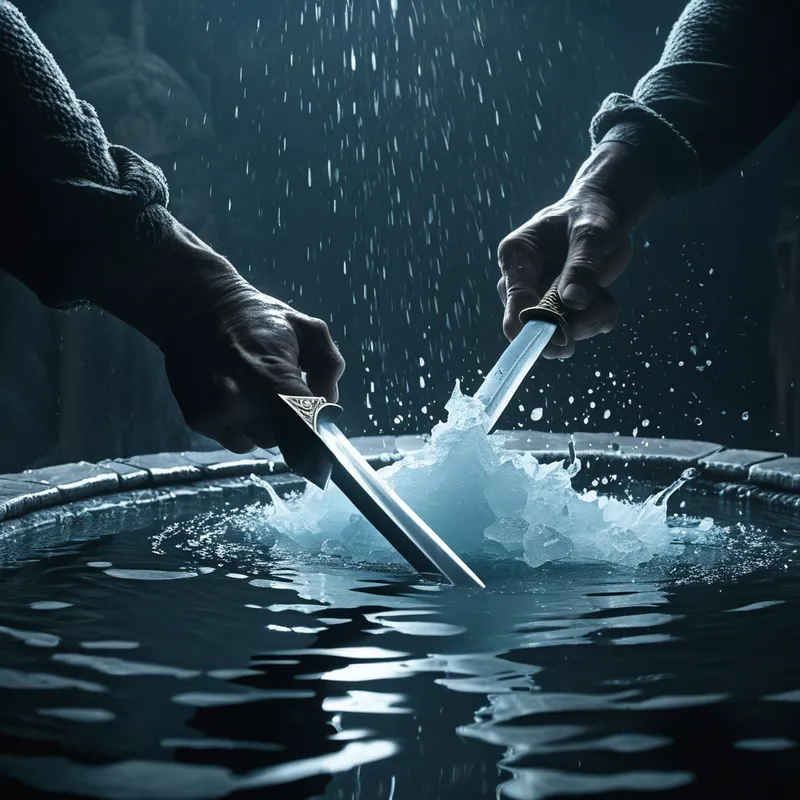
The climax was not the shaping, but the yaki-ire. The blade, glowing a blinding, soul-white heat, was ready. In this moment, the smith did not see a piece of steel. He saw a child of earth and heaven, raw and potential. He knew the final ingredient. With a cry that was part agony, part ecstasy, he did not use [water](/myths/water “Myth from Chinese culture.”/) alone. He opened his own spirit. Some say he stepped into the quenching trough himself. Others whisper he poured his life’s breath over the metal. The steam that erupted was not mere vapor; it was a dragon’s sigh, a spirit’s first breath. When [the mist](/myths/the-mist “Myth from Celtic culture.”/) cleared, the blade lay in the [water](/myths/water “Myth from Chinese culture.”/), perfect, its curve the arc of a destiny fulfilled. Along its spine, a pattern shimmered—not just the grain of the metal, but the frozen record of a storm, a flowing river, the very ki of the universe. He had not made a sword. He had midwifed a katana into the world.
Cultural Origins & Context
This myth, in its many variations, is the soul-story of the Japanese sword. It is not a single, codified tale from a text like the Kojiki, but a living folklore that crystallized around the figure of the tosho. These smiths, from legendary figures like [Masamune](/myths/masamune “Myth from Japanese culture.”/) to countless unnamed artisans, were seen as practitioners of a sacred, Shinto-infused craft.
The myth was passed down orally within smithing lineages and through the warrior class that wielded the blades. Its societal function was multifaceted. For the [samurai](/myths/samurai “Myth from Japanese culture.”/), it explained why the katana was more than a weapon; it was his tamashii, his honor made manifest. To lose it was a spiritual catastrophe. For the culture at large, it modeled the ideal of creation: a process requiring absolute purity, self-sacrifice, and a harmonious alignment with natural and spiritual forces. The forge was a himorogi, a temporary altar where the human and divine collaborated. The myth served as a constant reminder that true excellence—in any endeavor—requires the maker to risk themselves in the making.
Symbolic Architecture
At its core, the myth is a profound [allegory](/symbols/allegory “Symbol: A narrative device where characters, events, or settings represent abstract ideas or moral qualities, conveying deeper meanings through symbolic storytelling.”/) for the [birth](/symbols/birth “Symbol: Birth symbolizes new beginnings, transformation, and the potential for growth and development.”/) of [consciousness](/symbols/consciousness “Symbol: Consciousness represents the state of awareness and perception, encompassing thoughts, feelings, and experiences.”/) from the union of opposites. The sword is the ultimate [symbol](/symbols/symbol “Symbol: A symbol can represent an idea, concept, or belief, serving as a powerful tool for communication and understanding.”/) of discriminated [awareness](/symbols/awareness “Symbol: Conscious perception of self, surroundings, or internal states. Often signifies awakening, insight, or heightened sensitivity.”/)—the sharp, cutting edge that separates “this” from “that,” [decision](/symbols/decision “Symbol: A decision in a dream reflects the choices one faces in waking life and can symbolize the pursuit of clarity and resolution.”/) from doubt, self from other.
The sword is not a tool for division, but the axis upon which the world of chaos turns into the world of order.
The raw tamahagane represents the unrefined contents of the unconscious—a messy amalgam of instincts, potentials, and [shadow](/symbols/shadow “Symbol: The ‘shadow’ embodies the unconscious, repressed aspects of the self and often represents fears or hidden emotions.”/) [material](/symbols/material “Symbol: Material signifies the tangible aspects of life, often representing physical resources, desires, and the physical world’s influence on our existence.”/). The relentless folding is the arduous work of introspection, of bringing unconscious material into the light of consciousness, [layer](/symbols/layer “Symbol: Layers often symbolize complexity, depth, and protection in dreams, representing the various aspects of the self or situations.”/) by painful layer, to create [strength](/symbols/strength “Symbol: ‘Strength’ symbolizes resilience, courage, and the ability to overcome challenges.”/) and [resilience](/symbols/resilience “Symbol: The capacity to recover quickly from difficulties, adapt to change, and maintain strength through adversity.”/). The smith himself symbolizes the <abbr title=“The central archetype of order and organization in the psyche, the “I”>ego, but an ego in service to a greater totality. His purification ritual is the ego’s necessary submission, clearing away personal agenda to become a conduit.
The pivotal [moment](/symbols/moment “Symbol: The symbol of a ‘moment’ embodies the significance of transient experiences that encapsulate emotional depth or pivotal transformations in life.”/) of yaki-ire is the symbolic [death](/symbols/death “Symbol: Symbolizes transformation, endings, and new beginnings; often associated with fear of the unknown.”/). The white-hot [blade](/symbols/blade “Symbol: A sharp-edged tool or weapon symbolizing cutting action, separation, precision, or violence. It represents both creative power and destructive force.”/) is the nascent [psyche](/myths/psyche “Myth from Greek culture.”/) at its most vulnerable, poised between formation and [dissolution](/symbols/dissolution “Symbol: The process of breaking down, dispersing, or losing form, often representing transformation, release, or the end of a state of being.”/). The smith’s sacrifice—the offering of his own [spirit](/symbols/spirit “Symbol: Spirit symbolizes the essence of life, vitality, and the spiritual journey of the individual.”/)—represents [the ego](/myths/the-ego “Myth from Jungian culture.”/)’s ultimate surrender to the process. It is the [moment](/symbols/moment “Symbol: The symbol of a ‘moment’ embodies the significance of transient experiences that encapsulate emotional depth or pivotal transformations in life.”/) where personal [identity](/symbols/identity “Symbol: Identity represents the sense of self, encompassing personal beliefs, cultural background, and social roles.”/) is risked for the sake of the emerging Self. The resulting [blade](/symbols/blade “Symbol: A sharp-edged tool or weapon symbolizing cutting action, separation, precision, or violence. It represents both creative power and destructive force.”/), with its unique hamon (temper line), is the individuated Self: a unique, integrated entity born from the [fusion](/symbols/fusion “Symbol: The merging of separate elements into a unified whole, often representing integration of self, relationships, or conflicting aspects of identity.”/) of conscious discipline and unconscious, instinctual power (the kami). It is a [soul](/symbols/soul “Symbol: The soul represents the essence of a person, encompassing their spirit, identity, and connection to the universe.”/) in form.
The Dreamer’s Resonance
When this myth stirs in the modern dreamer, it often signals a profound crisis of creation or identity. To dream of forging a sword is to dream of forging a self. The dreamer may be in a life phase requiring a definitive choice, the carving out of a new career path, or the integration of a powerful but chaotic talent or emotion.
Somatically, this can feel like a pressure in the chest or solar plexus—the forge of the body. There may be dreams of intense heat or, conversely, of plunging into cold water, mirroring the quenching process. The dream-ego might be laboring tirelessly (the folding) or standing paralyzed before a critical, irreversible action (the quenching). The appearance of a guiding but silent figure (the kami) suggests the unconscious is providing the raw energy and pattern, but the conscious self must perform the terrifying, sacrificial act of commitment. The anxiety in such dreams is not of failure, but of creation—the terrifying responsibility of bringing something permanent, sharp, and potentially dangerous (a new aspect of oneself) into the world.
Alchemical Translation
The myth’s journey is a perfect map for the alchemical process of individuation. The [nigredo](/myths/nigredo “Myth from Alchemical culture.”/) is found in the base, impure tamahagane—the initial state of confused, suffering, or conflicted psyche. The albedo is the prolonged purification and folding, the “whitening” where one refines their thoughts and emotions through conscious effort and introspection.
The [rubedo](/myths/rubedo “Myth from Alchemical culture.”/)—the reddening, the royal marriage—is the moment of yaki-ire. Here, the ultimate opposites meet: fire and water, spirit and matter, sacrifice and birth, the human ego and the divine archetype (the kami). This is not a gentle union but a violent, transformative immersion.
The Self is not found, it is forged in the moment the ego consents to its own necessary dissolution within a greater pattern.
For the modern individual, this translates to those pivotal life choices where logic alone is insufficient. It is the entrepreneur investing their entire life savings into a vision. It is the artist finally releasing their deeply personal work to the public. It is the individual ending a toxic relationship, the sharp cut that severs to save. In each case, a part of the old, comfortable identity “dies” in the quench. What emerges is not the same person, but a tempered one—a consciousness that has integrated a fragment of the transcendent, making it both more uniquely itself and more connected to the universal. The sword is not for external battle, but for the internal one: the ongoing, conscious discrimination required to live an authentic, purposeful life. You are both the smith and the steel, and the kami awaits your invitation to the forge.
Associated Symbols
Explore related symbols from the CaleaDream lexicon: