
The Sacred Hoop Myth Meaning & Symbolism
A powerful story of a world fractured by disharmony and made whole again through the restoration of sacred, interconnected circles of life.
The Tale of The Sacred Hoop
Listen. In the time before memory, [the world](/myths/the-world “Myth from Tarot culture.”/) was not as you see it now. It was a single, breathing entity, a great circle of life where every voice had its place in the song. The people walked with the buffalo, who spoke to the grass, which drank from the rain, which was called by the thunder beings. The four winds moved in a gentle dance, and the four-legged, the winged ones, the crawling ones, and the two-legged all knew their kinship. This was The Hoop of the People, unbroken and strong.
But a silence began. A forgetting. One by one, the strands of the song were neglected. The two-legged began to listen not to the heartbeat of [the earth](/myths/the-earth “Myth from Hindu culture.”/), but to a new, sharp voice within their own minds—a voice of separation. They took more than the grass could regrow. They spoke words that cut rather than connected. They forgot the ceremonies of gratitude. With each act of taking without giving, a thread in the great Hoop snapped.
The world did not shatter all at once, but it began to unravel. The buffalo grew thin and distant. The rivers ran muddy and slow. The winds clashed in anger, bringing storms that had no purpose. The people grew sick in body and spirit, turning on one another, their communities fracturing into scattered, fearful bands. The sacred Hoop was broken. Where there had been one song, there was now a cacophony of cries. The center, which had held all things in balance, could not hold.
In this time of great sorrow, a figure emerged from the suffering. Not a warrior with a spear, but a Keeper. Her eyes held the grief of the world, and in her hands, she felt the phantom memory of the Hoop’s shape. She went out into the wounded world, not to conquer, but to listen. She sat by the last clean spring and heard its weeping song. She followed the lone wolf and understood its lonely path. She gathered the stories from the oldest ones, the fragments of the original instructions.
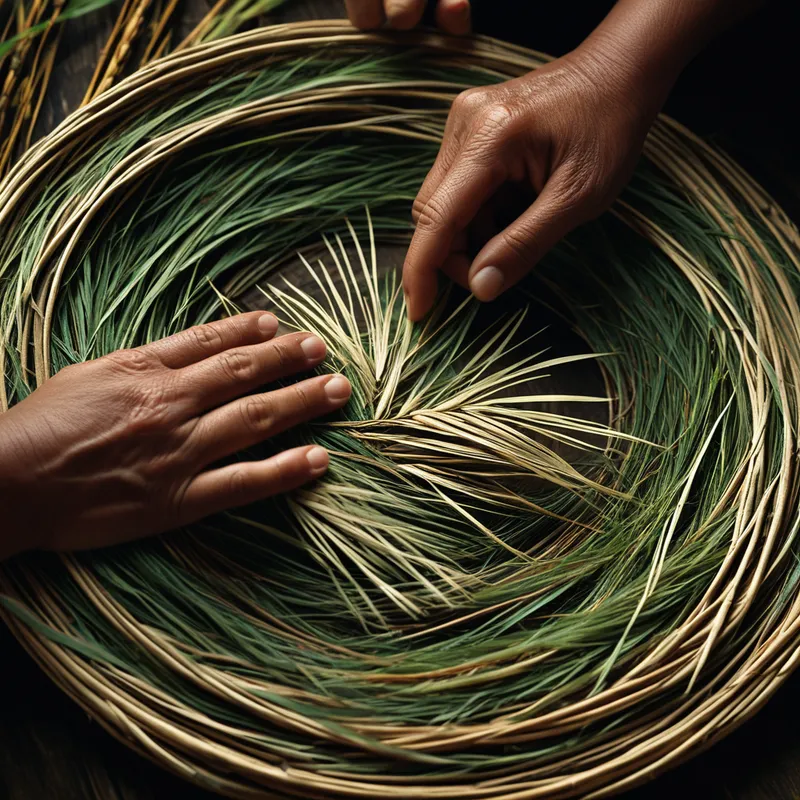
And then, she began to weave. Not with arrogance, but with a prayer in every movement. She took the sweetgrass for kindness, the red willow for resilience, the feather for prayer, the hide for sustenance. She sang the old songs as she worked, calling the names of all relations. One by one, others drawn by the song came to sit with her. They added their own strands—a story of forgiveness, an act of healing, a promise to protect. Slowly, painstakingly, a new circle began to form in their midst. It was small, but it was whole.
As they held this new Hoop between them, something shifted in the world’s breath. The winds softened. A herd of deer approached the edge of their camp, not in fear, but in recognition. The people felt a warmth return to their hearts, a memory of the original connection. They understood: the Sacred Hoop was not a lost object to be found, but a living relationship to be remade, together, with every breath and every step. The circle was mended, not to its old form, but to a new, conscious wholeness, forever remembered as fragile and sacred.
Cultural Origins & Context
The narrative of the Sacred Hoop, or the Circle of Life, is not a single, copyrighted story but a profound cosmological principle shared across many Indigenous nations of North America, including but not limited to the Lakota (whose concept of Čhaŋgléška Wakháŋ is pivotal), the Navajo (with their philosophy of Hózhǫ́), and the Anishinaabe. It is the bedrock of a worldview that sees existence as an interconnected, cyclical, and balanced system.
This “myth” was not merely told for entertainment; it was and is lived philosophy, transmitted through oral tradition, ceremony, daily practice, and sacred objects like medicine wheels and prayer hoops. Elders and wisdom-keepers were its primary custodians, teaching it to guide ethical living, community governance, and ecological stewardship. Its societal function was foundational: to instruct each generation that the health of the individual, the community, and the natural world are inseparable. A break in one part of the circle—through greed, disrespect, or violence—meant sickness for the whole. Thus, the story served as both a map of reality and a moral compass, emphasizing responsibility, reciprocity, and the perpetual work of maintaining balance.
Symbolic Architecture
At its core, the Sacred Hoop is a master [symbol](/symbols/symbol “Symbol: A symbol can represent an idea, concept, or belief, serving as a powerful tool for communication and understanding.”/) of totality. It represents the [psyche](/myths/psyche “Myth from Greek culture.”/) in its original, intended state of [integration](/symbols/integration “Symbol: The process of unifying disparate parts of the self or experience into a cohesive whole, often representing psychological wholeness or resolution of internal conflict.”/), where all aspects—instinct, [emotion](/symbols/emotion “Symbol: Emotion symbolizes our inner feelings and responses to experiences, often guiding our actions and choices.”/), intellect, and [spirit](/symbols/spirit “Symbol: Spirit symbolizes the essence of life, vitality, and the spiritual journey of the individual.”/)—are in harmonious [dialogue](/symbols/dialogue “Symbol: Conversation or exchange between characters, representing communication, relationships, and narrative flow in games and leisure activities.”/).
The circle has no beginning and no end; thus, the self is not a linear project to be completed, but a continuous process of relating.
The broken Hoop symbolizes the inevitable [human](/symbols/human “Symbol: The symbol of a human represents individuality, complexity of emotions, and social relationships.”/) experience of [fragmentation](/symbols/fragmentation “Symbol: The experience of breaking apart, losing cohesion, or being separated into pieces. Often represents disintegration of self, relationships, or reality.”/), what [psychology](/symbols/psychology “Symbol: Psychology in dreams often represents the exploration of the self, the subconscious mind, and emotional conflicts.”/) calls [dissociation](/symbols/dissociation “Symbol: A psychological separation from one’s thoughts, feelings, or identity, often experienced as a journey away from the self during trauma or stress.”/), [trauma](/symbols/trauma “Symbol: A deeply distressing or disturbing experience that overwhelms the psyche, often manifesting in dreams as unresolved emotional wounds or psychological injury.”/), or a state of alienation from [the Self](/myths/the-self “Myth from Jungian culture.”/). This is not a “fall from grace” in a punitive sense, but a depiction of the psychic wound that occurs when we [exile](/symbols/exile “Symbol: Forced separation from one’s homeland or community, representing loss of belonging, punishment, or profound isolation.”/) parts of our [nature](/symbols/nature “Symbol: Nature symbolizes growth, connectivity, and the primal forces of existence.”/) or live out of alignment with our deepest values. The scattering of the people represents the compartmentalization of the psyche—the inner critic, the wounded [child](/symbols/child “Symbol: The child symbolizes innocence, vulnerability, and potential growth, often representing the dreamer’s inner child or unresolved issues from childhood.”/), the neglected creative spirit, all living in isolated conflict.
The Keeper, often envisioned as a [grandmother](/symbols/grandmother “Symbol: The symbol of ‘Grandmother’ often represents wisdom, nurturing, and heritage, reflecting the influence of maternal figures in one’s life.”/) figure, is the [archetype](/symbols/archetype “Symbol: A universal, primordial pattern or prototype in the collective unconscious that shapes human experience, behavior, and creative expression.”/) of the Self. She does not fight the fragmentation with force, but with attentive, compassionate recollection. Her act of weaving is the central symbolic [action](/symbols/action “Symbol: Action in dreams represents the drive for agency, motivation, and the ability to take control of situations in waking life.”/) of healing. It is the painstaking work of psychotherapy, of dreamwork, of mindful practice—gathering the lost, rejected, and forgotten parts (the [shadow](/symbols/shadow “Symbol: The ‘shadow’ embodies the unconscious, repressed aspects of the self and often represents fears or hidden emotions.”/)) and consciously reintroducing them into the personal totality. The new Hoop she creates is not a [regression](/symbols/regression “Symbol: A psychological or spiritual return to earlier states of being, often involving revisiting past patterns, memories, or developmental stages for insight or healing.”/) to a naive [innocence](/symbols/innocence “Symbol: A state of purity, naivety, and freedom from guilt or corruption, often associated with childhood and moral simplicity.”/), but an achieved wholeness, stronger for having been consciously remade.
The Dreamer’s Resonance
When the motif of the Sacred Hoop appears in modern dreams, it often signals a profound somatic and psychological process of re-membering. The dreamer may not see a literal hoop, but experience its symbolism: dreaming of repairing a fragmented object, finding a circular room where all their past selves are gathered, or witnessing broken relationships suddenly heal.
Somatically, this can coincide with a release of chronic tension, a feeling of “coming home” to the body, or a deep, restorative breath after a period of constriction. Psychologically, it marks a transition out of a state of inner civil war. [The ego](/myths/the-ego “Myth from Jungian culture.”/), which had identified with only a small, “acceptable” part of the psyche, begins to relax its guard. The dream is an expression of the Self’s intrinsic movement toward integration. It is the psyche’s own “Keeper” beginning the weave, often after a period of intense crisis or disintegration that made the old, fragmented way of living untenable. The dream is a promise: wholeness is not a distant memory, but an imminent possibility born from the very materials of one’s brokenness.

Alchemical Translation
The myth of the Sacred Hoop is a perfect allegory for the Jungian process of individuation. The alchemical [prima materia](/myths/prima-materia “Myth from Alchemical culture.”/)—the base, confused matter—is the state of the broken world, analogous to the neuroses, complexes, and sense of meaninglessness that bring someone into analysis or onto a path of inner work.
The goal is not to discard the broken pieces, but to recognize them as the essential ingredients of the true self.
[The first stage](/myths/the-first-stage “Myth from Alchemical culture.”/), [nigredo](/myths/nigredo “Myth from Alchemical culture.”/) (the blackening), is the painful acknowledgment of the break: the depression, the anxiety, the feeling of being scattered and out of relation with oneself and the world. The Keeper’s journey of listening in grief is this stage—confronting [the shadow](/myths/the-shadow “Myth from Jungian culture.”/) without flinching.
The albedo (the whitening) is the work of gathering and clarification. This is the analytic work of recalling memories, examining patterns, and understanding the narratives that created the fragments. It is weaving with conscious intention.
The final stages, citrinitas (the yellowing) and [rubedo](/myths/rubedo “Myth from Alchemical culture.”/) (the reddening), are symbolized by the completion of the new Hoop and the restoration of balance to the world. This is the emergence of a new, more capacious personality structure. The individual no longer lives from a fragile, partial identity but from a centered Self that can hold paradox, engage in deep relationship, and act with integrity. The circle is closed, but now it is conscious. The modern individual, through their own “weaving,” achieves what the myth promises: a psychic sovereignty where one is both a distinct point on the circle and the guardian of the entire, sacred circumference.
Associated Symbols
Explore related symbols from the CaleaDream lexicon: