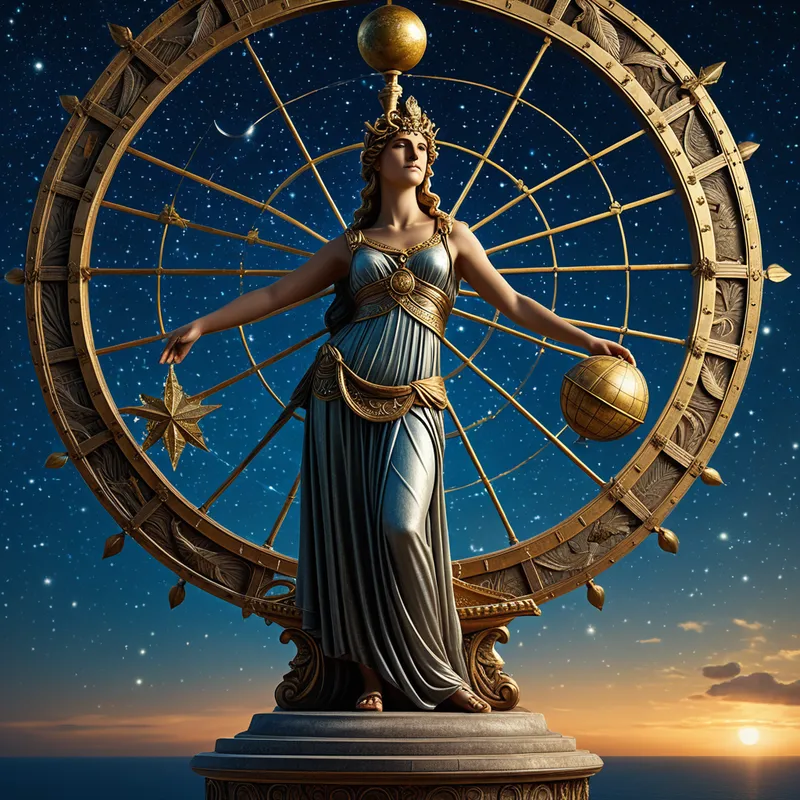
The Roman goddess Fortuna (Tyc Myth Meaning & Symbolism
The story of Fortuna, the Roman goddess of fortune, whose spinning wheel governs the unpredictable rise and fall of all human destiny.
The Tale of The Roman goddess Fortuna
Listen. Can you hear it? The low, groaning creak of ancient wood, the soft whisper of silk against stone. It is the sound of the wheel turning. It is the sound of her.
In the liminal space between the ordered temples of Jupiter and the chaotic tides of [the sea](/myths/the-sea “Myth from Greek culture.”/), she dwells. She is [Fortuna](/myths/fortuna “Myth from Roman culture.”/). Some say she is the daughter of Jupiter, born from the first breath of possibility. Others whisper she emerged from the deep, from [the womb](/myths/the-womb “Myth from Various culture.”/) of [Oceanus](/myths/oceanus “Myth from Greek culture.”/) herself, salt-rimed and unpredictable as the waves.
She is often veiled, a blindfold of finest linen drawn across eyes that see not individuals, but the great, swirling patterns of destiny. In one hand, she holds a cornucopia, spilling grapes, grain, and gold coin onto the marble at her feet—a promise of prosperity without reason. In the other, she grips a ship’s rudder, for she steers the course of every life, though the destination is never certain.
But her true power is the Wheel.
It is vast, oak and iron, set upon an axis that pierces the heart of [the world](/myths/the-world “Myth from Tarot culture.”/). Its rim is carved with the faces of humanity: the laughing king, the weeping beggar, the hopeful merchant, the despairing soldier. The wheel groans, turns, and turns again. With a sound like thunder, the king is cast down, his face scraping the cold earth. With a sigh like [the wind](/myths/the-wind “Myth from Various culture.”/), the beggar is lifted, dizzying, to the zenith, [the cornucopia](/myths/the-cornucopia “Myth from Global/Universal culture.”/)’s bounty suddenly within his grasp.
She does not smile. She does not frown. Her veiled face is impassive as she sets the great engine in motion. A merchant’s ship, laden with silk and spice, is guided by her unseen hand into a safe harbor under a benevolent sun. The next, by the same hand, is dashed upon rocks hidden beneath a sudden squall. One child is born in a palace, another in a ditch. It is not malice. It is not [justice](/myths/justice “Myth from Tarot culture.”/). It is simply the turn.
Mortals build her shrines at crossroads, pour libations of wine and oil, and beg for her favor. They call her Fortuna Augusta, Fortune of the Emperor, trying to chain her power to the state. They call her Fortuna Redux, Fortune the Home-Bringer, pleading for safe return. They call her Fortuna Muliebris, Fortune of Women, seeking her grace in the private sphere. But the wheel turns for the emperor and the slave alike. The libation dries. The prayer is carried off by the same wind that fills a rival’s sails.
Her story is not one of battle or love, but of perpetual, silent motion. It is the story of the rudder’s slight shift, the wheel’s inexorable rotation—the sublime, terrifying physics of chance that governs every breath from the first cry to the last sigh. To know Fortuna is to stand at the shore, feeling the tide pull the sand from beneath your feet, knowing you are in the hands of a power that is profoundly indifferent, and yet, contains all possibilities.
Cultural Origins & Context
Fortuna’s worship was one of the most pervasive and adaptable in the Roman world. Unlike many Olympian deities with fixed Greek counterparts, Fortuna was quintessentially Roman, her character shaped by [the Republic](/myths/the-republic “Myth from Platonic culture.”/)’s and later the Empire’s pragmatic, often anxious, relationship with destiny. Her origins are likely Italic, possibly merging with the Greek [Tyche](/myths/tyche “Myth from Greek culture.”/), but she was claimed wholly by Rome.
Her cult was populist and ubiquitous. Shrines and temples to various aspects of Fortuna stood in harbors, at crossroads, in marketplaces, and in homes. This reflected her societal function: she was the divine explanation for the terrifying and exhilarating unpredictability of life in a burgeoning, militaristic, and socially mobile empire. A soldier could rise from obscurity to glory through valor and sheer luck. A merchant’s entire fortune could be made or lost on a single voyage. Political fortunes could turn on a rumor or an omen.
Fortuna gave a name and a face to this cosmic uncertainty. By worshipping her, Romans engaged in a profound psychological act: they ritualized their acknowledgment of life’s fundamental precariousness. Prayers and offerings were not attempts to control fate, but to negotiate with it, to invite a favorable “turn” of the wheel. She was both feared and revered, a reminder that no amount of planning, virtue, or power could grant absolute security. In a culture obsessed with order, law, and pietas (duty), Fortuna was the necessary, wild counterpart—the acknowledgment of chaos within the cosmos.
Symbolic Architecture
Fortuna is not a deity of moral order, but of amoral process. She represents the raw, unconscious field of potentiality from which all manifested [life](/symbols/life “Symbol: The symbol of ‘Life’ represents a journey of growth, interconnectedness, and existential meaning, encompassing both the joys and challenges that define human experience.”/) emerges—and into which it eventually recedes.
The Wheel is the central symbol of cyclical time, of the inevitable revolutions of fate, fortune, and the psyche itself. To be at the top is to be identified with the persona, the visible success; to be at the bottom is to confront the shadow, the repressed and forgotten self.
Her [blindfold](/symbols/blindfold “Symbol: A blindfold represents willful ignorance, surrender of control, or a test of trust. It can symbolize both vulnerability and inner vision.”/) signifies the impartiality of [chance](/symbols/chance “Symbol: A representation of opportunities and unpredictability in life, illustrating how fate can influence one’s journey.”/). It is not that she is blind to us, but that she sees according to a [logic](/symbols/logic “Symbol: The principle of reasoning and rational thought, often representing order, structure, and intellectual clarity in dreams.”/) incomprehensible to the [human](/symbols/human “Symbol: The symbol of a human represents individuality, complexity of emotions, and social relationships.”/) mind, a [pattern](/symbols/pattern “Symbol: A ‘Pattern’ in dreams often signifies the underlying structure of experiences and thoughts, representing both order and the repetitiveness of life’s situations.”/) woven from threads of causality hidden to our limited [perception](/symbols/perception “Symbol: The process of becoming aware of something through the senses. In dreams, it often represents how one interprets reality or internal states.”/). The cornucopia and the rudder present the dual [nature](/symbols/nature “Symbol: Nature symbolizes growth, connectivity, and the primal forces of existence.”/) of her influence: the bestowal of [abundance](/symbols/abundance “Symbol: A state of plentifulness or overflowing resources, often representing fulfillment, prosperity, or spiritual richness beyond material needs.”/) and the steering of life’s [direction](/symbols/direction “Symbol: Direction in dreams often relates to life choices, guidance, and the path one is following, emphasizing the importance of navigation in personal journeys.”/), both occurring seemingly at random. She is the archetypal embodiment of [synchronicity](/symbols/synchronicity “Symbol: Meaningful coincidences that suggest an underlying connection between events, often interpreted as guidance or confirmation from the universe.”/)—the acausal connecting principle that links inner psychic states with outer events in a meaningful way, outside [linear](/symbols/linear “Symbol: Represents order, predictability, and a direct, step-by-step progression. It symbolizes a clear path from cause to effect.”/) cause and effect.
Psychologically, Fortuna symbolizes the autonomous, unpredictable [activity](/symbols/activity “Symbol: Activity in dreams often represents the dynamic aspects of life and can indicate movement, progress, and engagement with personal or societal responsibilities.”/) of the unconscious. We plan and strive ([the ego](/myths/the-ego “Myth from Jungian culture.”/)’s domain), but we are perpetually subject to eruptions from within—sudden inspirations, overwhelming emotions, forgotten memories, life-changing dreams—that can overturn our carefully constructed worlds in an instant. She is the “luck” that feels destined, the “[accident](/symbols/accident “Symbol: An accident represents unforeseen events or mistakes that can lead to emotional turbulence or awakening.”/)” that changes everything, the unexpected turn in our personal narrative.
The Dreamer’s Resonance
To dream of Fortuna, or more commonly, of her symbols, is to encounter the [psyche](/myths/psyche “Myth from Greek culture.”/)’s own acknowledgment of a critical turning point or a pervasive undercurrent of uncertainty.
Dreaming of a spinning wheel, especially one you are forced to ride or that controls your movement, often coincides with life phases where external circumstances feel utterly beyond your control—job loss, health crises, sudden windfalls or losses. Somatically, this may manifest as vertigo, a loss of grounding, or anxiety in [the pit](/myths/the-pit “Myth from Christian culture.”/) of the stomach. The dream is presenting the autonomous movement of the psyche; you are not in the driver’s seat of your life narrative at that moment.
A dream of a blindfolded figure can indicate a feeling that your destiny is being guided by forces you cannot see or understand. It may reflect a sense of injustice (“Why is this happening to me?”) or a call to surrender the ego’s insistence on total foresight and control. The rudder appearing in a dream, disconnected from a ship, suggests a deep, intuitive knowing about the direction you should take, if only you could grasp it.
These dreams are not omens, but manifestations. They make visible the inner psychic reality of being in Fortuna’s grip. The psychological process is one of confronting the limits of the ego. The dream invites the dreamer to relate to life not as a sole author, but as a participant in a larger, mysterious unfolding.

Alchemical Translation
The alchemical journey is one of transmuting base, unconscious material (the [prima materia](/myths/prima-materia “Myth from Alchemical culture.”/)) into the gold of conscious realization (the Self). Fortuna’s myth models the crucial first stage of this process: the dissolution of the old, rigid ego-structure by the unpredictable waters of the unconscious.
To be placed upon Fortuna’s Wheel is to undergo the mortificatio—the alchemical “killing” of the old king, the outworn identity. The descent is not a punishment, but a necessary return to the primal source for renewal.
The individual identified solely with their position “at the top” of the wheel—their status, achievements, and planned life—experiences the turn as catastrophe. This is the alchemical [nigredo](/myths/nigredo “Myth from Alchemical culture.”/), [the dark night of the soul](/myths/the-dark-night-of-the-soul “Myth from Christian Mysticism culture.”/), where all seems lost. Yet, this very dissolution is the beginning of the work. Stripped of former certainties, one is forced to confront the raw, unformed potentials of [the self](/myths/the-self “Myth from Jungian culture.”/) that were hidden by success.
The goal is not to stop the wheel—an impossibility—but to move from being a figure on the wheel to finding one’s center in the axis. The axis is the point of stillness around which the turns of fate revolve. Psychologically, this is the achievement of a connection to the Self, the inner archetype of wholeness and order. From this centered place, the rises and falls of external fortune are witnessed with greater equanimity. The cornucopia’s gifts are enjoyed without attachment, and the rudder’s shifts are met with adaptability rather than terror.
The alchemical translation of Fortuna’s myth is thus an invitation to cultivate a relationship with the unpredictable. It is the work of building a soul-structure resilient and fluid enough to contain both abundance and loss, guidance and blindness, trusting that the turning itself is part of a greater, integrating motion whose ultimate aim is not our comfort, but our completion.
Associated Symbols
Explore related symbols from the CaleaDream lexicon: