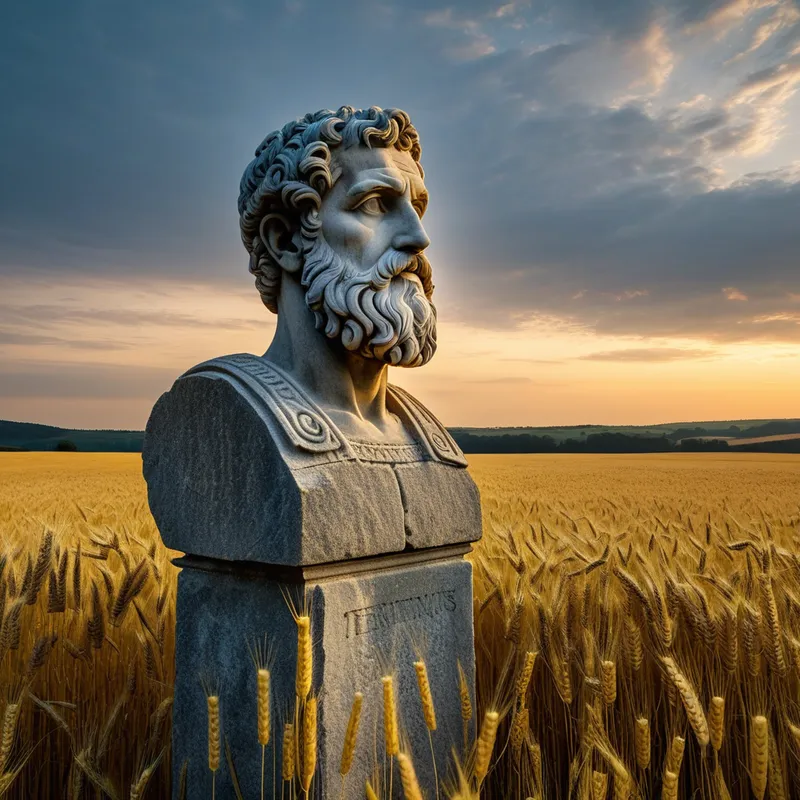
The Roman god Terminus Myth Meaning & Symbolism
The myth of the boundary stone god who could not be moved, teaching that true strength and sanctity are found in defining the sacred space of the self.
The Tale of The Roman god Terminus
Listen, and hear the tale of the stone that would not yield. In the days when Rome was young, a tangle of hills and ambitions, the king was a man named Numa Pompilius. He was a king of peace, a weaver of sacred laws, who sought to bind the fierce spirit of his people not with walls of war, but with boundaries of the spirit.
His task was immense: to survey the wild lands, to mark where one man’s field ended and another’s began, to draw order from the formless earth. He called upon all the gods to bless this work, to hallow the stones that would be driven into the soil. To Jupiter, greatest of all, he dedicated the high places. To Faunus, he offered libations for the untamed woods. But when the priests came to the highest hill, the Capitoline, a strange and stubborn silence met their prayers.
They prepared to consecrate the entire hill to Jupiter, to clear it for his mighty temple. The air was thick with incense, the chant of the pontifices rising like smoke. But as they began the rites of evocation, asking any lesser spirits to depart, a profound resistance settled over the place. The sacred boundary stones, the termini, already stood there, ancient and moss-covered from a time before memory. The priests could not proceed. The will of the hill itself seemed to push back.
Numa, wise in the ways of signs, consulted the oracles. The message was clear and shocking. There was already a divine power residing there, one who refused to be "evoked" or moved. His name was Terminus. He was not a god of thunder or love, but of the limit itself. He was the spirit within the stone, the invisible line made divine. And he would not budge.
So a great compromise was struck, a testament to Roman practicality and deep piety. The glorious Temple of Jupiter Optimus Maximus would be built, but it would have a hole in its roof. For right within the inner sanctum, the cella of the king of gods, they left one humble, uncarved stone. This was Terminus. No statue looked down from above; the open sky was his canopy. The message was carved into the very fabric of the world’s greatest temple: even Jupiter must respect a boundary. The god of the limit held his ground, and in doing so, he defined the sacred space for all others.
Cultural Origins & Context
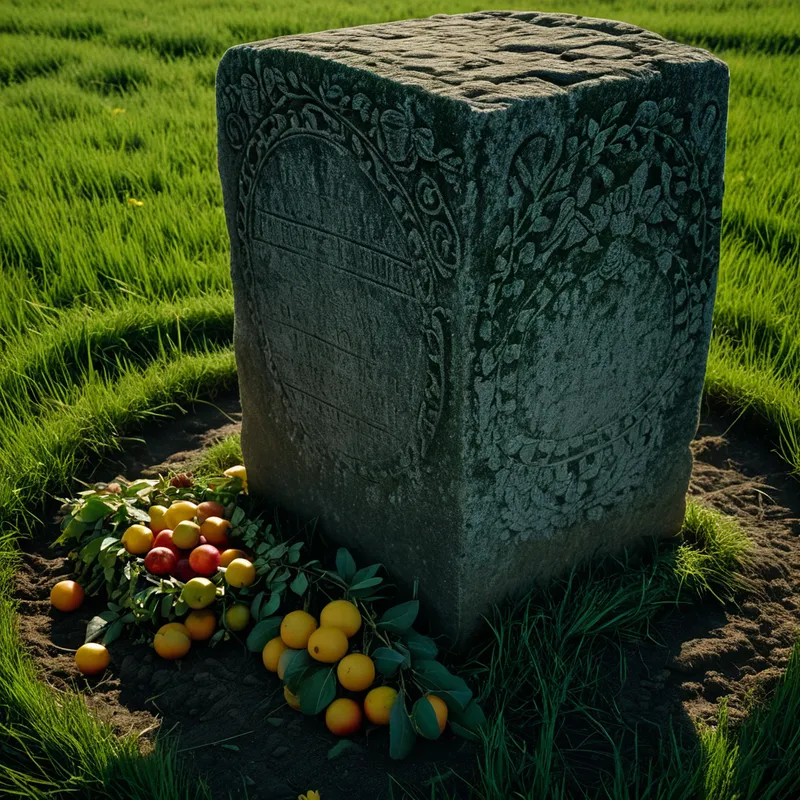
The myth of Terminus is not a saga of epic journeys, but a foundational story of Roman identity, rooted in the most practical soil. His worship was ancient, likely predating the anthropomorphic Olympian gods, originating in the simple agrarian cults of the Italic peoples. Terminus was a numen</ab title>, a spiritual presence inherent in the boundary marker itself.
His primary festival, the Terminalia, was a communal, domestic affair. Neighbors would meet at their shared boundary stone, decorate it with garlands, and make offerings of grain, honey, and wine. They would sacrifice a lamb or a suckling pig, its blood sanctifying the line. This was not a state ceremony led by distant priests, but a ritual performed by the people whose lives were defined by those limits. It was a social contract made sacred, preventing conflict and affirming mutual respect. The myth of his immovability on the Capitoline elevated this humble practice to a national principle, symbolizing the inviolability of Roman law, treaties (fines), and ultimately, the empire's borders.
Symbolic Architecture
Terminus represents the archetypal principle of the limen, the threshold. He is not the content within a space, but the defining edge that creates the space itself. Psychologically, he symbolizes the structure of the ego, the necessary boundary that differentiates self from other, conscious from unconscious.
A self without a boundary is not a liberated self; it is a dissolved self. The sacred stone does not imprison, it defines the temple.
His immovability before Jupiter, the supreme symbol of authority and psychic totality, is profoundly significant. It states that the process of integration (building the inner temple) cannot proceed by obliterating the ego. The conscious "I," with its limits and definitions, must be preserved and honored within the greater structure of the Self. Terminus is the ego that rightly refuses to be "evoked" or dissolved prematurely. His place in the temple, open to the sky, suggests that true boundaries are not walls that shut out the divine, but vessels that give it a specific form and location.
The Dreamer's Resonance
When the archetype of Terminus stirs in the modern unconscious, it often manifests in dreams of thresholds, walls, fences, or property lines. One might dream of building a wall, repairing a broken fence, or discovering an ancient, overgrown stone marker in their garden. Conversely, dreams of boundaries being violently transgressed—walls crumbling, strangers intruding into one's house, fences being torn down—signal a crisis in this psychic function.
Somatically, this can feel like a sudden need for personal space, a tightening in the solar plexus, or a visceral sense of "this far, and no further." Psychologically, the dreamer is navigating a process of definition. This could relate to setting healthy limits in a relationship, defining one's professional role, or, more deeply, confronting the diffuse anxiety that comes from a weak sense of self. The dream of Terminus is the psyche’s attempt to re-establish the temenos, the sacred precinct, within which inner work can safely occur.

Alchemical Translation
The alchemical journey of individuation is not merely a dissolution into the unconscious, but a circumambulation of the Self, a defining of its sacred perimeter. The myth of Terminus models the crucial first stage of this opus: the fixation.
The alchemical stone is first found as a common boundary marker. The work begins not by seeking gold, but by honoring the place where you stand.
The "evocation" attempted by Numa’s priests represents the spiritual temptation to bypass the ego, to transcend personal limits without integrating them. Terminus’s refusal forces a confrontation with the base matter of one's own life—the job, the relationships, the personal history, the flaws. These are the "stones" that seem humble and fixed. The alchemical translation is to cease trying to move or spiritualize them away, but to consecrate them. To build one's inner temple around them. To make the limit itself sacred.
In this process, the ego-stone is not destroyed but transformed. It remains, solid and defining, but now it is the central, honored artifact within the greater temple of the psyche, open to the heavens (the transcendent function). The individual learns that their boundaries are not limitations to their spirit, but the very shape through which their spirit meets the world. One becomes, like Terminus, both unyielding and holy, the defined stone that makes boundless reverence possible.
Associated Symbols
Explore related symbols from the CaleaDream lexicon: