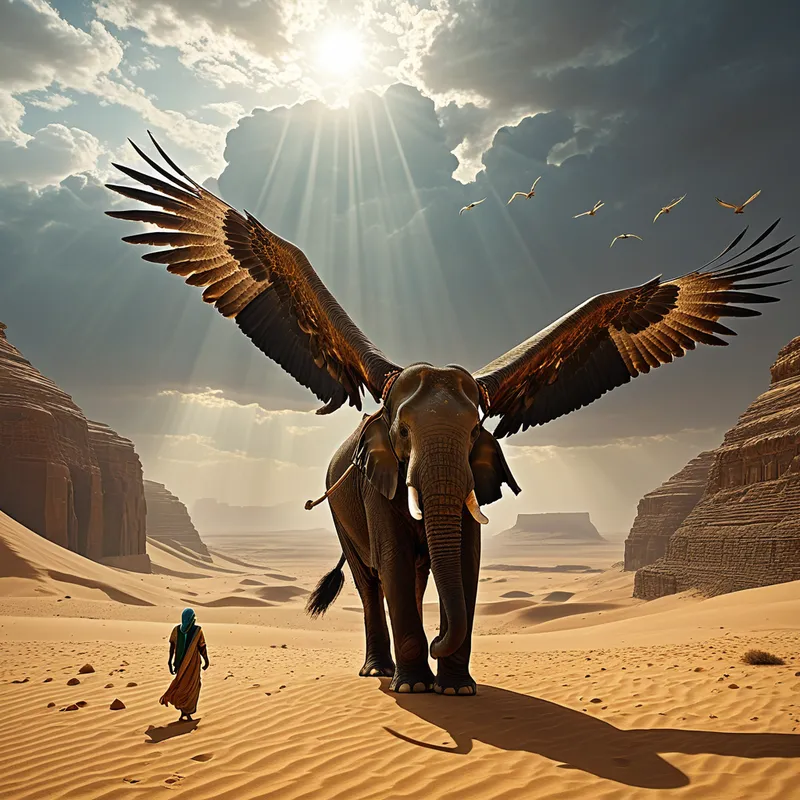
The Roc Bird of Arabia Myth Meaning & Symbolism
A myth of a titanic eagle that carries heroes and elephants, embodying the terrifying and sublime power of the sky, fate, and the unconscious psyche.
The Tale of The Roc Bird of Arabia
Hear now a tale of the Empty Quarter, where the sands are older than kings and the wind knows the names of forgotten gods. It is a tale not of men, but of the sky’s own shadow—the Rukh, the Roc.
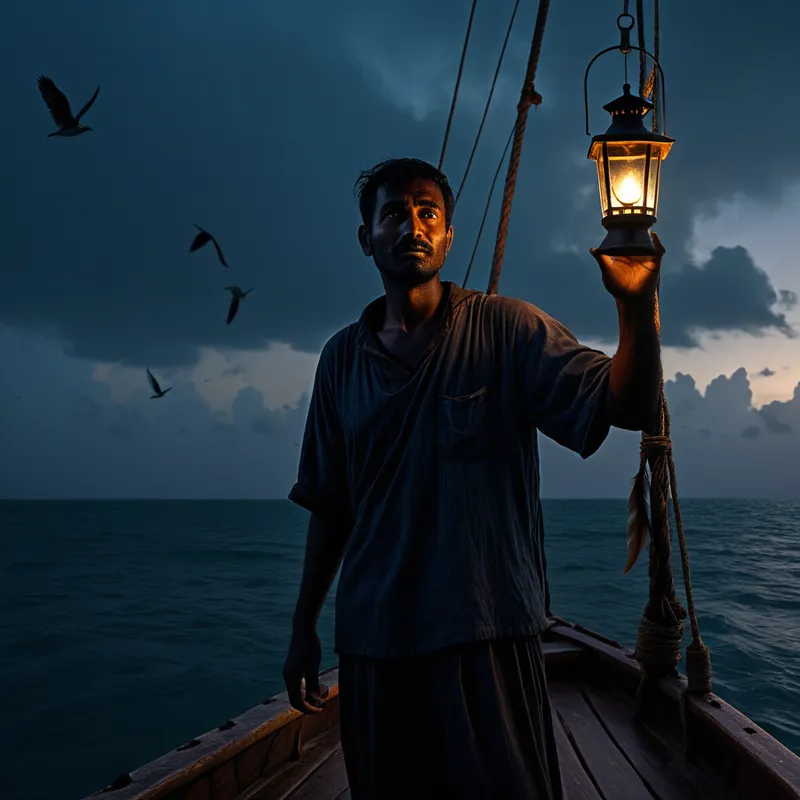
In the days when the sea was a sapphire road and the desert a sea of its own, there sailed a captain, bold and cursed with a hunger for the unseen. His name was lost to the simoom, but his ship, the Sayyad, was known. It was he who sailed beyond the maps, past the Isle of Apes and the Valley of Diamonds, into a cerulean silence where the waves grew still and the air tasted of ozone and ancient stone.
It was there the shadow fell.
First, as a darkening of the sun at noon, a great cloud that was no cloud. Then, a wind that was not wind, but the downbeat of wings that spanned horizons. The Roc descended. Its feathers were like plates of burnished bronze, its eyes, twin suns of cold, avian intelligence. It did not shriek; its silence was more terrible than any sound. With talons that could grasp the minarets of Samarkand, it plunged into the churning sea. The waters boiled, and when it rose, in its grip struggled a beast of the deep—a great serpent, or some say, a full-grown elephant, trumpeting its final, watery terror. The Sayyad was but a leaf in the maelstrom, and the sailors, prostrate on the deck, knew they were insects before a god of prey.
But the captain looked up. And in that looking, a madness—or a destiny—was sealed. He saw not just a monster, but a mystery. He saw the single, titanic feather that drifted down, a shaft as long as a palm tree, which he ordered retrieved. This feather became his obsession, his proof, and his compass.
Years later, driven by that obsession, he found its source: the Roc’s nest. It was not a nest of twigs, but a mountain of mighty branches piled upon the highest, most inaccessible peak at the world’s edge. And within it, the egg—a dome of alabaster, vast as a palace dome. The captain’s men, in their greed, attacked it with axes, seeking the riches they imagined within. They broke the shell, and from it spilled not gold, but a horror: a lake of yolk, and within it, the unformed, monstrous chick of the Roc.
The sky then learned to scream.
The mother Roc returned. Her cry was the sound of continents splitting, her grief a sandstorm of fury. She saw the ruin of her unborn and the tiny, scurrying figures of men. One by one, she took them. Not to eat, but to drop from a height where the air itself froze, letting them fall onto the jagged rocks below, a precise and terrible justice. The captain, clinging to the ruins of the nest, witnessed the finality of his trespass. He had sought to conquer a legend and had only awakened its wrath. His fate, like that of his crew, was written in the unforgiving script of the sky.
Cultural Origins & Context
The myth of the Roc, or Rukh, is woven from the threads of sailor’s yarns, caravan tales, and the vast, imaginative geography of medieval Islamic cosmology. It finds its most famous literary anchor in the One Thousand and One Nights, particularly in the voyages of Sinbad the Sailor. However, its roots dig deeper, likely influenced by Persian mythology and perhaps even echoes of the Indian Garuda or the Madagascan elephant bird, whose giant eggs sparked travelers’ tales.
This was a story told not in courts first, but on the decks of dhows under starry skies and around caravan campfires in the desert night. It served as a natural philosophy, explaining the unexplainable—a sudden, devastating storm, a lost mountain peak, a giant eggshell found on a remote shore. It functioned as a cautionary tale about the limits of human ambition and the sacred, terrifying scale of a world not made for man. The Roc was the embodiment of the sublime indifference and raw power of nature, a feathered deity of the upper air that governed the fate of those who dared the unknown.
Symbolic Architecture
The Roc is the ultimate symbol of the Self in its most majestic and terrifying aspect. It is not a god one prays to, but a force one encounters, a psychic fact of immense power.
The Roc does not belong to the human world; it is the human world that exists, precariously, beneath the shadow of its wings.
It represents the ultimate authority of the unconscious—the ruler archetype in its transpersonal form. Its nest, high on a mountain, is the inaccessible center of the psyche, the seat of the nascent Self (the egg). To attack this center with the crude tools of conscious greed (the axes) is to invite a catastrophic reaction from the whole psyche. The Roc’s vengeance is not evil; it is the psyche’s autonomous, enraged movement to restore its own sacred integrity.
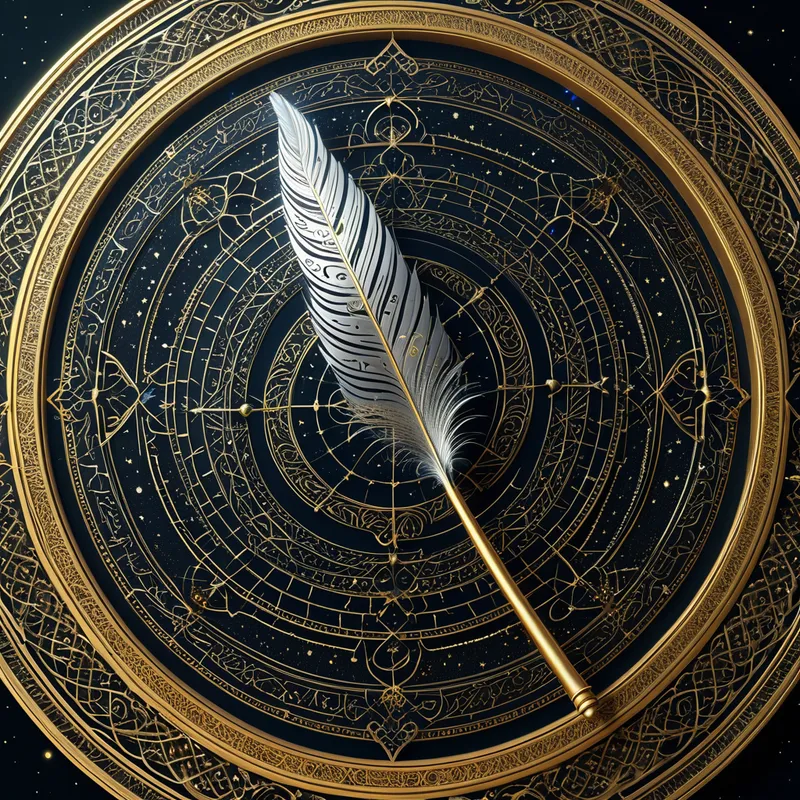
The single feather is a profound symbol. It is a numinous token—a piece of the transcendent that falls into the human realm. For the captain, it is both a prize and a curse, a fragment of the divine that inflames his ego to seek the whole, initiating the fatal journey. It is the dream image, the synchronistic event, that hints at a reality too vast to comprehend, yet too compelling to ignore.
The Dreamer's Resonance
To dream of the Roc is to feel the psyche stirring in its most profound depths. One might dream of a shadow that blots out the sun, of a single, enormous feather found in an ordinary street, or of being carried aloft by a giant bird into terrifying heights.
Somatically, this can feel like a lifting in the chest—a mix of awe and dread, a literal feeling of being elevated or targeted. Psychologically, it signals an encounter with a content of the unconscious that is of monumental importance. The dreamer is in the grip of a fate that is larger than their personal life. It often precedes or accompanies a life transition so massive it feels archetypal: a calling, a catastrophic loss, a rebirth, or the crushing realization of one’s own smallness in the grand scheme. The dreamer is the captain, and the Roc is the objective psyche presenting its bill. The process is one of being forced to acknowledge a power that does not negotiate.
Alchemical Translation
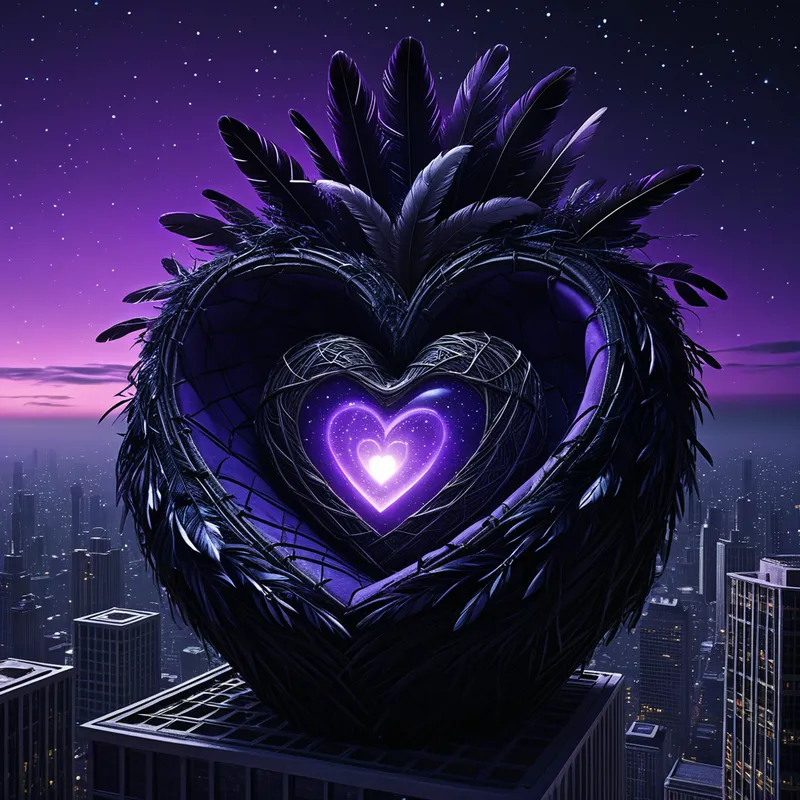
The myth of the Roc models the perilous stage of the individuation process where the ego, having glimpsed the Self (the feather), arrogantly attempts to storm the citadel and possess it. This is the inflation that precedes the mortificatio.
The crushing of the egg is the inflation of the ego; the vengeance of the Roc is the necessary humiliation that follows.
The captain’s journey is an anti-individuation narrative, a warning. True psychic transmutation does not come from looting the nest of the Self. It comes from a respectful, fearful, and ultimately humble relationship with that transcendent power. The alchemical "gold" is not inside the egg to be stolen; it is the transformative relationship itself, forged in the awe of the encounter.
For the modern individual, the "Roc experience" is that moment when life itself—through illness, loss, an overwhelming passion, or a transcendent insight—seizes us and demonstrates, unequivocally, that we are not in full control. The process of alchemical translation is to endure this carrying-aloft, this terrifying flight, without identifying as the victim or the conqueror. It is to survive the descent, humbled and stripped of the ego’s greedy axes, having learned to navigate not by the maps of ambition, but by the stars of a reality that includes the Roc. One does not become the Roc; one learns to sail on the seas over which it flies, respecting its domain.
Associated Symbols
Explore related symbols from the CaleaDream lexicon:
- Bird — The primordial symbol of spirit, transcendence, and the soul, here magnified to a cosmic scale, representing the terrifying majesty of the spiritual realm.
- Mountain — The inaccessible height where the Roc nests, symbolizing the ultimate goal of the spiritual or psychological quest, a place of both revelation and supreme danger.
- Egg — The unformed potential of the Self, the wholeness that contains all possibilities, which must be incubated by the psyche, not shattered by conscious force.
- Sky — The domain of the Roc, representing consciousness in its vast, impersonal aspect, fate, and the realm of archetypal forces beyond human influence.
- Ocean — The realm from which the Roc plucks its prey, symbolizing the boundless, unconscious depths from which archetypal contents suddenly surface.
- Journey — The captain's fatal voyage, embodying the perilous quest for meaning and encounter with the numinous, which irrevocably alters the traveler.
- Fate — The inescapable destiny orchestrated by the Roc's power, representing the archetypal patterns that govern human life beyond personal choice.
- Shadow — The literal shadow of the Roc that falls upon the ship, representing the overwhelming emergence of unconscious contents that darken and dominate the conscious mind.
- Death — The precise, devastating justice meted out by the Roc, symbolizing the necessary death of the old, arrogant ego-structure required for any profound transformation.
- Pride — The captain's hubris in attacking the nest, representing the inflationary ego that believes it can conquer and possess the sacred core of the psyche.