The River of Life Myth Meaning & Symbolism
A celestial river, born from the heavens, descends to earth to purify the ashes of ancestors, carving a path of liberation through the world of mortals.
The Tale of The River of Life
Hear now the tale of the river that flows from heaven to the underworld, the story of a descent that became a deliverance.
In the high, timeless halls of Svarga, flowed a river of such sublime purity that its waters were the very essence of life itself. This was Ganga, daughter of the mountain and the sky, a celestial stream whose dance was the music of the spheres. Her home was the domain of the gods, far from the dust and sorrow of mortal earth.
Yet on that earth, in the lineage of the great king Sagara, a terrible penance unfolded. Sixty thousand princes, his sons, had been reduced to ashes by the wrath of a sage. Their souls could not ascend; they were trapped, haunting the earth as restless ghosts, for they lacked the sacred waters that alone could purify ashes and grant passage to the afterlife. The lament of a lineage echoed through the worlds.
The plea reached the ears of Bhagiratha, a monarch whose heart was a vessel of duty and grief. He renounced his throne. For centuries, he stood on one foot, arms raised to a blistering sun, his austerity piercing the veil between worlds. His tapas was a single, burning question aimed at the heart of creation: How can the dead find peace?
The heavens trembled. The lord Vishnu was moved. He appeared before the skeletal king. “Your prayer is granted,” he intoned. “But the river of heaven is a force of creation. If she falls directly, her torrent will shatter the earth. Only one can break her fall. You must persuade Shiva.”
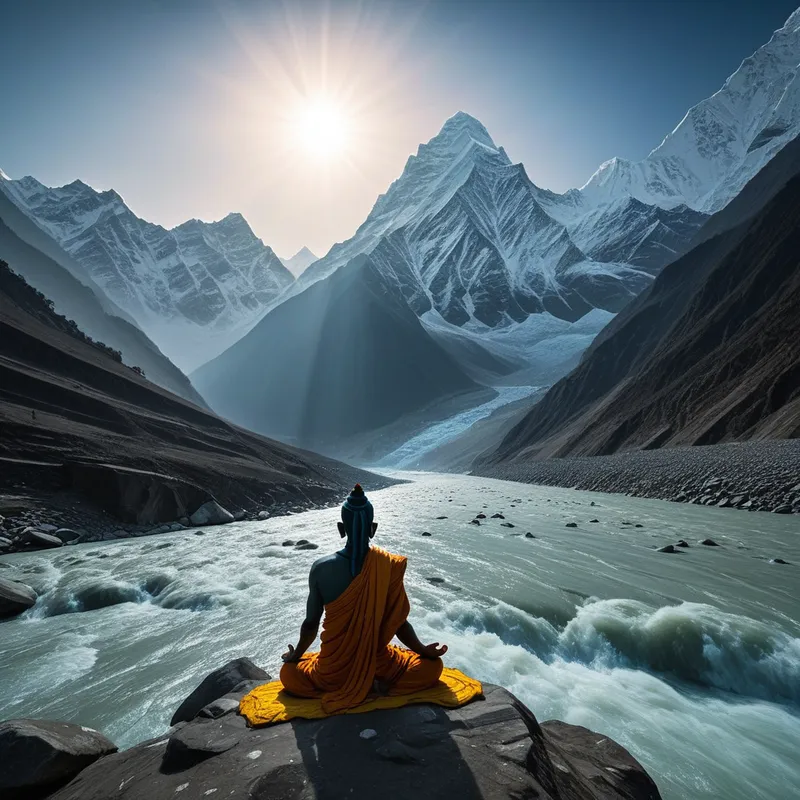
And so Bhagiratha sought the abode of the great ascetic, where Shiva sat in eternal meditation upon the icy peaks of the Himalayas, his body smeared with ashes, his mind merged with the infinite. With the same relentless devotion, Bhagiratha prayed. A flicker of compassion stirred in the yogi’s deep silence. A slight, knowing nod.
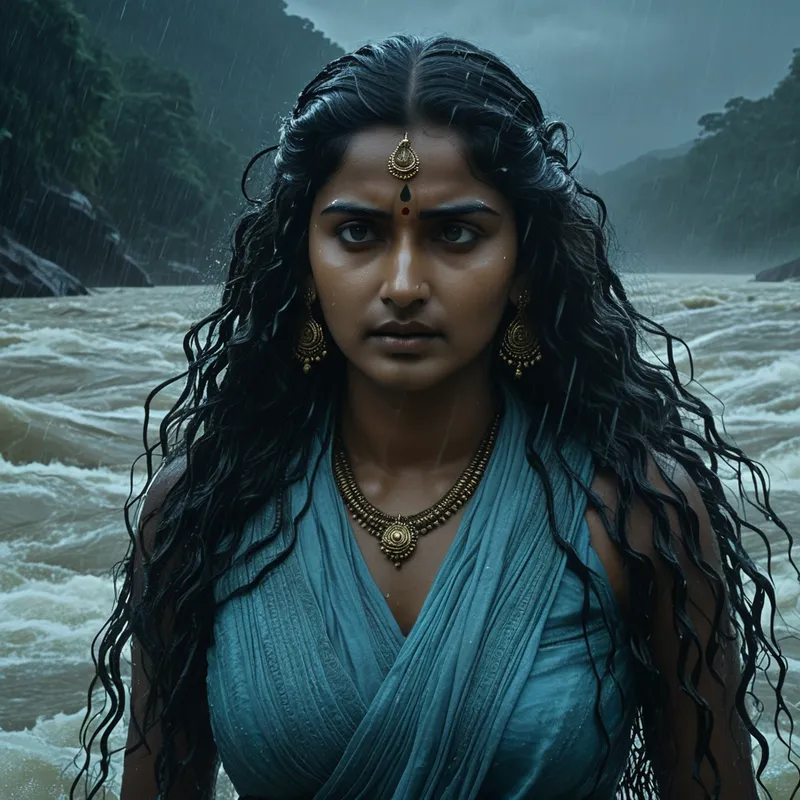
The stage was set for a cosmic collision. Ganga, arrogant in her divine power, looked down upon the earth and the petty mortal who dared summon her. She decided to teach them all a lesson. With a roar that split the firmament, she threw herself from the high heaven, a deluge of stars and liquid thunder aimed to wash the earthly realm into oblivion.
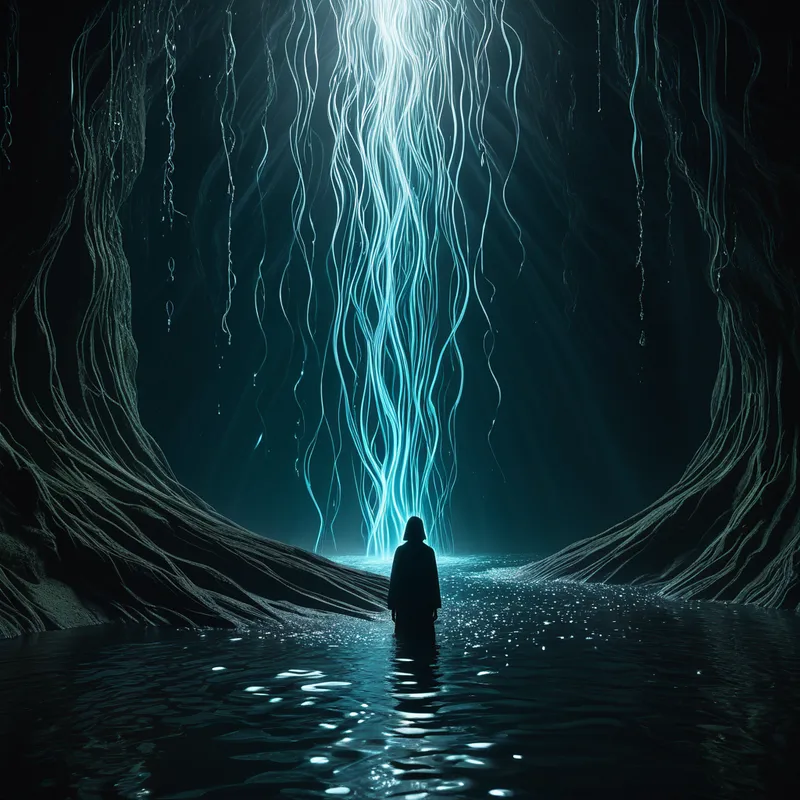
But as the cataclysmic flood descended, Shiva merely looked up. He did not rise. He did not raise a weapon. He simply loosened a single strand of his matted, piled hair. The mighty Ganga, in all her furious pride, crashed into that tangled forest of locks. The universe held its breath. The river raged and swirled, seeking an outlet, but the ascetic’s hair was a labyrinth without end. For years, she twisted and turned, humbled, her fury spent, until she became a gentle, murmuring stream seeking release.
Then, with infinite gentleness, Shiva let her flow—not as a destroyer, but as a lifeline. A single, silvery thread escaped his hair and touched the earth. Bhagiratha, ahead on his chariot, guided this trickle across the length of Bharat, to the sea, and finally to the netherworld where the ashes of the princes lay. The touch of those now-gentle waters was a sigh of release. Sixty thousand lights ascended from the dust, purified, liberated. The river that was meant to destroy had become the path to salvation. She flowed on, forever after, as the Ganges—the River of Life, flowing from heaven, through the hair of God, to the heart of the world.
Cultural Origins & Context
This myth, primarily told in the epic Mahabharata and the Puranas, is not merely an etiological story for a geographical river. It is a foundational narrative of dharma, duty, and the relationship between the human and divine realms. Passed down through generations by storytellers, priests, and scholars, it served multiple societal functions.
It sanctified the landscape, transforming the Ganges from a physical river into a theological entity—a tirtha (crossing place) between worlds. It validated the practices of ancestor worship (shraddha) and the yearning for liberation (moksha). The story was recited during rituals for the dead, offering a mythic map for the soul’s journey. Furthermore, it established a model of kingship through Bhagiratha, defining the ideal ruler as one who undertakes extreme personal sacrifice for the spiritual welfare of his people. The myth thus wove together cosmology, sociology, and soteriology, making the river a central artery in the body of Hindu spiritual life.
Symbolic Architecture
At its core, the River of Life myth is a profound allegory for consciousness, energy, and the process of transformation.
The celestial Ganga represents pure, undifferentiated cosmic energy and divine grace—potent, beautiful, but ultimately impersonal and dangerous in its raw state. It is the unconscious, creative force in its untamed form. The earthly realm symbolizes manifested reality, the world of form, suffering, and karma (the ashes of the ancestors). Bhagiratha’s penance is the focused, disciplined will of the conscious ego, undertaking the arduous journey to bridge the two.
The divine cannot reach the human without the human’s fervent call; and the human cannot contain the divine without a transformative vessel.
The pivotal symbol is Shiva’s matted hair (jata). Shiva, the great transformer, represents the transcendent principle that can mediate between overwhelming power and fragile form. His hair is not a barrier but a transformer—a labyrinthine psychic structure (the complex, often tangled mind of the yogi or the adept) that breaks down raw, undifferentiated energy into a usable, life-giving stream. The descent of the river is the descent of spirit into matter, of grace into the realm of time, which must be mediated to prevent psychic inflation or destruction.
The Dreamer's Resonance
When this mythic pattern surfaces in modern dreams, it often signals a profound process of emotional or psychic purification. To dream of a mighty, terrifying river from the sky may reflect an overwhelming influx from the unconscious—a surge of repressed emotion, creative inspiration, or ancestral trauma that feels it will obliterate the dreamer’s conscious world.
Dreaming of attempting to guide such a river, like Bhagiratha, speaks to the ego’s struggle to integrate this powerful content responsibly. The somatic sensation may be one of immense pressure, a feeling of being tasked with an impossible duty. Conversely, dreaming of being caught in a tangled, labyrinthine space where a torrent is slowed and gentled (the Shiva function) indicates a necessary, often difficult, process of containment and mediation happening within the psyche itself. The dreamer is not the force, but the vessel through which the force is made bearable and beneficial. It is the psyche’s way of modeling the alchemy of turning trauma into tributaries of meaning.
Alchemical Translation
For the individual on the path of individuation, the myth maps the critical process of transmuting raw, archetypal energy into a sustainable source of life and meaning.
The “ashes of the ancestors” represent the inherited, unconscious complexes—the familial patterns, cultural conditioning, and personal traumas that lie dead yet unpeaceful within us. Our “Bhagiratha”—the disciplined, devoted aspect of consciousness—must undertake the hard, lonely work of “penance”: self-examination, therapy, or deep reflection, to call for the healing waters.
The descent of “Ganga” is the inevitable, often chaotic, eruption of the unconscious that this call provokes—a midlife crisis, a creative breakthrough, a depressive episode, or a spiritual awakening that threatens to dismantle our familiar world.
The alchemical vessel is not found, but grown; it is the tangled, patient work of building a capacity to hold what would otherwise destroy.
Here, we must cultivate our inner “Shiva.” This is the development of a witnessing consciousness, an ascetic’s detachment that does not suppress the flood but contains it within the intricate “matted hair” of our reflective mind—through journaling, meditation, art, or dialogue. We allow the furious energy to swirl, lose its destructive edge, and gradually become a manageable flow. This gentled stream is then directed consciously (guided by the chariot) to touch and purify those old “ashes.” The liberated “princes” are the psychic energies once bound in complexes, now released to serve the soul’s broader purpose. The river that flows through us thereafter is no longer a threat from the deep, but a sacred current of integrated life, connecting our highest aspirations to our grounded reality, making our very being a tirtha—a crossing place for liberation.
Associated Symbols
Explore related symbols from the CaleaDream lexicon: