The Ring of the Nibelung Myth Meaning & Symbolism
A cursed ring forged from stolen gold unleashes a cycle of greed, betrayal, and destruction that topples gods and consumes mortals in a search for love.
The Tale of The Ring of the Nibelung
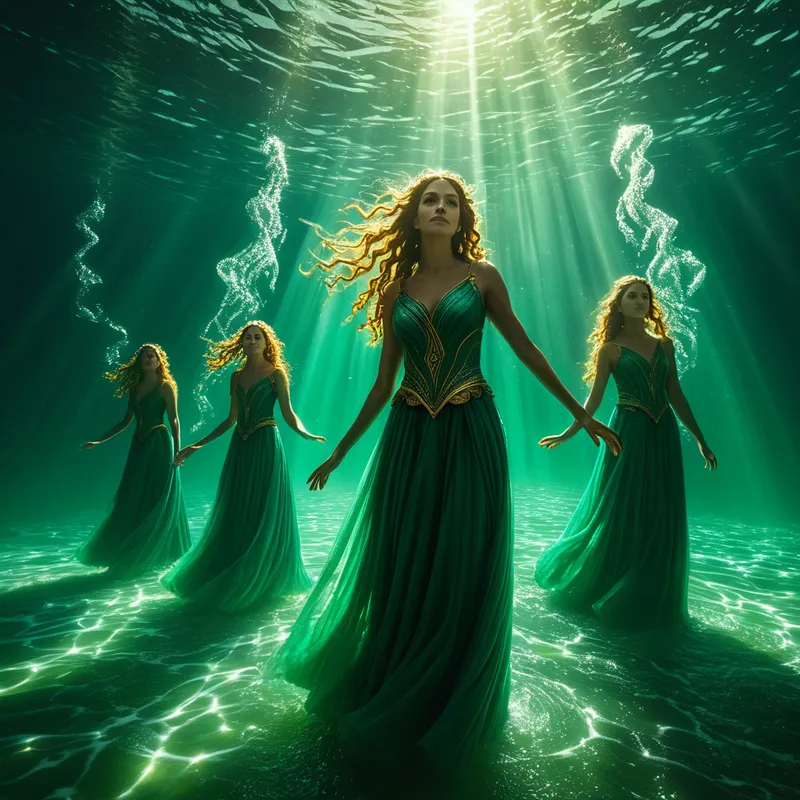
Hear now the tale that begins in the deep, where the waters are old and cold. In the green-gold gloom of the Rhine, three maidens swam, daughters of the river’s dream. Their laughter was the current’s song, and their charge was a treasure: a hoard of gold that caught the sun’s lost light on the riverbed. But within that hoard slept a greater power. He who would forge a ring from that gold, and renounce love to do so, would wield dominion over all the world.
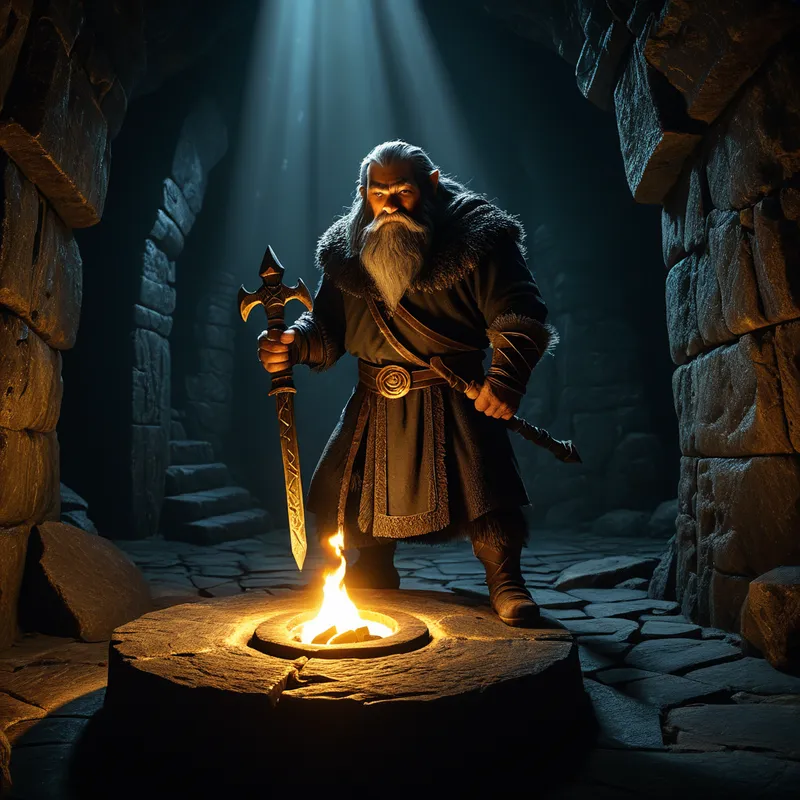
Into their watery realm came Alberich, a Nibelung dwarf, his heart already a cramped and sunless place. He desired the maidens, but they mocked his rough form and grasping nature. Spurned, his desire curdled into a wrath so pure it became a kind of clarity. He heard their secret, saw the gold’s gleam, and with a voice that cracked like stone on stone, he cried out his renunciation: “Love I curse forever!” He tore the gold from its rocky bed and fled into the depths, leaving the maidens’ song to become a wail that echoed up through the water, a warning the world above could not yet hear.
In the heights, where the gods dwelled in Valhalla, a different debt came due. The giants Fasolt and Fafner had built the gods’ shining hall, and their price was Freia, she who tended the apples of eternal youth. Without her, the gods would wither and age. The trickster Loki was sent to find another ransom. His journey led him down, down to Nibelheim, where he found Alberich, now a tyrant. The dwarf, with the power of the ring and a magical helmet called the Tarnhelm, had enslaved his own kin, forcing them to dig and hoard treasure in the dark. Through guile, Loki captured Alberich and dragged him before the gods. The dwarf was forced to yield his hoard, but as the final gold was piled, a tiny gap remained. To fill it, the ring itself was demanded. Alberich clung to it, and as it was torn from him, he laid upon it a curse: care and death to all who wear it, until it returns to him.
The giants took the gold, Freia was freed, and the ring passed to them. Immediately, the curse stirred. Greed flared. Fafner slew Fasolt for the treasure and fled to a desolate heath, using the Tarnhelm to transform into a dragon, brooding atop his hoard in lonely, paranoid splendor.
Years flowed like the Rhine. The ring slept with the dragon, but its poison seeped into the world. A hero was needed, one free of the gods’ treaties. He was Siegfried, raised in the forest by Alberich’s brother, Mime, who hoped the boy would slay the dragon and win the ring for him. Siegfried, fearless and innocent of the world’s corruption, forged the shattered sword of his father anew—Nothing. With it, he slew the dragon Fafner. A drop of the dragon’s blood touched his lips, granting him understanding of the birds’ speech. They warned him of Mime’s treachery, and Siegfried struck the dwarf down. The birds then sang of a glorious bride, Brünnhilde, sleeping on a rock surrounded by fire. Passing through the flames untouched, Siegfried awakened her, and they pledged a love as fierce and pure as the elements.
But the ring was now on Siegfried’s finger, and the curse does not sleep. Through potions of forgetfulness and webs of betrayal spun by the scheming Gunther and his sister Gutrune, and their cunning half-brother Hagen, Siegfried was tricked. He forgot Brünnhilde, won her for Gunther, and in a fury of betrayal, Brünnhilde revealed the secret of Siegfried’s vulnerable spot. On a hunt, Hagen drove a spear into his back.
The hero fell. Back in the hall of the Gibichungs, as Hagen and Gunther fought over the ring on the dead man’s hand, Brünnhilde arrived, her grief transformed into a terrible understanding. She ordered a funeral pyre built by the Rhine. Taking the ring from Siegfried’s finger, she placed it on her own and mounted her steed, riding into the flames. The Rhine overflowed its banks, quenching the fire. In the waters, the Rhinemaidens appeared, and as Hagen lunged for the ring, they dragged him down into the depths. The ring was returned to the gold in the river. In the sky, Wotan and the gods watched as Valhalla itself caught fire, the old order consumed in a final, redemptive blaze. From the ashes, only the Rhine flowed on, clean once more.
Cultural Origins & Context
This monumental myth cycle reaches us primarily through the Der Ring des Nibelungen, a tetralogy of operas by composer Richard Wagner in the 19th century. Wagner synthesized ancient sources—the Norse Poetic Edda, the Icelandic Völsunga Saga, and the Middle High German Nibelungenlied—into a unified, revolutionary artwork, or Gesamtkunstwerk. The culture of “Wagnerian Opera” is thus a unique fusion: a 19th-century Romantic re-imagining of archaic Germanic and Norse mythology, presented through a then-radical synthesis of music, poetry, drama, and stagecraft.
Its societal function was complex. For Wagner and his audience, it was a national mythopoetic project, an attempt to provide a foundational epic for the German spirit. It was passed down not by oral bards, but through the ritual of the opera house, specifically the festival theater at Bayreuth, which became a secular temple for this modern mythology. The myth served as a mirror for 19th-century anxieties about industrial power (Alberich’s enslaved Nibelheim), corrupting materialism (the ring), and the collapse of traditional religious and social orders (the twilight of the gods).
Symbolic Architecture
At its heart, the Ring is a vast symbolic architecture of the psyche. The Ring itself is not merely power, but consciousness of power divorced from its natural, fluid state. The gold in the river represents potential, the unconscious wealth of life. Forged through a renunciation of love, it becomes contracted, rigidified will—the ego’s desperate attempt to secure itself against the vulnerability of relationship.
The curse upon the ring is the law of the unconscious: that which is taken by force, without love or integration, will ultimately destroy the possessor and all they try to control.
The gods, especially Wotan, represent the established ruling consciousness, the “old king” of the psyche, bound by his own laws and treaties (neuroses, complexes). He is paralyzed, unable to act directly, and must engineer a free hero, Siegfried, to do what he cannot. Siegfried is the archetypal puer aeternus, the undifferentiated Self, all impulse and courage but without wisdom or memory. His journey is one of necessary inflation (slaying the dragon) and inevitable betrayal, for a consciousness that does not know its own shadow is doomed to be felled by it.
Brünnhilde, the Valkyrie, embodies the anima in its highest form—the connecting principle between the divine (Wotan) and the human (Siegfried). Her sleep surrounded by fire is the soul’s latent potential, protected by the transformative element, awaiting the fearless touch of the heroic consciousness to be integrated.

The Dreamer’s Resonance
When this myth stirs in modern dreams, it often signals a profound confrontation with the psychology of power and contract. To dream of a lost or sought-after ring of great power suggests the dreamer is grappling with a core complex—a “gold” in their nature (a talent, a trauma, a deep desire) that has been “stolen” from its natural state (repressed, exploited, or claimed by a “Alberich” complex of resentment and greed).
Dreams of dragons guarding hoards point to a psychic structure that has become rigid and isolated, a complex that once served a purpose (protection, acquiring resources) but has now become a monstrous, paranoid entity blocking further growth. The dream of forging a weapon (Nothing) speaks to a need to re-integrate one’s lineage, to re-assemble the broken sword of one’s will and purpose. Most poignantly, dreams of betrayal by a loved one, or of causing such betrayal through forgetfulness, mirror Siegfried’s fate. They indicate a painful but necessary stage where an old, innocent consciousness must die so that a more conscious relationship to love and power can be born from the ashes.
Alchemical Translation
The entire cycle is a grand alchemical opus for the soul. It begins with the nigredo, the blackening: Alberich’s renunciation in the dark waters, the theft that initiates the long, corrosive curse. The hoarding in Nibelheim and the dragon’s brooding represent the mortificatio, a state of putrefaction and sterile isolation where the stolen gold seems to promise everything but delivers only paralysis and fear.
Siegfried’s journey is the albedo, the whitening. His fearless actions—forging the sword, slaying the dragon—are the heroic, purifying operations that break open the hardened complex. The awakening of Brünnhilde is the sacred marriage, the coniunctio, of the solar hero and the lunar anima, a moment of transcendent, if fleeting, wholeness.
The fiery demise of Siegfried, Brünnhilde, and Valhalla is the final rubedo, the reddening. It is not a tragedy, but the supreme sacrifice necessary for completion. The old structures of the psyche—the tyrannical ego (the ring’s curse), the ruling but impotent consciousness (the gods), and the inflated heroic identity—must be immolated.
The ring returned to the Rhine is the gold restored to the waters, the conscious will dissolved back into the unconscious flow. This is individuation’s goal: not to possess the treasure, but to return it to its source, thereby transforming the entire system. The individual is no longer ruled by a cursed, contracting desire for power, but participates in the flowing, generative power of life itself. The cycle ends where it began, but the waters are now conscious of their own depth.
Associated Symbols
Explore related symbols from the CaleaDream lexicon: