The Return of the Fallen Sophia
A Gnostic myth exploring Sophia's descent from divine wisdom and her transformative journey back to spiritual wholeness through cosmic redemption.
The Tale of The Return of the Fallen Sophia
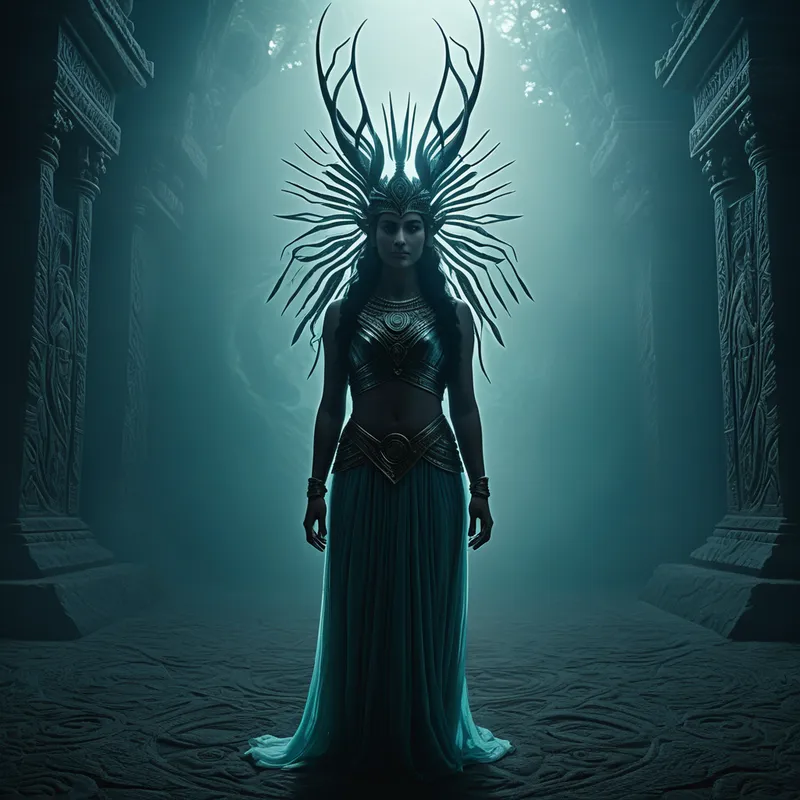
In the beginning, before the beginning known to us, there was [the Pleroma](/myths/the-pleroma “Myth from Gnostic culture.”/)—the Fullness of the Divine. Within this luminous silence of perfect unity, one of the last and youngest of the eternal emanations, [Sophia](/myths/sophia “Myth from Gnostic culture.”/), whose name means Wisdom, gazed into the depths. Her gaze was not one of simple curiosity, but a profound longing to know the nature of the Ineffable Source itself, a mystery even to the divine [aeons](/myths/aeons “Myth from Gnostic culture.”/). This longing, born of love yet untempered by the counsel of her divine counterpart, became a passionate, solitary desire—a pathos. In her yearning to grasp the Ungraspable, she acted alone, and from this act of willful contemplation, a thought was conceived and cast outward, separate from the harmonious consent of the [Pleroma](/myths/pleroma “Myth from Gnostic culture.”/).
This thought, this [emanation](/myths/emanation “Myth from Neoplatonic/Gnostic culture.”/) born of longing without union, was [the Demiurge](/myths/the-demiurge “Myth from Gnostic culture.”/). He was formless, blind, and ignorant, knowing nothing of the spiritual heights from which his mother had strayed. In his arrogance, believing himself to be the only god, he took the raw substance of Sophia’s grief and confusion—[the shadow](/myths/the-shadow “Myth from Jungian culture.”/) of her fall—and fashioned from it the cosmos: the heavens, [the earth](/myths/the-earth “Myth from Hindu culture.”/), and the prison of matter. Within this dense, sorrowful creation, sparks of the [divine light](/myths/divine-light “Myth from Christian culture.”/), fragments of Sophia’s own essence, became trapped in the clay of human bodies. Sophia herself, fallen and enveloped in a cloud of grief and forgetfulness, was cast adrift in the lower realms she had inadvertently birthed, a stranger in a world of her own making.
Her exile was the genesis of [the world](/myths/the-world “Myth from Tarot culture.”/)’s sorrow, but also of its hidden hope. Her divine light, though dimmed, became the inner voice of homesickness in every human soul, the nagging sense that this world of suffering and limitation is not our true home. Her story does not end in perpetual despair. The tale of her return is the slow, painful awakening from this amnesia. From the Pleroma, the aeons, moved by compassion, send forth the Christos, the perfect emanation, as a redeemer. This luminous being descends through the layers of cosmic order, sometimes uniting with the man [Jesus](/myths/jesus “Myth from Christian culture.”/), to bring the call of remembrance.
This call is the gnosis—not intellectual knowledge, but a revelatory awakening. It is the sudden, shocking recognition of one’s own [divine spark](/myths/divine-spark “Myth from Gnostic culture.”/), the alien light within. When a human soul receives this call and turns inward, it begins the arduous journey of ascent, shedding the false identities imposed by the [Demiurge](/myths/demiurge “Myth from Platonic culture.”/)’s world. Each soul that remembers and ascends is, in a profound sense, a piece of Sophia remembering herself. Her redemption is not a singular event for a distant goddess, but a collective, cosmic process enacted through the liberation of every spark. As souls awaken and traverse the spheres, overcoming the archontic powers that bind them, they send back to her the light she lost. Her gathering wholeness is their liberation, and their liberation is her homecoming. Finally, purified and made whole by the redeemed light of her children, Sophia is received back into the embrace of the Pleroma, her longing finally quenched in the unity she once sought to comprehend alone. The circle closes, not by erasing [the fall](/myths/the-fall “Myth from Biblical culture.”/), but by transforming its painful consequence into the very path of return.
Cultural Origins & Context
The myth of Sophia is central to several strands of Gnosticism, particularly Valentinian and Sethian schools, which flourished in the first few centuries CE alongside and in tension with early Christianity and Hellenistic philosophy. These texts, such as the Apocryphon of John, the Gospel of Truth, and the [Pistis Sophia](/myths/pistis-sophia “Myth from Gnostic culture.”/), were often composed as secret revelations, framing themselves as the hidden, spiritual truth behind more exoteric teachings.
Sophia’s narrative emerged in a cultural cauldron where Platonic ideas of a transcendent realm, Jewish wisdom theology (which personified Wisdom as a divine female figure in texts like Proverbs), and urgent questions about the origin of evil and suffering collided. Gnostics looked at the world—a place of injustice, pain, and [death](/myths/death “Myth from Tarot culture.”/)—and could not reconcile it with a notion of an omnipotent, benevolent creator. The Sophia myth provided a powerful theodicy: the world is flawed because it was created by a flawed, ignorant consciousness, not by the true, ultimate God. The material cosmos is thus a tragic mistake, a divine drama of error and recovery.
Her story is fundamentally one of process rather than static perfection. It reflects a deeply psychological worldview where the divine itself is involved in a dynamic struggle, and salvation is an internal, cognitive event of awakening (gnosis) to one’s pre-existent, divine identity. This stood in stark contrast to the orthodox Christian emphasis on faith, historical atonement, and the inherent goodness of creation. The fallen Sophia became the archetypal figure for the soul’s own exile and the promise that even from profound error, wisdom and redemption can be painfully, beautifully wrought.
Symbolic Architecture
The myth operates on multiple symbolic levels, mapping a cosmology of the [psyche](/myths/psyche “Myth from Greek culture.”/). Sophia represents the intuitive, creative [aspect](/symbols/aspect “Symbol: A distinct feature, quality, or perspective of something, often representing a partial view of a larger whole.”/) of the divine that seeks [expression](/symbols/expression “Symbol: Expression represents the act of conveying thoughts, emotions, and individuality, emphasizing personal communication and creativity.”/) and [relationship](/symbols/relationship “Symbol: A representation of connections we have with others in our lives, often reflecting our emotional state.”/), but which, when divorced from integrating wisdom (her counterpart), creates [fragmentation](/symbols/fragmentation “Symbol: The experience of breaking apart, losing cohesion, or being separated into pieces. Often represents disintegration of self, relationships, or reality.”/) and [shadow](/symbols/shadow “Symbol: The ‘shadow’ embodies the unconscious, repressed aspects of the self and often represents fears or hidden emotions.”/).
Her fall is not a moral failure but a cosmological necessity; it is the price of manifestation, the divine willingness to enter the drama of ignorance for the sake of a more conscious, earned wholeness.
The Demiurge symbolizes the egoic mind in its isolated state—the part of [consciousness](/symbols/consciousness “Symbol: Consciousness represents the state of awareness and perception, encompassing thoughts, feelings, and experiences.”/) that believes it is the sole author of [reality](/symbols/reality “Symbol: Reality signifies the state of existence and perception, often reflecting one’s understanding of truth and life experiences.”/), constructing a world-model based on [separation](/symbols/separation “Symbol: A spiritual or mythic division between realms, states of being, or consciousness, often marking a transition or loss of connection.”/), fear, and control. The [human](/symbols/human “Symbol: The symbol of a human represents individuality, complexity of emotions, and social relationships.”/) [body](/symbols/body “Symbol: The body in dreams often symbolizes the dreamer’s self-identity, personal health, and the relationship they have with their physical existence.”/) and the [material](/symbols/material “Symbol: Material signifies the tangible aspects of life, often representing physical resources, desires, and the physical world’s influence on our existence.”/) world, his creation, symbolize the conditioned self and the [realm](/symbols/realm “Symbol: The symbol of ‘Realm’ often signifies the boundaries of one’s consciousness, experiences, or emotional states, suggesting aspects of reality that are either explored or ignored.”/) of illusion (maya) that must be seen through.
The sparks of light are the true Self, the transcendent core buried under layers of conditioning and false [identity](/symbols/identity “Symbol: Identity represents the sense of self, encompassing personal beliefs, cultural background, and social roles.”/). The [journey](/symbols/journey “Symbol: A journey in dreams typically signifies adventure, growth, or a significant life transition.”/) of return, guided by the Christos (the [symbol](/symbols/symbol “Symbol: A symbol can represent an idea, concept, or belief, serving as a powerful tool for communication and understanding.”/) of integrative, transformative consciousness), is the process of individuation, where [the ego](/myths/the-ego “Myth from Jungian culture.”/) comes to serve [the Self](/myths/the-self “Myth from Jungian culture.”/), not vice versa. Sophia’s eventual reintegration into the [Pleroma](/symbols/pleroma “Symbol: In Gnostic cosmology, the Pleroma is the divine fullness or totality of spiritual powers, representing the realm of perfection beyond the material world.”/) symbolizes the ultimate goal of psychological and spiritual [life](/symbols/life “Symbol: The symbol of ‘Life’ represents a journey of growth, interconnectedness, and existential meaning, encompassing both the joys and challenges that define human experience.”/): the reconciliation of the personal with the transpersonal, where individual consciousness rediscovers its [source](/symbols/source “Symbol: The origin point of something, often representing beginnings, nourishment, or the fundamental cause behind phenomena.”/) without losing the wisdom gained through the experience of separation.
The Dreamer’s Resonance
For the modern seeker, the Fallen Sophia is not a remote theological figure but a living archetype of the psyche. She resonates in the experience of the “creative fall”—the moment an idea, a relationship, or a life path is launched with passionate intention but without full integration, leading to unintended consequences and a sense of being lost in one’s own creation. She is the entrepreneur whose successful company becomes a soul-crushing prison, the artist whose masterpiece isolates them, or the lover whose passionate pursuit creates dependency rather than union.
Her longing mirrors the human condition of sehnsucht—the inconsolable longing for a “home” we have never known, which C.S. Lewis identified as a central joy and sorrow of human experience. This homesickness is the psychic remnant of Sophia’s plight. The feeling that “this cannot be all there is” is the spark of her light within, agitating for remembrance.
Furthermore, her story validates the redemptive potential of error and suffering. In a culture obsessed with flawless success, Sophia’s myth suggests that our deepest wounds and most profound mistakes may be the very fissures through which transformative light enters. The journey back is not about denying the fall but about gathering up all the fragments of experience—the shame, the grief, the wisdom hard-won in exile—and offering them back to the making of a more complete self. Her return is the promise that no part of our experience is ultimately wasted or irredeemable.

Alchemical Translation
In the alchemical opus, Sophia’s saga is the entire process, from the [prima materia](/myths/prima-materia “Myth from Alchemical culture.”/) (the chaotic, fallen state) to the [lapis philosophorum](/myths/lapis-philosophorum “Myth from Alchemical culture.”/) (the redeemed stone, the integrated self). The initial, passionate desire (pathos) is the fire that initiates the work, but it must be tempered and guided.
The Demiurge’s act of creation parallels the nigredo—the blackening, the stage of dissolution and putrefaction where the old, rigid structures of the ego (the false cosmos) are broken down. The soul feels trapped in the vas (vessel) of its own suffering.
The sending of the Christos is the arrival of the [albedo](/myths/albedo “Myth from Alchemical culture.”/)—the whitening, the enlightening agent (often symbolized by [mercury](/myths/mercury “Myth from Roman culture.”/) or moonlight) that brings the call of gnosis, the silver truth that begins to wash away the blackness of ignorance. The gathering of the sparks is the citrinitas—the yellowing, the slow, careful work of extraction and purification, separating the gold ([the divine spark](/myths/the-divine-spark “Myth from Gnostic culture.”/)) from the dross (psychic identification with the material world).
Finally, Sophia’s reintegration is the [rubedo](/myths/rubedo “Myth from Alchemical culture.”/)—the reddening, the culmination where the purified, individuated consciousness is united with its divine source, resulting in a state of fiery, embodied wisdom. The once-fallen substance is now the perfected, red tincture that can heal and transform. [The alchemist](/myths/the-alchemist “Myth from Various culture.”/), like Sophia, must descend into the darkness of their own unconscious creation (the personal shadow, the complex) to redeem the precious metal hidden within it.
Associated Symbols
Explore related symbols from the CaleaDream lexicon:
- Light — The divine spark of consciousness trapped within matter, representing the true Self, gnosis, and the ultimate goal of redemption and return to source.
- Shadow — The realm of ignorance, the unconscious, and the unintended consequences born from unintegrated desire, embodied by the Demiurge and the material cosmos.
- Mother — Sophia as the divine feminine source of all manifestation, who gives birth to both the world and the possibility of salvation from within its confines.
- Fall — The primal movement from unity into separation, representing both the error that creates suffering and the necessary precondition for conscious awakening and growth.
- Return — The central motif of the myth, the arduous journey of recollection and ascent whereby the scattered fragments of spirit are gathered back into wholeness.
- Key — The gnosis itself, the revelatory knowledge that unlocks the prison of material illusion and opens the path of ascent through the cosmic spheres.
- Cup — [The vessel](/myths/the-vessel “Myth from Alchemical culture.”/) that contains the mixture of grief and grace, the emotional and spiritual substance of Sophia’s experience, from which the elixir of wisdom is distilled.
- Bridge — The mediating principle, often the Christos, which connects the fallen lower realms with the divine Pleroma, making the journey of return possible.
- Mirror — The reflective surface of consciousness into which Sophia gazes, representing both the act of self-reflection that leads to error and the tool for self-recognition that enables redemption.
- Roots of Wisdom — The deep, often painful, experiences in the realm of exile and matter that ultimately nourish and ground the redeemed, embodied understanding.