The Rainmaker Myth Meaning & Symbolism
A story of a village in drought, where a solitary figure's inner stillness calls forth the rain, teaching that true power comes from harmony within.
The Tale of The Rainmaker
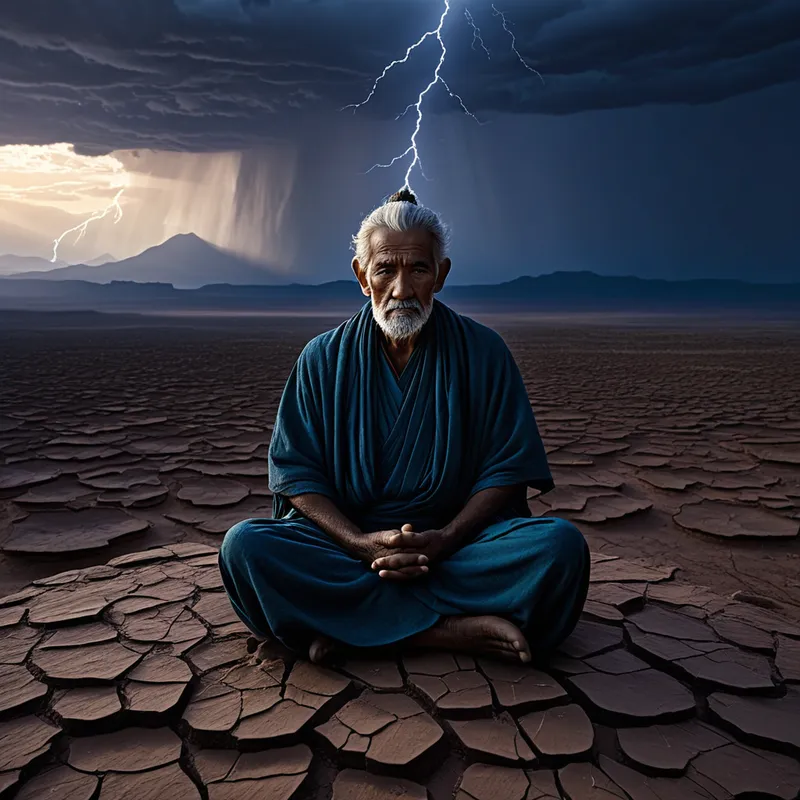
Listen. The land is a cracked tongue, thirsting. [The sky](/myths/the-sky “Myth from Persian culture.”/) is a bowl of hammered brass, empty of promise. In the village, the granaries sigh with dust. The children’s eyes are too bright, their play listless. The elders gather, their wisdom a dry riverbed. “We must call the rain,” they say, and [the word](/myths/the-word “Myth from Biblical culture.”/) is a prayer worn smooth with use.
They call for the dancers. For seven days and seven nights, the drums beat a frantic pulse against the silence of the heavens. Bodies painted with ochre and ash whirl in complex, sacred patterns, feet stamping [the earth](/myths/the-earth “Myth from Hindu culture.”/), voices hoarse with chanting. The air thickens with the smell of sweat and desperation, but not with moisture. The rituals are perfect, ancient, powerful. Yet the brass bowl of the sky remains unyielding. The people’s hope curdles into a quiet panic. Their doing has become a kind of screaming at [the void](/myths/the-void “Myth from Buddhist culture.”/).
Word travels, carried on the parched wind, of a solitary figure who lives beyond the third ridge. They say he is a Rainmaker. He is not a chief, nor a priest of the great ceremonies. He is a man who listens. With nothing left but the ghost of hope, the village sends a delegation.
They find him in a simple hut at the edge of [the wilderness](/myths/the-wilderness “Myth from Biblical culture.”/). He does not look like a savior. He is calm, his movements like [water](/myths/water “Myth from Chinese culture.”/) finding its level. They tell him of the drought, of the failing crops, of the dying beasts. They plead. He listens, his gaze holding the weight of their story. Finally, he nods. “I will come. Prepare a small hut for me at the edge of your village. Bring me food and water for three days. Do not disturb me.”
A ripple of disbelief passes through the elders. No drums? No dances? No sacrifices? But despair has made them obedient. They do as he asks.
The Rainmaker enters the hut. He closes the door. The village holds its breath. The first day passes in silence. The second day, the silence deepens, becoming a palpable presence. People find themselves speaking in whispers, moving more slowly. The frantic energy of their fear begins to settle, like dust in still air. They glance at the hut, a quiet question in their eyes.
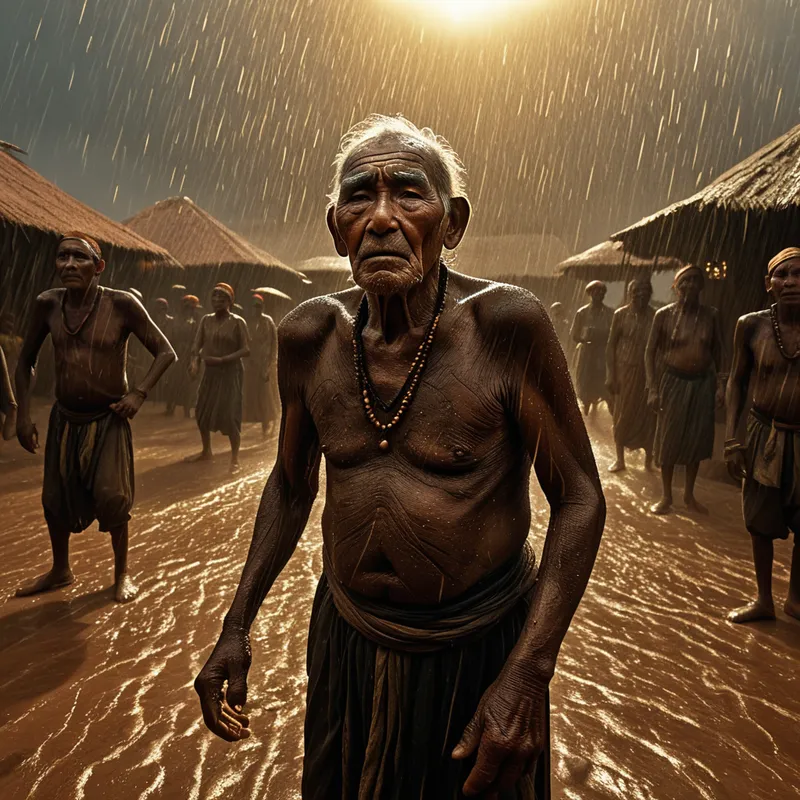
On the third day, a change whispers through [the world](/myths/the-world “Myth from Tarot culture.”/). The light softens. A different quality enters the air—a coolness, a scent of distant damp stone. And then, from the west, clouds gather, not as furious storm bearers, but gently, inevitably. The first drop falls, a perfect, shocking jewel on the dust. Then another. And then the sky opens, not in violence, but in a profound, generous release. The rain falls steadily, soaking the earth, filling the streams, washing the leaves. Life returns with the sound of its falling.
The people rush from their homes, faces upturned, laughing, crying. They turn to the hut. The door opens. The Rainmaker steps out, blinking in the gentle rain. He looks tired, but whole. The village elder approaches, awe-struck. “What did you do? What powerful magic did you perform?”
The Rainmaker smiles, a small, quiet [thing](/myths/thing “Myth from Norse culture.”/). “I did nothing of the sort. When I arrived, I found your village and your world in a state of profound disharmony. You were out of alignment with the Tao, with [the way](/myths/the-way “Myth from Taoist culture.”/) of things. Your rituals were born of fear, which only pushed the rain further away. So, I went into the hut. For three days, I put myself in order. I sat, and I became aligned. And when one becomes aligned within, the world around cannot help but come into alignment. The rain was simply the natural consequence.”
Cultural Origins & Context
The story of the Rainmaker is a rare myth that transcends a single culture, appearing in various forms in Chinese Taoist parables, in the lore of certain Native American traditions, and in the wisdom tales of African and Aboriginal storytellers. Its persistence across continents suggests it speaks to a universal human understanding, one that predates organized religion and lives in the realm of primal wisdom. It was never a myth of state or temple; it was a story told by elders around fires, by teachers to impatient students, by grandparents to children wondering about the nature of true power.
Its societal function was corrective and deeply psychological. In cultures where elaborate, communal ritual was the primary interface with the divine and the natural world, the Rainmaker story served as a crucial counter-narrative. It was a check against the inflation of [the ego](/myths/the-ego “Myth from Jungian culture.”/) of the priesthood and the collective, a reminder that the most potent magic is not in the complexity of the ceremony, but in the quality of the consciousness performing it. It taught that when collective action becomes frantic, rooted in anxiety, it loses its connection to the source. The story preserved the value of the individual’s inner work as a genuine service to the whole.
Symbolic Architecture
At its [heart](/symbols/heart “Symbol: The heart symbolizes love, emotion, and the core of one’s existence, representing deep connections with others and self.”/), the myth is not about meteorology, but about ontology—the study of being. The [drought](/symbols/drought “Symbol: Drought signifies a period of emotional scarcity, lack of resources, or feelings of deprivation leading to anxiety or intense longing.”/) symbolizes a state of psychic [aridity](/symbols/aridity “Symbol: Aridity symbolizes emotional or spiritual barrenness, a lack of nourishment, and a state of profound dryness or emptiness.”/), a [life](/symbols/life “Symbol: The symbol of ‘Life’ represents a journey of growth, interconnectedness, and existential meaning, encompassing both the joys and challenges that define human experience.”/) lived out of sync with one’s own [nature](/symbols/nature “Symbol: Nature symbolizes growth, connectivity, and the primal forces of existence.”/) and the nature of [reality](/symbols/reality “Symbol: Reality signifies the state of existence and perception, often reflecting one’s understanding of truth and life experiences.”/). It is a [condition](/symbols/condition “Symbol: Condition reflects the state of being, often focusing on physical, emotional, or situational aspects of life.”/) of spiritual and emotional [famine](/symbols/famine “Symbol: A profound lack or scarcity, often of food, representing deprivation, survival anxiety, and systemic collapse.”/), where [effort](/symbols/effort “Symbol: Effort signifies the physical, mental, and emotional energy invested toward achieving goals and personal growth.”/) yields only [dust](/symbols/dust “Symbol: Dust often symbolizes neglect, forgotten memories, or the passage of time and life’s impermanence.”/).
The true ritual is not the dance performed for the gods, but the stillness cultivated to hear them.
The frantic villagers and their perfect rituals represent the directed [consciousness](/symbols/consciousness “Symbol: Consciousness represents the state of awareness and perception, encompassing thoughts, feelings, and experiences.”/) of the ego. It is all [action](/symbols/action “Symbol: Action in dreams represents the drive for agency, motivation, and the ability to take control of situations in waking life.”/), all will, all “doing.” It believes power is external, to be seized or begged for through correct formula. This is the modern mindset: if we just work harder, plan better, shout louder, we can force the [outcome](/symbols/outcome “Symbol: Outcome symbolizes the results of actions or decisions, often reflecting hopes, fears, and the consequences of choices.”/). The myth reveals this as the root of the drought itself.
The Rainmaker embodies the Self, in its [aspect](/symbols/aspect “Symbol: A distinct feature, quality, or perspective of something, often representing a partial view of a larger whole.”/) as the unifier. His hut is the [temenos](/myths/temenos “Myth from Greek culture.”/), the protected [vessel](/symbols/vessel “Symbol: A container or structure that holds, transports, or protects something essential, representing the self, emotions, or life journey.”/) of inner work. His three days of solitude map onto the classic alchemical stages: [nigredo](/myths/nigredo “Myth from Alchemical culture.”/) (the blackening, confronting the disorder), [albedo](/symbols/albedo “Symbol: In alchemy, the whitening stage representing purification, spiritual ascension, and the emergence of consciousness from darkness.”/) (the whitening, purification and [insight](/symbols/insight “Symbol: A sudden, deep understanding of a complex situation or truth, often arriving unexpectedly and illuminating hidden connections.”/)), and [rubedo](/myths/rubedo “Myth from Alchemical culture.”/) (the reddening, [integration](/symbols/integration “Symbol: The process of unifying disparate parts of the self or experience into a cohesive whole, often representing psychological wholeness or resolution of internal conflict.”/) and new life). He does not fight the drought; he rectifies the internal condition that mirrors it. The rain, then, is the spontaneous, natural [expression](/symbols/expression “Symbol: Expression represents the act of conveying thoughts, emotions, and individuality, emphasizing personal communication and creativity.”/) of a world brought back into [harmony](/symbols/harmony “Symbol: A state of balance, agreement, and pleasing combination of elements, often associated with musical consonance and visual or social unity.”/). It is the grace that follows right alignment, not the [trophy](/symbols/trophy “Symbol: The trophy symbolizes achievement, recognition, and the reward for perseverance in competitive endeavors.”/) seized by force.
The Dreamer’s Resonance
When this myth pattern stirs in the modern dreamer, it often manifests as dreams of futile striving. You are in an exam you didn’t study for, running but getting nowhere, shouting in a soundproof room. The somatic feeling is one of clenched effort, of breath held tight in the chest. This is the [psyche](/myths/psyche “Myth from Greek culture.”/)’s depiction of the “village dance”—the ego’s exhausting, ineffective efforts to solve a problem from its own limited, anxious level.
Alternatively, one might dream of a quiet, empty room, a secluded cabin in a storm, or simply a profound, weighty silence that feels generative rather than empty. This is the call to the hut. The dream is presenting the solution not as another, better action, but as a cessation of action. The psychological process underway is the ego’s recognition of its own limitations and the slow, often reluctant, turning towards the deeper resources of [the Self](/myths/the-self “Myth from Jungian culture.”/). The dream invites a surrender of doing in favor of being, promising that from that recalibrated center, right action will flow naturally, as rain follows alignment.

Alchemical Translation
For the individual on the path of individuation, the Rainmaker myth is a master guide to psychic transmutation. Our personal “droughts”—creative blocks, relational impasses, depression, chronic anxiety—are rarely solved by more frantic effort (more self-help books, more forceful affirmations, more busyness). That effort, however well-intentioned, is often the problem, a manifestation of the ego’s dissonance.
The alchemical work is to build the inner hut. This is the disciplined practice of withdrawal from the collective frenzy, whether that frenzy is external or internal (the constant chatter of the mind). It is entering [the vessel](/myths/the-vessel “Myth from Alchemical culture.”/) of meditation, therapy, journaling, or solitary reflection—any practice that allows for a quiet sorting of one’s inner elements.
The gold is not manufactured; it is revealed when the base metal of chaotic being is allowed to settle into its own inherent order.
The “three days” represent the non-negotiable time and patience required. In this vessel, one confronts the inner disorder (nigredo): the fears, the misplaced desires, the adaptations that are out of sync with the Self. One then aligns (albedo): listening, without agenda, to what the deeper psyche actually needs, wants, and is. The final stage (rubedo) is not a forced eruption, but an emergence. One steps back into the world, not with a new, forceful plan, but as a realigned being. From this place, actions are no longer desperate prayers for rain, but natural, effective expressions of a harmonious system. The “rain”—the creative solution, the healed relationship, the sense of peace—falls not because you stormed the heavens, but because you finally came home to your own ground, and the heavens, in their own time, recognized you.
Associated Symbols
Explore related symbols from the CaleaDream lexicon: