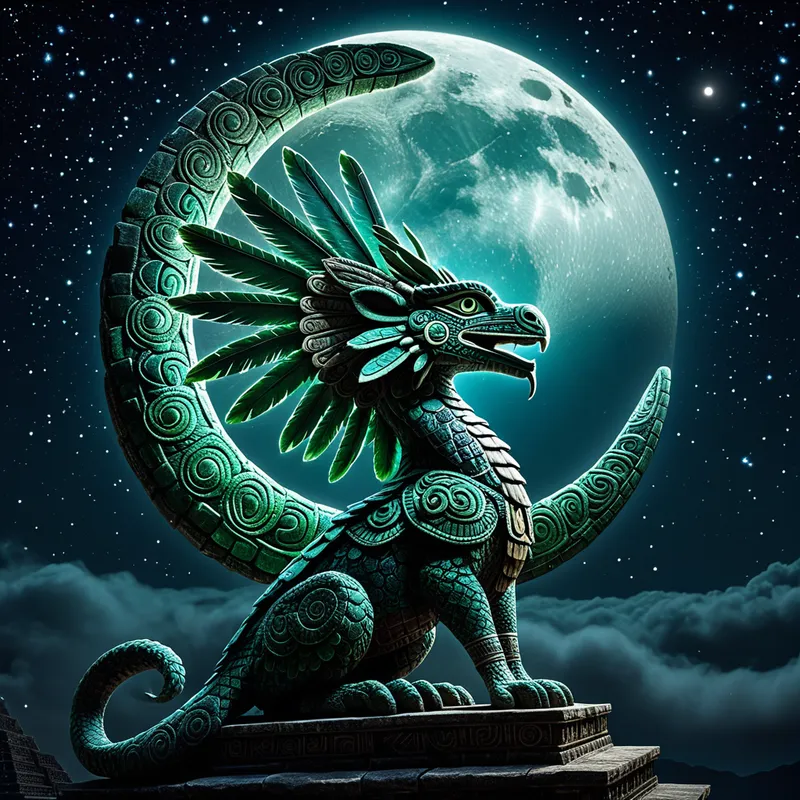
The Rabbit in the Moon Aztec Myth Meaning & Symbolism
A humble rabbit offers itself as food to the god Quetzalcoatl, who, moved by its sacrifice, immortalizes its image on the face of the moon.
The Tale of The Rabbit in the Moon Aztec
Listen. The world was young, and the gods walked the earth in forms both terrible and beautiful. Quetzalcoatl, the Plumed Serpent, had taken the guise of a weary, white-bearded old man. His journey was long, a pilgrimage of spirit that had worn his divine essence thin. The dust of forgotten roads clung to his robes, and a profound hunger, deeper than that of the belly—a hunger for the truth of this newborn world—gnawed at his soul.
He wandered until the sun bled into the western hills, painting the sky in hues of fire and ash. In a quiet clearing, under the first hesitant stars, he found he could go no further. His strength, that which had once shaped mountains, had fled. He sat upon a cold stone, his breath a faint mist in the chilling air. The world was vast, silent, and indifferent.
From the brush came a soft rustling. Not the footfall of a jaguar or the slither of a snake, but a timid, gentle sound. A rabbit emerged, its fur the color of dried grass and twilight. It paused, nose twitching, sensing not a god, but a creature in need. The rabbit’s small heart beat a rhythm of simple compassion. It gathered what it could—a few blades of green grass, a tender shoot—and placed them before the old man with a quiet hop.
Quetzalcoatl looked at the meager offering, then into the rabbit’s dark, liquid eyes. “Little one,” he said, his voice like wind through ancient reeds, “your kindness is great, but this cannot sustain me. My hunger is of a different kind.”
The rabbit understood not the words, but the essence of suffering before it. A stillness fell over the clearing. The wind held its breath. In that moment, a choice was made not by a cunning mind, but by an instinct purer than thought. The rabbit did not flee. Instead, it drew itself up, a small monument of fur and bone in the vast night.
“Then, venerable one,” its spirit seemed to say, “if my food is not enough, take me. Let my body be your sustenance.”
And it offered itself.
A profound silence shattered. Not with sound, but with light. The frail form of the old man dissolved in a blaze of iridescent feathers and scales. Quetzalcoatl stood revealed in his terrible glory, his presence filling the clearing with a wind that smelled of rain and incense. But his eyes held no wrath, only an awe so deep it was akin to grief. He beheld this ultimate gift, this sacrifice born not of duty or desire for glory, but of a humble, fearless heart.
He reached out, but not to take. To lift. His touch was as gentle as moonbeams. He cradled the rabbit, its form now glowing with an inner luminescence. “No,” the god’s voice echoed in the foundations of the world. “Your flesh shall not be food. Your spirit shall be a lesson for all time. No act of true heart is ever forgotten.”
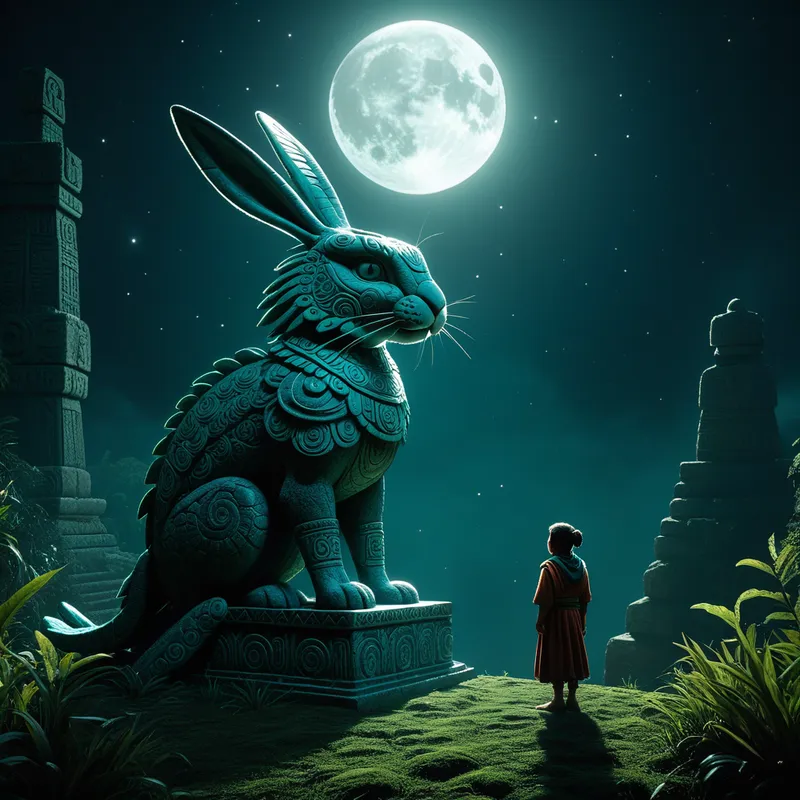
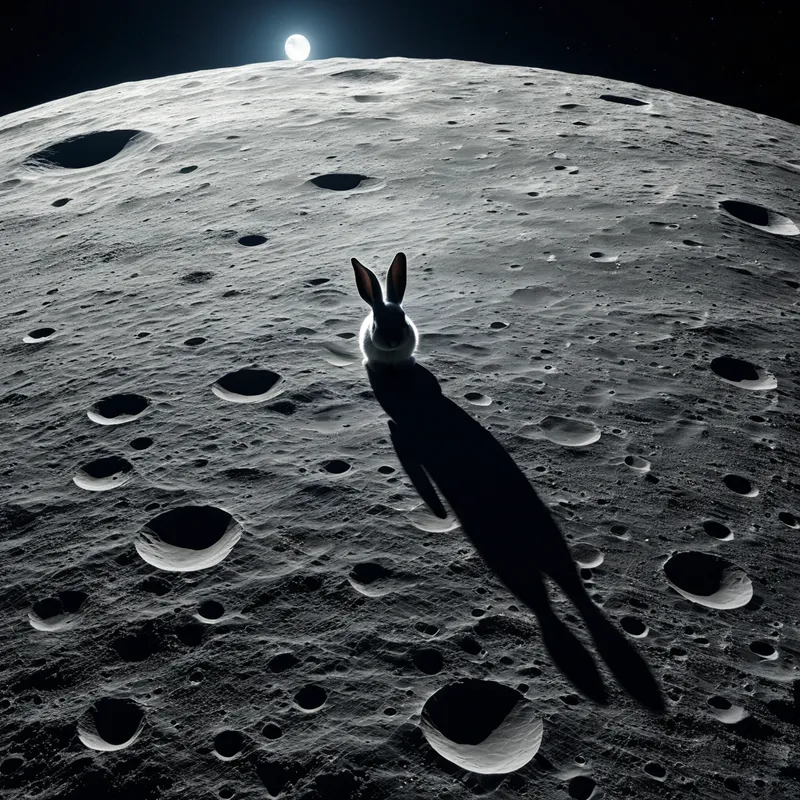
And with that, he raised his hand to the sky. The dark bowl of the night, with its scatter of stars, became his canvas. He took the image of the rabbit—its essence of offering, its quiet courage—and pressed it, gently, onto the brilliant face of the full Moon. There it burned, a silhouette of perfect humility, forever caught in the act of its own giving. A story written in light for every human, every creature, to see and wonder, for as long as the moon would rise.
Cultural Origins & Context
This myth, known to the Mexica and other Nahua peoples, was not merely a charming fable. It was a foundational narrative embedded in the tonalpohualli, the sacred calendar, and reflected in their profound astrological observations. The moon, or Metztli, was a powerful deity, often associated with water, fertility, and the night. The pattern seen on its surface was not random chaos; it was a divine signature, a permanent record of a cosmological event.
The tale was likely told by tlamatinime (wise ones) and elders to illustrate core societal and spiritual values. In a culture where grand, bloody sacrifice on the steps of towering teocalli was the supreme act of sustenance for the gods, this myth presented a radical counterpoint. It validated a different kind of offering: one that was small, personal, voluntary, and born of empathetic compassion rather than ritual obligation. It served as a moral compass, teaching that the magnitude of an act is not measured by its scale, but by the purity of the intent behind it. The rabbit’s sacrifice was the ultimate model of humility—the smallest, most vulnerable creature enacting the greatest spiritual law.
Symbolic Architecture
At its [heart](/symbols/heart “Symbol: The heart symbolizes love, emotion, and the core of one’s existence, representing deep connections with others and self.”/), the myth is an [alchemy](/symbols/alchemy “Symbol: A transformative process of purification and creation, often symbolizing personal or spiritual evolution through difficult stages.”/) of opposites. The mighty, celestial god is brought to his knees by a mundane need, while the lowly, earthly [rabbit](/symbols/rabbit “Symbol: Rabbits often symbolize fertility, intuition, and resourcefulness in dreams, potentially reflecting a need for growth or change.”/) ascends to celestial immortality through a spiritual act. This inversion is the myth’s central power.
The most profound offerings are not extracted by demand, but emerge spontaneously from a heart that sees no separation between self and other.
The rabbit symbolizes the Innocent [archetype](/symbols/archetype “Symbol: A universal, primordial pattern or prototype in the collective unconscious that shapes human experience, behavior, and creative expression.”/) in its most potent form. It acts without ego, without calculation of reward or fear of [loss](/symbols/loss “Symbol: Loss often symbolizes change, grief, and transformation in dreams, representing the emotional or psychological detachment from something or someone significant.”/). Its offering is an instinctual [expression](/symbols/expression “Symbol: Expression represents the act of conveying thoughts, emotions, and individuality, emphasizing personal communication and creativity.”/) of its essential [nature](/symbols/nature “Symbol: Nature symbolizes growth, connectivity, and the primal forces of existence.”/)—to nurture, to connect. Quetzalcoatl, here, represents not just divinity, but the receptive principle—the one who recognizes and validates true worth. The [moon](/symbols/moon “Symbol: The Moon symbolizes intuition, emotional depth, and the cyclical nature of life, often reflecting the inner self and subconscious desires.”/) becomes the mirror of the [collective unconscious](/symbols/collective-unconscious “Symbol: The Collective Unconscious refers to the part of the unconscious mind shared among beings of the same species, embodying universal experiences and archetypes.”/), eternally reflecting this archetypal [moment](/symbols/moment “Symbol: The symbol of a ‘moment’ embodies the significance of transient experiences that encapsulate emotional depth or pivotal transformations in life.”/) of perfect [empathy](/symbols/empathy “Symbol: The capacity to understand and share the feelings of others, often manifesting as emotional resonance or intuitive connection in dreams.”/). The rabbit’s [image](/symbols/image “Symbol: An image represents perception, memories, and the visual narratives we create in our minds.”/) is not a reward, but a [revelation](/symbols/revelation “Symbol: A sudden, profound disclosure of truth or insight, often through artistic or musical means, that transforms understanding.”/); it shows humanity what the gods truly value.
The Dreamer’s Resonance
When this myth stirs in the modern dream, it often surfaces during times of existential hunger or feelings of powerless humility. To dream of offering oneself, like the rabbit, may feel terrifying—a somatic sense of vanishing, of being consumed. This is not a nightmare of predation, but the psyche’s processing of a necessary ego-death. The dreamer may be in a situation where their conventional resources (the grass the rabbit first offered) feel insufficient, and a deeper, more essential part of the self is being called to the altar.
Conversely, dreaming of seeing the rabbit in the moon can signal a moment of profound recognition. It is the psyche acknowledging that a recent act of vulnerability, a small kindness given without expectation, or a moment of humble surrender, has had a far greater, transformative impact than realized. The dream is a cosmic affirmation: your offering has been seen. It has been etched into the permanent record of your soul’s journey. The feeling upon waking is often one of quiet awe and a mysterious, unshakeable peace, as if a silent covenant with the universe has been fulfilled.
Alchemical Translation
For the individual navigating the path of individuation, the Rabbit in the Moon models the critical stage where the heroic ego must surrender. Our modern quests are often grand—seeking the gold of achievement, recognition, or perfect self-mastery. We play the part of Quetzalcoatl the powerful seeker. But the myth insists that the transmutation occurs only when we also embody the rabbit.
The “hunger” is our spiritual or psychological lack. The “rabbit” is that small, humble, often-ignored part of ourselves—our simple kindness, our unguarded vulnerability, our instinct to give without strategy. The alchemical fire is the moment we offer that part, not our strength, to the transformative process. We must be willing to sacrifice our self-protection, our pride, our calculated persona, to the greater need of the journey itself.
Immortality is not earned by what we conquer, but conferred by what we sincerely offer of our essential, vulnerable self.
The “moon” that bears our image is the integrated Self. It is a cooler, reflective light, not the blazing, consuming light of the solar ego. It signifies that our lasting identity, our eternal signature in the cosmos of the psyche, will be shaped not by our victories, but by our most authentic, humble gifts. The myth teaches that individuation’s final prize is not a crown of dominion, but a silhouette of grace—a permanent reminder that in absolute humility lies the only true ascension.
Associated Symbols
Explore related symbols from the CaleaDream lexicon:
- Moon — The eternal canvas and witness, symbolizing the reflective unconscious mind where acts of true spirit are permanently recorded as archetypal patterns.
- Sacrifice — The core action of the myth, representing the voluntary offering of the small self (ego) for a transcendent principle, which paradoxically leads to immortality.
- Rabbit — The embodiment of the Innocent archetype, representing humility, vulnerability, spontaneous compassion, and the transformative power of uncalculated giving.
- God — Specifically Quetzalcoatl, representing the divine principle that recognizes, validates, and transfigures authentic sacrifice, acting as the agent of cosmic justice and meaning.
- Light — The illuminating force of revelation; the rabbit’s essence becomes light, and the moon reflects it, symbolizing how true spiritual acts bring hidden virtues into conscious awareness.
- Humility — The essential quality of the rabbit’s act; not self-debasement, but an ego-less alignment with a reality greater than oneself, which is the prerequisite for transformation.
- Mirror — The moon functions as a divine mirror, showing humanity not its own face, but the face of the ideal—the image of perfect, selfless offering.
- Immortality — The paradoxical result; by offering its mortal life, the rabbit achieves a permanent, celestial existence, symbolizing how authentic psychological sacrifices lead to enduring wholeness.
- Gift — The rabbit’s offering is the pure gift, given without expectation of return, which is the only kind of gift capable of altering cosmic order.
- Heart — The symbolic center of the action; the sacrifice originates not from doctrine or fear, but from the compassionate, instinctual intelligence of the heart.